Greece
Thessaloniki
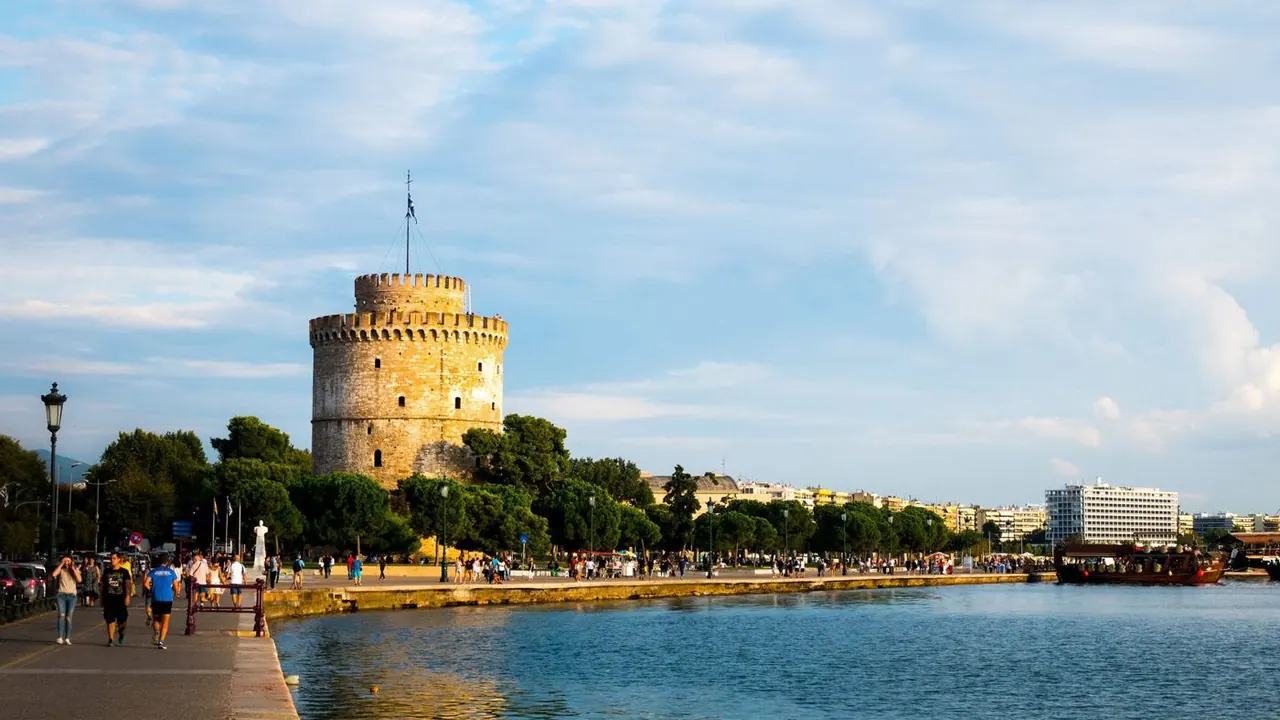
The White Tower from the promenade
- Food & drink77
- Nightlife76
- Day trips74
Photo: Destinygreece, CC BY-SA 4.0, cropped
Match
61
Every category weighted equally
- Beach & sun60
- Culture & arts64
- Food & nightlife64
- Family trip60
- Outdoors63
- Relax & unwind58
- Shopping & style61
- On a budget62
Thessaloniki in twelve categories
Our verdict on each, scored 0 to 100 against the same fixed benchmark cities, so a score means the same thing on every page.
Beaches & swimming. Scores 55 out of 100.
Food & drink. Scores 77 out of 100.
Culture & sights. Scores 73 out of 100.
Nightlife. Scores 76 out of 100.
Nature & outdoors. Scores 66 out of 100.
Day trips. Scores 74 out of 100.
Good for families. Scores 50 out of 100.
Getting around. Scores 60 out of 100.
Shopping & style. Scores 50 out of 100.
Affordability. Scores 66 out of 100.
Live music & performing arts. Scores 52 out of 100.
Wellness & relaxation. Scores 33 out of 100.
Thessaloniki category by category
Beaches & swimming
55Thessaloniki faces the sea but does not swim in it. The Thermaic Gulf along the city waterfront is for walking beside, not bathing in, and the closest beaches at Perea, Agia Triada and Nea Michaniona, about forty minutes away by bus, have shallow, ordinary water that locals use mostly on weekday evenings.
The real beaches are in Halkidiki, whose first peninsula, Kassandra, begins about an hour's drive away. There the water is clear, warm and often above 25°C in August, and the coves are among the best in Greece. A car makes this easy, but it is a day out or a reason to move on, not part of a city stay.
Food & drink
77Greeks regard Thessaloniki as the country's best city to eat in, and a visit bears it out. The cooking carries layers of Ottoman, Sephardic Jewish and Anatolian refugee influence: spiced kebabs and soutzoukakia, peppers and aubergines worked a dozen ways, and long meze tables at ouzeri where tsipouro arrives with small plates almost unasked. Mornings belong to bougatsa, flaky pastry filled with cream or cheese, and to trigona from the old pastry shops.
The Kapani and Modiano markets are working markets for fish, olives, spices and cured meats, with simple tavernas tucked between the stalls. Ladadika and Ano Poli have the classic tavernas, the waterfront has coffee at every hour, and the wines of Naoussa and Macedonia are easy to find. Fine dining exists but is thin; the strength is everyday eating.
Culture & sights
73Thessaloniki's heritage is Byzantine first. Fifteen early Christian and Byzantine churches and monuments are listed by UNESCO, among them the Rotunda with its fourth-century mosaics, the great basilica of Agios Dimitrios over the patron saint's crypt, and Agia Sofia. Roman Thessaloniki shows in the Arch of Galerius and the excavated Roman Forum, and the White Tower stands on the waterfront as the city's emblem.
The Archaeological Museum holds the gold of ancient Macedonia, and the Museum of Byzantine Culture is one of the best of its kind. Above the centre, Ano Poli keeps Ottoman-era houses, lanes and the long sections of city wall up to the Heptapyrgion fortress. Below, much of the centre was rebuilt after the fire of 1917 and is plain apartment blocks, so the sights come as islands in a modern city rather than an intact old town.
Nightlife
76With a large student population and the Greek habit of going out late, Thessaloniki has a night that starts around eleven and runs well past three. Ladadika, the old warehouse quarter by the port, is packed with bars and meze places; the streets around Valaoritou fill with small, louder bars and DJ nights; and the Bit Bazaar flea-market square turns into a crowd of outdoor tables after dark.
In summer much of the action moves to the waterfront and to big open-air clubs on the edge of the city, and on weekends whole streets are standing room only. It is a casual, social scene rather than a polished one, and it is busy on weeknights too.
Nature & outdoors
66The city's own green space is the Seich Sou pine forest on the hills behind Ano Poli, with trails and views over the gulf, and Mount Hortiatis above it. The waterfront promenade is the everyday outdoor space, long and flat and good for walking or cycling at sunset.
The bigger landscapes take a car. Mount Olympus, Greece's highest mountain at 2,918m, rises about an hour and a half away, with the Enipeas gorge and serious hut-to-hut hiking from Litochoro. Halkidiki's peninsulas offer coastal walks, sailing and kayaking, and in winter Kaimaktsalan and Seli have skiing within about two hours. Summer heat pushes most activity to mornings or the mountains.
Day trips
74The heartland of ancient Macedonia lies around the city. Vergina, about an hour away, holds the royal tombs of the Macedonian kings under a mound turned into a museum, one of the most striking sites in Greece. Pella, Alexander the Great's birthplace, has mosaic floors and a fine museum, and Dion sits at the foot of Olympus with its sanctuary and Roman town.
Veria has an old Jewish quarter and Byzantine chapels, Edessa a town centre built around waterfalls, and Naoussa the vineyards behind Xinomavro wine. The Halkidiki villages and boat trips along the Mount Athos coast from Ouranoupoli fill longer days, and Kavala is about two hours east. Intercity buses reach most of this, but a car makes the circuit far easier.
Good for families
50Children are welcome everywhere in Thessaloniki, out late with their parents at tavernas and on the waterfront, and the long seafront promenade with its playgrounds and park strip is the easiest place to spend an afternoon with them. The Noesis science centre and planetarium is the main attraction made for children, and there is a modest zoo in the Seich Sou forest.
Beyond that the offer is thin. Pavements are narrow and often blocked by parked cars, traffic is heavy, Ano Poli is steep and July and August are hot. Families who want beach days usually base themselves in Halkidiki and visit the city instead.
Getting around
60Thessaloniki is a long, narrow city pressed between hills and sea, and most of what a visitor wants lies in a flat strip a short walk from the waterfront. The White Tower, Aristotelous Square, the markets, Ladadika and the main churches are all within about half an hour on foot of each other, and the promenade is a pleasant way to cover the distance.
A metro line runs east to west beneath the centre and the bus network covers the rest, though buses crawl in heavy traffic. Ano Poli means a steep climb or a taxi, which is cheap and plentiful. Pavements are often cluttered with parked cars. For Vergina, Olympus or Halkidiki, hiring a car is the practical choice.
Shopping & style
50Tsimiski and the parallel streets behind the waterfront make up the main high street, with Greek and international chains and some shoe and fashion shops, and large malls sit on the city's edge. The more interesting shopping is food: the Kapani and Modiano markets for spices, olives, cheeses, loukoumi and tsipouro to take home.
The Bit Bazaar has a few antique and junk stalls among its cafés, and small independent shops are scattered around Valaoritou and Ladadika. It is a fine place to shop for a morning, without a luxury district or a craft tradition to plan a visit around.
Affordability
66Thessaloniki is one of the better-value cities in Southern Europe. Tavernas and ouzeri serve generous plates for modest bills, bougatsa and street snacks cost little, and a night out with drinks is gentle on the budget because the city is priced for students and locals rather than visitors.
Hotels are mostly mid-range and sensibly priced outside big events and the autumn trade fair, and museum entry and public transport are inexpensive. The main extra cost comes from car hire for day trips.
Live music & performing arts
52Thessaloniki has the cultural institutions of a regional capital. The Thessaloniki Concert Hall on the waterfront hosts the State Orchestra of Thessaloniki, chamber music and visiting performers, and the National Theatre of Northern Greece runs seasons at the Royal Theatre and the Society for Macedonian Studies theatre, nearly all in Greek. In summer, open-air theatres such as the one on the hill at Dasos host concerts.
The most rewarding live music for a visitor is informal: rebetiko and laika played at tavernas late into the night, where the music is the reason the place is full. There is also a small jazz and indie circuit for the student crowd.
Wellness & relaxation
33The city's Ottoman bathhouses, such as the Bey Hamam, survive as monuments rather than working baths, so there is no bathing culture to join in the centre. The thermal springs at Lagadas, about half an hour away, offer simple spring-fed baths, and hotel spas cover the rest.
What Thessaloniki does have is an unhurried pace. Long hours over iced coffee at a seafront café and the slow evening walk along the waterfront are a real part of life here, and they make the city a calm stay even without spas.
When should you go?
Pick a month to see what it is like. The climate figures are measured averages, not a forecast.
Thessaloniki in July
Daytime high, °C
Rainfall in the month, mm
The whole year
Shaded against this city’s own year: the deepest cell is its best month for that figure and the palest its weakest.
Temperature and rainfall are climate normals, averaged over the years shown. Thessaloniki: 1991-2020 normals, Thessaloniki Airport (14 km from centre).
Before you go
| Measure | Thessaloniki |
|---|---|
| Official language | Greek |
| Currency | Euro (EUR) |
| Sockets | CF230 V, 50 Hz |
| Driving side | Right |
| Time zone | UTC+2, UTC+3 in summer |
| Emergency number | 112 |
| Elevation | 6 m |
| Main airport | Thessaloniki Macedonia International Airport (SKG)14 km from centre90 non-stop destinations |
| Public holidays this year | 15 days |
By the numbers
| Measure | Thessaloniki |
|---|---|
| City population | 309,617 |
| People per km² | 16,042 |
| Museums within 10 km | 32 |
| UNESCO World Heritage sites within 50 km | 1 |
| Swim season, months above 21 °C | 5 months |
Compare Thessaloniki with
Every comparison with a written verdict behind it.