Ireland
Dublin
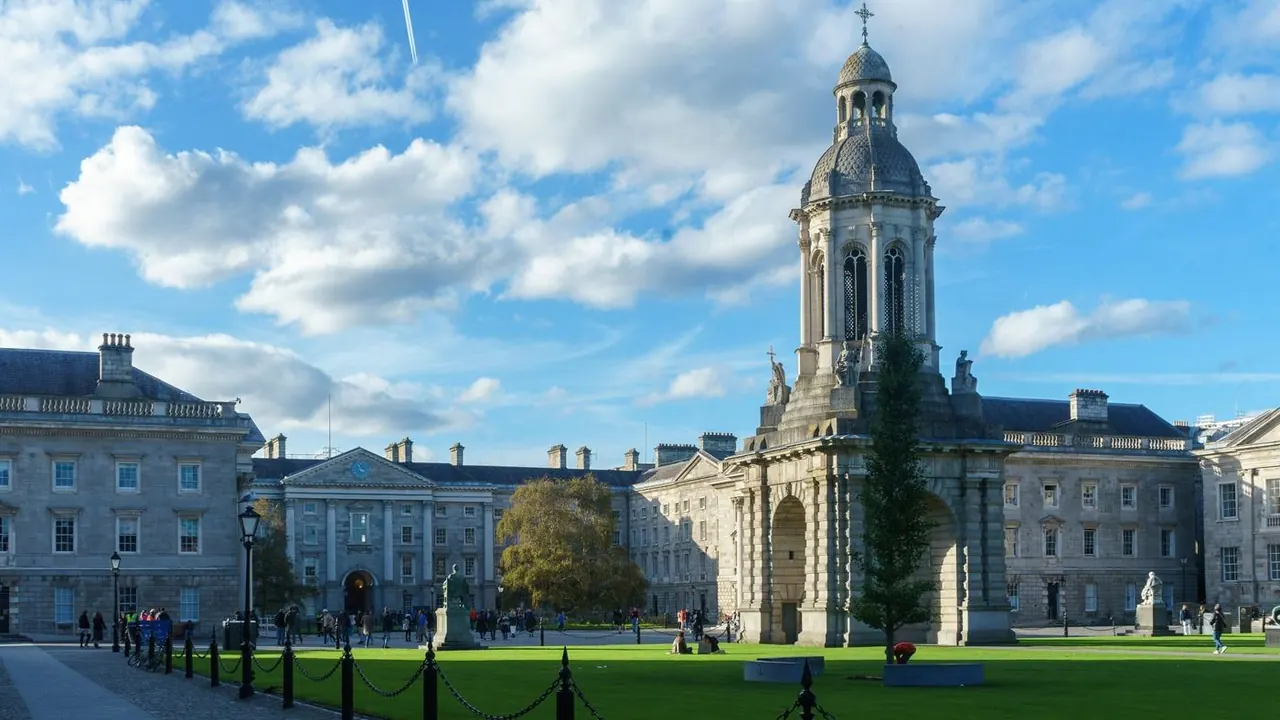
The Campanile, Trinity College
- Day trips72
- Nature & outdoors70
- Getting around66
Photo: David Kernan, CC BY 4.0, cropped
Match
53
Every category weighted equally
- Beach & sun46
- Culture & arts57
- Food & nightlife54
- Family trip51
- Outdoors54
- Relax & unwind47
- Shopping & style54
- On a budget49
Dublin in twelve categories
Our verdict on each, scored 0 to 100 against the same fixed benchmark cities, so a score means the same thing on every page.
Beaches & swimming. Scores 27 out of 100.
Food & drink. Scores 50 out of 100.
Culture & sights. Scores 64 out of 100.
Nightlife. Scores 62 out of 100.
Nature & outdoors. Scores 70 out of 100.
Day trips. Scores 72 out of 100.
Good for families. Scores 57 out of 100.
Getting around. Scores 66 out of 100.
Shopping & style. Scores 54 out of 100.
Affordability. Scores 20 out of 100.
Live music & performing arts. Scores 65 out of 100.
Wellness & relaxation. Scores 25 out of 100.
Dublin category by category
Beaches & swimming
27Dublin has plenty of coast. Dollymount Strand on North Bull Island, Sandymount, Killiney and Portmarnock are all sandy and close, and the DART runs along the bay to most of them. The trouble is the water. The Irish Sea rarely gets past about 15°C even in August, and summer days that feel like beach weather are few.
People swim here, but mostly in the bracing, all-year way: early dips at the Forty Foot in Sandycove, at the Seapoint steps or at the Vico rocks under Dalkey, followed by a flask of tea. That habit is charming to see and fun to try. If you want warm-water beach days, though, this is the wrong city.
Food & drink
50Eating in Dublin is solid more than distinctive. The best of it relies on very good Irish produce: Atlantic fish and shellfish, grass-fed beef and lamb, farmhouse cheeses, soda bread. Modern bistros around Dublin 2 and Dublin 8 cook these well. Traditional dishes like coddle and Irish stew are easy to find but don't go very deep, and the international range is respectable without being remarkable.
Drink is the stronger half. A pint of stout poured slowly in a Victorian pub is a real local pleasure, Irish whiskey has its own distilleries and tasting bars, and Saturday markets like the one in Temple Bar's Meeting House Square add some street food. Eating out costs a lot for what you get, and most visitors remember the pubs more than the meals.
Culture & sights
64Most of Dublin's sights sit within a short walk of each other. Trinity College has the Book of Kells and the Long Room library. Nearby are the free national museums of archaeology and natural history and the National Gallery, and the Chester Beatty Library in the grounds of Dublin Castle holds an exceptional collection of manuscripts and books from across Asia and the Islamic world. Christ Church and St Patrick's are medieval cathedrals, and Kilmainham Gaol tells the story of Irish independence with real force.
The city's character comes from its Georgian streets: brick terraces with painted doors around Merrion and Fitzwilliam Squares, and the Custom House and Four Courts along the Liffey. Literary history runs through everything, from Joyce to Wilde. It's a rewarding three days, but it isn't a city of grand monuments.
Nightlife
62In Dublin, going out mostly means going to the pub, and the pubs are very good at it. Old pubs with snugs, mahogany bars and coal fires sit on side streets around Grafton Street and Baggot Street. Camden Street, Wexford Street and George's Street are livelier, with younger crowds, cocktail bars and late bars. Temple Bar is loud and packed with visitors every night, and you'll pay for the atmosphere.
Conversation is the main attraction, and on a Friday or Saturday the city is busy. Clubbing is the weak spot. Licensing laws close most venues not long after the pubs, so there are few clubs and nights rarely run to dawn. For a night of pints and talk it's excellent. For a club weekend it's limited.
Nature & outdoors
70Green space starts in the city. Phoenix Park is one of the largest enclosed city parks in Europe, with fallow deer grazing among the playing fields, and North Bull Island is a protected habitat for wintering wading birds. The DART takes you out to the headlands at both ends of Dublin Bay. Howth has a cliff path above the sea with seals in the harbour, and on the south side the coastal walk runs from Bray Head to Greystones.
The Dublin and Wicklow Mountains rise just south of the suburbs. They are rounded granite hills with bogland, forest and glacial lakes, crossed by the Wicklow Way, and the valley of Glendalough is about an hour away. Expect soft light, frequent rain and green in every season. It isn't high country.
Day trips
72The best day trip goes north into the Boyne Valley. Newgrange and Knowth are passage tombs older than the pyramids, and the valley also holds the Hill of Tara, the ruins of Mellifont and Monasterboice, and Trim's great Norman castle. To the south, Glendalough's monastic settlement with its round tower lies in a wooded valley in the Wicklow Mountains, and Powerscourt's terraced gardens are on the way.
Kilkenny, with its medieval streets and castle, is a comfortable outing by train or car. Belfast, a different city and a different country, is about two hours away by train. Closer to home, Malahide Castle and the fishing villages of Howth and Dalkey fill a gentler half day. Many of the rural sites are much easier with a tour or a hire car.
Good for families
57Dublin is easy and friendly with children, and its size helps. Dublin Zoo, one of the oldest in Europe, is inside Phoenix Park, where there is plenty of space to run around and deer to look for. In town, the free natural history museum, the Viking and medieval displays at Dublinia, and hands-on children's museums will keep younger visitors busy. A family theme park in County Meath is about half an hour's drive away.
The weather is the limit. The beaches are fine for rock pools and kites rather than swimming, so rainy days need indoor plans. Much of adult Dublin happens in pubs, but children are generally welcome in them during the day and early evening, often over a family lunch.
Getting around
66The centre of Dublin is small and flat, and the main sights, from Trinity to St Patrick's and Merrion Square to Temple Bar, are a pleasant walk apart either side of the Liffey. Two Luas tram lines cross the city. The DART runs along the bay to Howth, Dalkey and Bray, which makes the coast very easy to reach, and one tap-on card works on trams, trains and buses.
Outside those lines it gets harder. There is no metro, so the airport and much of the city depend on buses, which share crowded roads with cars and can be slow at rush hour. Inside the city you don't need a car at all. For the Boyne Valley or Wicklow, a car or a coach tour makes it much simpler.
Shopping & style
54Most shopping happens on two streets. Grafton Street is the pedestrian high street south of the river, home to Brown Thomas, the city's long-established department store, and around the corner is the Powerscourt Townhouse, a Georgian mansion turned into an arcade of small shops. Henry Street on the north side is for everyday high-street chains.
What's worth taking home is Irish: Aran knitwear, linen, tweed, Waterford-style crystal, pottery and good whiskey. The best design and craft shops are scattered around Drury Street and South William Street. There is little luxury beyond the department store, and few markets.
Affordability
20Dublin is an expensive city, and accommodation is the biggest cost. Hotel rooms in and near the centre are among the priciest in Europe, especially at weekends and when there's a big match or concert, and budget options are thin. Eating out and drinking cost a lot too, and a round in a city-centre pub adds up fast.
There is some relief. The national museums and gallery are free, the centre is walkable, and lunch menus and bakeries keep daytime meals reasonable. Staying near a DART or Luas stop outside the centre can bring the room bill down.
Live music & performing arts
65Theatre is Dublin's strongest suit. The Abbey is the national theatre, founded by Yeats and Lady Gregory, and stages Irish plays old and new. The Gate, in an eighteenth-century building, is known for classic productions, and the Gaiety and the large theatre at Grand Canal Dock take musicals and touring shows. The Dublin Theatre Festival in the autumn is a long-standing part of the calendar.
You can hear traditional music almost every night: fiddle, flute and bodhrán sessions in pubs, some put on for visitors and some played mainly for locals, which tend to be the best. The National Concert Hall has the national symphony orchestra and chamber music, and big arenas and mid-sized venues bring a steady flow of touring bands. Opera is the gap. There is no permanent opera house and only short seasons.
Wellness & relaxation
25Dublin has no bathing tradition beyond the sea, and the city isn't built for slowing down. Spas are mostly in the larger hotels, and there are no thermal baths, hammams or public bathhouses of note. The one real ritual is the cold sea dip at the Forty Foot or Seapoint, often followed by a sauna on the seafront.
If you want calm, it's in long walks in Phoenix Park or St Stephen's Green, a quiet afternoon in a Georgian square, or the slower pace of the villages along the bay, more than anything you'd call wellness.
When should you go?
Pick a month to see what it is like. The climate figures are measured averages, not a forecast.
Dublin in July
Daytime high, °C
Rainfall in the month, mm
The whole year
Shaded against this city’s own year: the deepest cell is its best month for that figure and the palest its weakest.
Temperature and rainfall are climate normals, averaged over the years shown. Dublin: 1991-2020 normals, Dublin Airport (9.3 km from centre).
Before you go
| Measure | Dublin |
|---|---|
| Official language | English, Irish |
| Currency | Euro (EUR) |
| Sockets | G230 V, 50 Hz |
| Driving side | Left |
| Time zone | UTC, UTC+1 in summer |
| Emergency number | 112 |
| Elevation | 20 m |
| Main airport | Dublin Airport (DUB)9 km from centre200 non-stop destinations |
| Public holidays this year | 11 days |
By the numbers
| Measure | Dublin |
|---|---|
| City population | 592,713 |
| People per km² | 5,154 |
| Museums within 10 km | 40 |
| UNESCO World Heritage sites within 50 km | 1 |
| Swim season, months above 21 °C | None |
Compare Dublin with
Every comparison with a written verdict behind it.
- Aberdeen
- Amsterdam
- Bath
- Belfast
- Cardiff
- Cork
- Edinburgh
- Galway
- Glasgow
- Inverness
- Kilkenny
- Killarney
- Limerick
- Liverpool
- London
- Manchester
- York