Japan
Hakone
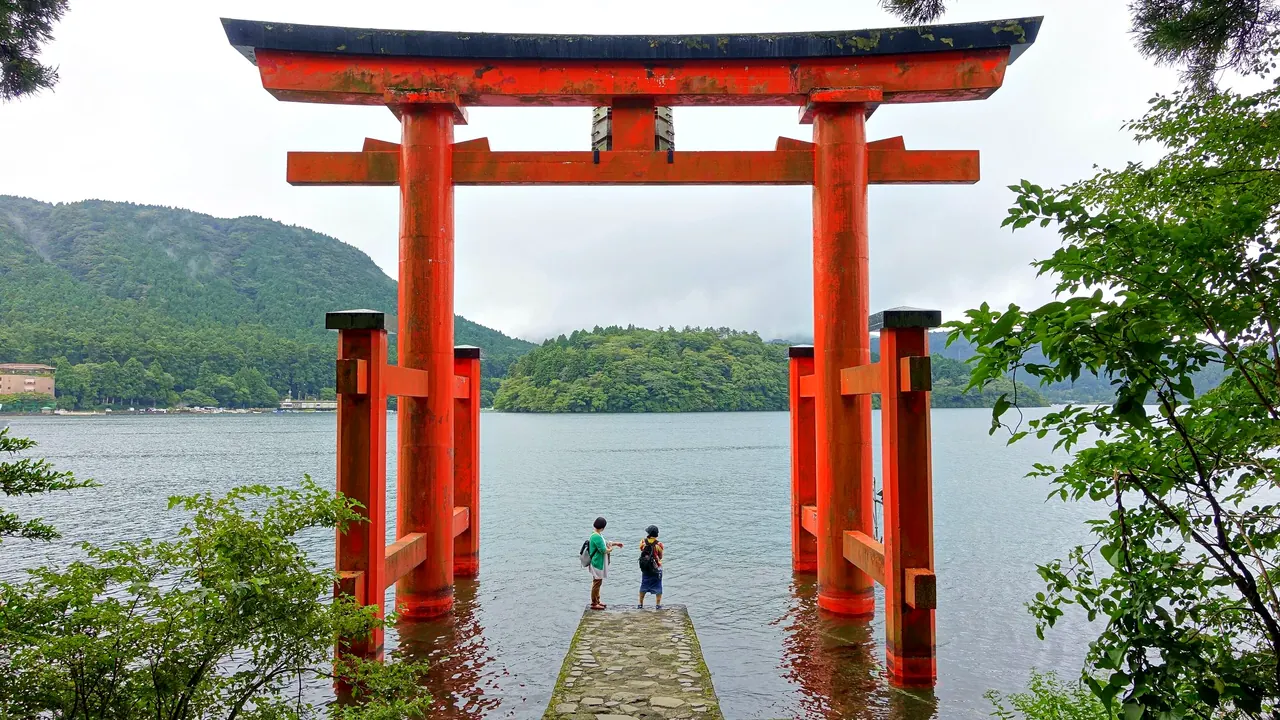
Lake Ashi through the torii of Hakone Shrine
- Wellness & relaxation95
- Nature & outdoors81
- Day trips80
Match
46
Every category weighted equally
- Beach & sun47
- Culture & arts44
- Food & nightlife35
- Family trip52
- Outdoors57
- Relax & unwind54
- Shopping & style42
- On a budget45
Hakone in twelve categories
Our verdict on each, scored 0 to 100 against the same fixed benchmark cities, so a score means the same thing on every page.
Beaches & swimming. Scores 18 out of 100.
Food & drink. Scores 33 out of 100.
Culture & sights. Scores 44 out of 100.
Nightlife. Scores 4 out of 100.
Nature & outdoors. Scores 81 out of 100.
Day trips. Scores 80 out of 100.
Good for families. Scores 62 out of 100.
Getting around. Scores 64 out of 100.
Shopping & style. Scores 28 out of 100.
Affordability. Scores 38 out of 100.
Live music & performing arts. Scores 6 out of 100.
Wellness & relaxation. Scores 95 out of 100.
Hakone category by category
Beaches & swimming
18Hakone is a mountain caldera, and swimming is not part of a stay. You cannot swim in Lake Ashi, and the nearest sea is Sagami Bay, down the valley at Odawara, where the shore is steep, pebbly and often rough. A better beach is Atami, under an hour away, where a sheltered stretch of sand faces water that reaches about 25°C in high summer. The Shonan beaches near Enoshima are further off. These make a summer outing at most. In Hakone the hot water you bathe in comes from the ground, not the sea.
Food & drink
33In Hakone most people eat at their inn. The typical stay includes a kaiseki dinner of many small seasonal courses, with mountain vegetables, river fish and local tofu, served in your room or a private dining room, and a Japanese breakfast the next morning. At its best this is very fine food, and it is the main reason to eat here.
Outside the inns the choice is small. Hakone-Yumoto's main street has soba shops, tofu specialists, snacks of fish cake from Odawara and sweet bean buns. At Owakudani you can buy the famous black eggs, boiled in the volcanic springs. Around the lake you mostly find set-meal restaurants for day visitors, and by early evening most places outside the inns are shut.
Culture & sights
44For a mountain resort, Hakone has a good set of art museums. The Hakone Open-Air Museum spreads sculpture across hillside lawns, with a Picasso pavilion among the works. The Pola Museum of Art hides Impressionist and Japanese paintings in a glass building sunk into beech forest. Smaller collections specialise in Japanese ceramics, glass and woodblock prints.
The historic sights come from Hakone's place on the Tokaido, the old road between Edo and Kyoto. Stretches of the cedar-lined stone road survive, and the Hakone Sekisho checkpoint has been rebuilt on the lakeshore. Hakone Shrine's red torii gate stands in the water of Lake Ashi. The sights are scattered around the caldera rather than packed into a town, so two days at a gentle pace covers them.
Nightlife
4Hakone has no nightlife to speak of. Evenings mean dinner at the inn, a last soak in the bath and an early night in a yukata. Hakone-Yumoto has a few small izakaya and bars that stay open a little later, but the villages up the mountain are dark and quiet soon after dinner. That quiet is the point of the place. Anyone who wants a night out should stay in Tokyo.
Nature & outdoors
81Hakone sits inside the caldera of an old volcano in the Fuji-Hakone-Izu National Park, and the landscape is the reason to come. At Owakudani, sulphur vents steam on a bare, yellowed slope. Lake Ashi fills the crater floor, ringed by forested hills, and on clear days the cone of Mount Fuji rises behind it. Ropeways and boats cross the caldera, but the best way to see it is on foot: the cedar-lined Old Tokaido Road, the ridge walks to Mount Kintoki and Mount Komagatake, or the quiet paths through the Sengokuhara pampas grass.
The seasons change the place sharply. Hydrangeas line the mountain railway in early summer, the hillsides turn red and gold in November, and winter brings the clearest Fuji views. Rain and mist are common, and Fuji hides for days at a time, especially in summer.
Day trips
80Hakone is well placed for days out. Odawara, at the foot of the mountains, has a rebuilt castle keep in a park of plum and cherry trees. Kamakura, with its Great Buddha, Zen temples and coastal shrines, is about an hour and a half away, and the port city of Yokohama is a similar trip. Tokyo is reached in under two hours on the Romancecar express, so some visitors base themselves in the mountains and take the city in day by day.
To the south, the hot-spring town of Atami and the Izu Peninsula offer temple towns such as Shuzenji. Over the ridge, the lakeside towns at the foot of Mount Fuji make a full day by bus.
Good for families
62Children enjoy getting around Hakone. They ride the zigzag mountain railway, the cable car and the ropeway over the steaming vents at Owakudani, then cross Lake Ashi on a replica pirate ship. On the lakeshore at Hakone-en, beside the Komagatake Ropeway, a small aquarium keeps Baikal seals and puts on seal shows. The Hakone Open-Air Museum has net sculptures they can climb inside and a footbath halfway round. Near Kowakudani a large onsen theme park lets families bathe together in swimsuits.
The drawbacks are practical. Traditional inns can be quiet, formal places, and the communal baths are nude and single-sex, which some children find strange, though some ryokan offer private family baths. There is no zoo, and beyond these few attractions little is made for children. At weekends the buses and ropeway are crowded, and the steep paths are hard going with a pushchair. Two or three days is about right.
Getting around
64Hakone is spread across a mountain caldera, but you do not need a car. A single regional pass covers the Hakone Tozan mountain railway, which zigzags up from Yumoto, the cable car, the ropeway over Owakudani, the sightseeing boats on Lake Ashi and the network of local buses. Together they form a loop that is part of the sightseeing.
The weakness is speed. The villages are kilometres apart on winding roads, so walking between them is not realistic except on hiking trails. At weekends and in the autumn-colour season, queues build at the ropeway and buses crawl in traffic. Sending luggage ahead to your inn and starting early make the day far easier.
Shopping & style
28The one local craft is yosegi-zaiku, a marquetry of naturally coloured woods made into geometric patterns. It covers puzzle boxes, trays and coasters, and you can watch it made in workshops around Hatajuku. The main street of Hakone-Yumoto is lined with shops selling sweets, pickles, fish cake and souvenirs, and the museum shops are good for design and art books. For fashion, a large outlet mall near Gotemba is a bus ride over the ridge. Otherwise Hakone is not a place to shop.
Affordability
38Hakone is a pricey part of Japan. The stay people come for is a night at a ryokan, with dinner, breakfast and a hot-spring bath, and at the better inns, especially rooms with a private outdoor bath, the cost mounts quickly. Weekends and autumn are the dearest times. It is cheaper to stay in simple inns and hostels around Hakone-Yumoto, eat in the soba shops at lunch and use the public day-bathhouses. The regional transport pass is good value, and once you have a bed the daily costs are modest.
Live music & performing arts
6There is essentially no performance life in Hakone. There is no theatre or concert hall, and no regular live music. You might catch an occasional small concert at a museum or a traditional performance laid on at an inn, but evenings are for bathing, not for shows. Tokyo is the place for kabuki, concerts or jazz.
Wellness & relaxation
95Bathing is the whole reason Hakone exists. Seventeen hot-spring areas are spread around the caldera, from the old riverside town of Hakone-Yumoto to Gora, Miyanoshita and the milky sulphur waters of Sengokuhara. The ritual is the same throughout: wash at a low stool, soak in near-scalding water, often in an outdoor bath under maples or cedars, then rest in a cotton yukata before dinner. Many inns have private baths on the room's balcony, and public day-bathhouses in the woods let you try several in a day.
The pace is slow and quiet, with early dinners, misty mornings and nothing to rush for. At weekends, in Golden Week and over the New Year break, Tokyo day visitors crowd the most famous spots. A midweek stay, ideally in winter or autumn, is the most restful.
When should you go?
Pick a month to see what it is like. The climate figures are measured averages, not a forecast.
Hakone in July
Daytime high, °C
Rainfall in the month, mm
The whole year
Shaded against this city’s own year: the deepest cell is its best month for that figure and the palest its weakest.
Where the figures come from
Hakone's temperatures are measured 43 km from the centre, at Kawaguchiko.
Hakone has no rain gauge within 25 km of the centre, so its rainfall comes from a gridded climate dataset read at the city rather than from a gauge further away.
Temperature and rainfall are climate normals, averaged over the years shown. Hakone: 1971-2000 (rainfall 1991-2020) normals, Kawaguchiko (42.9 km from centre).
Before you go
| Measure | Hakone |
|---|---|
| Official language | Japanese |
| Currency | Yen (JPY) |
| Sockets | AB100 V, 50 and 60 Hz depending on the region |
| Driving side | Left |
| Time zone | UTC+9 |
| Emergency number | Police 110, fire 119 |
| Elevation | 734 m |
| Main airport | Tokyo Haneda International Airport (HND)71 km from centre98 non-stop destinations |
| Public holidays this year | 16 days |
By the numbers
| Measure | Hakone |
|---|---|
| City population | 10,925 |
| People per km² | 118 |
| Museums within 10 km | 16 |
| UNESCO World Heritage sites within 50 km | 2 |
| Swim season, months above 21 °C | 5 months |
Compare Hakone with
Every comparison with a written verdict behind it.