Japan
Nagasaki
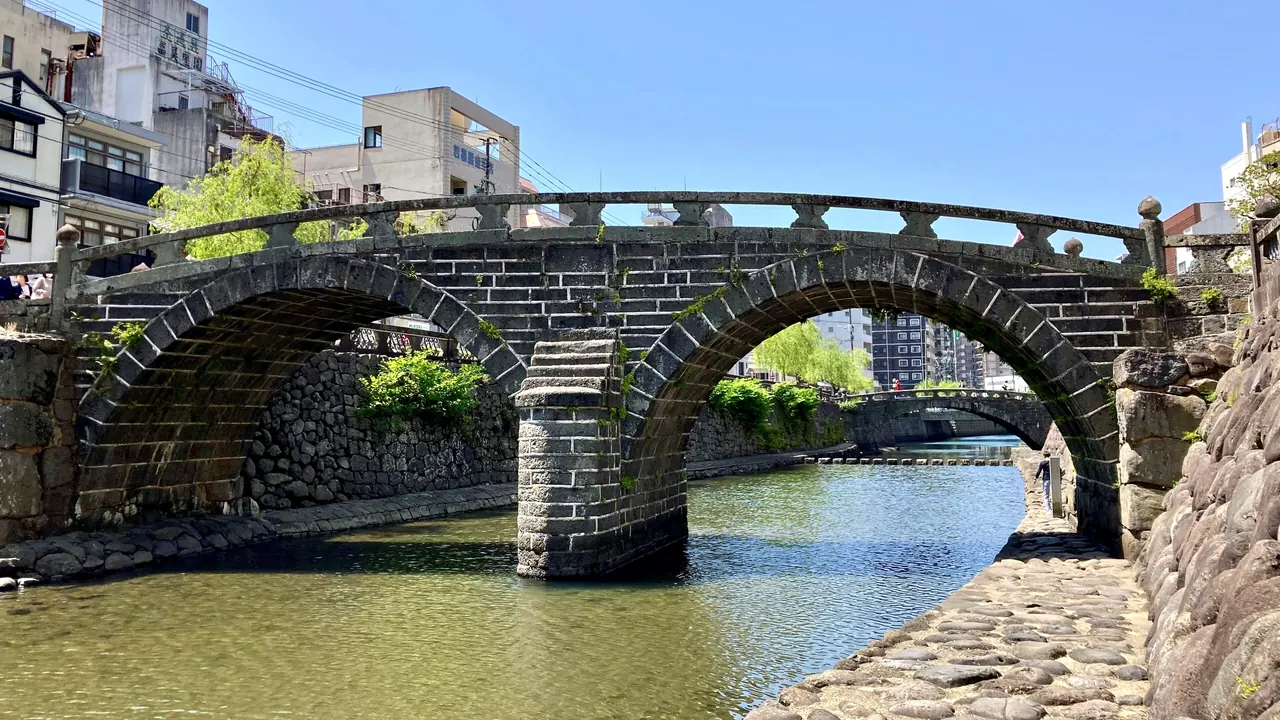
The Meganebashi stone bridge over the Nakashima River
- Getting around72
- Culture & sights70
- Day trips64
Match
53
Every category weighted equally
- Beach & sun52
- Culture & arts55
- Food & nightlife51
- Family trip56
- Outdoors57
- Relax & unwind53
- Shopping & style52
- On a budget53
Nagasaki in twelve categories
Our verdict on each, scored 0 to 100 against the same fixed benchmark cities, so a score means the same thing on every page.
Beaches & swimming. Scores 40 out of 100.
Food & drink. Scores 62 out of 100.
Culture & sights. Scores 70 out of 100.
Nightlife. Scores 32 out of 100.
Nature & outdoors. Scores 60 out of 100.
Day trips. Scores 64 out of 100.
Good for families. Scores 56 out of 100.
Getting around. Scores 72 out of 100.
Shopping & style. Scores 38 out of 100.
Affordability. Scores 60 out of 100.
Live music & performing arts. Scores 28 out of 100.
Wellness & relaxation. Scores 50 out of 100.
Nagasaki category by category
Beaches & swimming
40Nagasaki is a harbour city, not a beach city. The waterfront is all docks, shipyards and promenades, and nobody swims in the bay. The beaches are on the edges of the long peninsula, about an hour away by bus: Takahama on the Nomo coast is a clean sandy bay facing the open sea, and Iojima, a short ferry ride from the harbour, has a small resort beach.
The sea warms to about 26°C in August, and the swimming season runs from July to early September, with jellyfish turning up towards the end. A beach day here is a pleasant break from sightseeing, not a reason to come.
Food & drink
62Centuries as Japan's only window on the outside world left Nagasaki with a cuisine of its own. Champon, a thick pork-and-seafood noodle soup, and sara udon, crisp noodles under a glossy stir-fry, are the local staples. Castella sponge cake came with Portuguese traders and is sold everywhere. Shippoku, a banquet of shared dishes mixing Chinese, Dutch and Japanese influences, is the local celebration meal. Toruko rice, a heavy plate of pork cutlet, pilaf and spaghetti, is a café classic.
The fish from the surrounding waters is excellent, and izakaya around Shianbashi and Hamanomachi serve it simply. Chinatown is good for buns and casual plates. The range is narrow and there is little high-end dining, but eating well here is easy.
Culture & sights
70Nagasaki's sights tell a story found nowhere else in Japan. The Atomic Bomb Museum, the Peace Park and the hypocentre in Urakami are the reason many people come, and they are handled with great care. Around them lie the traces of four centuries of contact with the outside world: the rebuilt Dutch trading post on the fan-shaped island of Dejima, the Western merchant houses of Glover Garden on the southern hillside, Oura Cathedral, Japan's oldest surviving church, and the Twenty-Six Martyrs memorial.
The Chinese heritage is just as visible in the Ming-style Sofukuji temple, the Confucian shrine and Chinatown. The stone Meganebashi bridge crosses the Nakashima river among the temples of Teramachi. Two or three days cover it all.
Nightlife
32Going out in Nagasaki means Shianbashi, one of Kyushu's oldest entertainment districts. It is a tight grid of izakaya, small counter bars, karaoke and snack bars, and many of the snack bars are built around regulars rather than visitors. A relaxed evening of drinks and grilled fish is easy to find, and a few bars stay open late. There is little club scene, though, and the streets thin out well before midnight on most weeknights. Many visitors spend the evening on the night view from Mount Inasa instead.
Nature & outdoors
60The city fills a deep, narrow harbour ringed by steep green hills. Climbing them is part of any visit, and Mount Inasa, reached by ropeway, gives one of the finest night views in Japan over the lights of the bay. The coast of the long Nomo peninsula to the south is rocky and scenic.
Further out, Unzen-Amakusa National Park is about two hours away. Its volcanic peaks have steaming hells, hiking up Mount Fugen and the lava dome of Heisei-shinzan, and the autumn colour is very good. Kujukushima, a scatter of wooded islands off Sasebo, is best seen by boat or kayak. Summers are hot and humid, and the rainy season is wet, so spring and autumn suit outdoor plans best.
Day trips
64The most famous outing is a boat trip to Hashima, the abandoned coal-mining island known as Gunkanjima, whose concrete ruins are part of a UNESCO industrial heritage site. Landings depend on the weather. Shimabara, about two hours away, has a rebuilt castle and a street of samurai houses with carp in the canals. The onsen town of Unzen sits up in the volcanic hills above it.
Northwards, Huis Ten Bosch is a full-scale Dutch-themed resort town near Sasebo. The porcelain towns of Arita and Imari, and Hirado with its old trading-port and Christian heritage, are a long but rewarding day. Fukuoka is about an hour and a half by train. The Goto Islands' churches really need an overnight stay.
Good for families
56Nagasaki is safe, clean and polite, as Japanese cities are, and children usually love the trams and the ropeway up Mount Inasa. The Penguin Aquarium on the eastern shore keeps several species and lets the birds walk out onto a small beach. Dejima's miniature town and Glover Garden's moving walkways up the hill also go down well. Huis Ten Bosch, with its rides, canals and light shows, is the big family day out from the city.
What makes it harder are the hills: many streets are stairways, which is tough with a pushchair. The Atomic Bomb Museum also needs some thought for younger children. Summers are hot and humid.
Getting around
72Nagasaki's old tram network is one of the simplest in Japan. A handful of lines with a flat fare run along the valley floor, linking the station, the Peace Park, Dejima, Chinatown, Oura and the Glover Garden hill. Contactless IC cards work on them. Most sights are within a tram ride or a short walk of each other, and a car is pointless in the city.
The catch is the terrain. Houses climb the hillsides on narrow lanes and long flights of steps that buses can't reach, so walking anywhere off the valley floor is a climb. For the Inasa summit there is the ropeway, and buses fill the gaps to the outer districts and the peninsula.
Shopping & style
38Shopping in Nagasaki is local and modest. The covered Hamanomachi arcade is the city's main shopping street, with a department store, pharmacies and everyday chains, and there is a mall around the station. The things worth taking home are local. Boxed castella from the long-established bakeries is the classic gift, along with Nagasaki glassware and Chinatown sweets. From elsewhere in the prefecture come the everyday porcelain of Hasami and the fine white Mikawachi ware made near Sasebo. Arita porcelain, from just over the border in Saga, is easy to find too. Fashion and luxury shopping are thin, and anyone keen on them will do better in a larger city.
Affordability
60Nagasaki is one of the easier places in Japan to travel on a moderate budget. Business hotels near the station and Shianbashi offer small, spotless rooms at fair rates outside festival periods. A bowl of champon or a set lunch is inexpensive, and the tram costs little for a whole day of sightseeing. Several sights charge only modest entry fees. The Hashima boat tours, the ropeway and evenings of sake and sashimi are where the spending builds up.
Live music & performing arts
28Nagasaki's great performance is a festival, not a season. Every October the Nagasaki Kunchi at Suwa Shrine fills three days with dragon dances, ship floats and dances rooted in the city's Chinese and Dutch past. The Lantern Festival around Chinese New Year adds dragon dances and acrobatics in Chinatown. Outside those dates there is a municipal concert hall with touring classical and pop programmes, and a few small live-music bars, but very little a visitor can plan around.
Wellness & relaxation
50Japan's bathing culture reaches Nagasaki mostly from outside. The city has a few hot-spring facilities and neighbourhood sento, and some hotels have their own baths. The real onsen towns lie on the Shimabara peninsula: Obama, on the shore, has some of the hottest springs in Japan and a long open-air footbath facing the sunset. Unzen, higher up, is a classic mountain spa among steaming vents. Both are best enjoyed with an overnight stay at a ryokan.
The city itself has an unhurried harbour rhythm. Quiet hillside temples and evening walks along the waterfront make it easier to slow down than in a big city.
When should you go?
Pick a month to see what it is like. The climate figures are measured averages, not a forecast.
Nagasaki in July
Daytime high, °C
Rainfall in the month, mm
The whole year
Shaded against this city’s own year: the deepest cell is its best month for that figure and the palest its weakest.
Temperature and rainfall are climate normals, averaged over the years shown. Nagasaki: 1991-2020 normals, Nagasaki (2.2 km from centre).
Before you go
| Measure | Nagasaki |
|---|---|
| Official language | Japanese |
| Currency | Yen (JPY) |
| Sockets | AB100 V, 50 and 60 Hz depending on the region |
| Driving side | Left |
| Time zone | UTC+9 |
| Emergency number | Police 110, fire 119 |
| Elevation | 105 m |
| Main airport | Nagasaki Airport (NGS)19 km from centre10 non-stop destinations |
| Public holidays this year | 16 days |
By the numbers
| Measure | Nagasaki |
|---|---|
| City population | 404,656 |
| People per km² | 996 |
| Museums within 10 km | 26 |
| UNESCO World Heritage sites within 50 km | 2 |
| Swim season, months above 21 °C | 6 months |
Compare Nagasaki with
Every comparison with a written verdict behind it.