Japan
Nikko
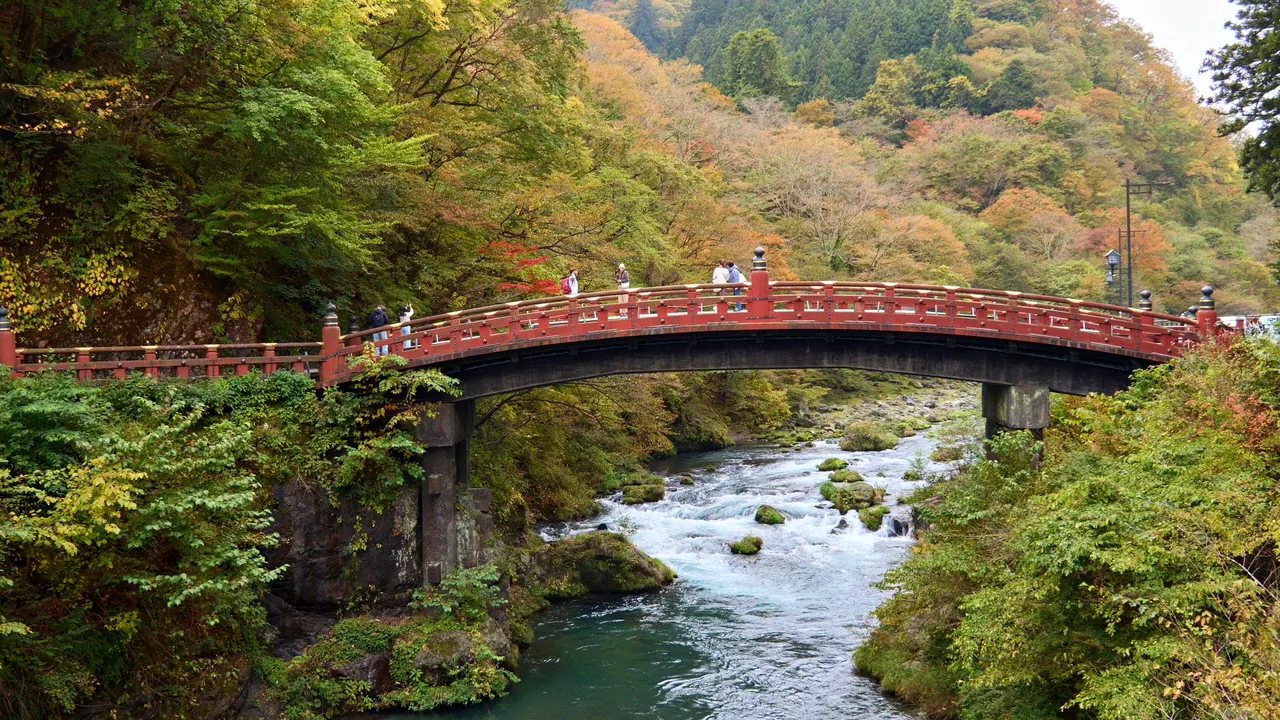
The Shinkyo bridge over the Daiya River in autumn
- Wellness & relaxation86
- Nature & outdoors85
- Culture & sights70
Match
44
Every category weighted equally
- Beach & sun43
- Culture & arts45
- Food & nightlife34
- Family trip49
- Outdoors54
- Relax & unwind50
- Shopping & style39
- On a budget45
Nikko in twelve categories
Our verdict on each, scored 0 to 100 against the same fixed benchmark cities, so a score means the same thing on every page.
Beaches & swimming. Scores 4 out of 100.
Food & drink. Scores 28 out of 100.
Culture & sights. Scores 70 out of 100.
Nightlife. Scores 5 out of 100.
Nature & outdoors. Scores 85 out of 100.
Day trips. Scores 62 out of 100.
Good for families. Scores 50 out of 100.
Getting around. Scores 55 out of 100.
Shopping & style. Scores 16 out of 100.
Affordability. Scores 56 out of 100.
Live music & performing arts. Scores 12 out of 100.
Wellness & relaxation. Scores 86 out of 100.
Nikko category by category
Beaches & swimming
4Nikko is a mountain town far inland, and the sea is several hours away. Lake Chuzenji and Lake Yunoko are cool highland lakes used for boating and fishing, not swimming, and there is no bathing beach to speak of. For water in summer, visitors use the hot springs or a hotel pool.
Food & drink
28The local speciality is yuba, the delicate skin lifted from simmering soy milk, served fresh, rolled, fried or in clear broth, and it reflects the vegetarian temple cooking that grew up around the shrines. Soba from mountain buckwheat, grilled river fish and sweet yokan bean jelly fill out the rest of the short list.
Most places to eat sit along the main road between the station and the shrines and cater to day visitors at lunch, so evenings are quiet and choice narrows sharply. The best meals are often the multi-course dinners served at ryokan and onsen inns. Visitors after range or depth will find little beyond these local dishes.
Culture & sights
70The Shrines and Temples of Nikko are a UNESCO-listed ensemble set in a forest of giant cedars, and they are the reason most people come. Toshogu, the mausoleum of the shogun Tokugawa Ieyasu, is the most lavishly decorated shrine in Japan, covered in lacquer, gold leaf and carvings, including the Yomeimon gate and the three wise monkeys. Next to it stand Rinnoji temple with its great hall of gilded Buddhas, Futarasan Shrine and the quieter Taiyuinbyo mausoleum.
Around this core are the red Shinkyo bridge over the Daiya River, the Tamozawa Imperial Villa, a large Meiji-era summer residence, and the row of moss-covered stone Jizo statues along the Kanmangafuchi gorge. It is a compact set that one or two full days cover well, with few museums of note beyond it.
Nightlife
5There is effectively no nightlife. The day-trip crowds leave by late afternoon, restaurants close early and the main street is dark soon after. A few small bars and the hotel lounges in Kinugawa Onsen are about all there is, and evenings are spent over a long ryokan dinner and a soak in the hot spring.
Nature & outdoors
85Nikko is the gateway to Nikko National Park, and the landscape climbs fast. The hairpin bends of the Irohazaka road lead up to Lake Chuzenji at 1,269m, under the volcanic cone of Mount Nantai, where Kegon Falls drops nearly 100m from the lake's outlet. Further up, the Senjogahara marshland has level boardwalk trails through grassland and larch, ending at Ryuzu and Yudaki falls and the small Lake Yunoko.
Hiking ranges from these easy plateau walks to steep climbs of Nantai and Nikko-Shirane, and the Kinugawa gorge offers river rafting. Autumn is the great season, when the maples turn from the high marsh down to the town over several weeks, though the roads clog then. Summers are cool by Japanese standards, and winter brings snow, small ski slopes and frozen waterfalls.
Day trips
62The biggest day trip is Tokyo itself, about two hours by limited express or by shinkansen via Utsunomiya, which puts the whole capital within reach of a long day. Utsunomiya, under an hour away, is known for its gyoza, and the pottery town of Mashiko, with its kilns and folk-craft heritage, is an easy outing beyond it.
To the north, the thatched post town of Ouchi-juku lies at the edge of a two-hour journey, and Ashikaga has its old school and flower park. Kinugawa Onsen, within Nikko's own boundaries, makes a short half-day. Beyond these, the places within reach are mostly mountains and lakes rather than towns.
Good for families
50Nikko is safe, clean and easy-going, and the Kinugawa side of the area has the attractions aimed at children: an Edo-period theme village with ninja and samurai shows, and a park of detailed miniature world landmarks. Older children usually enjoy the boat rides on Lake Chuzenji, the falls and the boardwalks of Senjogahara.
The shrines themselves are less suited to small children, with long staircases, gravel paths and crowds at weekends and in autumn, and the main attractions are spread out enough that bus journeys with toddlers can drag. It works well for a family stay of two or three days, less well for longer.
Getting around
55The town stretches along one road from the two adjacent railway stations up to the shrine area, about 2km of gentle uphill walking or a short bus ride. Within the shrine precinct everything is on foot, though with plenty of steps.
Lake Chuzenji, Kegon Falls and Senjogahara are reached by local bus up the Irohazaka road, which is easy enough most of the year but can crawl for hours on autumn foliage weekends. Kinugawa Onsen is a short train ride away. A car is not needed, but distances and bus dependence make the area slower to cover than its size suggests.
Shopping & style
16Shopping is a single main street of souvenir shops and food stores. The genuine local crafts are Nikko-bori, a style of wood carving on trays and boxes, and Nikko geta, traditional sandals with woven straw soles, alongside packaged yuba and yokan to take home. Anyone who wants fashion, design or department stores waits for Tokyo.
Affordability
56Day-to-day costs are moderate. Simple meals of soba or yuba dishes, local buses and entry to the shrines are reasonably priced, and the town has a good supply of plain guesthouses and hostels for budget travellers. The expense comes with the classic stay: a ryokan or onsen hotel with a multi-course dinner and breakfast costs considerably more, and rooms in the lake area and in autumn foliage season are the dearest of the year.
Live music & performing arts
12There is no theatre or concert life. The performance worth planning around is the Toshogu festival in spring and autumn, when a procession of around a thousand men in samurai armour and period costume re-enacts the shogun's funeral march, accompanied by yabusame, horseback archery. Outside those days, live performance means shows staged at the theme park in Kinugawa and the occasional sacred dance at the shrines.
Wellness & relaxation
86Hot springs are woven through the area. Kinugawa Onsen, a riverside resort town of large inns along a gorge, is a short train ride away, and further up the mountains Yumoto Onsen on Lake Yunoko has milky, sulphur-scented water and a more remote, rustic feel. Lake Chuzenji and the smaller inns of the town have their own baths, and many ryokan offer open-air pools looking onto forest or river.
The rhythm suits slowing down: cedar-shaded shrine paths in the morning, a long soak in the late afternoon, a kaiseki-style dinner and an early night. Autumn weekends bring crowds, but on weekdays and in winter the mountain resorts are deeply quiet, with snow on the outdoor baths.
When should you go?
Pick a month to see what it is like. The climate figures are measured averages, not a forecast.
Nikko in July
Daytime high, °C
Rainfall in the month, mm
The whole year
Shaded against this city’s own year: the deepest cell is its best month for that figure and the palest its weakest.
Where the figures come from
Nikko has no weather station within reach, so its figures come from a gridded climate model rather than a measured record, and read a broad area rather than the city itself.
Temperature and rainfall are climate normals, averaged over the years shown. Nikko: 2001-2020 normals, NASA POWER reanalysis grid, no weather station within 90 km.
Before you go
| Measure | Nikko |
|---|---|
| Official language | Japanese |
| Currency | Yen (JPY) |
| Sockets | AB100 V, 50 and 60 Hz depending on the region |
| Driving side | Left |
| Time zone | UTC+9 |
| Emergency number | Police 110, fire 119 |
| Elevation | 660 m |
| Main airport | Tokyo Haneda International Airport (HND)134 km from centre98 non-stop destinations |
| Public holidays this year | 16 days |
By the numbers
| Measure | Nikko |
|---|---|
| City population | 77,027 |
| People per km² | 53 |
| Museums within 10 km | 5 |
| UNESCO World Heritage sites within 50 km | 1 |
Compare Nikko with
Every comparison with a written verdict behind it.