United States
Savannah
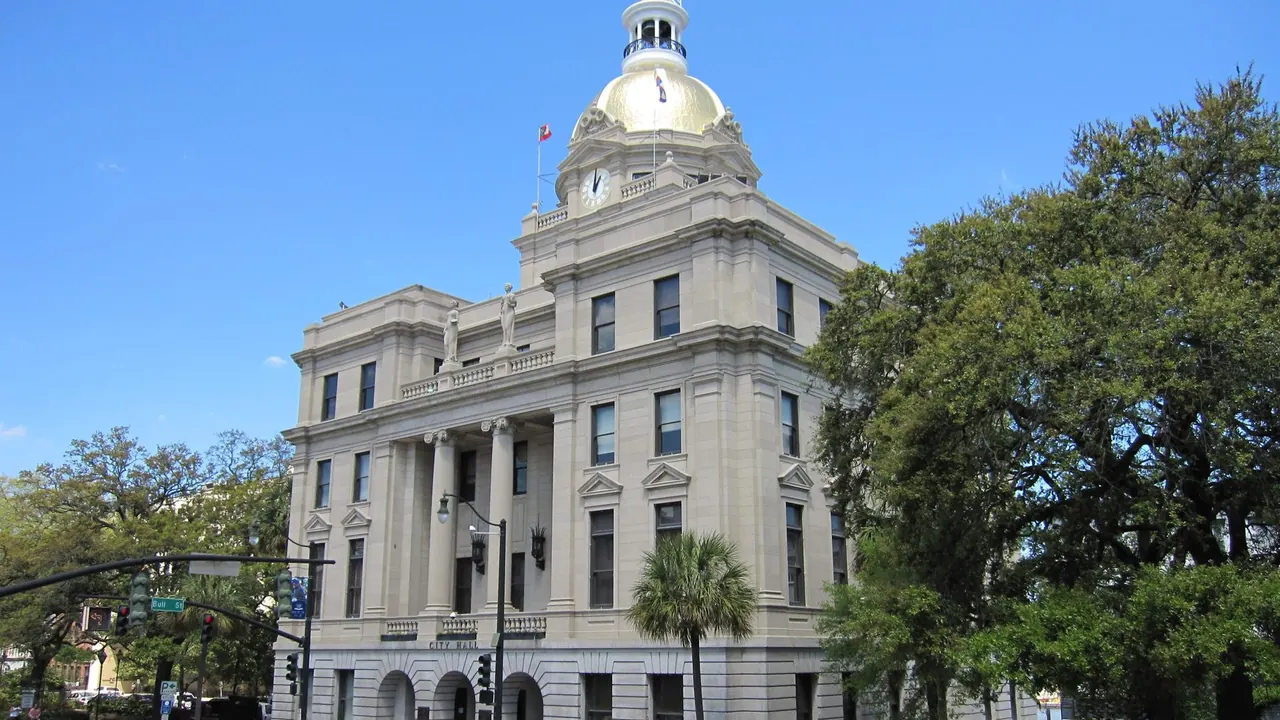
Savannah City Hall and its golden dome
- Culture & sights68
- Day trips60
- Food & drink58
Photo: Chris M Morris, CC BY 2.0, cropped
Match
51
Every category weighted equally
- Beach & sun50
- Culture & arts53
- Food & nightlife51
- Family trip51
- Outdoors51
- Relax & unwind50
- Shopping & style51
- On a budget49
Savannah in twelve categories
Our verdict on each, scored 0 to 100 against the same fixed benchmark cities, so a score means the same thing on every page.
Beaches & swimming. Scores 55 out of 100.
Food & drink. Scores 58 out of 100.
Culture & sights. Scores 68 out of 100.
Nightlife. Scores 52 out of 100.
Nature & outdoors. Scores 48 out of 100.
Day trips. Scores 60 out of 100.
Good for families. Scores 50 out of 100.
Getting around. Scores 58 out of 100.
Shopping & style. Scores 42 out of 100.
Affordability. Scores 35 out of 100.
Live music & performing arts. Scores 40 out of 100.
Wellness & relaxation. Scores 40 out of 100.
Savannah category by category
Beaches & swimming
55Savannah sits on a river, not the sea, so beach time means a drive of about half an hour east to Tybee Island. There the Atlantic is warm through summer, around 28°C by August, and the wide, flat sand suits long walks, paddling children and a lazy afternoon under an umbrella. The water is greenish-brown rather than clear, coloured by the surrounding marshes, and the setting is a low-key beach town rather than anything glamorous.
For most visitors the beach is one day of the stay rather than the reason for it. Spring and early autumn are the pleasant seasons; midsummer brings heat, humidity and afternoon thunderstorms, and the sea stays cool enough to put most people off from December to March.
Food & drink
58Savannah eats in the Lowcountry tradition: shrimp and grits, she-crab soup, fried green tomatoes, Lowcountry boil heaped with sausage, corn and shrimp, and oysters roasted over fire in the cooler months. Family-style Southern dining rooms with platters passed down long tables are part of the local identity, and wild Georgia shrimp from the nearby coast turn up on almost every menu.
Above that sits a small but serious tier of chef-led restaurants in restored townhouses and warehouses around the historic district and the streets south of Forsyth Park. Range beyond Southern cooking is thin, and the riverfront leans heavily towards fried seafood for passing crowds. Pralines, old-fashioned ice cream parlours and craft cocktail bars round out a scene that is satisfying for a long weekend rather than a deep one.
Culture & sights
68The city itself is the main sight. James Oglethorpe's 1733 town plan survives almost intact, a grid of twenty-odd garden squares shaded by live oaks hung with Spanish moss, each framed by Federal, Regency, Greek Revival and Victorian houses. Walking from square to square, past ironwork balconies, churches such as the Cathedral of St John the Baptist and the old cotton warehouses of Factors Walk above the river, fills a day or two with ease.
The Telfair Museums cover art from the Telfair Academy to the modern Jepson Center, and the Owens-Thomas House tells the story of the enslaved people who ran it alongside the family who lived there. House museums, the art school's museum, Forsyth Park's fountain and the haunting Bonaventure Cemetery complete a compact, atmospheric set, more about setting than great collections.
Nightlife
52Going out in Savannah is easy-going and sociable. The historic district allows drinks in to-go cups on the street, so evenings drift between River Street's cobbled bars, the taverns around City Market and quieter cocktail rooms tucked into old townhouses. Art school students keep a handful of dive bars and dance nights busy around the edges of downtown.
Weekends draw bachelorette parties and a loud riverfront crowd, and St Patrick's Day turns the whole city into one of the largest street parties in the American South. Beyond that the club scene is small and most of the city winds down well before the early hours.
Nature & outdoors
48Savannah is surrounded by Lowcountry: flat, open salt marsh threaded with tidal creeks, live-oak hammocks and low barrier islands. The best of it is on the water, kayaking or paddleboarding through the marsh at high tide, dolphin-spotting boat trips and birding for herons, egrets and wood storks. The avenue of oaks at Wormsloe, the trails of Skidaway Island State Park and the cycle path out to Tybee give gentler ways in.
There are no hills anywhere near, and summer heat, humidity and biting insects make long outings hard work from June to September. Spring and autumn are the seasons to be outdoors.
Day trips
60The best day out is Charleston, about two hours north by car, with its own historic peninsula, plantations and waterfront. Closer to home, the antebellum town of Beaufort lies about an hour away among the Sea Islands, and Hilton Head's resort island is under an hour. Fort Pulaski, a brick Civil War fortress on the road to Tybee, makes an easy half day.
South along the Georgia coast, Jekyll Island's millionaires' historic district and the village on St Simons Island are reachable in about an hour and a half. Nearly all of these trips need a car, as public transport out of the city is minimal.
Good for families
50Savannah is manageable with children, if not built for them. The squares and Forsyth Park give shade and space to run, the open-air trolley tours and the free ferry across the river are easy treats, and older children often enjoy the ghost walks and the forts. The birthplace of the Girl Scouts' founder draws families from across the country, and a small wildlife centre on the edge of town shows native animals.
Tybee Island adds a gentle beach and a sea-turtle centre. There is no large zoo, aquarium or theme park, and the summer heat makes long walks with young children tiring.
Getting around
58Within the historic district Savannah is a walker's city: flat, compact and laid out on a grid where every few blocks you pass through another shaded square. Most of the sights, restaurants and hotels sit within a short walk of each other, and a free downtown shuttle and a small passenger ferry across the river cover what the feet do not.
Beyond that core the city spreads out in typical American fashion. Bonaventure Cemetery, Wormsloe and Tybee Island all need a car, a taxi or a tour, and local buses are of limited use to visitors. Summer heat also makes midday walking much harder than the map suggests.
Shopping & style
42Broughton Street is the main shopping street, a run of restored storefronts with clothing boutiques, home-goods shops and a few national chains. The art school's influence shows in the shops selling work by students and graduates, and antique dealers and bookshops are scattered through the squares south of it.
River Street and City Market lean towards pralines, hot sauce and souvenirs. There is no luxury district or department store of note, so shopping here is an enjoyable browse rather than a reason to come.
Affordability
35Savannah is not a cheap stay. Inn and hotel rooms in the historic district are priced as a popular weekend destination, and spring weekends and festival dates push them higher still. Eating out costs what it does across the American South once tax and tip are added, which is more than in most of Southern Europe.
The saving grace is that much of the pleasure is free: walking the squares, Forsyth Park, the riverfront and the cemeteries cost nothing. Staying in motels by the highway or visiting midweek in summer brings costs down noticeably, though a car then becomes part of the budget.
Live music & performing arts
40Savannah's high point is the Savannah Music Festival each spring, a long-running event mixing classical chamber music, jazz, blues and Americana in historic theatres and churches across the city. The restored Lucas and Trustees theatres host touring shows and concerts, there is a local philharmonic orchestra, and an autumn jazz festival fills Forsyth Park.
Outside those seasons the offer is modest: a few bars with live bands, buskers in the squares and occasional theatre. A visitor who plans around the spring festival will find plenty; one arriving at random may find little to attend.
Wellness & relaxation
40There is no bathing tradition in Savannah, and wellness means a handful of hotel and day spas. What the city does offer is pace. Life in the historic district is unhurried, the squares are made for sitting on a bench under the oaks, and a porch or a garden courtyard in one of the old inns is an easy place to do very little.
That calm fades on River Street at weekends and during the big spring festivities, and the summer humidity can be more draining than soothing. For a restful stay, choose a quiet inn on a southern square and come midweek in spring or autumn.
When should you go?
Pick a month to see what it is like. The climate figures are measured averages, not a forecast.
Savannah in July
Daytime high, °C
Rainfall in the month, mm
The whole year
Shaded against this city’s own year: the deepest cell is its best month for that figure and the palest its weakest.
Temperature and rainfall are climate normals, averaged over the years shown. Savannah: 1991-2020 normals, Savannah Airport (9.9 km from centre).
Before you go
| Measure | Savannah |
|---|---|
| Currency | US Dollar (USD) |
| Sockets | AB120 V, 60 Hz |
| Driving side | Right |
| Time zone | UTC-5, UTC-4 in summer |
| Emergency number | 911 |
| Elevation | 15 m |
| Main airport | Savannah Hilton Head International Airport (SAV)12 km from centre39 non-stop destinations |
| Public holidays this year | 12 days |
By the numbers
| Measure | Savannah |
|---|---|
| City population | 147,780 |
| People per km² | 524 |
| Museums within 10 km | 19 |
| UNESCO World Heritage sites within 50 km | 0 |
| Swim season, months above 21 °C | 6 months |
Compare Savannah with
Every comparison with a written verdict behind it.