Czechia
Karlovy Vary
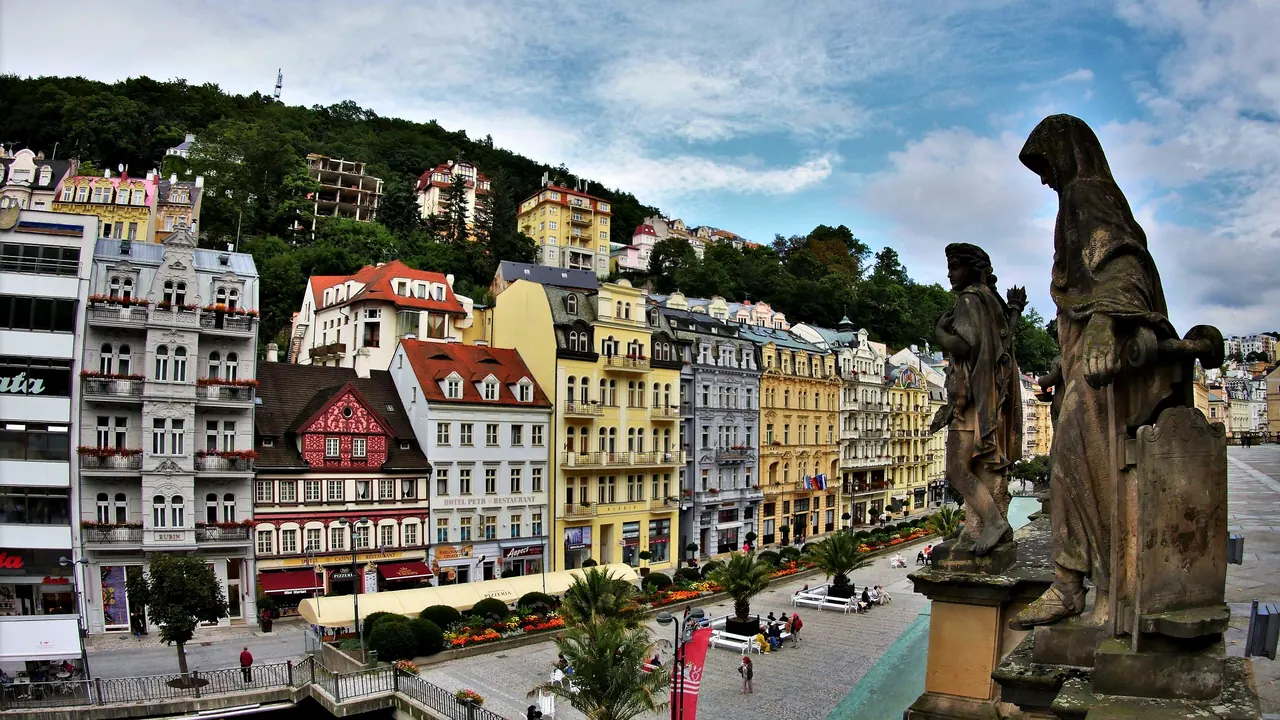
The promenade along the Teplá
- Wellness & relaxation88
- Getting around64
- Day trips62
Photo: Rolf Dietrich Brecher from Germany, CC BY-SA 2.0, cropped
Match
46
Every category weighted equally
- Beach & sun45
- Culture & arts49
- Food & nightlife42
- Family trip47
- Outdoors51
- Relax & unwind51
- Shopping & style46
- On a budget48
Karlovy Vary in twelve categories
Our verdict on each, scored 0 to 100 against the same fixed benchmark cities, so a score means the same thing on every page.
Beaches & swimming. Scores 9 out of 100.
Food & drink. Scores 33 out of 100.
Culture & sights. Scores 55 out of 100.
Nightlife. Scores 14 out of 100.
Nature & outdoors. Scores 60 out of 100.
Day trips. Scores 62 out of 100.
Good for families. Scores 35 out of 100.
Getting around. Scores 64 out of 100.
Shopping & style. Scores 42 out of 100.
Affordability. Scores 60 out of 100.
Live music & performing arts. Scores 34 out of 100.
Wellness & relaxation. Scores 88 out of 100.
Karlovy Vary category by category
Beaches & swimming
9This is an inland spa town in a wooded valley, a long way from any sea. In summer, locals swim in Lake Medard, a flooded former mine near Sokolov about half an hour away, and in a few smaller reservoirs and ponds in the hills. Otherwise swimming means a pool, including warm outdoor pools fed by the springs. Nobody comes here for the water in that sense.
Food & drink
33Eating here is traditional and fairly narrow. Hearty Czech cooking is the base: roast pork, dumplings, goulash and svíčková, with good Pilsner-style beer. The town has two edible souvenirs of its own. One is the thin, round spa wafers, sold warm from stalls along the colonnades. The other is Becherovka, the herbal liqueur that was invented here and is still distilled in town.
Cafés with cakes and coffee line the promenades along the Teplá river, and they suit the slow rhythm of a spa stay. Restaurants on the main promenade lean towards international menus for hotel guests. There is little street food and no real market, and only a handful of more ambitious kitchens.
Culture & sights
55The town itself is the sight. Belle Époque and neo-Renaissance hotels, villas and bathhouses rise in pastel tiers up both sides of the narrow Teplá valley. In 2021 the spa quarter was listed by UNESCO as one of the Great Spa Towns of Europe. The colonnades frame the hot springs. The Mill Colonnade is a long run of Corinthian columns, the Market Colonnade is carved timber, and the Hot Spring Colonnade houses the Vřídlo, a geyser that shoots water at about 72°C several metres into the air.
Other landmarks include Dientzenhofer's baroque Church of St Mary Magdalene and the gilded Russian Orthodox church of Saints Peter and Paul. The museums are small and specialised, devoted to Moser glass, Becherovka and local history. A day or two covers it all comfortably.
Nightlife
14Evenings are quiet. Spa guests eat early and walk the promenade, and the town is largely asleep by eleven. There are hotel bars, a few cocktail and wine bars, Czech pubs and some casinos. The exception is the week of the international film festival in early summer, when crowds, parties and outdoor bars fill the valley. For the rest of the year, a late night out means one more drink in the hotel bar.
Nature & outdoors
60Thick beech and spruce forest climbs straight out of the spa valley. A marked network of old spa walking paths leads up to lookout points such as the Diana tower, which you can reach by funicular, and to the stag-leap rock above the town. These are gentle, well-graded trails, laid out originally for convalescents.
Further out, the Slavkov Forest protected area has upland moors and quiet villages. The Ore Mountains on the German border are about forty minutes away. There is cycling and hiking there in summer, and in winter, downhill and cross-country skiing around Klínovec. The Ohře river below the town is a favourite for easy canoeing. The landscape is green and rolling rather than dramatic.
Day trips
62Loket, a castle town in a tight loop of the Ohře, is only about twenty minutes away and is the most rewarding short outing. Mariánské Lázně and Františkovy Lázně are about an hour away and complete the trio of West Bohemian spa towns. One is grand and set in parkland, the other small and classical. Bečov nad Teplou keeps the reliquary of St Maurus, one of the country's great medieval treasures, in its castle. Jáchymov, a silver- and uranium-mining town, belongs to the UNESCO-listed Ore Mountains mining landscape.
The old border town of Cheb and the brewing city of Plzeň are both about an hour or more away. Prague can be done in a long day by coach, about two hours each way.
Good for families
35The town is safe, clean and easy to stroll, but it is built around adults taking cures. Children usually enjoy the geyser in the Hot Spring Colonnade, tasting the warm spring water from little spouted cups, the funicular up to the Diana lookout and its small animal enclosure, and the spa wafers. Forest walks and the outdoor thermal pool fill an afternoon or two, and Loket's castle is an easy family outing. Beyond that there is little aimed at children. The steep valley sides are tiring with a pushchair.
Getting around
64The spa quarter is a long, narrow strip along the Teplá river, and most of what a visitor wants lies within a pleasant walk along the promenades. The valley sides are steep, though. Local buses and the funicular help with the climbs to hotels and viewpoints. The upper and lower railway stations connect to Loket, Cheb and Mariánské Lázně on slow regional lines, and coaches run to Prague in about two hours. You do not need a car in town, but one makes the forests and smaller villages easier to reach.
Shopping & style
42Shopping centres on the promenades of Stará louka and Tržiště. Jewellers, fur and fashion boutiques for well-off spa guests sit beside shops selling spa cups, wafers and Becherovka. The genuine local specialities are Moser crystal, made in the town since the nineteenth century and sold from its own showroom, and Karlovy Vary porcelain from the surrounding factories. Garnet jewellery from Bohemia is another classic. Away from these, the range is small, and there are no markets of note.
Affordability
60It is a moderately priced resort by European standards and dearer than ordinary Czech towns. The grand spa hotels and the restaurants along the colonnades charge for the setting. One street back, the pubs and canteens serve Czech food and beer at local prices. Local buses, the funicular and the colonnades themselves cost little or nothing. Rooms are cheapest outside the summer season and the festival week, which is the most expensive time to stay.
Live music & performing arts
34The Karlovy Vary Symphony Orchestra grew out of the spa orchestras that played to guests for centuries, and it still gives regular concerts. These are often light classical programmes, and in summer some are held outdoors on the colonnades. The ornate municipal theatre, designed by Fellner and Helmer, hosts touring drama, operetta and concerts. An autumn Dvořák festival adds a few highlights. It is a pleasant evening's entertainment rather than a scene, and the town's best-known festival is devoted to film.
Wellness & relaxation
88Taking the waters is the reason the town exists. Thirteen main springs of differing temperature and mineral content are piped into the colonnades. Guests carry porcelain spa cups with spouts and sip them while walking, following a drinking cure that has been prescribed here for centuries. Dozens of spa hotels and sanatoria offer medical stays with carbonated baths, peat wraps, massages and doctors' consultations. Several have pools filled with the warm spring water, and there is an outdoor thermal pool on the hillside above the river.
The pace is the other half of it. Days are made up of slow walks between springs, coffee and cake, and forest paths. Public bathhouses are fewer than the town's fame suggests, so the full experience is best had by booking a spa stay.
When should you go?
Pick a month to see what it is like. The climate figures are measured averages, not a forecast.
Karlovy Vary in July
Daytime high, °C
Rainfall in the month, mm
The whole year
Shaded against this city’s own year: the deepest cell is its best month for that figure and the palest its weakest.
Where the figures come from
Karlovy Vary's station stands 156 m above the city centre, so the centre is likely a little warmer than the figures say.
Karlovy Vary has no rain gauge within 25 km of the centre, so its rainfall comes from a gridded climate dataset read at the city rather than from a gauge further away.
Karlovy Vary's sunshine is measured 37 km from the centre, at Cheb.
Temperature and rainfall are climate normals, averaged over the years shown. Karlovy Vary: 1999-2020 (sunshine 1981-2010, rainfall 1991-2020) normals, Karlovy Vary (4.6 km from centre).
Before you go
| Measure | Karlovy Vary |
|---|---|
| Official language | Czech |
| Currency | Czech Koruna (CZK) |
| Sockets | CE230 V, 50 Hz |
| Driving side | Right |
| Time zone | UTC+1, UTC+2 in summer |
| Emergency number | 112 |
| Elevation | 447 m |
| Main airport | Václav Havel Airport Prague (PRG)100 km from centre178 non-stop destinations |
| Public holidays this year | 13 days |
By the numbers
| Measure | Karlovy Vary |
|---|---|
| City population | 49,073 |
| People per km² | 830 |
| Museums within 10 km | 2 |
| UNESCO World Heritage sites within 50 km | 3 |
Compare Karlovy Vary with
Every comparison with a written verdict behind it.
- Baden-Baden
- Basel
- Berlin
- Bled
- Bratislava
- Brno
- Cesky Krumlov
- Colmar
- Cologne
- Cortina d'Ampezzo
- Dresden
- Dusseldorf
- Frankfurt
- Freiburg
- Graz
- Hallstatt
- Hamburg
- Heidelberg
- Innsbruck
- Leipzig
- Ljubljana
- Lubeck
- Lucerne
- Luxembourg
- Munich
- Nuremberg
- Prague
- Salzburg
- Strasbourg
- Stuttgart
- Vienna
- Wroclaw
- Zurich