France
Nantes
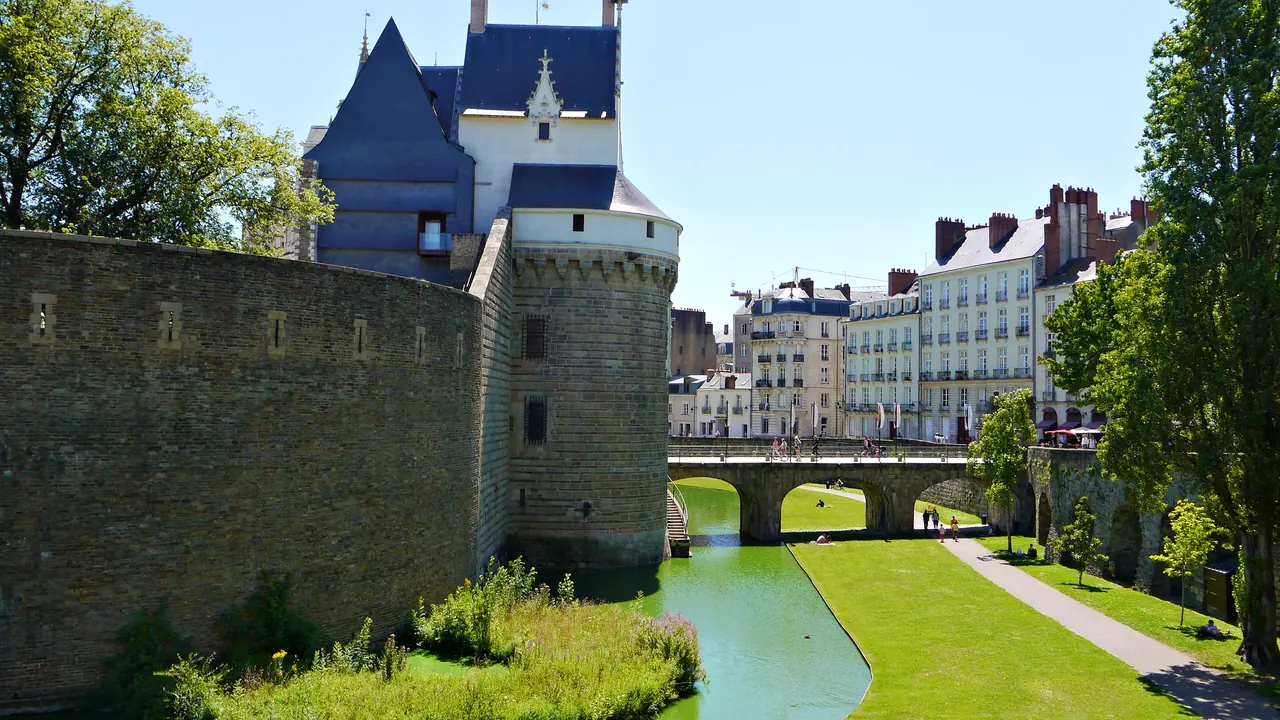
The Castle of the Dukes of Brittany with its moat and stone bridge
- Getting around75
- Day trips72
- Families66
Photo: Carole44, CC BY-SA 3.0, cropped
Match
55
Every category weighted equally
- Beach & sun52
- Culture & arts59
- Food & nightlife56
- Family trip57
- Outdoors57
- Relax & unwind52
- Shopping & style56
- On a budget54
Nantes in twelve categories
Our verdict on each, scored 0 to 100 against the same fixed benchmark cities, so a score means the same thing on every page.
Beaches & swimming. Scores 42 out of 100.
Food & drink. Scores 60 out of 100.
Culture & sights. Scores 60 out of 100.
Nightlife. Scores 47 out of 100.
Nature & outdoors. Scores 55 out of 100.
Day trips. Scores 72 out of 100.
Good for families. Scores 66 out of 100.
Getting around. Scores 75 out of 100.
Shopping & style. Scores 48 out of 100.
Affordability. Scores 46 out of 100.
Live music & performing arts. Scores 56 out of 100.
Wellness & relaxation. Scores 36 out of 100.
Nantes category by category
Beaches & swimming
42Nantes sits inland on the Loire, so the beach is a day out rather than part of daily life. The nearest proper beaches are around 50km away. Trains reach the long, sheltered sandy bay at La Baule and the coves around Pornic in about an hour, and Saint-Brevin and the Jade coast are close by car.
This is the Atlantic, so the sea warms to about 19°C to 21°C in late summer and the season is short. On calm days the beaches are clean, wide and good for families. A summer weekend can bring a lot of locals to the shore, but nobody chooses Nantes for swimming.
Food & drink
60Eating in Nantes means the food of the lower Loire and southern Brittany. That brings pike-perch or sole with beurre blanc, which was born here, oysters and shellfish from the nearby coast, buckwheat galettes and crêpes, and salted-butter biscuits. The local wine is Muscadet, a crisp white grown in the vineyards just south-east of the city and made for seafood. The covered Talensac market is the place to see the region's produce.
The bistro scene is solid and fairly priced by French standards, from lunch menus in the Bouffay lanes to more ambitious cooking around Graslin and on the Ile de Nantes. It is a good place to eat well rather than a city you would travel to just for the food.
Culture & sights
60The core of Nantes is the moated Château des Ducs de Bretagne. Its white stone courtyard and ramparts house a well-made museum of the city's history, and it is open about Nantes' role in the Atlantic slave trade. Close by is the Gothic Cathedral of Saint-Pierre-et-Saint-Paul, with the Renaissance tomb of Francis II. The Musée d'Arts holds a good collection running from old masters to contemporary work.
The merchant wealth of the 18th century shows on the Ile Feydeau, where façades lean slightly on old river silt, and in the Graslin quarter. The 19th-century Passage Pommeraye is a three-level shopping arcade. On the riverbank stands the Memorial to the Abolition of Slavery, and a museum is dedicated to Jules Verne, born here. Two or three days covers it all comfortably.
Nightlife
47A large student population keeps Nantes more lively after dark than its size suggests. The medieval Bouffay quarter is the heart of it, with narrow streets packed with pubs, wine bars and terraces that fill on warm evenings. Later at night the crowd moves to the old banana warehouses and docks on the western tip of the Ile de Nantes, where riverside bars and clubs stay open until the early hours.
The Graslin and Madeleine areas are better for quieter cocktail and wine bars. The scene is friendly and easy to join, but it is a regional city's night out. Midweek outside term it is fairly calm.
Nature & outdoors
55The landscape around Nantes is flat and watery. The Erdre river, often called one of France's prettiest, winds north from the centre past manor houses and woods, and is best seen from a towpath, a canoe or a river boat. The Loire à Vélo cycle route follows the river east through vineyards and west along the estuary to the sea. The Brière regional park, a huge marsh of reed beds and thatched hamlets, is about an hour away and good for birdwatching and punt trips.
The rocky Côte Sauvage near Le Croisic and the cliff paths around Pornic give fine coastal walking. In town, the Jardin des Plantes is a lovely botanical garden. There are no hills to climb, and the weather is mild and often damp.
Day trips
72Nantes is a good base for western France. Guérande, a walled medieval town above glittering salt marshes, is about an hour away. So are the fishing port of Le Croisic and the seaside villas of La Baule. Angers, with its striped fortress and the Apocalypse Tapestry, is under an hour by fast train. Saumur's château and cave-dwelling villages, and the Loire Valley beyond, are within two hours.
Closer in, Clisson is a small town rebuilt in Italian style around a ruined castle, set among the Muscadet vineyards with their wine estates. Vannes, a half-timbered walled town on the Gulf of Morbihan, and Rennes are each about an hour and a quarter by train. Noirmoutier island, with its salt pans and small harbours, is an easy drive.
Good for families
66Nantes is easy with children, and it has one attraction made for them. At the Machines de l'Ile on the old shipyards, a 12-metre mechanical elephant walks around with passengers on its back. Next to it is a carousel of giant sea creatures you can ride. The Jardin des Plantes has playgrounds and quirky giant benches, the Jules Verne museum works for older children, and the trams make moving around with a buggy simple.
Outside the city, the drive-through safari park at Port-Saint-Père is about half an hour away. The Puy du Fou historical theme park, one of France's best-loved family days out, is about an hour and a quarter by car. The calm sandy beaches at La Baule and Pornic round off a summer stay.
Getting around
75The centre of Nantes is compact, flat and easy to walk. The castle, cathedral, Bouffay, Graslin and the Ile de Nantes are all within about half an hour of each other on foot. Nantes brought trams back before any other French city, and three tram lines plus a busway form a simple network that a visitor picks up at once. Small river shuttles cross the Loire, and cycling is easy on the flat streets and riverside paths.
The station is central, with fast trains to Paris in about two hours and regional trains to the coast. A car only helps for the vineyards, the marshes and the smaller coastal villages.
Shopping & style
48Shopping in Nantes is pleasant and compact. The Passage Pommeraye, a 19th-century arcade climbing over three levels, is the most memorable place to browse. Around it, Rue Crébillon and the Graslin quarter hold the chain fashion, a department store and some better boutiques. Independent designers and second-hand shops gather in the streets around Bouffay and Decré.
For something local, look for salted-butter biscuits, berlingot sweets, Guérande salt and Muscadet, and visit the covered Talensac market. There is little luxury retail, and it is not a place to plan a vacation around shopping.
Affordability
46Nantes costs what a large French regional city costs. Hotels are far cheaper than in the capital and usually easy to find, and the trams and the walkable centre keep transport costs low. Eating out is the main expense. The set lunch menus are good value, but dinners and drinks are priced at normal French levels. Prices go up on the coast in high summer, which matters if you plan beach days.
Live music & performing arts
56Nantes has a livelier stage than most cities its size. Its best-known event is La Folle Journée, a winter classical festival that packs hundreds of short, cheap concerts into a few days and draws crowds from across France. The neoclassical Théâtre Graslin hosts the regional opera company, and the Pays de la Loire national orchestra plays at the city's concert hall.
The Lieu Unique, an arts centre in the old LU biscuit factory, puts on contemporary theatre, dance and music. Venues on the Ile de Nantes host touring bands and electronic acts. The city is also the home of giant street-theatre puppetry, which has shaped its taste for spectacle in public spaces, and summer brings outdoor art and performance.
Wellness & relaxation
36Nantes has no bathing culture of its own. In the city, wellness means hotel and day spas, along with slow afternoons in the Jardin des Plantes or by the Erdre. The strongest tradition nearby is thalassotherapy, the French seawater cure, which has long-established centres at La Baule and Pornic about an hour away. The city's pace is relaxed and unhurried, but nobody comes here to rest.
When should you go?
Pick a month to see what it is like. The climate figures are measured averages, not a forecast.
Nantes in July
Daytime high, °C
Rainfall in the month, mm
The whole year
Shaded against this city’s own year: the deepest cell is its best month for that figure and the palest its weakest.
Temperature and rainfall are climate normals, averaged over the years shown. Nantes: 1991-2020 normals, Nantes (6.6 km from centre).
Before you go
| Measure | Nantes |
|---|---|
| Official language | French |
| Currency | Euro (EUR) |
| Sockets | CE230 V, 50 Hz |
| Driving side | Right |
| Time zone | UTC+1, UTC+2 in summer |
| Emergency number | 112 |
| Elevation | 2 m |
| Main airport | Nantes Atlantique Airport (NTE)8 km from centre97 non-stop destinations |
| Public holidays this year | 11 days |
By the numbers
| Measure | Nantes |
|---|---|
| City population | 327,734 |
| People per km² | 5,027 |
| Museums within 10 km | 11 |
| UNESCO World Heritage sites within 50 km | 0 |
| Swim season, months above 21 °C | None |
Compare Nantes with
Every comparison with a written verdict behind it.
- Annecy
- Antibes
- Avignon
- Bath
- Biarritz
- Bilbao
- Bordeaux
- Brighton
- Bristol
- Cannes
- Cardiff
- Chamonix
- Colmar
- Dijon
- Lille
- London
- Lyon
- Marseille
- Montpellier
- Nice
- Paris
- Saint-Tropez
- San Sebastian
- Strasbourg
- Toulouse