Switzerland
St. Moritz
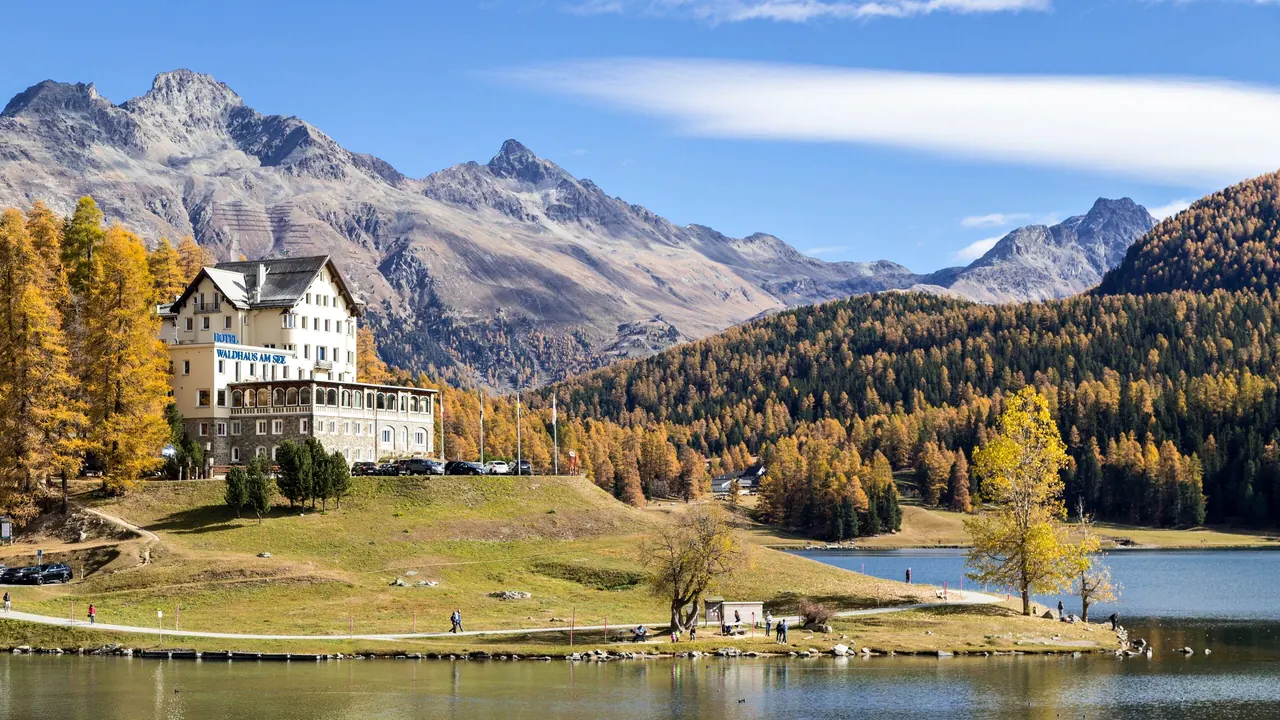
The lake of St. Moritz and a lakeside hotel in autumn
- Nature & outdoors94
- Getting around78
- Wellness & relaxation60
Photo: JoachimKohler-HB, CC BY-SA 4.0, cropped
St. Moritz lies in Swiss Alps, which has its own page.
Match
41
Every category weighted equally
- Beach & sun39
- Culture & arts40
- Food & nightlife38
- Family trip43
- Outdoors48
- Relax & unwind44
- Shopping & style42
- On a budget37
St. Moritz in twelve categories
Our verdict on each, scored 0 to 100 against the same fixed benchmark cities, so a score means the same thing on every page.
Beaches & swimming. Scores 10 out of 100.
Food & drink. Scores 44 out of 100.
Culture & sights. Scores 20 out of 100.
Nightlife. Scores 27 out of 100.
Nature & outdoors. Scores 94 out of 100.
Day trips. Scores 46 out of 100.
Good for families. Scores 48 out of 100.
Getting around. Scores 78 out of 100.
Shopping & style. Scores 42 out of 100.
Affordability. Scores 2 out of 100.
Live music & performing arts. Scores 22 out of 100.
Wellness & relaxation. Scores 60 out of 100.
St. Moritz category by category
Beaches & swimming
10St. Moritz sits at about 1,800m with no sea within a day's reach, so this is not a swimming destination. The lakes of the Upper Engadine are glacier-fed and cold. Lej da Staz, a small forest lake a walk from town, warms the most and has a lawn and a small bathing area, but even in a warm July the water rarely goes above about 20°C and the season lasts a few weeks. Lake St. Moritz itself is for looking at and for windsurfers in wetsuits. Most visitors who want to swim use a hotel pool or the town's indoor pool.
Food & drink
44For a small mountain town, St. Moritz eats unusually well at the top end. Grand hotels and smart mountain restaurants hold a remarkable number of serious kitchens for the size of the place, and during the winter season the fine dining is the main event of an evening. On the slopes, sunny terraces at Corviglia and on the Muottas Muragl and Diavolezza summits serve long lunches.
The local cooking is Engadine and Graubünden fare: capuns wrapped in chard, pizzoccheri from over the Italian border, air-dried beef and the dense Engadine nut tart, best eaten at the old confectioners in the village. Below the luxury tier the choice thins fast, there is nothing like street food or a market, and out of season many kitchens close.
Culture & sights
20St. Moritz is a resort first, and its sights are few and small. The best is the Segantini Museum, a domed building given over to the Alpine paintings of Giovanni Segantini, including his great triptych of life, nature and death. The Engadin Museum shows the region's painted farmhouse interiors, and the leaning tower of a lost medieval church stands above the village.
The rest of the heritage is the story of the resort itself: the birthplace of Alpine winter tourism, twice a Winter Olympic host in 1928 and 1948, with the Cresta Run and the bobsleigh track still in use. An afternoon covers it.
Nightlife
27Going out in St. Moritz is a winter, high-season affair. Between Christmas and early March, the grand hotel bars fill with fur and champagne, après-ski runs on terraces at the foot of the slopes, and a couple of famously exclusive clubs keep late hours for those with the right introduction. It is glamorous rather than wild, and expensive. In summer and in the shoulder seasons the village is quiet by eleven and many places are shut. People who want a real night out are in the wrong place.
Nature & outdoors
94This is the heart of it. St. Moritz sits on the Upper Engadine, a wide high valley strung with lakes beneath peaks over 3,000m, with larch forest on the slopes and an unusually sunny, dry climate. In winter Corviglia, Corvatsch and Diavolezza give big skiing, the frozen lakes host horse racing and polo, and the valley floor holds some of the best cross-country trails in the Alps, used each March by the Engadin ski marathon.
In summer the lifts carry hikers to high trails, among them the walk to the Morteratsch glacier and the routes above the Bernina Pass. Lake Silvaplana's afternoon wind makes it a famous kitesurfing and windsurfing spot, and the Swiss National Park, with ibex and chamois, is under an hour away.
Day trips
46Day trips from St. Moritz are about mountain villages and the railway that links them. The Bernina line, part of a UNESCO-listed railway, climbs over the pass and drops to Poschiavo and Tirano in Italy in around two and a half hours, with the Valtellina vineyards beyond. Closer by, Sils Maria keeps the house where Nietzsche spent his summers, and Zuoz, Guarda and Scuol in the Lower Engadine have sgraffito-decorated houses.
Over the Maloja Pass, the stone village of Soglio and Chiavenna lie within about an hour by car or bus, and the Benedictine convent of Müstair, with its Carolingian frescoes, is a longer drive. The list is charming but small, and the towns are villages.
Good for families
48St. Moritz is safe, clean and easy to manage with children, and the outdoor life suits them: ski schools and gentle nursery slopes on Corviglia, sledging runs, skating on natural ice and, in summer, lakeside walks and lift-served hikes. Its character is adult luxury, though, and there is little made specifically for children beyond the slopes and an indoor pool. Families with younger children often prefer the quieter neighbouring villages of the valley, which are calmer and feel more built around family stays.
Getting around
78St. Moritz needs no car. The Rhaetian Railway arrives at the lakeside station, and the regional buses and trains connect the whole Upper Engadine, from Maloja to Zuoz, along with the ski lifts and funiculars. The village is small but split in two, with the main shopping and hotel area of Dorf on a steep hillside above the lake and Bad on the flat below, so there is some climbing, eased by escalators and a lift up from the station. In winter, pavements can be icy and footwear matters.
Shopping & style
42Shopping here means one thing: luxury. Via Serlas and the streets around it hold an unusual number of top fashion, watch and jewellery boutiques for such a small place, aimed squarely at the winter crowd, along with furriers and high-end ski wear. Beyond that there is little to do: a few shops for Engadine woodwork, linen and nut tart, outdoor gear, and not much else. There are no markets or independent design streets, and some boutiques close outside the season.
Affordability
2St. Moritz is among the most expensive places to stay anywhere. Grand hotels, mountain lunches, lift passes and even a coffee are priced for a wealthy winter clientele, and peak weeks around Christmas and February cost the most. Summer and the edges of the season are noticeably easier, and many hotels include local lifts and public transport in the room, but even then there is no cheap way to do St. Moritz. Visitors on a budget stay in simpler guesthouses elsewhere in the valley and come in for the day.
Live music & performing arts
22St. Moritz has no theatre or concert hall of its own, and most weeks of the year there is little to attend. What it does have are a few seasonal festivals of real quality. A long-running summer jazz festival brings well-known names to intimate rooms, the Engadin Festival puts on chamber and classical concerts in churches and hotel halls across the valley, and winter brings a classical series on the slopes and in hotel ballrooms. Outside those dates, music means a pianist in a hotel bar.
Wellness & relaxation
60St. Moritz was a spa before it was a ski resort. Its iron-rich mineral spring drew visitors for centuries, and St. Moritz Bad still has a medical bath that treats guests with the spring water and peat. The real strength is the hotel spas, which are among the most elaborate in the Alps, with indoor-outdoor pools facing the peaks, and there is a public indoor pool with saunas for everyone else. The Lower Engadine's thermal baths at Scuol are a rail journey away.
The dry, sunny mountain air and quiet summer and autumn weeks make for a restful stay. High winter is more social and showy than calm.
When should you go?
Pick a month to see what it is like. The climate figures are measured averages, not a forecast.
St. Moritz in July
Daytime high, °C
Rainfall in the month, mm
The whole year
Shaded against this destination’s own year: the deepest cell is its best month for that figure and the palest its weakest.
Where the figures come from
St. Moritz has no rain gauge within 25 km of the centre, so its rainfall comes from a gridded climate dataset read at the destination rather than from a gauge further away.
Temperature and rainfall are climate normals, averaged over the years shown. St. Moritz: 2015-2025 (rainfall 1991-2020) normals, Samedan (5.5 km from centre).
Before you go
| Measure | St. Moritz |
|---|---|
| Official language | French, German, Italian, Romansh |
| Currency | Swiss Franc (CHF) |
| Sockets | CJ230 V, 50 Hz |
| Driving side | Right |
| Time zone | UTC+1, UTC+2 in summer |
| Emergency number | 112 |
| Elevation | 1,822 m |
| Main airport | Zürich Airport (ZRH)145 km from centre226 non-stop destinations |
| Public holidays this year | 9 days |
By the numbers
| Measure | St. Moritz |
|---|---|
| Population | 5,027 |
| People per km² | 175 |
| Museums within 10 km | 7 |
| UNESCO World Heritage sites within 50 km | 2 |
Compare St. Moritz with
Every comparison with a written verdict behind it.
- Adelboden
- Alpe d'Huez
- Andermatt
- Arosa
- Aspen
- Avoriaz
- Chamonix
- Châtel
- Courchevel
- Crans-Montana
- Davos
- Engelberg
- Flaine
- Grindelwald
- Gstaad
- Klosters
- La Clusaz
- La Plagne
- La Rosière
- Laax
- Le Grand-Bornand
- Lenzerheide
- Les Arcs
- Les Deux Alpes
- Les Gets
- Les Menuires
- Leukerbad
- Megève
- Méribel
- Montgenèvre
- Morzine
- Mürren
- Saas-Fee
- Saint-Gervais-les-Bains
- Samnaun
- Samoëns
- Serre Chevalier
- Tignes
- Val Cenis
- Val d'Isère
- Val Thorens
- Verbier
- Wengen
- Zermatt