United Kingdom
Cambridge
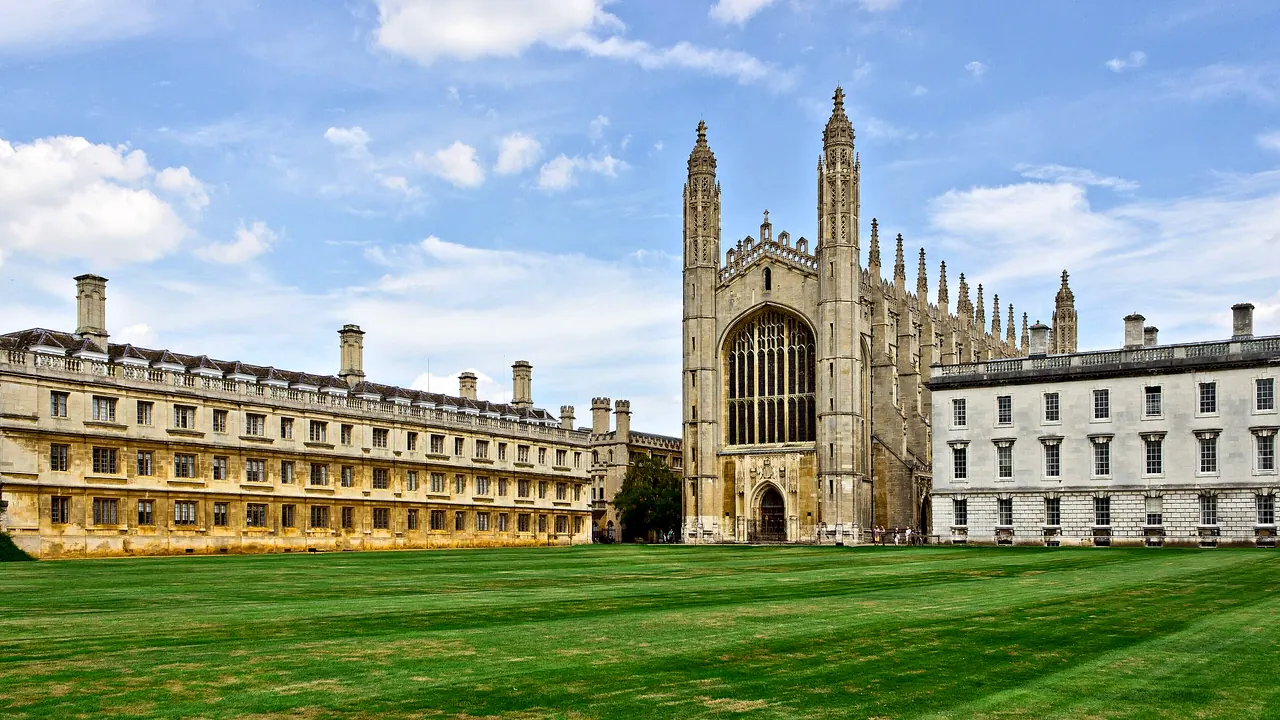
King's College Chapel from King's Back Court
- Day trips78
- Getting around72
- Culture & sights70
Photo: Dmitry Tonkonog, CC BY-SA 3.0, cropped
Match
46
Every category weighted equally
- Beach & sun39
- Culture & arts54
- Food & nightlife47
- Family trip46
- Outdoors47
- Relax & unwind42
- Shopping & style49
- On a budget44
Cambridge in twelve categories
Our verdict on each, scored 0 to 100 against the same fixed benchmark cities, so a score means the same thing on every page.
Beaches & swimming. Scores 8 out of 100.
Food & drink. Scores 40 out of 100.
Culture & sights. Scores 70 out of 100.
Nightlife. Scores 35 out of 100.
Nature & outdoors. Scores 35 out of 100.
Day trips. Scores 78 out of 100.
Good for families. Scores 55 out of 100.
Getting around. Scores 72 out of 100.
Shopping & style. Scores 42 out of 100.
Affordability. Scores 28 out of 100.
Live music & performing arts. Scores 55 out of 100.
Wellness & relaxation. Scores 38 out of 100.
Cambridge category by category
Beaches & swimming
8Cambridge is an inland city on the flat fen edge, and there is no beach within easy reach. The nearest coast, the Suffolk shingle towns and the sandy Norfolk shore, is roughly an hour and a half away by car, on a North Sea that rarely gets much above 17°C.
Swimming here means fresh water. Jesus Green Lido, a long outdoor pool from the 1920s, fills up on warm summer days, and a loyal crowd swims in the Cam upstream at Grantchester Meadows. That is pleasant on a hot afternoon, but nobody should come for a beach vacation.
Food & drink
40Eating in Cambridge is comfortable rather than memorable. The strongest local thread is the English pub, and the city has plenty of old ones, low-beamed rooms along the river and in the lanes around the colleges, serving ales and Sunday roasts. The open-air market on Market Hill runs every day with street-food stalls alongside fruit and vegetables, and there are traditional tea rooms for scones by the river.
Beyond that, there is a small fine-dining tier near the river commons, a decent spread of Asian and Mediterranean places along Mill Road, and many chain restaurants in the centre. There is no regional cuisine to seek out, and a few days is enough to cover it.
Culture & sights
70The heart of Cambridge is its colleges, a run of courts, chapels and libraries built over eight centuries along the Backs and the streets beside them. King's College Chapel, with its fan vaulting and great windows, is one of the finest late Gothic buildings in Europe, and Trinity's Great Court, the Wren Library, St John's and the tiny Round Church fill out a remarkably dense historic core. Several colleges charge for entry and close around exams.
The university museums are the other strength. The Fitzwilliam holds a collection of art and antiquities far grander than the city's size suggests, and Kettle's Yard, the Polar Museum, the archaeology and anthropology museum and the Whipple's scientific instruments reward a slower visit. Two or three days covers it well.
Nightlife
35Going out in Cambridge mostly means the pub. Historic inns in the centre, riverside pubs with gardens and a cluster of livelier bars around Regent Street and Mill Road make for good evenings, especially in summer when drinkers spill onto the green spaces by the river.
The club scene is small and aimed at students, and it rises and falls with the university terms: lively in autumn and spring, noticeably quieter in the long summer break and at Christmas. Anyone wanting a big night out takes the train to London.
Nature & outdoors
35The landscape around Cambridge is flat and open, the edge of the Fens, with wide skies and very little relief. What it offers is gentle: punting on the Cam through the Backs, a walk or cycle along the towpath to Grantchester across water meadows grazed by cattle, and big commons like Midsummer Common and Jesus Green in the middle of town.
Further out, Wicken Fen is one of the oldest nature reserves in Britain, good for birds, dragonflies and wild ponies, and the chalk hills at Wandlebury give a short woodland walk. Level cycle routes run in most directions. There are no hills worth the name and no dramatic scenery within reach.
Day trips
78Cambridge is a good base for trips out. London is under an hour by train, close enough for a museum or a show and back the same evening. Ely, about fifteen minutes away by train, has one of England's great cathedrals rising above the fens, and Audley End's Jacobean house sits just outside the market town of Saffron Walden.
In Suffolk, Bury St Edmunds has its abbey ruins and Georgian streets, and the timber-framed wool towns of Lavenham and Long Melford are an easy drive. Norwich, with its cathedral, castle and medieval lanes, is about an hour and a quarter by train. Peterborough Cathedral and Newmarket, the home of horse racing, are closer still. Anglesey Abbey and Wimpole are big National Trust estates on the doorstep.
Good for families
55Cambridge is an easy city with children: small, flat, safe and green, with commons and playgrounds close to the centre. Punting on the river is a hit with most ages, and the free Museum of Zoology, with a whale skeleton hanging over the entrance, and the dinosaurs at the Sedgwick Museum work well for curious children.
The best family outing is just south of the city at Duxford, the Imperial War Museum's huge airfield of historic aircraft. Wimpole's working farm and small wildlife parks in the villages add more. The college sights themselves are hushed and grown-up, and there is no theme park or large zoo, so a few days is about right.
Getting around
72Almost everything a visitor wants in Cambridge lies within a short walk: the colleges, the market, the museums and the river are packed into a flat, largely pedestrian centre. Bicycles are the local way to move, and hiring one is the easiest way to reach Grantchester or the further colleges.
The railway station sits on the south-east edge of town, a walk of about twenty-five minutes or a short bus ride to the centre. Buses cover the city and park-and-ride sites but are nothing special, and attractions out in the countryside, such as the big country estates, are easier with a car. Cars themselves are a poor choice in the centre, where traffic and parking are restricted.
Shopping & style
42Shopping in Cambridge is a pleasant mix on a small scale. The everyday market on Market Hill sells food, books and crafts, and on Sundays local makers join in. Around it, the Grand Arcade and Lion Yard hold the familiar high-street names, while Green Street, Trinity Street and King's Parade have small independent clothes shops, old bookshops and university gift shops.
Books are the real speciality, from long-established academic booksellers to second-hand dealers in the lanes. Mill Road adds international grocers and vintage shops. There is no luxury street and no local craft tradition to hunt for, so shopping fits round sightseeing rather than shaping a trip.
Affordability
28Cambridge is an expensive place to stay. Hotel stock in and near the centre is limited and in steady demand from university visitors, conferences and day-trippers who decide to stay, so rooms cost a lot, especially in summer and around graduations. Eating and drinking out is priced like the wealthy south-east of England.
There are compensations. The Fitzwilliam and most of the university museums are free, the centre needs no transport, and evensong in the college chapels costs nothing. Entry to the most famous colleges is charged, though. Staying out of term in a college room, where offered, can be the best-value option.
Live music & performing arts
55The distinctive thing to hear in Cambridge is choral music. The choirs of King's College, St John's and Trinity are among the best known in the world, and choral evensong in their chapels is open to anyone during term, a sung service in a candlelit Gothic or Renaissance interior. Organ recitals and chapel concerts add to it.
The Arts Theatre, founded by Keynes in 1936, takes touring drama, and the student ADC Theatre and the Footlights tradition give a steady programme of student plays and comedy. The Corn Exchange hosts touring bands and orchestras, and the Cambridge Folk Festival, running since the 1960s, is a fixture of the summer. There is no opera house or resident orchestra of international standing.
Wellness & relaxation
38Cambridge has no spa or bathing culture of its own. Wellness here means a hotel spa, a day spa or a swim at the open-air lido. What it does offer is a quieter kind of rest: an afternoon on the river in a punt, a bench in a college garden or the Botanic Garden, a long walk across the meadows to Grantchester for tea in an orchard.
The centre itself is not always calm. In summer the narrow streets around King's Parade fill with tour groups and day visitors. Early mornings, evenings and the edges of town are where the slow pace is.
When should you go?
Pick a month to see what it is like. The climate figures are measured averages, not a forecast.
Cambridge in July
Daytime high, °C
Rainfall in the month, mm
The whole year
Shaded against this city’s own year: the deepest cell is its best month for that figure and the palest its weakest.
Where the figures come from
Cambridge's temperatures are measured 59 km from the centre, at Wattisham.
Cambridge has no rain gauge within 25 km of the centre, so its rainfall comes from a gridded climate dataset read at the city rather than from a gauge further away.
Temperature and rainfall are climate normals, averaged over the years shown. Cambridge: 1991-2020 normals, Wattisham (58.5 km from centre).
Before you go
| Measure | Cambridge |
|---|---|
| Official language | English |
| Currency | Pound Sterling (GBP) |
| Sockets | G230 V, 50 Hz |
| Driving side | Left |
| Time zone | UTC, UTC+1 in summer |
| Emergency number | 112 or 999 |
| Elevation | 6 m |
| Main airport | London Stansted Airport (STN)37 km from centre197 non-stop destinations |
| Public holidays this year | 8 days |
By the numbers
| Measure | Cambridge |
|---|---|
| City population | 123,867 |
| People per km² | 3,043 |
| Museums within 10 km | 17 |
| UNESCO World Heritage sites within 50 km | 0 |
Compare Cambridge with
Every comparison with a written verdict behind it.
- Aberdeen
- Amsterdam
- Antwerp
- Bath
- Belfast
- Brighton
- Bristol
- Bruges
- Brussels
- Cardiff
- Cologne
- Dublin
- Dusseldorf
- Edinburgh
- Ghent
- Glasgow
- Haarlem
- Inverness
- Lille
- Liverpool
- London
- Maastricht
- Manchester
- Oxford
- Paris
- Rotterdam
- St Andrews
- The Hague
- Utrecht
- York