France
Bordeaux
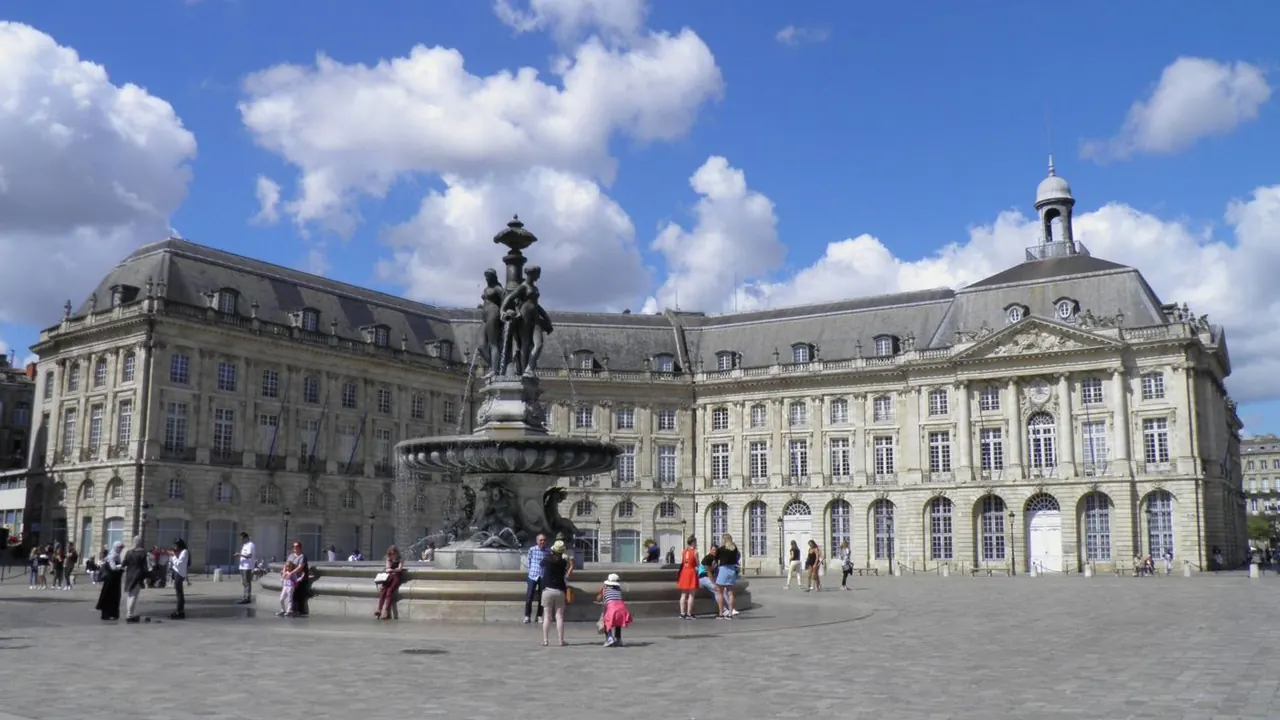
The Three Graces fountain, Place de la Bourse
- Food & drink78
- Day trips78
- Getting around76
Photo: Gzen92, CC BY-SA 4.0, cropped
Match
59
Every category weighted equally
- Beach & sun57
- Culture & arts63
- Food & nightlife61
- Family trip59
- Outdoors61
- Relax & unwind57
- Shopping & style61
- On a budget57
Bordeaux in twelve categories
Our verdict on each, scored 0 to 100 against the same fixed benchmark cities, so a score means the same thing on every page.
Beaches & swimming. Scores 50 out of 100.
Food & drink. Scores 78 out of 100.
Culture & sights. Scores 68 out of 100.
Nightlife. Scores 50 out of 100.
Nature & outdoors. Scores 58 out of 100.
Day trips. Scores 78 out of 100.
Good for families. Scores 57 out of 100.
Getting around. Scores 76 out of 100.
Shopping & style. Scores 56 out of 100.
Affordability. Scores 42 out of 100.
Live music & performing arts. Scores 55 out of 100.
Wellness & relaxation. Scores 40 out of 100.
Bordeaux category by category
Beaches & swimming
50Bordeaux sits on a river, not the sea, so beach days start with a train or a drive. The Atlantic coast is about an hour west: long, empty sand beaches backed by pine forest and dunes at Lacanau and along the Médoc, with strong surf, rip currents and lifeguarded zones you should stay inside. The sea peaks at about 20-21°C in August.
For calmer water, take the train to Arcachon, about an hour. The sheltered basin warms to around 22°C in summer and suits small children, and the beaches at Cap Ferret and below the Dune du Pilat are close by. These make a good day out in July and August. Outside high summer, the coast is for walking, not swimming.
Food & drink
78Wine comes first in Bordeaux. Bars by the glass, wine shops and restaurant lists draw on the surrounding appellations, and you can taste Médoc, Graves, Saint-Émilion and sweet Sauternes in the same week. The Cité du Vin by the river covers wine from every angle. The cooking is south-western and generous: entrecôte à la bordelaise cooked over vine cuttings, lamprey in red wine, duck from the Landes, and oysters from the Arcachon basin, eaten raw with a glass of white.
On weekend mornings, locals stand at the oyster counters of the Marché des Capucins. Canelés, small caramelised custard cakes, are sold in every bakery. Classic brasseries and serious modern bistros cluster around Saint-Pierre, Chartrons and Saint-Michel. The range beyond French cooking is modest.
Culture & sights
68Bordeaux's main sight is the city itself. Its 18th-century centre of pale limestone, called the Port of the Moon for the curve of the Garonne, is a UNESCO site and one of the most complete classical cityscapes in France. The Place de la Bourse and the shallow Miroir d'eau in front of it, the colonnaded Grand Théâtre, and long streets of façades with carved masks reward slow walking. Gothic landmarks punctuate them: the Cathédrale Saint-André, the Basilique Saint-Michel with its tall separate bell tower, and the medieval Grosse Cloche gate.
The museums are solid rather than famous. The Musée d'Aquitaine covers regional history and the city's slave-trading past, the Musée des Beaux-Arts holds European painting, and the CAPC shows contemporary art in a vast former colonial warehouse. Three or four days covers it well.
Nightlife
50Going out in Bordeaux mostly means wine bars and café terraces. The squares of Saint-Pierre and the old centre fill on warm evenings, and Place de la Victoire is the loud, cheap student end of town. Chartrons and the Bassins à flot docks draw an older crowd for the evening.
The clubs are mostly in one place: the Quai de Paludate, a strip of former warehouses on the left bank near the Gare Saint-Jean, where the night starts late and runs until morning. A few bars on boats moored along the Garonne add to it. The city is at its liveliest on weekends in term time, when the students are around. A good night here is a long dinner and then bars, with dancing for those who seek it out.
Nature & outdoors
58The country around Bordeaux is flat and gentle: vineyards, river meadows and, to the west and south, the huge pine forest of the Landes. The best of it lies about an hour away on the coast. The Dune du Pilat, the tallest sand dune in Europe, rises over the Arcachon basin, where tidal flats, oyster beds and the Île aux Oiseaux draw birdwatchers and kayakers. Further north, Lacanau and the Médoc shore are a serious surfing coast.
Cycling is the easiest outdoor pleasure. Long flat greenways run from the city through the vineyards of Entre-Deux-Mers and out to the ocean. There is no real hiking terrain nearby: the Pyrenees are a long journey south.
Day trips
78Day trips are one of the strongest reasons to base yourself in Bordeaux. Saint-Émilion, a medieval hill town of honey-coloured stone with an underground monolithic church, is a UNESCO site about forty minutes away by train and surrounded by famous vineyards. The château country of the Médoc runs north along the estuary, with Margaux and Pauillac about an hour away, and the sweet-wine villages of Sauternes and the Graves lie to the south. Many estates take visitors for tastings, which is easiest with a car or a tour.
Arcachon, with its seaside villas and oyster ports, is about an hour by train. Vauban's citadel at Blaye sits across the estuary. Cognac and its brandy houses are within about two hours, as are Biarritz and the Basque coast at the edge of a day.
Good for families
57Bordeaux is easy with children rather than built for them. The centre is flat, largely car-free and served by trams, so pushchairs manage well. On hot days the Miroir d'eau on the quays turns into a giant paddling pool. The Jardin Public has a pond, a carousel and a puppet theatre, and Cap Sciences on the river runs hands-on science exhibitions.
The best family days are outside the city: climbing the Dune du Pilat, the calm beaches of the Arcachon basin, or a small zoo on the edge of town. Since the city's main pleasures are wine and long meals, older children may find a long stay slow.
Getting around
76Central Bordeaux is a pleasure to cross on foot. It is flat, and many streets are pedestrianised, including the long Rue Sainte-Catherine. Most sights line up along a few kilometres of the left bank, from the Chartrons district to Saint-Michel. The tram network fills in the gaps: its lines are easy to follow and reach the Cité du Vin, the right bank and the main station. With wide riverside paths and plenty of bike lanes, cycling feels natural.
You do not need a car in the city. Trains run to Saint-Émilion and Arcachon, but for vineyard visits in the Médoc or Sauternes you need a car, a driver or a tour.
Shopping & style
56Rue Sainte-Catherine, a pedestrian street more than a kilometre long, carries the high-street chains and a big department store. Luxury labels gather a few streets away in the Triangle d'Or around Cours de l'Intendance. Rue Notre-Dame in Chartrons is lined with antique dealers and small independent boutiques, and the quays host a Sunday market.
Wine is the speciality that makes shopping here worthwhile. Cellars sell everything from everyday Bordeaux to rare old vintages and will ship abroad. Canelés and Arcachon oysters are the other local things to take home. Beyond that, the range is what you would expect of a large French regional city.
Affordability
42Bordeaux costs what a prosperous French city costs: cheaper than the capital, but not a budget destination. Hotel rooms in the centre are mid-to-high priced, and they climb further in summer and during big wine events. Set lunch menus are the best-value way to eat well. Trams are inexpensive, and the city itself is free to walk and admire. Château tastings, guided wine tours and a good bottle at dinner are where the money goes.
Live music & performing arts
55Bordeaux's big night out is the Grand Théâtre. It is a colonnaded opera house from 1780 with a gilded auditorium, and the city's opera and ballet companies perform there through the season. The national orchestra of Bordeaux Aquitaine plays in a modern auditorium nearby. Plays run in several theatres, mostly in French.
For music, a dedicated hall on the right bank programmes jazz and world music, a large arena takes touring acts, and small bars host local bands. It is a respectable regional scene with one outstanding stage, and quiet in high summer, when the seasons pause.
Wellness & relaxation
40Bordeaux has no thermal baths or bathing culture of its own. The local speciality is vinotherapy: treatments using grape seeds and vine extracts, offered at a few spa hotels set among the vineyards just outside the city, which make a calm retreat for a day or two. In town, wellness means hotel spas and the slow rhythm of the place, with long lunches, evening walks along the quays and shaded benches in the Jardin Public. For real thermal waters, Dax in the Landes is about an hour and a half south.
When should you go?
Pick a month to see what it is like. The climate figures are measured averages, not a forecast.
Bordeaux in July
Daytime high, °C
Rainfall in the month, mm
The whole year
Shaded against this city’s own year: the deepest cell is its best month for that figure and the palest its weakest.
Temperature and rainfall are climate normals, averaged over the years shown. Bordeaux: 1991-2020 normals, Bordeaux / Merignac (9.5 km from centre).
Before you go
| Measure | Bordeaux |
|---|---|
| Official language | French |
| Currency | Euro (EUR) |
| Sockets | CE230 V, 50 Hz |
| Driving side | Right |
| Time zone | UTC+1, UTC+2 in summer |
| Emergency number | 112 |
| Elevation | 1 m |
| Main airport | Bordeaux–Mérignac Airport (BOD)11 km from centre95 non-stop destinations |
| Public holidays this year | 11 days |
By the numbers
| Measure | Bordeaux |
|---|---|
| City population | 267,991 |
| People per km² | 5,425 |
| Museums within 10 km | 18 |
| UNESCO World Heritage sites within 50 km | 4 |
Compare Bordeaux with
Every comparison with a written verdict behind it.