Japan
Osaka
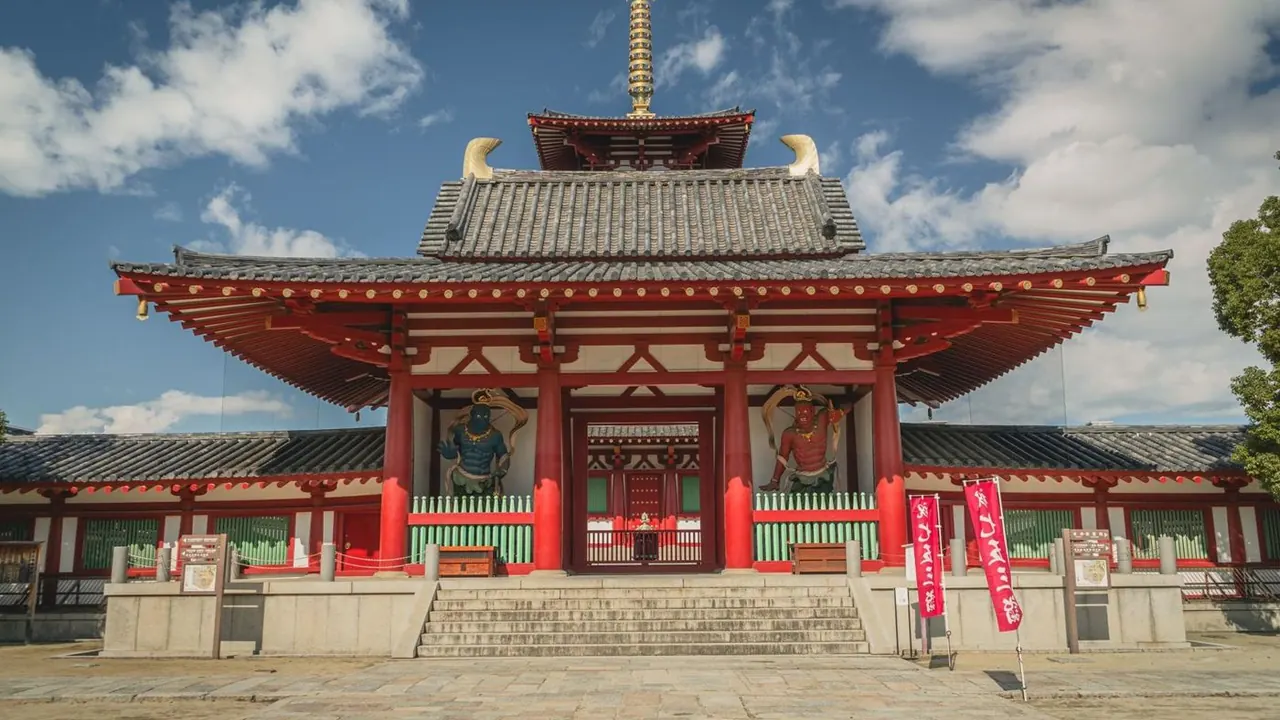
Shitennō-ji temple
- Day trips97
- Food & drink91
- Getting around90
Photo: Sarmat Batagov, Pexels License
Match
73
Every category weighted equally
- Beach & sun68
- Culture & arts76
- Food & nightlife76
- Family trip72
- Outdoors72
- Relax & unwind69
- Shopping & style77
- On a budget71
Osaka in twelve categories
Our verdict on each, scored 0 to 100 against the same fixed benchmark cities, so a score means the same thing on every page.
Beaches & swimming. Scores 34 out of 100.
Food & drink. Scores 91 out of 100.
Culture & sights. Scores 63 out of 100.
Nightlife. Scores 80 out of 100.
Nature & outdoors. Scores 58 out of 100.
Day trips. Scores 97 out of 100.
Good for families. Scores 88 out of 100.
Getting around. Scores 90 out of 100.
Shopping & style. Scores 80 out of 100.
Affordability. Scores 60 out of 100.
Live music & performing arts. Scores 66 out of 100.
Wellness & relaxation. Scores 66 out of 100.
Osaka category by category
Beaches & swimming
34Osaka is a port city on an enclosed, heavily built-up bay, and it does not do beach vacations. A few bathing beaches open for the high summer: Suma on the Kobe side and Nishikinohama or Tannowa down the coast towards Wakayama, each roughly an hour by train. In August the water reaches about 26°C, warm enough for a comfortable swim, but the sand is coarse, the setting is suburban, and the official season covers little more than July and August.
Locals treat these beaches as a summer outing with friends rather than a reason to travel. Visitors who want clear water and white sand go much further south to the Kii Peninsula or fly to Okinawa.
Food & drink
91Osaka has long called itself the nation's kitchen, and eating here is the main event. Its own dishes are cheap, filling and made for standing or sitting at a counter: takoyaki turned on griddles at street stalls, okonomiyaki cooked at the table, kushikatsu skewers dipped once in a shared pot of sauce, and kitsune udon in a light, kombu-rich broth. Dotonbori and Namba are the noisy centre of it, Kuromon Market sells seafood and grilled scallops to snack on, and the alleys of Ura-Namba and Tenma are full of tiny izakaya where neighbours eat elbow to elbow.
The range runs far beyond comfort food. The basement food halls of the Umeda department stores are tempting, and Kitashinchi is a quiet district of refined kaiseki, sushi and kappo counters at the very top level. Sake from the nearby Nada breweries, highballs and craft beer go with everything, and the rule of the city is simple: good value and plenty of it, wherever you sit.
Culture & sights
63Osaka is a merchant city rebuilt after wartime bombing, and its heritage comes in separate pieces rather than as a historic townscape. Osaka Castle, a reconstruction standing on its original massive stone walls and moats, is the landmark. Shitennoji claims to be one of the oldest Buddhist temples in Japan, and Sumiyoshi Taisha, with its arched red bridge and an ancient shrine style, is among the most important shrines in the region.
The museums are better than most visitors expect: the Museum of Oriental Ceramics holds a fine Korean and Chinese collection, and the Nakanoshima riverside gathers several art museums together. Elsewhere it is the modern city that is worth seeing, the neon of Dotonbori, the old Shinsekai district under Tsutenkaku tower and the towers of Umeda. Two or three days cover the sights, and serious temple-going happens in neighbouring cities.
Nightlife
80Osaka is loud, friendly and sociable after dark, and it has a reputation across Japan for exactly that. Minami is the heart of it: the neon of Dotonbori and Namba, the standing bars and izakaya alleys of Ura-Namba, and Amerikamura with its young crowd, small clubs and DJ bars. In the north, the lanes around Umeda and Ohatsutenjin are full of tiny bars, while Kitashinchi is the city's expensive hostess and whisky bar district, quieter and more formal.
Strangers talk to each other at the counter more readily than elsewhere in Japan, and that easy humour sets the tone. Trains stop around midnight, so many people simply stay out until the first train in the morning. Clubbing is good rather than legendary, but for bar-hopping and late food it is hard to beat.
Nature & outdoors
58The city itself is flat, dense concrete, with Osaka Castle Park and the riverbanks as its main green space. Within an hour by train, though, the landscape changes. Minoo Park has a forest trail beside a stream that climbs to a waterfall, with spectacular maples in autumn. The Rokko mountains behind Kobe offer ridge hikes with views over the bay, and Mount Ikoma and the Kongo range to the east give easy wooded walks.
Cherry blossom in spring and red leaves in late autumn are the best seasons; summer is hot and humid and makes hiking hard work. There is no high mountain country or wild coast within easy reach, so this suits walkers and day hikers rather than people planning an outdoor vacation.
Day trips
97Few cities make a better base for days out. Kyoto, with its temples, gardens and old streets, is under half an hour by train. Nara, with its great bronze Buddha at Todaiji and deer roaming the park, takes about forty minutes. Himeji Castle, the finest surviving original castle in Japan, is about half an hour on the bullet train or about an hour on the JR rapid service, and Kobe, with its harbour, Kitano's old foreign merchants' houses and the sake breweries of Nada, is closer still.
Further out, the temple mountain of Koyasan takes about two hours and offers overnight stays in monasteries, while Uji has tea houses and the Byodoin temple. Wakayama Castle, the old post town of Omi-Hachiman and the lakeside towns of Lake Biwa round out a list that could easily fill two weeks. Trains are frequent, simple to use and quick, so almost every trip is easy to plan.
Good for families
88Osaka works very well with children. Universal Studios Japan, a full theme-park resort, sits on the bay a short train ride from the centre. Kaiyukan, one of the largest aquariums anywhere, is built around a huge central tank with whale sharks, and the Tempozan area beside it has a big Ferris wheel. Tennoji Zoo, the Kids Plaza play museum, the science museum and the large Expo '70 Commemorative Park with its giant Tower of the Sun add plenty more.
The city is safe, clean and welcoming to families, with lifts and baby rooms in stations and department stores. The hardest parts are the crowds at weekends and the humid summer heat; spring and autumn are the easiest seasons for a family visit.
Getting around
90Osaka is easy to get around without a car. The Midosuji subway line runs north to south through the city, linking Umeda, Shinsaibashi, Namba and Tennoji, and the JR loop line and other subway lines fill in the rest. Trains are clean, punctual and frequent, signs are in English, and one rechargeable IC card works on all of them as well as on lines to Kyoto, Nara and Kobe.
The main difficulty is the stations themselves. Umeda in particular is a vast underground maze where different railway companies share a few city blocks, and changing between lines can take ten minutes of walking. The central districts are walkable, and many visitors also rent bicycles, which locals use everywhere on the flat streets.
Shopping & style
80Shopping in Osaka is about size and practicality. Shinsaibashi-suji is a long covered arcade of fashion, cosmetics and drugstores running down towards Namba, and the department stores around Umeda, some dating back generations, have large food halls and luxury floors. Midosuji Avenue holds the international flagships, and Amerikamura has vintage clothing and streetwear shops.
Den Den Town is the city's electronics, anime and games district, and Tenjinbashisuji, which claims to be Japan's longest shopping street, is a local arcade of small family shops and snacks. Traditional crafts are thinner than elsewhere in the region, and kitchen knives and tools along Sennichimae Doguyasuji are the most memorable local purchase.
Affordability
60Osaka is a fair-priced city for a visitor, and eating is where it is most generous. Takoyaki, noodle bowls, set lunches and convenience-store meals are cheap, and the izakaya are reasonable even in the busiest districts. Local transport costs little, and most temples, parks and shrines are free or inexpensive.
The bigger costs are rooms, especially in cherry-blossom and autumn-leaf season and at weekends, and the big tickets such as Universal Studios Japan. Business hotels keep a comfortable, compact room within reach, and staying slightly outside Namba or Umeda makes a clear difference.
Live music & performing arts
66Osaka is the home of bunraku, the classical puppet theatre in which three puppeteers work each large figure on stage, and the National Bunraku Theatre in Nippombashi stages full seasons with English guides. Kabuki comes to the city in seasonal runs at several halls rather than at a home stage of its own, so it takes some planning to catch. Festival Hall and Symphony Hall host the city's orchestras and touring performers.
The city is also the capital of Japanese stand-up comedy, with manzai double acts in the theatres of Namba, although these are entirely in Japanese. Small live houses for rock and jazz are spread around Minami and Umeda, and the all-female Takarazuka Revue, with its lavish musical shows, has its home theatre about forty minutes away by train.
Wellness & relaxation
66Japanese bathing culture is part of everyday life in Osaka. Small neighbourhood sento bathhouses are still scattered through the older districts, and large super sento complexes offer several hot pools, saunas and open-air baths for a long, cheap evening of soaking. For a true hot-spring experience, Arima Onsen, one of the oldest spa towns in Japan, lies about an hour away in the hills behind Kobe, with iron-red and clear springs and traditional inns.
The city itself is fast, noisy and sociable, and few people come to slow down. The calmest moments are quiet: early mornings at Sumiyoshi Taisha, a walk along the Nakanoshima rivers, or an evening in the bath before bed.
When should you go?
Pick a month to see what it is like. The climate figures are measured averages, not a forecast.
Osaka in July
Daytime high, °C
Rainfall in the month, mm
The whole year
Shaded against this city’s own year: the deepest cell is its best month for that figure and the palest its weakest.
Temperature and rainfall are climate normals, averaged over the years shown. Osaka: 1991-2020 normals, Osaka (1.8 km from centre).
Before you go
| Measure | Osaka |
|---|---|
| Official language | Japanese |
| Currency | Yen (JPY) |
| Sockets | AB100 V, 50 and 60 Hz depending on the region |
| Driving side | Left |
| Time zone | UTC+9 |
| Emergency number | Police 110, fire 119 |
| Elevation | 20 m |
| Main airport | Kansai International Airport (KIX)38 km from centre62 non-stop destinations |
| Public holidays this year | 16 days |
By the numbers
| Measure | Osaka |
|---|---|
| City population | 2,751,862 |
| People per km² | 12,340 |
| Museums within 10 km | 44 |
| UNESCO World Heritage sites within 50 km | 6 |
| Swim season, months above 21 °C | 5 months |
Compare Osaka with
Every comparison with a written verdict behind it.