Morocco
Marrakech
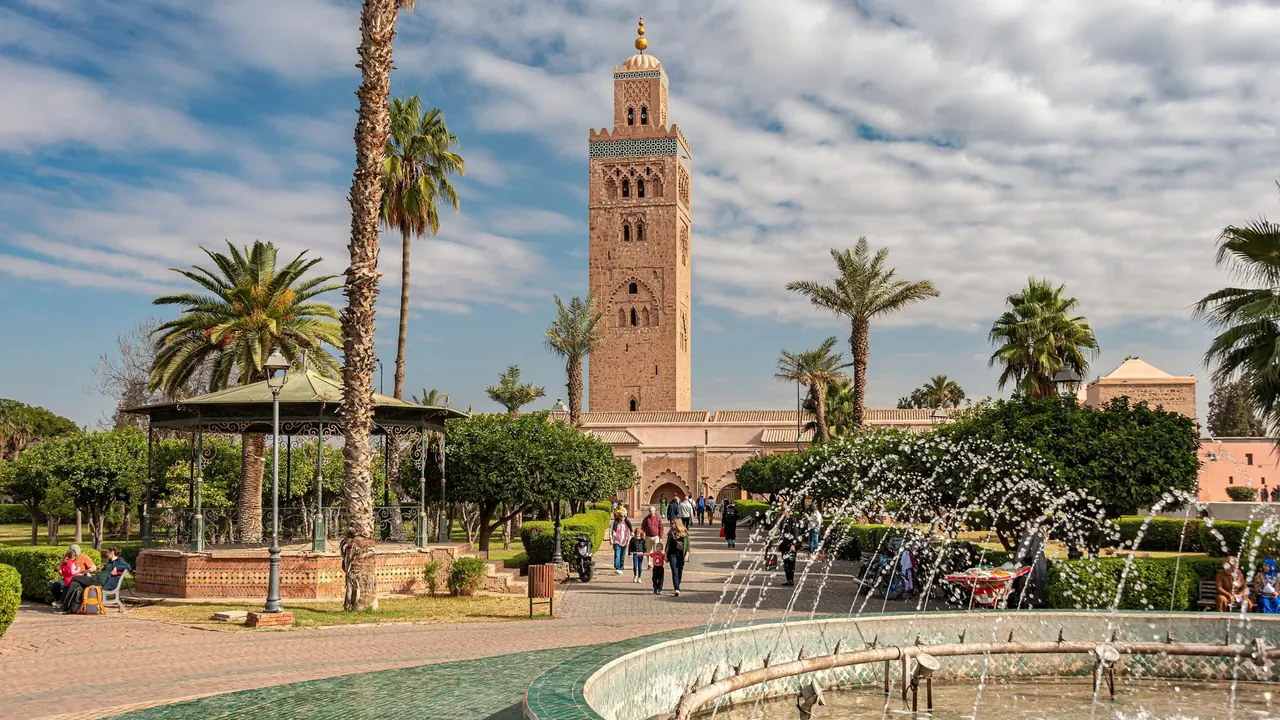
The Koutoubia Mosque from its gardens
- Culture & sights76
- Wellness & relaxation75
- Shopping72
Photo: Jorge Franganillo, CC BY 2.0, cropped
Match
49
Every category weighted equally
- Beach & sun47
- Culture & arts51
- Food & nightlife49
- Family trip46
- Outdoors49
- Relax & unwind52
- Shopping & style53
- On a budget51
Marrakech in twelve categories
Our verdict on each, scored 0 to 100 against the same fixed benchmark cities, so a score means the same thing on every page.
Beaches & swimming. Scores 7 out of 100.
Food & drink. Scores 64 out of 100.
Culture & sights. Scores 76 out of 100.
Nightlife. Scores 33 out of 100.
Nature & outdoors. Scores 70 out of 100.
Day trips. Scores 28 out of 100.
Good for families. Scores 25 out of 100.
Getting around. Scores 38 out of 100.
Shopping & style. Scores 72 out of 100.
Affordability. Scores 72 out of 100.
Live music & performing arts. Scores 25 out of 100.
Wellness & relaxation. Scores 75 out of 100.
Marrakech category by category
Beaches & swimming
7Marrakech is an inland city on a dry plain, and the sea is not part of a stay here. The nearest real beach is on the Atlantic at Essaouira, a long drive of around two and a half to three hours, where the water is cool and the wind is strong. Swimming in Marrakech means the plunge pool of a riad or a hotel pool, and in the heat of summer those pools matter a great deal. The Lalla Takerkoust reservoir in the Atlas foothills, about 40km away, offers a lakeside afternoon, but it is a change of scene rather than a beach.
Food & drink
64Moroccan cooking is the reason to eat here: slow tagines with preserved lemon or prunes, couscous on Fridays, pastilla, harira soup, and tanjia, the Marrakchi speciality of meat cooked for hours in a clay urn buried in the embers of a hammam furnace. At dusk the square of Jemaa el-Fna fills with grill stalls, snail sellers and bowls of spiced soup, and the medina's lanes have mechoui counters where lamb is pulled from underground ovens. Mint tea, poured from a height, punctuates every day.
The limits show after a few days. Many riad and medina menus repeat the same handful of dishes, international choice sits mostly in Gueliz and Hivernage, and alcohol is served only in licensed restaurants and hotels. The best meals tend to come from home-style cooking in riads and small local places rather than from a deep restaurant scene.
Culture & sights
76The walled medina, a UNESCO World Heritage site, is the main sight in itself: a dense maze of red earth walls, carved cedar doorways, fountains and mosques that has kept its medieval street pattern. The Koutoubia minaret, a model for later Almohad towers, rises over it, and the great square of Jemaa el-Fna is listed by UNESCO for its storytellers and performers. Within walking distance are the tilework and stucco of the Ben Youssef Madrasa, the Saadian Tombs, the ruined grandeur of El Badi Palace and the painted courtyards of the Bahia Palace.
Beyond the walls, the Jardin Majorelle with its cobalt-blue villa and the Yves Saint Laurent museum beside it show the city's twentieth-century side, and the Menara and Agdal gardens date back to the Almohad era. Museums are small, and most visitors see the main sights in two or three days.
Nightlife
33Evenings in the medina centre on Jemaa el-Fna and on long dinners, not on bars. Alcohol is served only in licensed hotels, restaurants and a few rooftop terraces, so there is no street drinking or casual pub culture. Those who want to go out head to Hivernage and Gueliz in the new town, where lounge bars, hotel bars and a handful of large clubs with DJs and dinner shows stay open late, often at resort-style prices. It suits a cocktail at sunset over the rooftops more than a long night out.
Nature & outdoors
70The snow-capped wall of the High Atlas is visible from the city on clear days, and it is the great outdoor draw. Within about an hour and a half are the Ourika valley with its riverside villages and waterfalls at Setti Fatma, and Imlil, the trailhead for walks between Berber villages and for the two-day climb of Jebel Toubkal, at 4,167m the highest peak in North Africa. Oukaimeden has winter skiing, and spring brings almond blossom and green terraces.
Closer still, the stony Agafay desert offers camel rides, quad biking and nights under clear skies, and hot-air balloons lift off at dawn over the plain. The Ouzoud waterfalls make a longer outing. In the city itself the landscape is flat and hot, softened by palm groves and historic gardens, and summer heat limits activity to early mornings.
Day trips
28Marrakech is a weak base for visiting other towns. Most excursions from the city go into the mountains and the desert, and the places that really draw visitors lie beyond an easy day out. The favourite is Essaouira, a whitewashed, walled Atlantic port with a UNESCO-listed medina, a working fishing harbour and thuya-wood workshops. It is about two and a half hours away by road, so it makes a long day and is better with a night there. Ait Benhaddou and the kasbahs around Ouarzazate lie over the Tizi n'Tichka pass and need an overnight stay.
Closer to the city, the choice is small. The weekly souks in the foothill villages, such as Asni and Amizmiz, show rural Berber trade. Up the Nfis valley, the twelfth-century Almohad mosque at Tinmel is a rare monument out in the countryside. Fes and Rabat are trips of their own, not outings.
Good for families
25Marrakech is hard work with children. The medina's narrow lanes are crowded and shared with motorbikes and donkey carts, sellers are persistent, and summer heat makes midday sightseeing exhausting. There is little built for children: a water park on the edge of the city, camel rides in the palm grove and the snake charmers and acrobats of Jemaa el-Fna, which some children love and others find unsettling.
What makes it manageable is accommodation. A riad with a plunge pool or a resort hotel with gardens gives families a calm base, and Moroccans are warm towards children. Older children who enjoy markets and a sense of adventure do best, ideally in spring or autumn.
Getting around
38The medina is compact enough to walk, and walking is the only way into most of it, but it is a maze of unnamed alleys where getting lost is part of the experience and unofficial guides offer directions for a tip. Motorbikes and carts squeeze through the same lanes, and pavements outside the walls are patchy. Between the medina, Gueliz and the Majorelle garden, visitors rely on small beige petit taxis, where agreeing a fare first is often needed, or on a city bus network that is cheap but not easy for newcomers. There is no metro or tram, and trips to the mountains or desert mean a driver or a tour.
Shopping & style
72Shopping is one of the main reasons people come. The souks north of Jemaa el-Fna are organised by trade, with lanes of leatherworkers, dyers, metalworkers, carpet sellers and babouche makers, and the Mellah has its spice stalls. Carpets, lanterns, tadelakt pottery, argan oil, Berber jewellery and woven baskets are the classic finds, and bargaining is expected, often at length and with tea.
For quieter shopping, Gueliz and the edges of the medina have concept stores and design boutiques reworking Moroccan crafts, and the Sidi Ghanem industrial quarter has showrooms where designers and decorators buy. Luxury fashion and department stores are almost absent, and the pressure of the souk sellers tires some visitors.
Affordability
72Day-to-day costs are low by European standards. Food at the Jemaa el-Fna stalls and local canteens, petit taxis, mint tea and entry to the palaces and madrasas are all cheap, and simple riads in the medina offer real character for modest money. The city has a well-developed luxury tier, though, with boutique riads, palace hotels and smart restaurants charging international prices, and alcohol is expensive because it is sold only in licensed places. First prices in the souks are set high for visitors, so the final cost depends on patience in bargaining.
Live music & performing arts
25The city's performing life happens in the open air. Each evening Jemaa el-Fna fills with gnawa musicians playing iron castanets and the three-stringed guembri, drummers, storytellers telling tales in Darija and circles of musicians from the Atlas, a tradition UNESCO lists as intangible heritage. Gnawa ceremonies and Andalusian music can sometimes be heard in cultural houses and riads, and the long-running Marrakech Popular Arts Festival brings folk troupes from across Morocco.
Beyond that there is little to attend. There is no opera or orchestra season and almost no theatre for visitors, and most staged entertainment is dinner shows with belly dancing aimed at tourists.
Wellness & relaxation
75Bathing is part of everyday life here. Every quarter of the medina has a public hammam, where locals scrub with black olive soap and a kessa glove in steam rooms, and visitors can join them or choose one of the many spa hammams in riads and hotels, which add argan oil massages and rhassoul clay wraps. The range runs from simple neighbourhood baths to lavish marble spas.
The other half of rest is the riad itself: inward-facing houses built around a courtyard with a fountain, orange trees and a roof terrace, where the noise of the lanes drops away. Outside those walls the medina is loud, crowded and demanding, so the restorative pace comes from retreating rather than from the city at large. The gardens of Majorelle, Agdal and Menara offer quieter hours.
When should you go?
Pick a month to see what it is like. The climate figures are measured averages, not a forecast.
Marrakech in July
Daytime high, °C
Rainfall in the month, mm
The whole year
Shaded against this city’s own year: the deepest cell is its best month for that figure and the palest its weakest.
Temperature and rainfall are climate normals, averaged over the years shown. Marrakech: 1991-2020 normals, Marrakech (5.1 km from centre).
Before you go
| Measure | Marrakech |
|---|---|
| Official language | Arabic, Standard Moroccan Tamazight |
| Currency | Moroccan Dirham (MAD) |
| Sockets | CE50 Hz |
| Driving side | Right |
| Time zone | UTC+1 |
| Emergency number | Police 19/112, ambulance 15, fire 15 |
| Elevation | 465 m |
| Main airport | Marrakesh Menara Airport (RAK)6 km from centre113 non-stop destinations |
| Public holidays this year | 11 days |
By the numbers
| Measure | Marrakech |
|---|---|
| City population | 1,002,697 |
| People per km² | 4,360 |
| Museums within 10 km | 14 |
| UNESCO World Heritage sites within 50 km | 1 |
Compare Marrakech with
Every comparison with a written verdict behind it.