Morocco
Rabat
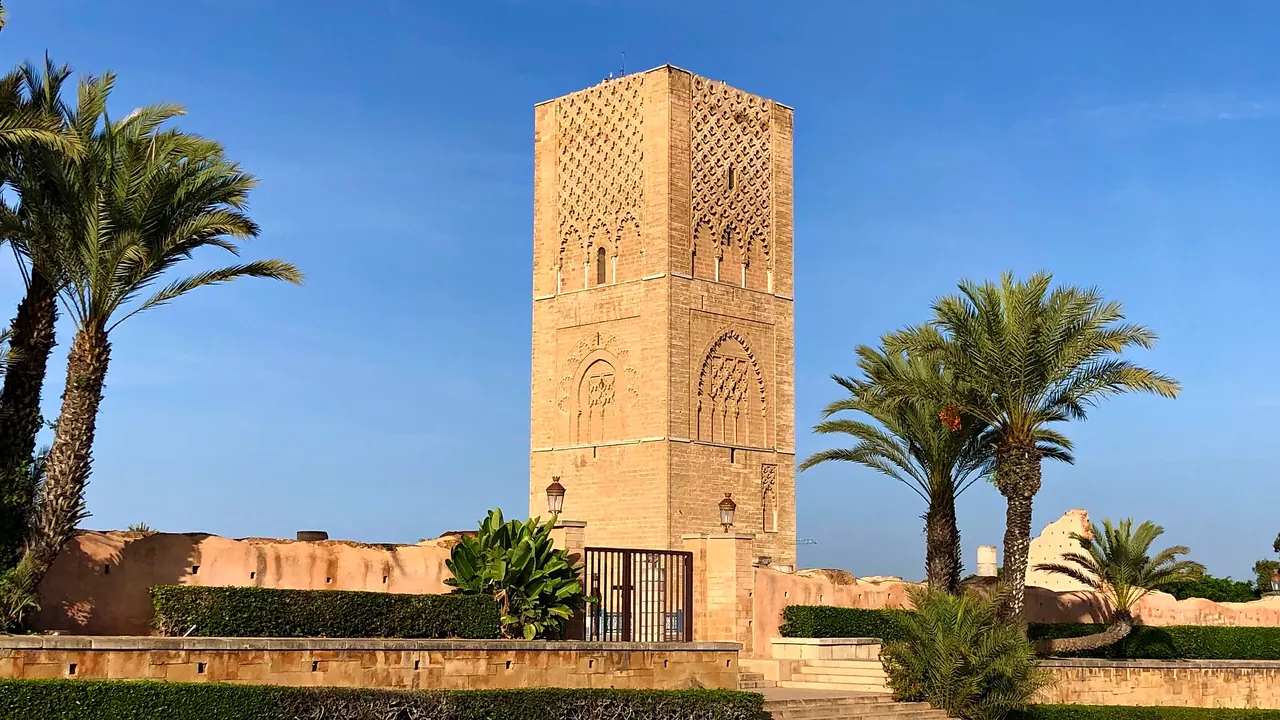
The Hassan Tower between palms in golden light
- Affordable cities72
- Culture & sights65
- Day trips60
Photo: Aemazy, CC BY-SA 4.0, cropped
Match
51
Every category weighted equally
- Beach & sun51
- Culture & arts53
- Food & nightlife49
- Family trip54
- Outdoors53
- Relax & unwind52
- Shopping & style51
- On a budget53
Rabat in twelve categories
Our verdict on each, scored 0 to 100 against the same fixed benchmark cities, so a score means the same thing on every page.
Beaches & swimming. Scores 45 out of 100.
Food & drink. Scores 55 out of 100.
Culture & sights. Scores 65 out of 100.
Nightlife. Scores 22 out of 100.
Nature & outdoors. Scores 42 out of 100.
Day trips. Scores 60 out of 100.
Good for families. Scores 48 out of 100.
Getting around. Scores 60 out of 100.
Shopping & style. Scores 45 out of 100.
Affordability. Scores 72 out of 100.
Live music & performing arts. Scores 40 out of 100.
Wellness & relaxation. Scores 55 out of 100.
Rabat category by category
Beaches & swimming
45Rabat faces the open Atlantic, and the city beach lies right below the walls of the Kasbah of the Udayas, where the Bou Regreg river meets the sea. It is a busy local beach for football, surfing and family outings more than a place to lie in the sun, and the swell and currents often make swimming a matter of staying close to shore. Calmer and cleaner sand is found south of the city along the coast towards Temara, Harhoura and Skhirat, a short taxi ride away.
The water reaches about 21°C in late summer and stays bracing for much of the year. Summer weekends bring crowds of Moroccan families, and beachwear is more modest than at international resorts. The beaches are a pleasant afternoon, not the reason to come.
Food & drink
55Eating in Rabat means Moroccan home cooking without the tourist theatre of the bigger medinas: tagines, couscous on Fridays, harira and grilled sardines in simple medina eateries, and snail broth and msemen pancakes from street stalls in the evening. The fish market area near the port and the restaurants along the river and the coast serve good, plain Atlantic seafood. Café culture is strong, with men lingering over mint tea and coffee on the terraces of the Ville Nouvelle and pastry shops selling almond and honey sweets.
As a capital with embassies, the Agdal and Hassan districts add French, Lebanese and international restaurants, and a few hotels and restaurants serve Moroccan wine. Alcohol is otherwise discreet, and the range is narrower than a visitor who travels to eat might hope.
Culture & sights
65Rabat's sights span almost two thousand years and are listed by UNESCO as a whole. The Kasbah of the Udayas, entered through its carved Almohad gate, is a whitewashed and blue-washed citadel above the river mouth with an Andalusian garden inside. The unfinished 12th-century Hassan Tower stands over a field of broken columns beside the marble Mausoleum of Mohammed V, and the Chellah, a walled ruin of Roman Sala and a Marinid necropolis, is overgrown with fig trees and nesting storks.
Between these lie the compact medina, the city walls and gates such as Bab er-Rouah, and a French-era Ville Nouvelle of art deco and neo-Moorish buildings. The Mohammed VI Museum of Modern and Contemporary Art and the archaeology museum round out a calm, well-kept set that most visitors see in two or three days.
Nightlife
22Rabat is a quiet capital after dark. Evenings belong to the cafés, the riverside promenade along the Bou Regreg and families strolling the medina streets, which stay lively until late in summer and during Ramadan nights. Drinking happens in hotel bars and a small number of lounges and restaurants in Agdal and the Hassan district, frequented by diplomats and young professionals. There is little in the way of clubbing, and visitors looking for a big night out usually head to Casablanca.
Nature & outdoors
42The city's natural setting is the Bou Regreg estuary and the Atlantic shoreline, best seen from the walls of the kasbah or along the coast road south, where low cliffs and rocky points break the swell. Surf schools work the beaches at the river mouth and south of the city, and the estuary suits rowing and paddling. Inland, the Maamora forest, one of the largest cork oak forests anywhere, offers easy walking and cycling, and the Exotic Gardens at Bouknadel and the lake reserve at Sidi Boughaba draw birdwatchers.
The climate is mild enough to be outdoors in every season. What Rabat lacks is relief: the Middle Atlas and the Rif are several hours away, so serious hiking needs more than a day.
Day trips
60Rabat sits on Morocco's best rail line, which makes it a practical base. Casablanca is about an hour away by train, mostly for the Hassan II Mosque on its ocean platform and the art deco city centre. The high-speed line reaches Tangier in about an hour and a half, with its kasbah and views across the strait, and the whitewashed, mural-painted town of Asilah is close by on the same route. Meknes, the imperial city of Moulay Ismail with its monumental gates and granaries, is about two hours by train.
Across the river, Salé has an older and more traditional medina and a fine Marinid madrasa, an easy half day by tram. Fez and the Roman ruins of Volubilis are better treated as an overnight trip.
Good for families
48Rabat is one of the easiest Moroccan cities to manage with children. The medina is calm and hassle is rare, the tram makes moving around simple, and Moroccan culture is warm and welcoming towards families. The national zoo on the edge of the city is large and modern, with African animals in open enclosures, and the Jardin d'Essais botanical garden and the Exotic Gardens at Bouknadel give space to run around.
Beyond that, attractions aimed at children are few, the city beaches have strong waves that call for close supervision, and midsummer afternoons can be hot. A family visit works best as part of a wider trip rather than a week built around the city.
Getting around
60The main sights cluster along the river: the medina, the Kasbah of the Udayas, the Hassan Tower and the Ville Nouvelle are all within walking distance of one another on broad, flat streets. The Chellah, Agdal and the coast are further out but reached easily by the tram, which links Rabat and Salé across the river, or by the small blue petit taxis that are cheap and plentiful. Buses are less useful for visitors.
The main station, Rabat Ville, sits in the centre and connects to the national rail network, so a car is unnecessary for both the city and the main day trips.
Shopping & style
45The heart of shopping in Rabat is the medina, and above all Rue des Consuls, a long covered street of carpet dealers, leather, brass, ceramics and embroidered textiles. Rabat has its own carpet tradition, with dense, deep-coloured pile carpets, and haggling here is noticeably gentler than in the country's bigger souks. The Oudayas has a few artisan workshops, and Salé across the river is known for pottery.
Modern shopping is limited to Agdal's high streets and a large shopping mall by the river, useful rather than exciting. Visitors keen on souks find more depth elsewhere in Morocco.
Affordability
72Day-to-day costs are low. Medina meals, café terraces, the tram and petit taxis are cheap by any European standard, and the main sights charge little or nothing. As the capital, though, Rabat has fewer budget riads than the tourist cities and more business hotels, so accommodation and the restaurants of Agdal and the Hassan district cost noticeably more than elsewhere in Morocco. Alcohol, available mainly in hotels, is the expensive item.
Live music & performing arts
40As the capital, Rabat holds Morocco's national cultural institutions. The Mohammed V National Theatre and the large Grand Theatre on the Bou Regreg host Moroccan and Arab music, theatre and visiting productions, though programmes are mostly in Arabic and French and run irregularly. The city's big moment is the Mawazine festival, a long-running annual event that brings international pop stars and Arab, African and Gnawa musicians to open-air stages across the city.
At other times, live music means Andalusian and chaabi performances at cultural centres and the occasional concert, and a visitor needs to look for it rather than finding it every night.
Wellness & relaxation
55The hammam is part of everyday life in Rabat, and the medina and Salé have neighbourhood bathhouses where locals come for steam and a vigorous scrub with black soap. They are simple and local, so a first-timer may prefer the hammams and spas of the larger hotels and a few riads, which offer the same ritual with more comfort and argan oil massages.
What makes Rabat restful is its pace. It is the calmest of Morocco's major cities, with tidy boulevards, quiet medina lanes, the Andalusian garden in the kasbah and long evening walks along the river, so a stay here feels unhurried rather than overwhelming.
When should you go?
Pick a month to see what it is like. The climate figures are measured averages, not a forecast.
Rabat in July
Daytime high, °C
Rainfall in the month, mm
The whole year
Shaded against this city’s own year: the deepest cell is its best month for that figure and the palest its weakest.
Temperature and rainfall are climate normals, averaged over the years shown. Rabat: 1991-2020 normals, Rabat-Sale (7.6 km from centre).
Before you go
| Measure | Rabat |
|---|---|
| Official language | Arabic, Standard Moroccan Tamazight |
| Currency | Moroccan Dirham (MAD) |
| Sockets | CE50 Hz |
| Driving side | Right |
| Time zone | UTC+1 |
| Emergency number | Police 19/112, ambulance 15, fire 15 |
| Elevation | 87 m |
| Main airport | Rabat-Salé Airport (RBA)9 km from centre45 non-stop destinations |
| Public holidays this year | 11 days |
By the numbers
| Measure | Rabat |
|---|---|
| City population | 515,619 |
| People per km² | 4,370 |
| Museums within 10 km | 7 |
| UNESCO World Heritage sites within 50 km | 1 |
| Swim season, months above 21 °C | 4 months |
Compare Rabat with
Every comparison with a written verdict behind it.