North Macedonia
Ohrid
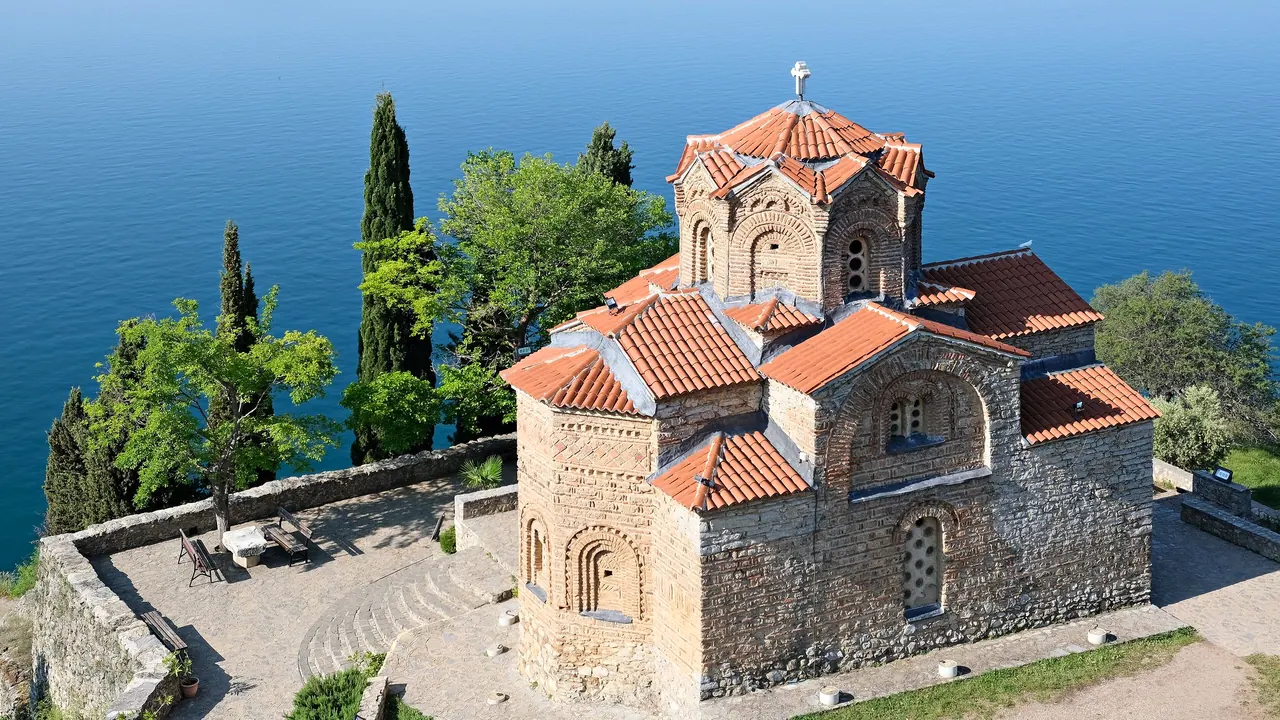
The Church of St John at Kaneo above Lake Ohrid
- Affordable cities80
- Nature & outdoors68
- Culture & sights66
Photo: kallerna, CC BY-SA 4.0, cropped
Match
49
Every category weighted equally
- Beach & sun50
- Culture & arts49
- Food & nightlife45
- Family trip54
- Outdoors54
- Relax & unwind49
- Shopping & style45
- On a budget52
Ohrid in twelve categories
Our verdict on each, scored 0 to 100 against the same fixed benchmark cities, so a score means the same thing on every page.
Beaches & swimming. Scores 55 out of 100.
Food & drink. Scores 38 out of 100.
Culture & sights. Scores 66 out of 100.
Nightlife. Scores 33 out of 100.
Nature & outdoors. Scores 68 out of 100.
Day trips. Scores 55 out of 100.
Good for families. Scores 45 out of 100.
Getting around. Scores 58 out of 100.
Shopping & style. Scores 32 out of 100.
Affordability. Scores 80 out of 100.
Live music & performing arts. Scores 25 out of 100.
Wellness & relaxation. Scores 32 out of 100.
Ohrid category by category
Beaches & swimming
55Ohrid's swimming is in a lake, not the sea, and it is one of the clearest lakes in Europe. In July and August the water reaches about 22°C to 24°C, and then the shore turns into the town's summer living room. Locals and visitors from across the region spread along concrete platforms, wooden jetties and short pebble strips. Within walking distance of the old town there are small coves below Kaneo and the town beach at Potpeš. Further south along the eastern shore, Lagadin, Gradište and Ljubaništa have longer stretches with beach bars and rented loungers.
The season is short. Before late June and after mid-September the water is cool and most beach bars are shut. Beaches are modest in size and fill up on August weekends. Nobody comes for white sand, but on a hot day the water is calm, clean and has no salt.
Food & drink
38Eating in Ohrid means Macedonian home cooking in a small lakeside town. Expect tavče gravče (beans baked in an earthenware dish), stuffed peppers, grilled meats, šopska salad, sheep's cheese and ajvar made from roasted peppers. Lake fish is the local speciality. The famous Ohrid trout is protected, so the belvica and other lake species are the ones to ask for. Wine comes from the Tikveš region and other Macedonian vineyards and is good and honest.
The range is narrow. The same dishes appear on menus all along the waterfront, and the best meals tend to be in family-run places in the upper old town or in villages along the shore. There is little fine dining and almost no international cuisine of note. The bakeries are good for burek in the morning.
Culture & sights
66Ohrid was one of the great centres of Slavic Orthodox learning, and its old town climbs a hill above the lake. The hill is crowned by the walls of Samuel's Fortress. The church of St Sophia holds some of the finest medieval frescoes in the Balkans. The church of St John at Kaneo, on a rock above the water, is the image everyone carries home. At Plaošnik, the rebuilt church of St Clement and St Panteleimon stands on the site of the early school associated with the Cyrillic tradition. Below it lie the remains of a Hellenistic theatre and early Christian mosaics.
Between these sites the streets hold smaller churches, Ottoman-era houses with overhanging upper floors, and a gallery of Byzantine icons. The town and lake are listed together by UNESCO. The whole set is compact and best walked slowly over a day or two.
Nightlife
33Nightlife in Ohrid depends entirely on the month. In high summer, crowds from Skopje and the wider region arrive. The lakefront promenade and the streets around the old bazaar fill with café-bars until late, and beach clubs along the southern shore play music into the small hours. The evening stroll along the water is the main event for most people.
From autumn to spring the town is quiet. A few bars stay open for a local crowd, and evenings mostly end over wine at dinner. Anyone looking for a serious club scene will not find one here.
Nature & outdoors
68The setting is the main reason to come. Lake Ohrid is deep, ancient and very clear, and mountains surround it on every side. Galičica National Park rises steeply between Ohrid and Lake Prespa. A road climbs to viewpoints where both lakes are visible at once, and trails lead up to summits above 2,000m. Paragliders launch from the same ridge. Kayaks and small boats are easy to hire, and the lakeshore path south of town makes a gentle walk.
At the southern end of the lake, springs feed a still, green pool where rowing boats carry visitors past the reeds. Across the water, the Albanian shore and its mountains fill the horizon. Spring and early autumn are the best seasons for walking. Winter is cold and grey, with snow on the peaks.
Day trips
55The best-known outing is to the monastery of St Naum at the southern tip of the lake, about 30km away. It can be reached by road or, in summer, by boat along the shore. Struga is a short ride west, a market town where the Black Drin river flows out of the lake. Bitola, about an hour and a quarter away, has a long Ottoman-era pedestrian street. Just outside it lie the ruins of Heraclea Lynkestis, with fine floor mosaics.
Other trips include the villages around Lake Prespa, the mountain monastery of Bigorski, and the carnival village of Vevčani. The Albanian border is close, so Pogradec on the far shore and the old town of Korçë make easy cross-border days. Roads are slow and public transport is thin, so a car or a driver helps.
Good for families
45Ohrid is a calm, safe and small town, and in summer children happily spend whole days in the clear lake water. Boat rides along the shore, ice cream on the promenade and the reconstructed prehistoric pile village on the water at the Bay of Bones fill the rest of the time. Macedonians are relaxed and warm towards children in restaurants and public places.
There is little else made for them. There are no zoos, aquariums or theme parks, and the old town's steep, cobbled lanes are hard going with a pushchair. Families tend to do best in a lakeside apartment with easy access to the water.
Getting around
58Central Ohrid is small enough to cross on foot. The promenade, the old bazaar and the main sights of the old town lie within a short walk of each other. The old town itself is steep, with cobbles and stairs that tire older visitors. Taxis are plentiful and easy to use for short hops.
The lakeside beaches and villages further south, and St Naum at the far end, are served by local buses and summer boats, but these are not frequent or simple to rely on. Most visitors staying outside town, or planning trips into the mountains and the wider region, hire a car or arrange a driver.
Shopping & style
32The one thing Ohrid is known for is the Ohrid pearl. It is not a true pearl but a bead coated in a lustre made from the scales of a small lake fish, a technique handed down for generations in a few families. Workshops sell the pearls in the old bazaar streets. Copies are common, so buy from a long-established workshop rather than a stall. Hand-carved wood, icons and filigree silver are the other traditional crafts.
Beyond these, shopping is modest. The streets around the bazaar sell souvenirs and summer clothes, and there are no design boutiques or fashion streets.
Affordability
80Ohrid is among the cheapest lake or coastal towns in Europe for a visitor. Guesthouse rooms and apartments are inexpensive, a full meal with local wine costs little, and taxis and buses are cheap. Entry fees for the churches and the fortress are low.
July and August are the exception. Lakefront rooms book up and cost more, especially on weekends. Late spring and early autumn give the best combination of low prices and good weather.
Live music & performing arts
25The performing arts in Ohrid mean the summer. The Ohrid Summer Festival, held every year since the early 1960s, brings classical concerts, opera and theatre to the church of St Sophia and to the ancient theatre in the old town, which are memorable settings. A choral festival adds sacred and folk singing.
Outside the festival season there is little to attend beyond occasional concerts and folk music at restaurants. Visitors who come for music should plan around the summer programme.
Wellness & relaxation
32Ohrid has no bathing or spa tradition of its own. Wellness here means a few hotel spas with pools, saunas and massage. The nearest thermal springs are a long drive away, in the mountains near Debar.
What Ohrid does offer is pace. In May, June and September, slow mornings over coffee by the water, quiet evenings on the promenade and the stillness of the lake make it an easy place to unwind. In August it is busier and noisier, and it is less restful for that.
When should you go?
Pick a month to see what it is like. The climate figures are measured averages, not a forecast.
Ohrid in July
Daytime high, °C
Rainfall in the month, mm
The whole year
Shaded against this city’s own year: the deepest cell is its best month for that figure and the palest its weakest.
Where the figures come from
Ohrid has no rain gauge within 25 km of the centre, so its rainfall comes from a gridded climate dataset read at the city rather than from a gauge further away.
Temperature and rainfall are climate normals, averaged over the years shown. Ohrid: 1999-2017 (rainfall 1991-2020) normals, Ohrid (0.2 km from centre).
Before you go
| Measure | Ohrid |
|---|---|
| Official language | Albanian, Macedonian |
| Currency | Denar (MKD) |
| Sockets | CF230 V, 50 Hz |
| Driving side | Right |
| Time zone | UTC+1, UTC+2 in summer |
| Emergency number | 112 |
| Elevation | 695 m |
| Main airport | Ohrid St. Paul the Apostle Airport (OHD)9 km from centre14 non-stop destinations |
| Public holidays this year | 12 days |
By the numbers
| Measure | Ohrid |
|---|---|
| City population | 38,818 |
| People per km² | 100 |
| Museums within 10 km | 11 |
| UNESCO World Heritage sites within 50 km | 2 |
Compare Ohrid with
Every comparison with a written verdict behind it.
- Athens
- Bari
- Belgrade
- Bled
- Budva
- Dubrovnik
- Kotor
- Lecce
- Matera
- Mostar
- Plovdiv
- Sarajevo
- Skopje
- Sofia
- Split
- Thessaloniki
- Tirana