Switzerland
Gstaad
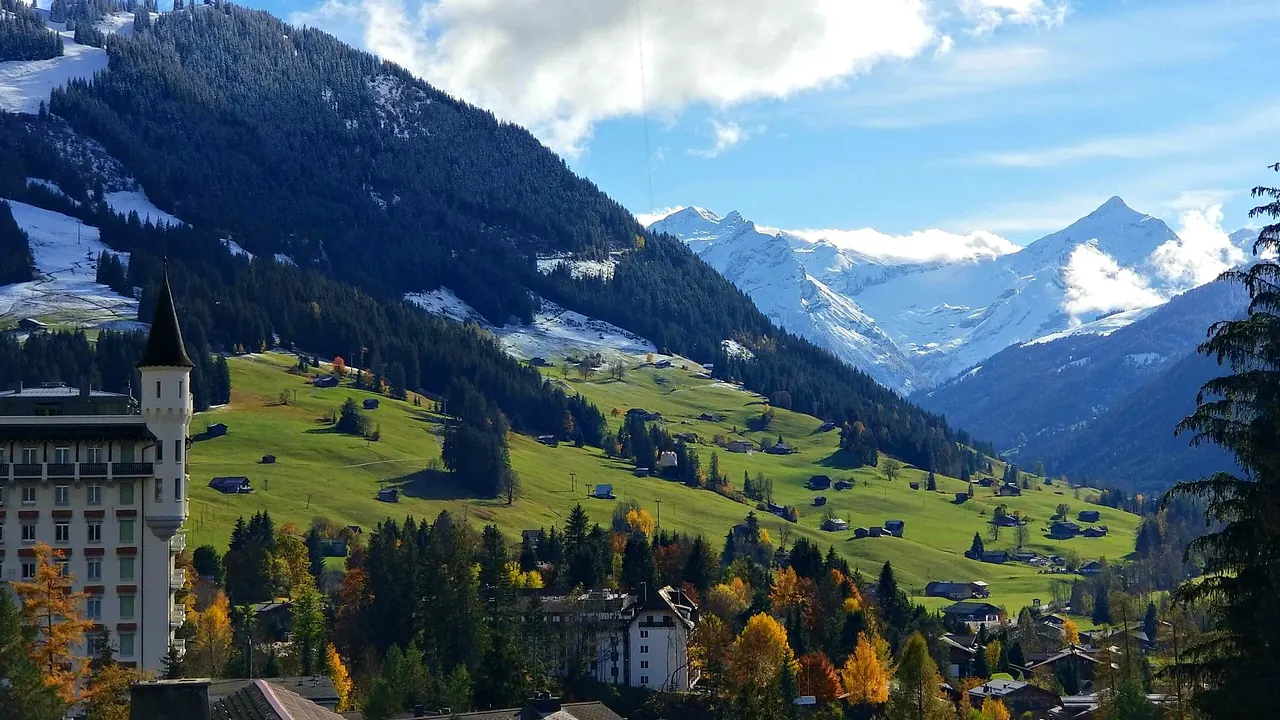
The Gstaad Palace above the valley and snowy peaks
- Nature & outdoors86
- Getting around72
- Day trips63
Photo: Samuel Barlow, CC BY-SA 4.0, cropped
Gstaad lies in Swiss Alps, which has its own page.
Match
41
Every category weighted equally
- Beach & sun39
- Culture & arts41
- Food & nightlife38
- Family trip43
- Outdoors48
- Relax & unwind44
- Shopping & style42
- On a budget37
Gstaad in twelve categories
Our verdict on each, scored 0 to 100 against the same fixed benchmark cities, so a score means the same thing on every page.
Beaches & swimming. Scores 12 out of 100.
Food & drink. Scores 40 out of 100.
Culture & sights. Scores 12 out of 100.
Nightlife. Scores 22 out of 100.
Nature & outdoors. Scores 86 out of 100.
Day trips. Scores 63 out of 100.
Good for families. Scores 48 out of 100.
Getting around. Scores 72 out of 100.
Shopping & style. Scores 45 out of 100.
Affordability. Scores 2 out of 100.
Live music & performing arts. Scores 40 out of 100.
Wellness & relaxation. Scores 54 out of 100.
Gstaad category by category
Beaches & swimming
12Gstaad is an Alpine village at about 1,050m, and swimming is a small summer extra. The mountain lakes at Lauenen and Arnensee have grassy shores where people take a quick dip on hot afternoons, but the water is cold even in July and August. Locals use the heated outdoor pool in the valley instead. Lake Geneva's shore at Montreux is the nearest proper lakeside bathing, a long excursion over the pass. If swimming matters to your trip, plan it around the hotel pool.
Food & drink
40Eating in Gstaad happens at two levels: the polished dining rooms of the grand hotels, several of them serious gourmet kitchens, and the wooden mountain huts on the slopes serving rösti, fondue and raclette in the sun. The local product is cheese. Saanen's hard, long-aged Hobelkäse is shaved into thin curls, and L'Etivaz, made over wood fires in summer alpine dairies, comes from just over the cantonal border. Small dairies and cheese cellars in the valley sell both.
Beyond that the range is narrow. The village is small, there is little casual or street-level eating, and in the shoulder seasons many kitchens close. Food is a pleasure here rather than the reason to come.
Culture & sights
12Gstaad has no museums or monuments to fill a day. Its heritage is in its buildings. The village and its neighbours keep the dark-timbered Saanenland chalet style, with carved and painted façades. The late-Gothic church of St Mauritius in Saanen has medieval wall paintings, and the old church at Rougemont is worth a short stop. These are pleasant moments on a walk, not a sightseeing programme.
Nightlife
22Nights in Gstaad are about the winter season. Between Christmas and February, après-ski starts in mountain huts and hotel bars, and a couple of exclusive late clubs run in the cellars of the grand hotels. The scene is small, dressy and sociable, and much of it happens at private chalet parties. Outside the peak weeks, and through most of summer, evenings end after dinner and a drink by the fire.
Nature & outdoors
86The village sits where several green valleys meet, with lifts rising straight from the edge of town. In winter there are several linked ski areas spread across the Saanenland: Wispile, Eggli, Rellerli, Saanenmöser and Rinderberg, plus cross-country trails on the valley floor and winter walking paths. The home slopes are mostly gentle and fairly low, so snow can be thin early in the season. Glacier 3000, about half an hour away above Col du Pillon, adds high-altitude snow and a suspension bridge between two peaks.
Summer is arguably the better season. Easy valley walks lead to Lauenensee and the waterfalls of the Geltental, longer routes cross alpine pastures and ridges, and there is mountain biking, paragliding and rafting on the Saane. The landscape is pastoral rather than savage.
Day trips
63The GoldenPass panoramic railway winds down from the village to Montreux on Lake Geneva in about an hour and a half. There you can walk the lakeside promenade and visit the Castle of Chillon, and the UNESCO-listed Lavaux vineyard terraces lie just beyond. Westward, the medieval hilltop town of Gruyères, with its castle and cheese dairies, is under an hour by car. Château-d'Oex is a short ride away for a quieter village visit.
To the east the line runs via Zweisimmen to Spiez and Thun on Lake Thun, and on to Bern's arcaded old town in about two hours. These are fine outings, but they all take a good part of the day.
Good for families
48Gstaad is safe, quiet and easy to manage with children. The gentle home slopes and ski schools suit beginners, sledge runs and horse-drawn sleigh rides fill winter afternoons, and summer brings short walks to lakes and farm pastures where cows and goats are part of the view. What it lacks is anything built specifically for children: no zoo, no aquarium, no indoor attractions for a wet day. Families who come tend to want a calm mountain stay, not a full programme.
Getting around
72The centre is a short, mostly car-free promenade, and everything in it is a few minutes' walk apart. Trains on the GoldenPass line stop in Gstaad and in neighbouring Saanen, Schönried and Saanenmöser, where several lifts start. Yellow PostBuses run up the side valleys to Lauenen and Gsteig and over to the Glacier 3000 cable car. Ski buses link the lift stations in winter. Still, the resort is spread along several valleys, connections thin out in the quiet months, and many visitors end up relying on hotel shuttles or a car.
Shopping & style
45Shopping means the Promenade, a short pedestrian street of chalets with an unusual concentration of luxury houses for so small a place: fine watchmakers and jewellers, international fashion labels, cashmere, furs and interior design. There are also a few shops selling local cheese, carved wood and the traditional papercut art of the Pays-d'Enhaut. Away from that one street there is very little, and nothing for a modest budget.
Affordability
2Gstaad is among the most expensive places in the Alps, and in the world. Its accommodation is dominated by grand hotels and rented chalets, mid-range rooms are scarce and fill early, and meals, ski passes and transport all come at the top of Swiss prices. Budget travellers can stay down the valley in Saanen or Zweisimmen and come in for the day. Summer and the shoulder seasons are noticeably gentler on the wallet than the Christmas and February peak.
Live music & performing arts
40Gstaad punches far above its size in classical music, thanks to the Gstaad Menuhin Festival, founded by Yehudi Menuhin. Each summer for several weeks, leading soloists and orchestras play in a large festival tent and in the village churches of Saanen, Rougemont, Lauenen and Gstaad, whose acoustics and intimacy are part of the appeal. Winter brings a chamber-music festival and concerts over the New Year. Between these seasons there is no regular theatre, opera or live-music scene, so time your visit if music is part of the plan.
Wellness & relaxation
54Gstaad has no thermal springs, public baths or bathing tradition of its own. Its wellness offer is the spas of its grand hotels, and for a village this size there are an unusual number of them. They are large and lavish, with indoor and outdoor pools, sauna landscapes and treatment rooms looking out over the mountains. Some sell day passes to visitors staying elsewhere, but the offer is built mainly around hotel guests.
The pace does the rest. The village centre is small and quiet, nights are dark and still, and the day falls into an easy rhythm of a walk, a long lunch and a sauna. It suits travellers who want comfort and calm in a pretty setting, not those looking for a culture of taking the waters.
When should you go?
Pick a month to see what it is like. The climate figures are measured averages, not a forecast.
Gstaad in July
Daytime high, °C
Rainfall in the month, mm
The whole year
Shaded against this destination’s own year: the deepest cell is its best month for that figure and the palest its weakest.
Where the figures come from
Gstaad's temperatures are measured 78 km from the centre, at Les Eplatures.
Gstaad has no rain gauge within 25 km of the centre, so its rainfall comes from a gridded climate dataset read at the destination rather than from a gauge further away.
Temperature and rainfall are climate normals, averaged over the years shown. Gstaad: 2010-2020 (rainfall 1991-2020) normals, Les Eplatures (77.5 km from centre).
Before you go
| Measure | Gstaad |
|---|---|
| Official language | French, German, Italian, Romansh |
| Currency | Swiss Franc (CHF) |
| Sockets | CJ230 V, 50 Hz |
| Driving side | Right |
| Time zone | UTC+1, UTC+2 in summer |
| Emergency number | 112 |
| Elevation | 1,050 m |
| Main airport | Geneva International Airport (GVA)94 km from centre150 non-stop destinations |
| Public holidays this year | 10 days |
By the numbers
| Measure | Gstaad |
|---|---|
| Population | 2,960 |
| Museums within 10 km | 0 |
| UNESCO World Heritage sites within 50 km | 4 |
Compare Gstaad with
Every comparison with a written verdict behind it.
- Adelboden
- Alpe d'Huez
- Andermatt
- Arosa
- Avoriaz
- Chamonix
- Châtel
- Courchevel
- Crans-Montana
- Davos
- Engelberg
- Flaine
- Grindelwald
- Klosters
- La Clusaz
- La Plagne
- La Rosière
- Laax
- Le Grand-Bornand
- Lenzerheide
- Les Arcs
- Les Deux Alpes
- Les Gets
- Les Menuires
- Leukerbad
- Megève
- Méribel
- Montgenèvre
- Morzine
- Mürren
- Saas-Fee
- Saint-Gervais-les-Bains
- Samnaun
- Samoëns
- Serre Chevalier
- St. Moritz
- Tignes
- Val Cenis
- Val d'Isère
- Val Thorens
- Verbier
- Wengen
- Zermatt