Poland
Wroclaw
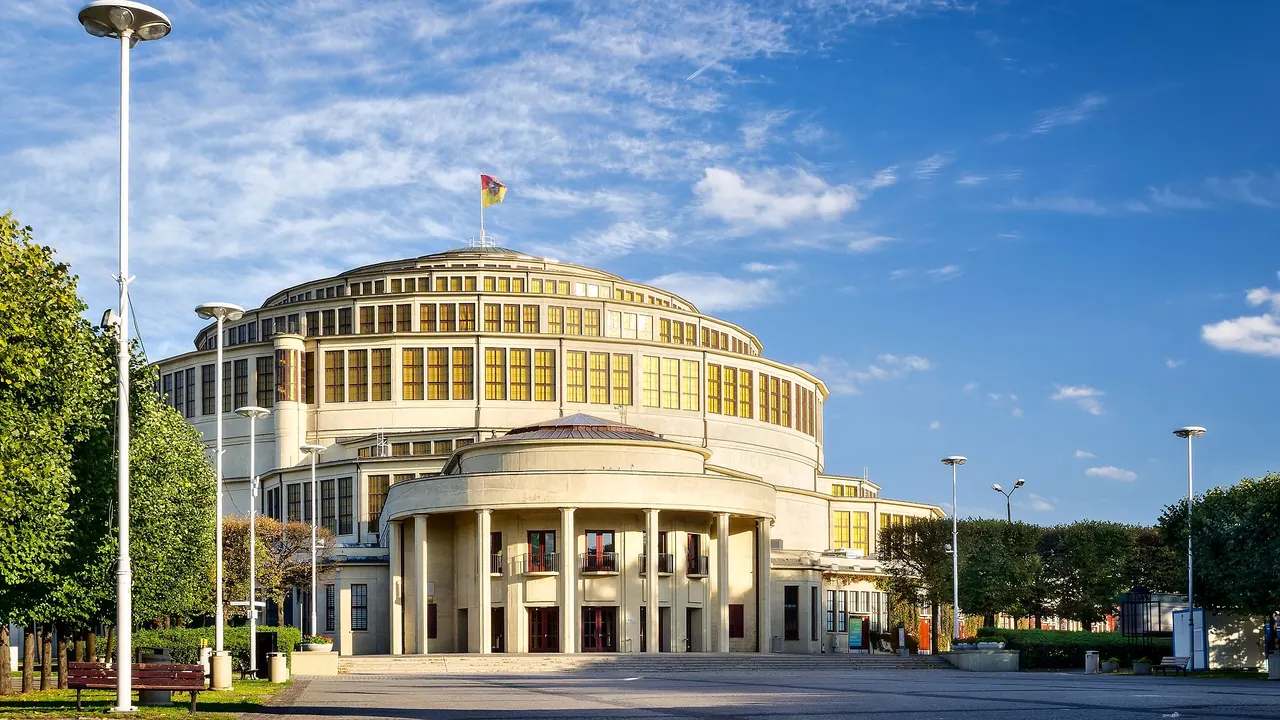
The Centennial Hall, a World Heritage Site
- Affordable cities74
- Getting around68
- Culture & sights66
Photo: Jar.ciurus, CC BY-SA 3.0 PL, cropped
Match
52
Every category weighted equally
- Beach & sun46
- Culture & arts58
- Food & nightlife54
- Family trip53
- Outdoors52
- Relax & unwind46
- Shopping & style53
- On a budget55
Wroclaw in twelve categories
Our verdict on each, scored 0 to 100 against the same fixed benchmark cities, so a score means the same thing on every page.
Beaches & swimming. Scores 8 out of 100.
Food & drink. Scores 48 out of 100.
Culture & sights. Scores 66 out of 100.
Nightlife. Scores 58 out of 100.
Nature & outdoors. Scores 55 out of 100.
Day trips. Scores 60 out of 100.
Good for families. Scores 60 out of 100.
Getting around. Scores 68 out of 100.
Shopping & style. Scores 40 out of 100.
Affordability. Scores 74 out of 100.
Live music & performing arts. Scores 58 out of 100.
Wellness & relaxation. Scores 32 out of 100.
Wroclaw category by category
Beaches & swimming
8Wroclaw is an inland city, and the Baltic coast is most of a day's journey north. In summer, sandy river beaches along the Oder fill with deckchairs and drinks stands, but they are for lounging rather than swimming. Locals who want to get in the water use outdoor pools or the lakes and reservoirs out in the Lower Silesian countryside. A visitor who wants sea and sand should plan a separate trip.
Food & drink
48Eating here means Polish comfort food done well: pierogi with every kind of filling, żurek sour rye soup served in a bread bowl, potato dumplings, roast duck and pork knuckle. Old-style milk bars still serve cheap canteen lunches, and the streets just off the Market Square have a fair number of modern bistros cooking Polish dishes with a lighter touch. The square itself is mostly tourist terraces where you pay for the view.
Beer is the strongest part of the drinking scene. There are brewpubs in historic cellars, plenty of Polish craft taps and a small vodka bar culture. The cooking is satisfying rather than distinctive, and it is not a city people travel to just to eat.
Culture & sights
66The heart of the city is the Market Square, one of the largest in Central Europe. It is lined with rebuilt merchant houses in pastel colours and has the Gothic Old Town Hall at its centre, with its elaborate gables and astronomical clock. A short walk over the river takes you to Ostrów Tumski, the cathedral island, where red-brick churches stand along quiet lanes and a lamplighter still lights the gas lamps by hand at dusk. The Baroque university, whose Aula Leopoldina is a gilded ceremonial hall, faces the Oder.
Further out is the Centennial Hall of 1913, an early concrete giant and a UNESCO site. The Racławice Panorama is a huge circular battle painting, and the National Museum has a strong collection of Silesian art. Much of the centre is post-war reconstruction after the siege of 1945, which gives the city an unusual layered history. Hundreds of small bronze dwarf statues are scattered across the streets for visitors to find.
Nightlife
58With a very large student population, Wroclaw has a lively night out for its size. Most of it happens in the cellars and courtyards around the Market Square. The busiest stretch is a courtyard passage off Ruska Street packed with small bars, where people drift from one door to the next until late. Shot bars, craft beer pubs and cocktail bars sit side by side, and Friday and Saturday nights carry on past 2am.
The club scene is modest: a few dance venues and some alternative spaces in old industrial buildings, nothing that draws people from abroad. In summer more of the drinking moves outdoors to the riverbanks and the islands. The city is noticeably quieter between university terms, when many of the students go home.
Nature & outdoors
55The city sits on a flat plain where the Oder splits into channels around a dozen islands. Riverside paths, Szczytnicki Park with its Japanese Garden, and the old trees of the botanical garden give plenty of green for walks and cycling within town. Kayaks and pedal boats go out on the river in summer.
For real hills, Ślęża rises alone from the plain within an hour's drive and is an easy half-day hike to its summit. The Sudetes lie further south-west: the Karkonosze ridge below Śnieżka and the strange sandstone mazes of the Table Mountains are both around two hours away. They make long but rewarding hiking days, with skiing in winter.
Day trips
60The surrounding region of Lower Silesia is full of castles, abbeys and small market towns, and most are within one or two hours by car. Książ, a huge hilltop castle above a wooded gorge, is the best-known trip. The wooden Churches of Peace at Świdnica and Jawor are UNESCO-listed and remarkable inside. Krzeszów's Baroque abbey and the fortress town of Kłodzko are also worth the drive.
The Jelenia Góra valley has a cluster of palaces and manor houses at the foot of the mountains, and the spa town of Szczawno-Zdrój and the old towns of Legnica and Opole make quieter outings. Trains reach many of these places, but a car makes it far easier to combine several in a day.
Good for families
60Wroclaw is an easy city with children. The centre is flat, largely car-free around the Market Square and safe. Hunting for the bronze dwarf statues on street corners keeps younger children busy for hours. The zoo is one of the oldest and largest in Poland, and its Afrykarium, a big aquarium building devoted to African habitats with a walk-through shark tunnel, is a real highlight.
There is also a hands-on water science centre in an old reservoir building, a multimedia fountain by the Centennial Hall that runs shows on summer evenings, and plenty of parks and playgrounds. Beyond that the list is short, and winters are cold and grey.
Getting around
68Most of what a visitor wants is within walking distance: the Market Square, the university, the cathedral island and the riverside are all close together on flat ground, and many streets in the old centre are pedestrianised. A large tram network, backed by buses, reaches the zoo, the Centennial Hall and the outer districts. Trams can be slow in rush-hour traffic and the network takes some getting used to.
Cycling is popular, with bike lanes along the river and a city bike system. The main station has direct trains across Lower Silesia, but some castles and mountain villages are much easier to reach by car.
Shopping & style
40Shopping here is practical rather than a draw. Large malls near the old town and the station cover the international chains. The Renoma building, a 1930s department store with a striking ceramic facade, is worth a look for its architecture alone. The brick-and-concrete market hall by the river sells produce, cured meats and pickles.
The best souvenirs are the blue-and-white stoneware made nearby in Bolesławiec, Baltic amber and tiny dwarf figurines. A few independent design and vintage shops are scattered around Nadodrze, but there is no luxury street and not much depth.
Affordability
74Wroclaw is one of the cheaper well-known cities in the European Union. Comfortable central hotels and apartments cost a fraction of what they would in Western capitals, and a filling lunch in a milk bar or a casual restaurant is very cheap. Beer is inexpensive, and trams, museums and the zoo are all modestly priced.
The Market Square terraces and the larger hotels on the square charge more, and big events and summer weekends push up room prices. A few streets away the city goes back to being cheap.
Live music & performing arts
58Wroclaw has a serious performing arts life for a city of its size. The National Forum of Music is a large modern concert hall with excellent acoustics and a full season of orchestral, choral and chamber music. The Wroclaw Opera performs in a nineteenth-century house close to the moat. The city also has a strong theatre tradition, linked to Jerzy Grotowski's experimental work, and several drama stages plus a musical theatre that stages popular shows.
The festival calendar adds Wratislavia Cantans, devoted to oratorio and early music, and the long-running Jazz on the Oder. Smaller clubs host jazz and indie gigs during the year. Almost all theatre is performed in Polish, so for most visitors the music is the real draw.
Wellness & relaxation
32Wroclaw has no bathing culture of its own. Relaxing in town means hotel spas, a large indoor aquapark with saunas, and slow afternoons in riverside cafés or on the islands. The pace is gentle compared with a capital, though the centre gets crowded on summer weekends.
For taking the waters, the historic spa towns of Lower Silesia are where to go. Szczawno-Zdrój is about an hour away, and Polanica and Kudowa are further south. All have pump rooms, spa parks and treatment houses in the old Central European style.
When should you go?
Pick a month to see what it is like. The climate figures are measured averages, not a forecast.
Wroclaw in July
Daytime high, °C
Rainfall in the month, mm
The whole year
Shaded against this city’s own year: the deepest cell is its best month for that figure and the palest its weakest.
Temperature and rainfall are climate normals, averaged over the years shown. Wroclaw: 1991-2020 (rainfall 1961-1990) normals, Wroclaw Copernicus Airport (10.5 km from centre).
Before you go
| Measure | Wroclaw |
|---|---|
| Official language | Polish |
| Currency | Zloty (PLN) |
| Sockets | CE50 Hz |
| Driving side | Right |
| Time zone | UTC+1, UTC+2 in summer |
| Emergency number | 112 |
| Elevation | 111 m |
| Main airport | Copernicus Wrocław Airport (WRO)11 km from centre84 non-stop destinations |
| Public holidays this year | 14 days |
By the numbers
| Measure | Wroclaw |
|---|---|
| City population | 673,531 |
| People per km² | 2,299 |
| Museums within 10 km | 42 |
| UNESCO World Heritage sites within 50 km | 2 |
Compare Wroclaw with
Every comparison with a written verdict behind it.
- Berlin
- Bratislava
- Brno
- Budapest
- Cesky Krumlov
- Dresden
- Gdansk
- Graz
- Hallstatt
- Krakow
- Leipzig
- Nuremberg
- Prague
- Salzburg
- Vienna
- Warsaw