Spain
Girona
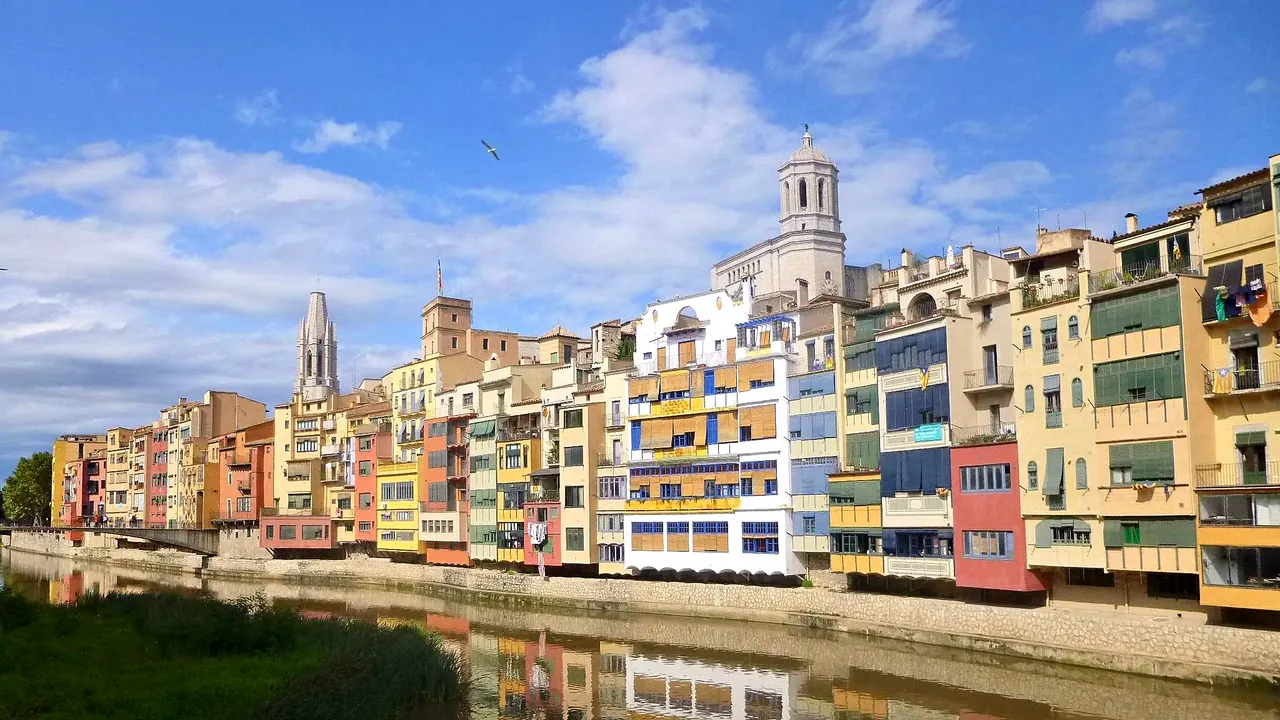
The houses on the Onyar with the cathedral and Sant Feliu
- Day trips86
- Nature & outdoors79
- Food & drink63
Match
54
Every category weighted equally
- Beach & sun55
- Culture & arts55
- Food & nightlife51
- Family trip58
- Outdoors62
- Relax & unwind56
- Shopping & style51
- On a budget54
Girona in twelve categories
Our verdict on each, scored 0 to 100 against the same fixed benchmark cities, so a score means the same thing on every page.
Beaches & swimming. Scores 55 out of 100.
Food & drink. Scores 63 out of 100.
Culture & sights. Scores 62 out of 100.
Nightlife. Scores 30 out of 100.
Nature & outdoors. Scores 79 out of 100.
Day trips. Scores 86 out of 100.
Good for families. Scores 46 out of 100.
Getting around. Scores 60 out of 100.
Shopping & style. Scores 37 out of 100.
Affordability. Scores 52 out of 100.
Live music & performing arts. Scores 37 out of 100.
Wellness & relaxation. Scores 42 out of 100.
Girona category by category
Beaches & swimming
55Girona sits inland on its river, so there is no beach in the city. The Costa Brava starts about 40 minutes away by car or bus. Sant Feliu de Guíxols, Platja d'Aro and Tossa de Mar are the closest, and further north L'Escala and the coves around Begur have some of the clearest water on the Spanish Mediterranean. The sea reaches about 23°C to 24°C in August, and the coast mixes long sandy bays with small pine-backed coves of rock and coarse sand.
The coast works well as a day out, but it is something you add to a city stay, not the stay itself. Without a car, the bus timetables limit how far along the coast you get. In July and August the most famous coves fill early and parking is hard to find.
Food & drink
63Girona eats well for its size. Catalan home cooking is the base: pa amb tomàquet, botifarra sausage with white beans, mar i muntanya dishes that put seafood and meat on one plate, and rice dishes on weekends. The city also has an international fine-dining reputation, and serious tasting-menu kitchens sit alongside the old-town taverns. Pastry shops sell xuixos, the cream-filled fried pastries tied to the city, and the Mercat del Lleó covers the produce of the Empordà plain.
The Empordà wine country is close, so local whites and reds and cava appear on most lists, and vermouth before lunch is a weekend habit. Range is the weak point. There is little street food and not much international cooking, and in the Barri Vell the menus aimed at visitors are less interesting than the neighbourhood places across the river.
Culture & sights
62The Barri Vell is the reason to come. It is a walled medieval quarter climbing steeply from the river Onyar, and its stone lanes and stairways lead up to the cathedral. A broad Baroque staircase rises to the cathedral, whose single Gothic nave is one of the widest in the world. Close by are the Romanesque cloister of Sant Pere de Galligants, the twelfth-century Arab Baths and the Call, a maze of narrow alleys that formed one of the best-preserved Jewish quarters in Europe. Its history is told in a dedicated museum.
You can walk along most of the medieval walls, which give views over the rooftops towards the Pyrenees. From the bridges you see the painted houses hanging over the Onyar, the city's best-known view. The art, history and cinema museums are good small collections, not major institutions. Most visitors see the essentials in a day or two of unhurried walking.
Nightlife
30Evenings in Girona centre on terraces and a long, slow dinner. Students fill the bars around Plaça de la Independència and the old quarter on weekday nights in term time, and a few music bars and small clubs stay open late at weekends, mostly on the edge of the centre. Summer brings outdoor drinking and the late Spanish rhythm, but anyone after a real night out takes the train to Barcelona.
Nature & outdoors
79Road cyclists from around the world base themselves in Girona. Quiet lanes lead straight out of town into rolling farmland, to the climbs of Rocacorba and Els Àngels and towards the coast. Former railway lines have been turned into greenways, flat traffic-free routes that run to Olot and down to Sant Feliu de Guíxols. On foot, the Devesa park and the riverbanks give easy green space in town, and the Gavarres hills begin right at the city's edge.
Within about an hour you reach the Garrotxa volcanic zone, with beech forests and cinder cones around Olot. You can also reach the Costa Brava cliff paths, where the old coast-guard trail links coves above clear water, and the wild headland of Cap de Creus. Kayaking and snorkelling are easy along the coast. The high Pyrenees, with summer hiking and winter skiing, are about an hour and a half away. Spring and autumn are the best seasons, because midsummer is hot inland.
Day trips
86Girona is an excellent base for day trips. Barcelona is under 40 minutes away by high-speed train, so a full day there with an evening back in a quieter city is easy. Figueres, with the Dalí Theatre-Museum, is about half an hour north. Dalí country continues at the castle of Púbol and at Portlligat beside Cadaqués, a whitewashed fishing village on the far side of the Cap de Creus.
Closer to Girona are the medieval village of Besalú with its fortified bridge, the stone villages of Pals and Peratallada, and the Greek and Roman ruins of Empúries on the shore. The monastery of Sant Pere de Rodes and the Romanesque church at Ripoll are also within reach. The Empordà wine country offers cellar visits among olive groves. France is close too: Perpignan is under an hour by fast train, and the harbour town of Collioure is about an hour and a half by car over the border, or a slower trip by regional train via Portbou. A car makes the villages much easier to reach.
Good for families
46Girona is calm, safe and easy to manage at a small scale. Children are welcome in restaurants and squares well into the evening, and the Devesa park has shade and play areas. Walking the city walls feels like an adventure to most children. Little is built for them, though. There is no zoo, aquarium or theme park, the museums are aimed at adults, and the Barri Vell is a climb of stairs and cobbles that makes pushchairs hard work. Families tend to use Girona as a quiet base and spend their days on the Costa Brava beaches.
Getting around
60Within the city you walk. The old town, the river and the modern centre are all within about twenty minutes of each other on foot, although the Barri Vell is steep, with plenty of stairs. The train station sits at the edge of the centre, with fast connections to Barcelona and Figueres and slower regional trains to small towns. Beyond that, things get harder. Buses reach the main Costa Brava resorts and Olot but run infrequently, and the hill villages, coves and wineries are far easier with a car. Many visitors rent one for part of their stay. Bikes are an easy option for local trips.
Shopping & style
37Shopping in Girona is pleasant but small. The Rambla and the streets around it in the old town have independent fashion and shoe shops, bookshops and delicatessens. The Mercat del Lleó is the place for Empordà cheeses, sausages, olive oil and wine to take home, and the many cycling shops sell kit and bikes to visiting riders. There are no luxury streets or big department stores, so serious shoppers go to Barcelona.
Affordability
52Girona's prices sit around the middle for Western Europe, and it is cheaper than the big Spanish cities. A weekday set lunch is good value, everyday cafés and taverns are reasonably priced, and you can reach almost everything on foot. Accommodation is the main cost. The old town has a limited number of rooms, and they get expensive in summer, during the spring flower festival and in the cycling season. Renting a car to explore the region also adds to the budget.
Live music & performing arts
37For a small city, Girona has a respectable stage life. The Auditori hosts touring orchestras, jazz and pop concerts, and the old Teatre Municipal stages Catalan-language drama and dance. Its standout event is Temporada Alta, a long autumn festival of international theatre and dance. In summer, the coast nearby adds outdoor music festivals in castle gardens and seaside towns. Outside these seasons the programme is thin, and there is no resident opera or orchestra. Many plays are performed in Catalan.
Wellness & relaxation
42Girona is an unhurried city. Long lunches, quiet stone lanes in the morning and evening walks along the river set the pace, and it is easy to slow down here. Bathing culture is limited. The Arab Baths are a monument to visit, not to use, and spas are mostly in hotels. The real option is Caldes de Malavella, a thermal-spring town about 20 minutes south with a Roman spa history. Its spring water hotels offer thermal pools and treatments.
When should you go?
Pick a month to see what it is like. The climate figures are measured averages, not a forecast.
Girona in July
Daytime high, °C
Rainfall in the month, mm
The whole year
Shaded against this city’s own year: the deepest cell is its best month for that figure and the palest its weakest.
Temperature and rainfall are climate normals, averaged over the years shown. Girona: 1991-2020 normals, Gerona / Costa Brava (10.1 km from centre).
Before you go
| Measure | Girona |
|---|---|
| Official language | Spanish |
| Currency | Euro (EUR) |
| Sockets | CF230 V, 50 Hz |
| Driving side | Right |
| Time zone | UTC+1, UTC+2 in summer |
| Emergency number | 112 |
| Elevation | 70 m |
| Main airport | Girona-Costa Brava Airport (GRO)10 km from centre18 non-stop destinations |
| Public holidays this year | 14 days |
By the numbers
| Measure | Girona |
|---|---|
| City population | 108,666 |
| People per km² | 2,779 |
| Museums within 10 km | 9 |
| UNESCO World Heritage sites within 50 km | 0 |
| Swim season, months above 21 °C | 3 months |
Compare Girona with
Every comparison with a written verdict behind it.
- Aix-en-Provence
- Alicante
- Antibes
- Avignon
- Barcelona
- Benidorm
- Biarritz
- Bilbao
- Bordeaux
- Cadiz
- Cannes
- Carcassonne
- Cordoba
- Granada
- Jerez de la Frontera
- Lyon
- Madrid
- Malaga
- Marbella
- Marseille
- Monaco
- Montpellier
- Nice
- Ronda
- Saint-Tropez
- Salamanca
- San Sebastian
- Santiago de Compostela
- Segovia
- Seville
- Toledo
- Toulouse
- Valencia
- Zaragoza