United Kingdom
Liverpool
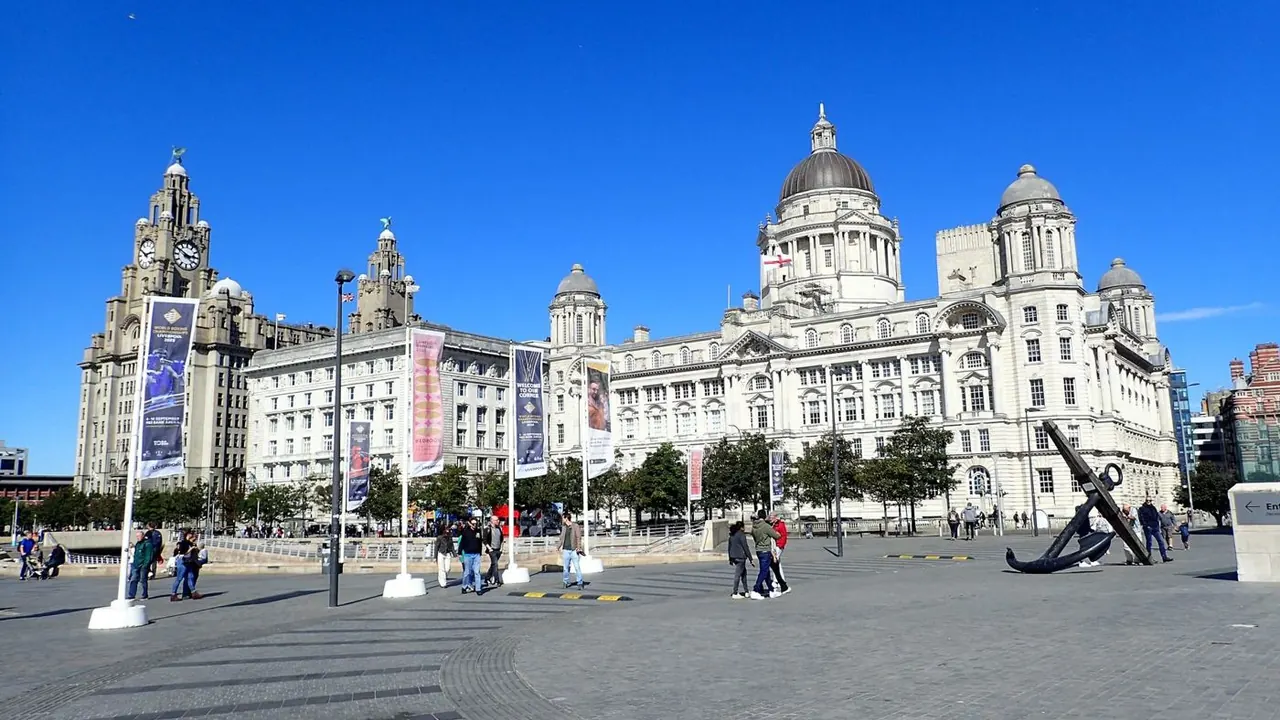
The Three Graces at Pier Head
- Getting around68
- Nightlife66
- Live music & the arts66
Photo: Marathon, CC BY-SA 2.0, cropped
Match
52
Every category weighted equally
- Beach & sun46
- Culture & arts58
- Food & nightlife55
- Family trip51
- Outdoors51
- Relax & unwind45
- Shopping & style54
- On a budget52
Liverpool in twelve categories
Our verdict on each, scored 0 to 100 against the same fixed benchmark cities, so a score means the same thing on every page.
Beaches & swimming. Scores 22 out of 100.
Food & drink. Scores 48 out of 100.
Culture & sights. Scores 64 out of 100.
Nightlife. Scores 66 out of 100.
Nature & outdoors. Scores 52 out of 100.
Day trips. Scores 64 out of 100.
Good for families. Scores 55 out of 100.
Getting around. Scores 68 out of 100.
Shopping & style. Scores 52 out of 100.
Affordability. Scores 50 out of 100.
Live music & performing arts. Scores 66 out of 100.
Wellness & relaxation. Scores 22 out of 100.
Liverpool category by category
Beaches & swimming
22Liverpool has sand within easy reach but little real swimming. Merseyrail runs north along the coast to Crosby, where Antony Gormley's iron figures stand out on the tidal flats, and on to Formby, whose broad beach is backed by pine-topped dunes. Across the river, New Brighton has a promenade and a sandy shore, and West Kirby has a walled marine lake where the water stays in at low tide.
The Irish Sea seldom gets above about 16°C even in late summer, the tide goes out a very long way, and currents and soft mud make parts of the shore unsafe. Locals go to the beach for walks, wind and sunsets rather than a swim, and a visitor should do the same.
Food & drink
48Eating out in Liverpool is relaxed and good-humoured rather than a reason to come. The local dish is scouse, a slow-cooked stew of meat, potato and vegetables that gave the city's people their nickname, and it turns up in pubs and cafés with pickled red cabbage and crusty bread. Beyond that the city cooks what most British cities cook, with fish and chips, Sunday roasts and a long-standing Chinatown around its great ornamental arch.
The more interesting eating is on Bold Street, lined with independent cafés and small international kitchens, in the street-food halls and bars of the Baltic Triangle, and in the Georgian Quarter. Fine dining is limited, while pubs, from Victorian gin palaces to cosy backstreet locals, are a highlight.
Culture & sights
64Liverpool's sights tell the story of a great port. The Pier Head is lined with the Three Graces, the Royal Liver Building with its copper birds among them, and beside it the brick and iron warehouses of the Royal Albert Dock, the largest group of Grade I listed buildings in the country, hold the Merseyside Maritime Museum and the International Slavery Museum. The Museum of Liverpool covers the city's own history, and the Beatles are remembered at the dock and around Mathew Street.
Up the hill, William Brown Street gathers the neoclassical St George's Hall, the World Museum and the Walker Art Gallery, which has a fine collection of Pre-Raphaelite painting. The city has two striking 20th-century cathedrals, the vast Gothic Anglican one and the round Catholic Metropolitan, linked by Hope Street. Most of this can be seen in two or three days.
Nightlife
66Liverpool has a reputation as a party city, and nights out start early and go on late. Concert Square and the streets around Seel Street and Wood Street fill with bars and clubs at weekends, and big groups celebrating a stag or hen weekend are part of the scene. Mathew Street is the noisier, more touristy strip.
For something less rowdy, the Baltic Triangle's converted warehouses hold bars and late club nights with a stronger underground and electronic leaning, and Lark Lane in the south has a run of easygoing local bars. A large student population keeps weeknights lively in term time. Many nights end well after 2am, though it never has the round-the-clock feel of the biggest cities.
Nature & outdoors
52The city is flat, but it has some fine Victorian parks, above all Sefton Park with its lake and palm house, and the riverside promenade makes a long, breezy walk along the Mersey. Riding the ferry across the river gives the classic view back to the waterfront.
Just out of town, Formby's dunes and pinewoods are a nature reserve where red squirrels and natterjack toads survive, and the Wirral Way follows an old railway line for walking and cycling to the Dee estuary, where wading birds gather in winter. Real hills mean a longer journey: the mountains of North Wales and the Lake District are each about two hours away, more than most visitors would plan for a day.
Day trips
64Liverpool sits well for outings. Chester is about 45 minutes by train, with its Roman walls, black-and-white timbered Rows and cathedral, and Manchester is under an hour away for its museums and Victorian centre. Closer still, Port Sunlight on the Wirral is a model village built for soap-factory workers, and Southport has a Victorian seaside promenade and a long pier.
Further along the North Wales coast, Conwy's walled town and castle and the old resort of Llandudno make a good longer day, about an hour and a half by car. The Lake District, with towns such as Windermere and Keswick, is about two hours and stretches the definition of a day trip. The list is respectable, though it thins quickly after Chester.
Good for families
55Liverpool is an easy, friendly city for families. Most of its big museums are free, and several suit children: the World Museum has dinosaurs, an aquarium room and a planetarium, and the Museum of Liverpool has a dedicated play gallery. The ferry across the Mersey is a simple outing that children enjoy, and the waterfront is flat and pedestrian.
The bigger draws lie outside the city: Chester Zoo, one of the largest in the country, is under an hour away, and Knowsley Safari Park is on the eastern edge of town. The beaches are fine for sandcastles but not for swimming, and loud weekend nights in the centre are something to plan around.
Getting around
68Most of what a visitor wants is walkable. The city centre, the Royal Albert Dock, the Pier Head, the Ropewalks and the two cathedrals lie within about 2km of one another, and the walk is easy, though Hope Street and the university quarter sit on a hill. Merseyrail's underground loop and its suburban lines reach Crosby, Formby, Southport and the Wirral simply and often, and the ferry crosses the river.
There is no tram or metro across the city, so places like Sefton Park and Anfield need a bus or a taxi, and the bus network is more confusing for a visitor than the trains. A car is not needed for the city itself, and only for some of the countryside further out.
Shopping & style
52Liverpool is a solid shopping city for the high street. Liverpool ONE, a large open-air district of streets and terraces between the centre and the docks, brings together the major British chains and department stores, and Church Street and Lord Street carry on from it. Luxury fashion is thin.
The more characterful shopping is on Bold Street, with vintage clothes, records and independent boutiques, and in the small makers' studios and design shops around the Baltic Triangle. Beatles memorabilia and football club merchandise are the souvenirs most visitors take home. There is no strong craft tradition or great market to seek out.
Affordability
50For a British city, Liverpool is good value. Hotel rooms cost noticeably less than in the capital or the country's most visited historic cities for most of the year, though they climb sharply on big match weekends, during the Grand National at nearby Aintree and around large concerts. Most of the major museums and galleries, including the maritime, slavery, world and Walker collections, are free, which keeps a sightseeing day cheap.
Eating and drinking out are at normal British levels, pubs offer good-value meals, and the centre is small enough that a visitor walks more than they pay for transport. It is not a budget destination by international standards, but money goes further here than in much of the country.
Live music & performing arts
66Music is central to Liverpool's identity, and not only because of the Beatles. Live bands play most nights in the pubs and small venues around Mathew Street, Seel Street and the Baltic Triangle, and the rebuilt Cavern Club on Mathew Street keeps a steady programme of tribute acts and new bands in a cellar that draws pilgrims from everywhere.
On the formal side, the Royal Liverpool Philharmonic, one of the oldest orchestras in the country, plays a full season in its art deco hall on Hope Street. The Everyman and the Playhouse produce their own respected theatre, and the Empire takes touring musicals and big shows. Opera comes only on tour, and the classical programme is good rather than world class.
Wellness & relaxation
22Liverpool is not a place people come to rest. There is no bathing culture, and wellness means hotel spas and a few day spas in the centre and around the docks. Weekend nights in the centre are loud. Quieter moments come from long walks in Sefton Park, an unhurried ferry crossing or a slow afternoon in the free galleries. A visitor wanting a properly restorative break would do better to stay out on the coast or the Wirral.
When should you go?
Pick a month to see what it is like. The climate figures are measured averages, not a forecast.
Liverpool in July
Daytime high, °C
Rainfall in the month, mm
The whole year
Shaded against this city’s own year: the deepest cell is its best month for that figure and the palest its weakest.
Where the figures come from
Liverpool's temperatures are measured 47 km from the centre, at Manchester Airport.
Liverpool has no rain gauge within 25 km of the centre, so its rainfall comes from a gridded climate dataset read at the city rather than from a gauge further away.
Temperature and rainfall are climate normals, averaged over the years shown. Liverpool: 1991-2020 normals, Manchester Airport (47.4 km from centre).
Before you go
| Measure | Liverpool |
|---|---|
| Official language | English |
| Currency | Pound Sterling (GBP) |
| Sockets | G230 V, 50 Hz |
| Driving side | Left |
| Time zone | UTC, UTC+1 in summer |
| Emergency number | 112 or 999 |
| Elevation | 70 m |
| Main airport | Liverpool John Lennon Airport (LPL)12 km from centre75 non-stop destinations |
| Public holidays this year | 8 days |
By the numbers
| Measure | Liverpool |
|---|---|
| City population | 513,441 |
| People per km² | 4,592 |
| Museums within 10 km | 31 |
| UNESCO World Heritage sites within 50 km | 2 |
| Swim season, months above 21 °C | None |
Compare Liverpool with
Every comparison with a written verdict behind it.