United States
Flagstaff
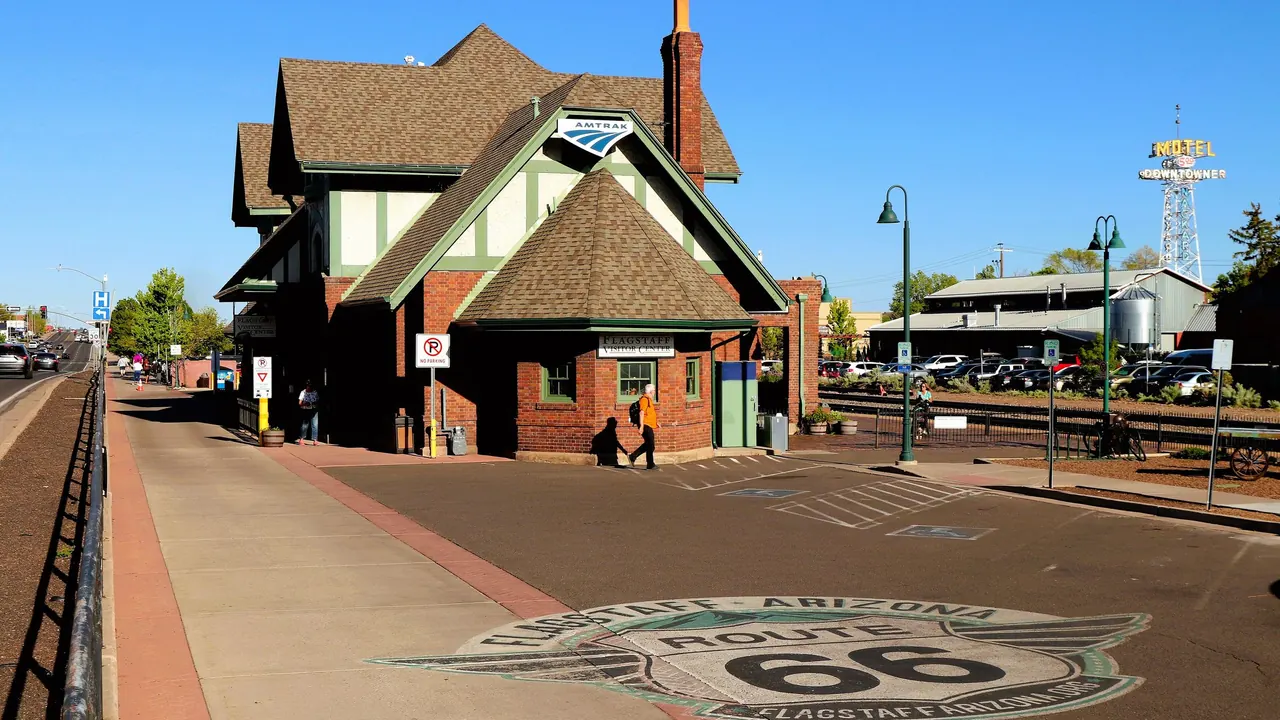
The old railway depot on Route 66
- Nature & outdoors90
- Families60
- Day trips55
Photo: Thank You (25 Millions) views, CC BY 2.0, cropped
Match
40
Every category weighted equally
- Beach & sun37
- Culture & arts37
- Food & nightlife33
- Family trip43
- Outdoors48
- Relax & unwind39
- Shopping & style36
- On a budget40
Flagstaff in twelve categories
Our verdict on each, scored 0 to 100 against the same fixed benchmark cities, so a score means the same thing on every page.
Beaches & swimming. Scores 7 out of 100.
Food & drink. Scores 35 out of 100.
Culture & sights. Scores 35 out of 100.
Nightlife. Scores 30 out of 100.
Nature & outdoors. Scores 90 out of 100.
Day trips. Scores 55 out of 100.
Good for families. Scores 60 out of 100.
Getting around. Scores 30 out of 100.
Shopping & style. Scores 28 out of 100.
Affordability. Scores 42 out of 100.
Live music & performing arts. Scores 30 out of 100.
Wellness & relaxation. Scores 32 out of 100.
Flagstaff category by category
Beaches & swimming
7Flagstaff sits at about 2,100m on a forested plateau in northern Arizona, hours from any coast, so this is not a place for a beach vacation. The nearest real swimming is in Oak Creek Canyon on the way down to Sedona, where Slide Rock and a few creek pools fill with families on hot summer days. The water is cold, the rocks are slippery and the spots are crowded at weekends. The reservoirs south of town are for boating and fishing rather than bathing, so otherwise swimming means a hotel or public pool.
Food & drink
35Eating in Flagstaff is casual and fairly limited. Its strongest suit is beer: a cluster of craft breweries in and around the historic downtown and the Southside neighbourhood, many with patios that fill on summer evenings. Beyond that you find the usual small Western university-town mix, with coffee houses, diners, Mexican and New Mexican cooking, burger and barbecue joints and a few more ambitious restaurants downtown.
Regional touches such as Navajo frybread, Navajo tacos and green chile do appear, but the town has no deep food culture of its own and no fine-dining tier worth planning around. It is fine for a hungry hiker, but it is not a reason to choose the town.
Culture & sights
35Flagstaff has a short list of sights, but a good one. The Lowell Observatory on Mars Hill is where Pluto was discovered in 1930, and its historic telescopes and night viewings are the town's signature attraction. The Museum of Northern Arizona, set in the pines on the edge of town, is a serious collection of Hopi, Navajo and Zuni art alongside the region's geology and natural history.
Add the Arts and Crafts era Riordan Mansion, the brick railroad-era downtown on old Route 66 and its historic station, and that is most of it. A day or two covers the town itself. The ancient pueblo sites nearby need a separate outing.
Nightlife
30Going out in Flagstaff means a walk around the downtown blocks and the Southside, where brewery taprooms, a few cocktail bars and old Route 66 saloons sit within a few minutes of each other. University students keep things livelier on term-time weekends than the town's size suggests, but there is little in the way of clubs. Most places quieten well before the small hours. Visitors who rise early for hiking or the Grand Canyon rarely miss what is not there.
Nature & outdoors
90This is Flagstaff's reason to exist as a base. The town sits at the foot of the San Francisco Peaks, a volcanic range topped by Humphreys Peak at 3,850m, with alpine trails, autumn aspen groves and a ski area on the slopes about half an hour away. Around it spreads one of the largest ponderosa pine forests in the world, crossed by an extensive urban trail network and the Arizona Trail. The cinder cones and black lava flows of Sunset Crater are just north of town.
Within an hour or so you reach the red rock canyons of Sedona and Oak Creek, Meteor Crater and the South Rim of the Grand Canyon, about an hour and a half away. The skies are dark enough to make this the world's first International Dark Sky City. Summers are pleasant at altitude with afternoon monsoon storms, and winters bring real snow.
Day trips
55The places within reach are mostly small and scattered, but they are varied. Sedona is under an hour away, a resort town of galleries and adobe-style shopping set among red rock. Beyond it the old copper-mining town of Jerome clings to a hillside, and Montezuma Castle and Tuzigoot preserve cliff dwellings and pueblos in the Verde Valley. Closer to Flagstaff, Walnut Canyon and Wupatki protect Sinagua ruins.
West along Route 66, Williams is the departure point for the historic railway to the Grand Canyon, whose rim village has early 20th-century lodges. Eastward, Winslow has a restored Harvey House hotel, and the Hopi mesas, with some of the oldest continuously inhabited villages in North America, are about two hours away. A car is essential for all of this.
Good for families
60Flagstaff is an easy, relaxed town to visit with children, and its attractions suit curious kids. The Lowell Observatory's telescope evenings and the dinosaur and geology displays at the Museum of Northern Arizona work well, and summer adds rope courses in the pines. Winter brings sledding and snow play on the mountain, which children who live in the desert lowlands drive up specially to enjoy.
A little further out are a drive-through wildlife park near Williams, the steam-era train to the Grand Canyon and the creek pools of Oak Creek Canyon. The catches are the altitude, which tires small children for the first day or two, cold nights even in summer and long drives between outings.
Getting around
30The historic downtown and Southside are compact and pleasant to walk, and a paved urban trail network makes cycling around town practical. A local bus system serves the university and main roads, and long-distance trains stop at the downtown station. But the motels strung along Route 66 are spread out, and the mountain, the national monuments, Sedona and the Grand Canyon all lie beyond any useful public transport. Realistically, a visitor needs a car or will be booking tours. Winter snow and ice sometimes make the mountain roads hard going.
Shopping & style
28Shopping here is small-scale. Downtown has outdoor gear shops, a few independent boutiques, bookshops and Route 66 souvenirs. The real draw is Native American craft, with Navajo rugs, Hopi kachina carvings, pottery and silver and turquoise jewellery sold in downtown galleries, the museum shop and trading posts on the roads north and east of town. Buying from established dealers, or directly from artists, is the way to be sure of authentic work. Beyond that there is a regional mall and big-box chains, and nothing that draws people to the town for shopping.
Affordability
42Flagstaff is moderately priced by American standards, but that is not cheap for most international visitors. Chain motels along old Route 66 keep a basic stay within reach. Rooms rise sharply on summer weekends and during school breaks, though, when the town is the main bed base for the Grand Canyon. Brewery and casual meals are reasonable, and tipping adds to every bill. Most visitors also need a hire car and fuel, plus national park and monument entry fees. Staying in town is usually much cheaper than staying in Sedona or at the canyon rim.
Live music & performing arts
30For a town of its size, Flagstaff has a steady, modest performing arts calendar. The Flagstaff Symphony Orchestra and the Northern Arizona University music school perform in the campus concert hall, and the restored Orpheum Theater downtown hosts touring bands and folk and indie acts. Community theatre companies stage plays through the year, and summer brings outdoor concerts in the pines and music festivals. Breweries and bars host local bands at weekends. It is a pleasant extra for an evening, not something to plan a trip around.
Wellness & relaxation
32Flagstaff has no bathing culture, no hot springs and only a handful of day spas and massage studios. Its restorative side comes from its setting: a quiet, slow-paced mountain town where evenings are cool, the air smells of pine and the stars are unusually bright. Visitors looking for spa treatments or retreats usually drive down to Sedona, about an hour away, whose resort spas, yoga studios and alternative healing offer are far more developed. Some people also find the altitude disrupts sleep for the first night or two.
When should you go?
Pick a month to see what it is like. The climate figures are measured averages, not a forecast.
Flagstaff in July
Daytime high, °C
Rainfall in the month, mm
The whole year
Shaded against this city’s own year: the deepest cell is its best month for that figure and the palest its weakest.
Where the figures come from
Flagstaff has no rain gauge within 25 km of the centre, so its rainfall comes from a gridded climate dataset read at the city rather than from a gauge further away.
Temperature and rainfall are climate normals, averaged over the years shown. Flagstaff: 1991-2020 normals, Flagstaff / Fort Tuthill (7.4 km from centre).
Before you go
| Measure | Flagstaff |
|---|---|
| Currency | US Dollar (USD) |
| Sockets | AB120 V, 60 Hz |
| Driving side | Right |
| Time zone | UTC-7 |
| Emergency number | 911 |
| Elevation | 2,106 m |
| Main airport | Flagstaff Pulliam Airport (FLG)7 km from centre2 non-stop destinations |
| Public holidays this year | 12 days |
By the numbers
| Measure | Flagstaff |
|---|---|
| City population | 76,831 |
| People per km² | 464 |
| Museums within 10 km | 1 |
| UNESCO World Heritage sites within 50 km | 0 |
Compare Flagstaff with
Every comparison with a written verdict behind it.
- Alta, Utah
- Aspen
- Beaver Creek
- Boulder
- Breckenridge
- Colorado Springs
- Copper Mountain
- Deer Valley
- Denver
- Huntington Beach
- Keystone
- Laguna Beach
- Las Vegas
- Los Angeles
- Newport Beach
- Palm Desert
- Palm Springs
- Park City
- Phoenix
- Salt Lake City
- San Diego
- San Francisco
- San Jose
- Santa Barbara
- Santa Fe
- Santa Monica
- Scottsdale
- Sedona
- Snowbird
- Steamboat Springs
- Telluride
- Tucson
- Vail
- Winter Park, Colorado