Germany
Berlin
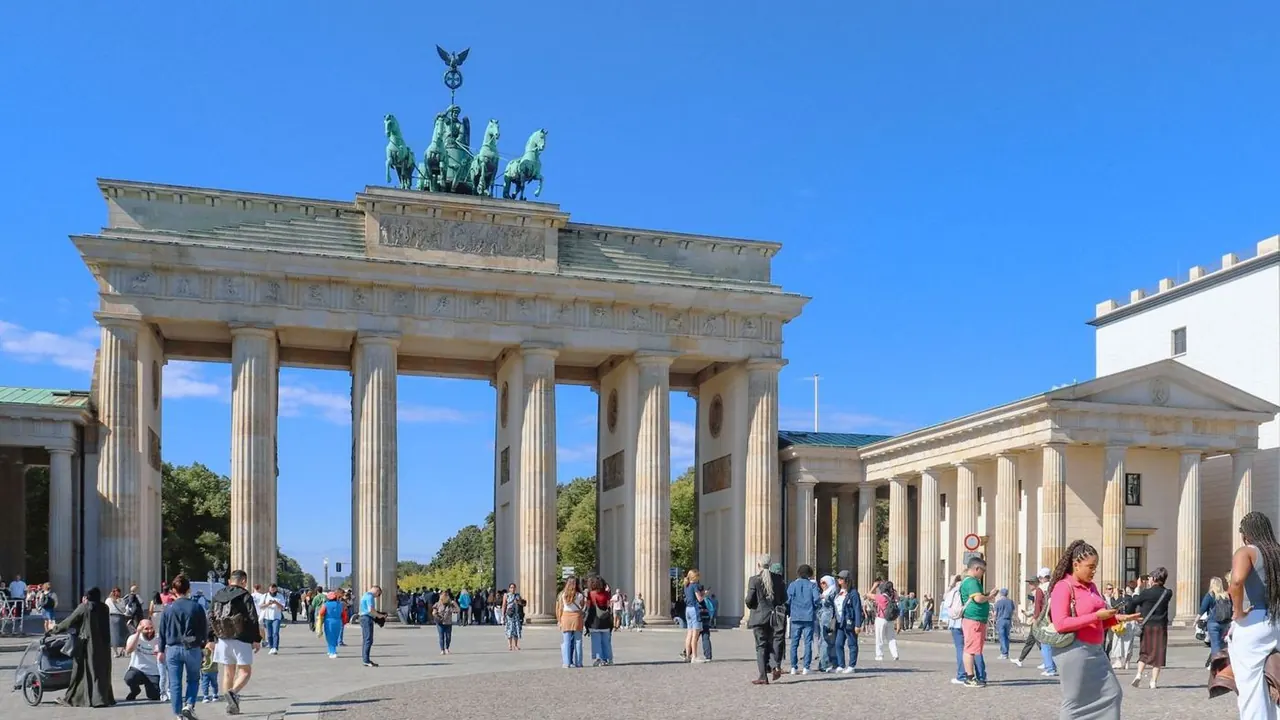
The Brandenburg Gate
- Nightlife98
- Live music & the arts90
- Culture & sights86
Photo: Claudia Solano, Pexels License
Match
69
Every category weighted equally
- Beach & sun62
- Culture & arts75
- Food & nightlife74
- Family trip64
- Outdoors62
- Relax & unwind62
- Shopping & style72
- On a budget66
Berlin in twelve categories
Our verdict on each, scored 0 to 100 against the same fixed benchmark cities, so a score means the same thing on every page.
Beaches & swimming. Scores 38 out of 100.
Food & drink. Scores 66 out of 100.
Culture & sights. Scores 86 out of 100.
Nightlife. Scores 98 out of 100.
Nature & outdoors. Scores 50 out of 100.
Day trips. Scores 66 out of 100.
Good for families. Scores 76 out of 100.
Getting around. Scores 82 out of 100.
Shopping & style. Scores 68 out of 100.
Affordability. Scores 48 out of 100.
Live music & performing arts. Scores 90 out of 100.
Wellness & relaxation. Scores 55 out of 100.
Berlin category by category
Beaches & swimming
38Berlin has no sea. The Baltic is around three hours away. What it does have is lake bathing, and Berliners take it seriously. On warm summer days the city heads for Strandbad Wannsee, a historic lido with a long sandy shore and wicker beach chairs, or for the Müggelsee in the east. Smaller forest lakes such as Schlachtensee, Krumme Lanke and Plötzensee are reachable by S-Bahn or bus. In July and August the water reaches about 20-23°C and is pleasant to swim in.
The season is short, though. Outside high summer the lakes are for looking at, so swimming is a nice extra to a city break, not a reason to book one.
Food & drink
66Berlin eats well without having a great cuisine of its own. The local classics are hearty and simple: currywurst from a street stand, pork knuckle, potato dishes and Berliner Weisse beer. The real strength is range. Decades of Turkish migration made the döner kebab a city staple, and Kreuzberg and Neukölln are full of Turkish bakeries and grill houses. Vietnamese, Levantine and Korean cooking are widespread and good, and there is a serious modern fine-dining tier.
Market halls such as Markthalle Neun in Kreuzberg host street-food evenings, and weekly markets fill the squares. Beer gardens in the parks, a specialty coffee scene and natural wine bars round it out. Eating out is casual and unfussy.
Culture & sights
86Berlin's sights are its collections and its history, more than a pretty old town, since war and division left the cityscape patchy. Museum Island is a UNESCO-listed group of five museums. It holds the bust of Nefertiti in the Neues Museum, classical antiquities and the Pergamon collections. Nearby, the Gemäldegalerie has one of Europe's great collections of old masters, and Charlottenburg Palace shows the Prussian court.
The twentieth century is what sets the city apart. The Brandenburg Gate, the Reichstag with its glass dome, the Memorial to the Murdered Jews of Europe, the Topography of Terror and the Berlin Wall Memorial on Bernauer Strasse tell the story at the places where it happened. The East Side Gallery, the Bauhaus-era housing estates and the socialist boulevard of Karl-Marx-Allee add architecture you will not see anywhere else.
Nightlife
98For club culture, Berlin is the city people travel to. The techno clubs in former power stations, factories and warehouses are known worldwide. There are no fixed closing hours, and parties often run from Saturday night into Monday. Door policies are famously strict and phones are often taped over, which keeps the inside private. Many regulars do not arrive until well after midnight.
Away from the clubs, the bar scene is just as deep. There are smoky corner Kneipen in Neukölln and Wedding, cocktail bars in Mitte and Kreuzberg, and beer in the parks and along the canal on summer evenings. Friedrichshain and Kreuzberg are the heart of it. The atmosphere is relaxed, the dress code is mostly black, and you can find a bar open almost any time.
Nature & outdoors
50Berlin is flat and green. The Tiergarten covers the middle of the city, and the old Tempelhof airfield is a huge open space where people cycle, skate and kite-surf on the runways. The Grunewald forest and the Havel lakes in the west offer long woodland walks and sailing. In the east, the Müggelsee and its forests are good for paddling and rowing. The Berlin Wall Trail runs right round the former West Berlin and is an easy cycle route for a day or two.
Beyond the city, Brandenburg's lake country and forests are good for canoe trips and quiet cycling. The landscape is pleasant rather than dramatic, though. There are no hills to climb and no coast, and the winters are grey.
Day trips
66Potsdam is the outstanding day trip, about half an hour away by S-Bahn or regional train. Sanssouci and the other Prussian palaces and gardens are a UNESCO site large enough to fill a whole day, and the Dutch Quarter adds charm. Lutherstadt Wittenberg, where the Reformation began, is about forty minutes away by fast train. Leipzig, with its Bach church and arcades, takes about 75 minutes, and Dessau has the Bauhaus buildings.
Dresden, with its rebuilt baroque skyline and art collections, is about two hours away, which makes for a long but rewarding day. The Spreewald villages and canals are about an hour out, and the Sachsenhausen memorial is closer still. After that the choice runs out fast.
Good for families
76Berlin works well with children. The Zoologischer Garten and its aquarium, in the west, hold one of the largest collections of species anywhere. The Tierpark in the east is a vast, leafy zoo where you can spend a whole day. The Natural History Museum has a towering dinosaur skeleton, the German Museum of Technology is full of trains, planes and hands-on science, and there are dedicated children's museums too.
Playgrounds are everywhere, and the lakes and parks give children room to run. Prams are easy on the flat streets and the trains, and the city is relaxed about children. There is no big theme park, and some of the historic sights are heavy going for young ones.
Getting around
82Berlin is easy to get around but large. The U-Bahn, S-Bahn, trams and buses share one ticket system. The S-Bahn Ring and the east-west line link most districts quickly, and the trains run through the night at weekends. Tram lines still cover much of the former East. The city is completely flat and has wide streets and plenty of bike lanes, so cycling is a natural choice for visitors.
The catch is distance. Mitte, Kreuzberg, Prenzlauer Berg and Charlottenburg are separate centres, each walkable, but you need transport between them. A car is unnecessary and parking is a nuisance.
Shopping & style
68Berlin is better for independent shops and second-hand finds than for luxury. In the west, the Kurfürstendamm has the big brands, and KaDeWe is a century-old department store famous for its food hall. In the centre, the Friedrichstrasse is more formal. Concept stores and young designers cluster in the streets of Mitte around Hackescher Markt, and Prenzlauer Berg and Kreuzberg have record shops, bookshops and vintage clothing.
The Sunday flea markets are what really sets the city apart. Mauerpark and Boxhagener Platz are the best known, good for East German curios, vinyl and old furniture. Luxury depth is thin, and there are few traditional crafts to bring home.
Affordability
48Berlin is mid-priced for a Western European capital. Hotels are cheaper than in most other big capitals, though trade fairs and summer weekends push rates up. Eating cheaply is easy, with döner, Vietnamese canteens, bakeries and corner bars. Beer in a Kneipe stays reasonable, and a day transport ticket covers the whole city. Museum entry and fine dining cost about what you would expect in a big European city, so a culture-heavy trip adds up.
Live music & performing arts
90Few cities have this much on stage. Berlin has three full opera houses: the Staatsoper on Unter den Linden, the Deutsche Oper and the Komische Oper. The Berlin Philharmonic, one of the world's great orchestras, plays in Scharoun's tent-like Philharmonie. The Konzerthaus on the Gendarmenmarkt and several other orchestras fill the rest of the classical calendar.
The theatre scene is famous, from the Berliner Ensemble, Brecht's old company, to the Schaubühne and the Volksbühne. Most plays are in German, so for visitors the opera, dance and the Friedrichstadt-Palast revue are easier to enjoy. Add a deep circuit of jazz cellars, rock venues and experimental music spaces, and there is something to see every night.
Wellness & relaxation
55Berlin has no thermal springs, but it does have a real German sauna culture. Large sauna and spa complexes offer Finnish saunas, steam rooms, ritual infusions and quiet rest rooms, usually mixed and clothes-free in the German manner. The Stadtbad Neukölln, an old bathhouse with columned halls and baths, is the most atmospheric place to swim and sweat.
The city itself is less hectic than its size suggests. Long Sunday mornings in café gardens and afternoons in the parks are part of local life. If you want spring water, Brandenburg has thermal resorts about an hour away.
When should you go?
Pick a month to see what it is like. The climate figures are measured averages, not a forecast.
Berlin in July
Daytime high, °C
Rainfall in the month, mm
The whole year
Shaded against this city’s own year: the deepest cell is its best month for that figure and the palest its weakest.
Temperature and rainfall are climate normals, averaged over the years shown. Berlin: 1991-2020 normals, Berlin / Alexanderplatz (0.9 km from centre).
Before you go
| Measure | Berlin |
|---|---|
| Official language | German |
| Currency | Euro (EUR) |
| Sockets | CF230 V, 50 Hz |
| Driving side | Right |
| Time zone | UTC+1, UTC+2 in summer |
| Emergency number | 112 |
| Elevation | 34 m |
| Main airport | Berlin Brandenburg Airport (BER)19 km from centre161 non-stop destinations |
| Public holidays this year | 10 days |
By the numbers
| Measure | Berlin |
|---|---|
| City population | 3,700,577 |
| People per km² | 4,153 |
| Museums within 10 km | 157 |
| UNESCO World Heritage sites within 50 km | 4 |
Compare Berlin with
Every comparison with a written verdict behind it.
- Aarhus
- Amsterdam
- Baden-Baden
- Cologne
- Copenhagen
- Dresden
- Dusseldorf
- Frankfurt
- Gdansk
- Hamburg
- Heidelberg
- London
- Munich
- New York
- Nuremberg
- Paris
- Prague
- Stuttgart
- Vienna