Switzerland
Arosa
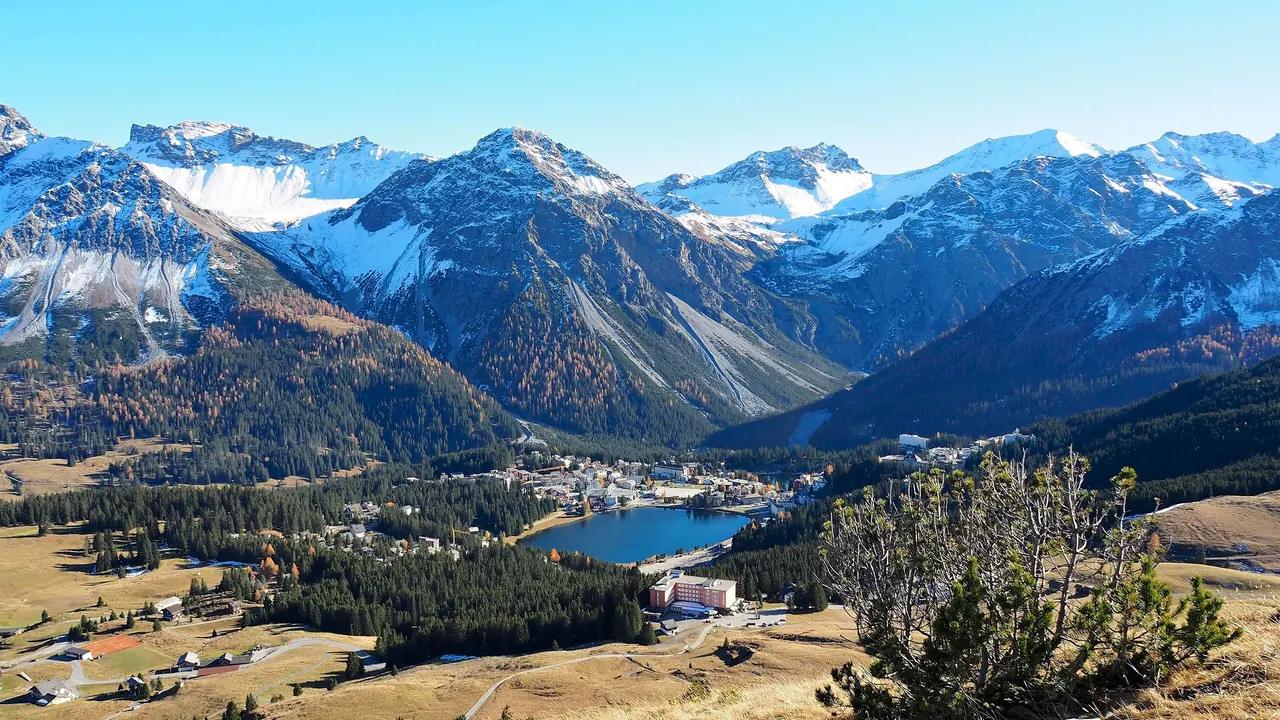
Arosa and the Obersee towards the Arosa Dolomites
- Nature & outdoors87
- Getting around72
- Families62
Photo: Andres Passwirth, CC BY-SA 4.0, cropped
Arosa lies in Swiss Alps, which has its own page.
Match
36
Every category weighted equally
- Beach & sun36
- Culture & arts33
- Food & nightlife30
- Family trip41
- Outdoors43
- Relax & unwind40
- Shopping & style33
- On a budget33
Arosa in twelve categories
Our verdict on each, scored 0 to 100 against the same fixed benchmark cities, so a score means the same thing on every page.
Beaches & swimming. Scores 20 out of 100.
Food & drink. Scores 30 out of 100.
Culture & sights. Scores 10 out of 100.
Nightlife. Scores 20 out of 100.
Nature & outdoors. Scores 87 out of 100.
Day trips. Scores 38 out of 100.
Good for families. Scores 62 out of 100.
Getting around. Scores 72 out of 100.
Shopping & style. Scores 12 out of 100.
Affordability. Scores 5 out of 100.
Live music & performing arts. Scores 22 out of 100.
Wellness & relaxation. Scores 55 out of 100.
Arosa category by category
Beaches & swimming
20Arosa has no sea anywhere near it. Swimming means its small mountain lakes. The Untersee has a lido with a lawn and a jetty, and the Obersee and the Schwellisee higher up attract hardy swimmers on warm afternoons. At this altitude the water rarely gets much above 20°C, and the season is a few weeks in July and August. A cold dip after a hike is pleasant, but nobody plans a summer stay here around the water.
Food & drink
30Eating in Arosa happens in hotel dining rooms, a few village restaurants and the huts on the slopes. The mountain restaurants are the most memorable part: rösti, capuns, barley soup and Graubünden dried meat on a terrace with a view across the valley. The luxury hotels add a small fine-dining tier for special evenings. Beyond that the choice is narrow, mostly fondue, raclette and Alpine comfort food, and many places close outside the winter and summer seasons. There is no street food and no market culture to speak of.
Culture & sights
10Arosa is a resort, not a place for sightseeing. The one sight of note is the Bergkirchli, a little wooden-shingled chapel from the late 15th century standing alone on a meadow above Innerarosa. The Schanfigg local history museum tells the story of the valley's farmers and of the village's past as a high-altitude health resort, when sanatoriums treated tuberculosis patients in the thin, dry air. A few grand old hotels are what remains of that era. An afternoon covers all of it.
Nightlife
20Going out in Arosa follows the ski season. In winter there is après-ski in slope-side bars from late afternoon, followed by a handful of hotel bars and a couple of small clubs that stay open late at weekends and in the busiest weeks. The atmosphere is smart and fairly sedate rather than wild. A long-running gay ski week in January brings the liveliest nights of the year. In summer and between seasons evenings are quiet and most people are in bed early.
Nature & outdoors
87Arosa sits at the head of the Schanfigg valley at 1,800m, in a basin of larches, lakes and bare summits, with the Weisshorn rising to over 2,600m directly above the village. In winter the lifts link to Lenzerheide across the ridge, making one of the larger ski areas in Graubünden, plus cross-country trails, winter walking paths and sledging runs. Snow is reliable thanks to the altitude.
In summer the same slopes become hiking and mountain-biking terrain, from easy lake circuits to high routes over the passes toward Davos and Lenzerheide. Marmots are common on the upper meadows, and the Arosa Bear Sanctuary keeps rescued brown bears in a large hillside enclosure. Note the dead-end valley position: everything is reached on foot or by lift from the village itself.
Day trips
38Arosa sits at the end of a road and a railway, and every outing starts with the hour-long train ride down to Chur. The journey itself is part of the pleasure, with curving viaducts over the Schanfigg gorges. Chur is the obvious day out. It is one of Switzerland's oldest towns, with a walkable old centre, a Romanesque cathedral and the Bündner art museum.
From Chur, trains continue to Maienfeld and the vineyards of the Bündner Herrschaft, to Vaduz in Liechtenstein and, with a longer day, along the Albula line toward St. Moritz or to Davos and Klosters. Count on two hours or more for those, so the list thins quickly beyond Chur.
Good for families
62Arosa works well for families who want a mountain vacation. In winter there are ski schools with gentle children's areas, long sledging runs and easy winter walks. In summer the lakes, playgrounds, short hikes to farm restaurants and the bear sanctuary fill the days, and the cable cars make high viewpoints easy for small legs. The village is safe, traffic is light and free buses help with tired children.
What it lacks is variety. There are no zoos, aquariums or museums made for children, rainy days are hard to fill beyond the indoor pool and ice rink, and the cost of eating out adds up quickly for a family.
Getting around
72No car is needed in Arosa. The Rhaetian Railway climbs up from Chur in about an hour, and within the village free buses link the station, the lake, Innerarosa and the lift stations. Lifts and cable cars then do the work on the mountain, and in winter they connect to the Lenzerheide side. The village stretches up a hillside between Ausserarosa and Innerarosa, so walking means plenty of slopes and stairs. With ski gear the bus is more useful than it looks. Reaching anywhere else is simple but slow, since every journey runs back down the single line to Chur.
Shopping & style
12Shopping in Arosa means ski and outdoor equipment, rental shops, a few fashion boutiques serving the hotel guests and the usual Swiss chocolate and souvenir stores along the main street. It covers what a stay needs and little more. For real shopping, the old town of Chur, an hour down the line, is the nearest place with any range.
Affordability
5Arosa is very expensive. Hotels lean toward the upscale end, the peak winter weeks are priced to match, and eating out, lift passes and ski rental all cost what you would expect in a Swiss mountain resort. The free village buses and the perks that come with the summer guest card help a little. Simple guesthouses and vacation apartments where you cook for yourself are the main way to keep costs down. Summer is noticeably cheaper than the ski season, but no time of year makes this a budget destination.
Live music & performing arts
22Arosa has no theatre or concert hall season, but it does have a few fixed points in its calendar. A long-established comedy festival in December puts stand-up and cabaret on stages around the village, partly outdoors in the snow. In summer a programme of chamber concerts and music courses fills the churches, including the old Bergkirchli, with classical music. Outside those weeks live performance comes down to the odd hotel pianist or a band at après-ski.
Wellness & relaxation
55Arosa was built as a place to recover. Its first visitors came for the dry, sunny mountain air, and the village has kept a slow, quiet rhythm. There are no thermal springs or public bathhouse culture here. The bathing happens in the spa areas of the larger hotels, some of them extensive, with pools, saunas and treatment rooms looking out on the peaks, plus a public indoor pool in the village. Outside the busiest ski weeks the calm is real: walks by the lake, sun terraces and early nights. It suits a quiet, restful stay more than a dedicated spa trip.
When should you go?
Pick a month to see what it is like. The climate figures are measured averages, not a forecast.
Arosa in July
Daytime high, °C
Rainfall in the month, mm
The whole year
Shaded against this destination’s own year: the deepest cell is its best month for that figure and the palest its weakest.
Where the figures come from
Arosa's temperatures are measured 31 km from the centre, at Samedan.
Arosa has no rain gauge within 25 km of the centre, so its rainfall comes from a gridded climate dataset read at the destination rather than from a gauge further away.
Temperature and rainfall are climate normals, averaged over the years shown. Arosa: 2015-2025 (rainfall 1991-2020) normals, Samedan (31.2 km from centre).
Before you go
| Measure | Arosa |
|---|---|
| Official language | French, German, Italian, Romansh |
| Currency | Swiss Franc (CHF) |
| Sockets | CJ230 V, 50 Hz |
| Driving side | Right |
| Time zone | UTC+1, UTC+2 in summer |
| Emergency number | 112 |
| Elevation | 1,775 m |
| Main airport | Zürich Airport (ZRH)114 km from centre226 non-stop destinations |
| Public holidays this year | 9 days |
By the numbers
| Measure | Arosa |
|---|---|
| Population | 3,185 |
| People per km² | 21 |
| Museums within 10 km | 1 |
| UNESCO World Heritage sites within 50 km | 2 |
Compare Arosa with
Every comparison with a written verdict behind it.
- Adelboden
- Alpe d'Huez
- Andermatt
- Avoriaz
- Chamonix
- Châtel
- Courchevel
- Crans-Montana
- Davos
- Engelberg
- Flaine
- Grindelwald
- Gstaad
- Klosters
- La Clusaz
- La Plagne
- La Rosière
- Laax
- Le Grand-Bornand
- Lenzerheide
- Les Arcs
- Les Deux Alpes
- Les Gets
- Les Menuires
- Leukerbad
- Megève
- Méribel
- Montgenèvre
- Morzine
- Mürren
- Saas-Fee
- Saint-Gervais-les-Bains
- Samnaun
- Samoëns
- Serre Chevalier
- St. Moritz
- Tignes
- Val Cenis
- Val d'Isère
- Val Thorens
- Verbier
- Wengen
- Zermatt