Belgium
Antwerp
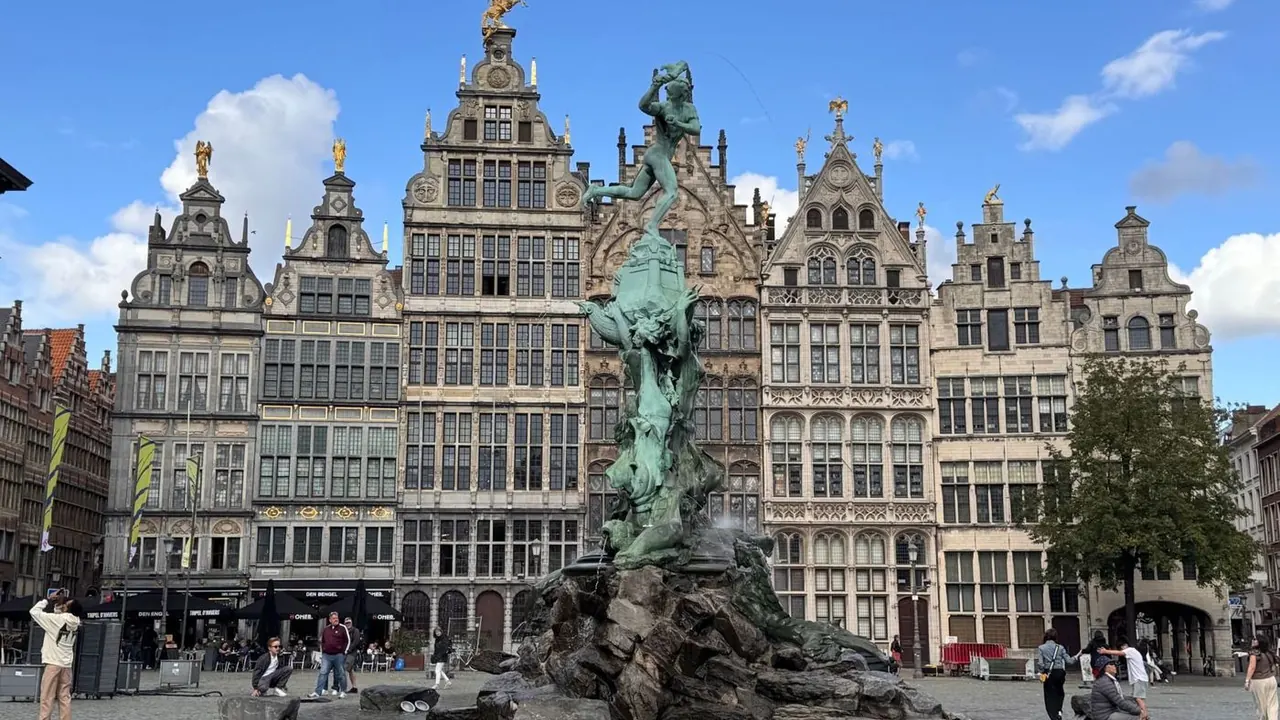
Grote Markt and the Brabo Fountain
- Day trips86
- Getting around75
- Culture & sights73
Photo: Norbert Jakab, Pexels License
Match
55
Every category weighted equally
- Beach & sun47
- Culture & arts63
- Food & nightlife58
- Family trip53
- Outdoors53
- Relax & unwind48
- Shopping & style60
- On a budget53
Antwerp in twelve categories
Our verdict on each, scored 0 to 100 against the same fixed benchmark cities, so a score means the same thing on every page.
Beaches & swimming. Scores 15 out of 100.
Food & drink. Scores 62 out of 100.
Culture & sights. Scores 73 out of 100.
Nightlife. Scores 56 out of 100.
Nature & outdoors. Scores 33 out of 100.
Day trips. Scores 86 out of 100.
Good for families. Scores 62 out of 100.
Getting around. Scores 75 out of 100.
Shopping & style. Scores 70 out of 100.
Affordability. Scores 38 out of 100.
Live music & performing arts. Scores 58 out of 100.
Wellness & relaxation. Scores 30 out of 100.
Antwerp category by category
Beaches & swimming
15Antwerp is a river port, not a seaside city. On the left bank of the Scheldt, Sint-Annastrand has sand and a promenade, but the tidal river is for looking at, not for swimming. The Belgian coast at Blankenberge and Knokke is under two hours away by train. That is a long day out to reach the North Sea, which rarely gets much above 18°C even in August. In summer people cool off in outdoor pools and recreation lakes on the city's edge. Beach life plays no real part in a stay.
Food & drink
62Eating in Antwerp means Flemish cooking: stoofvlees braised in dark beer, mussels with frites, shrimp croquettes and waffles. Frites come from proper friteries in paper cones, and the city has its own chocolate tradition, including the hand-shaped Antwerpse handjes. Beer is the real strength. The local amber ale is served in a round glass called a bolleke, and old brown cafés around the cathedral pour long lists of Trappist and abbey beers.
Above that sits a confident restaurant scene. The best of it is in Het Zuid and around the docks of Het Eilandje, where chefs cook modern, design-led food with a few starred tables among them. Around the Grote Markt the menus are aimed at tourists and are less reliable.
Culture & sights
73Antwerp was the richest port in northern Europe in the sixteenth century, and the wealth of the Flemish Baroque is still visible. Rubens's altarpieces hang in the Gothic Cathedral of Our Lady, whose spire rises over the Grote Markt and its guild houses. The painter's own house and studio can be visited. The Plantin-Moretus Museum, a printing house kept intact since the Renaissance, is on the UNESCO list. The Royal Museum of Fine Arts holds a major collection running from the Flemish primitives to Ensor.
The nineteenth century added Central Station, a domed railway cathedral, and the Art Nouveau streets of Zurenborg. Other good visits are the MAS museum tower on the docks, the Red Star Line emigration museum, the fashion museum MoMu and the Middelheim sculpture park. Most of it can be seen in two or three days.
Nightlife
56Antwerp goes out more seriously than its size suggests. Belgian bars have no fixed closing time, so brown cafés around the old centre and the student streets near the university often stay busy well past midnight. The city has a long-standing house and techno club tradition, with venues in old warehouses and under the railway near the docks, and one of the best-known gay scenes in the Low Countries. Het Zuid has smarter cocktail bars and wine bars, and Het Eilandje has waterfront terraces in summer. Weekends are lively. Midweek nights are quieter, and it is a city-sized scene rather than a famous one.
Nature & outdoors
33The country around Antwerp is flat, low and heavily built up, with the port taking up much of the river to the north. Green space in the city comes from parks such as Rivierenhof, Nachtegalenpark and the Stadspark. North of the city, the Kalmthoutse Heide is a large cross-border heathland with dunes and pine woods, good for walking and cycling, and the polders along the Scheldt make for quiet bike rides on dykes. Cycling is the natural way to use the landscape, but there are no hills, and nobody comes here for the outdoors.
Day trips
86Antwerp sits at the centre of one of the densest clusters of historic cities in Europe, joined by frequent trains. Mechelen, with its cathedral tower and Burgundian palaces, is a short hop away. Brussels and Leuven are each well under an hour. Ghent, with its castle, canals and the Van Eyck altarpiece, takes a little under an hour. Bruges is about an hour and a half away and is best seen on a quieter weekday.
North of the border, Rotterdam is about an hour away, and Delft, The Hague and the Kinderdijk windmills can all be done in a day. Closer in, Lier's beguinage and Zimmer clock tower suit a half day, and Breda and Maastricht are within reach too.
Good for families
62Antwerp's zoo, one of the oldest in the world, sits right next to Central Station, so a day there needs no planning. The compact, mostly flat centre is manageable with a pushchair. Children usually enjoy the MAS rooftop, the trams, the Steen castle on the river and the free foot tunnel under the Scheldt. Belgian culture is relaxed about children in cafés and restaurants. Bobbejaanland theme park and the attractions on the coast need a car or a longer train ride. Grey, damp weather for much of the year means having indoor plans ready.
Getting around
75Most of what a visitor wants lies within a half-hour walk, from Central Station along the Meir shopping street to the cathedral, the river and Het Zuid. Trams, some running underground as a premetro, cover the rest, including Het Eilandje and Zurenborg. The city's shared bikes and well-marked cycle lanes make cycling a natural choice. Central Station is the national rail hub, with fast links to Brussels, the Netherlands and the airport. A car is unnecessary and parking is a burden. Cobbles and tram tracks need watching on a bike.
Shopping & style
70Fashion is Antwerp's specialism. The fashion academy produced a famous generation of avant-garde designers, and their influence shows in the boutiques of the Nationalestraat, Kammenstraat and Het Zuid. These shops lean towards conceptual Belgian labels rather than global luxury houses. The Meir is the main high street, with chain stores and the grand Stadsfeestzaal arcade. The diamond quarter by Central Station is one of the world's main gem-trading districts. Antique and interiors shops line the Kloosterstraat, and the Vrijdagmarkt has secondhand auctions. Chocolate and beer make easy gifts.
Affordability
38Antwerp is a fairly expensive city, though rooms usually cost less than in nearby capitals. Eating out, especially sit-down dinners, follows Belgian price levels, which are high for Western Europe. A beer in a local café and frites from a stand stay reasonable, and lunch menus are cheaper than dinner. Public transport is good value, and because the centre is compact, getting around much of a stay costs nothing. The major museums charge ordinary European admission. The city suits a mid-range budget better than a shoestring one.
Live music & performing arts
58Antwerp has a performing arts scene of real substance for its size. Opera Ballet Vlaanderen, the Flemish opera and ballet company, performs in the city's historic opera house on the Frankrijklei and shares its seasons with a second house in Ghent. The Antwerp Symphony Orchestra plays in the Queen Elisabeth Hall next to Central Station. The deSingel arts campus has an adventurous programme of contemporary dance, music and theatre, and contemporary dance is where Flanders has an international name. AMUZ, in a Baroque church, is devoted to early music.
Most theatre is in Dutch, which rules much of it out for many visitors. Small jazz cafés, a well-known club for rock and alternative bands and a large arena for touring stars make up the rest of the scene.
Wellness & relaxation
30Antwerp has no thermal springs or historic bathhouses, and a stay is about museums, shopping and eating rather than rest. Flanders does have a solid sauna culture, and a few large sauna and wellness complexes in the suburbs and surrounding countryside offer pools, steam rooms and gardens, mostly reached by car. Otherwise there are hotel spas and day spas. The city's pace is calmer than a capital's, and a quiet afternoon in a park or a brown café is the usual way to unwind.
When should you go?
Pick a month to see what it is like. The climate figures are measured averages, not a forecast.
Antwerp in July
Daytime high, °C
Rainfall in the month, mm
The whole year
Shaded against this city’s own year: the deepest cell is its best month for that figure and the palest its weakest.
Where the figures come from
Antwerp has no rain gauge within 25 km of the centre, so its rainfall comes from a gridded climate dataset read at the city rather than from a gauge further away.
Antwerp's sunshine is measured 47 km from the centre, at Uccle.
Temperature and rainfall are climate normals, averaged over the years shown. Antwerp: 1991-2020 normals, Antwerpen / Deurne (5.2 km from centre).
Before you go
| Measure | Antwerp |
|---|---|
| Official language | French, German, Dutch |
| Currency | Euro (EUR) |
| Sockets | CE230 V, 50 Hz |
| Driving side | Right |
| Time zone | UTC+1, UTC+2 in summer |
| Emergency number | 112 |
| Elevation | 7 m |
| Main airport | Brussels Airport (BRU)36 km from centre191 non-stop destinations |
| Public holidays this year | 14 days |
By the numbers
| Measure | Antwerp |
|---|---|
| City population | 529,247 |
| People per km² | 2,542 |
| Museums within 10 km | 38 |
| UNESCO World Heritage sites within 50 km | 9 |
Compare Antwerp with
Every comparison with a written verdict behind it.