Germany
Lubeck
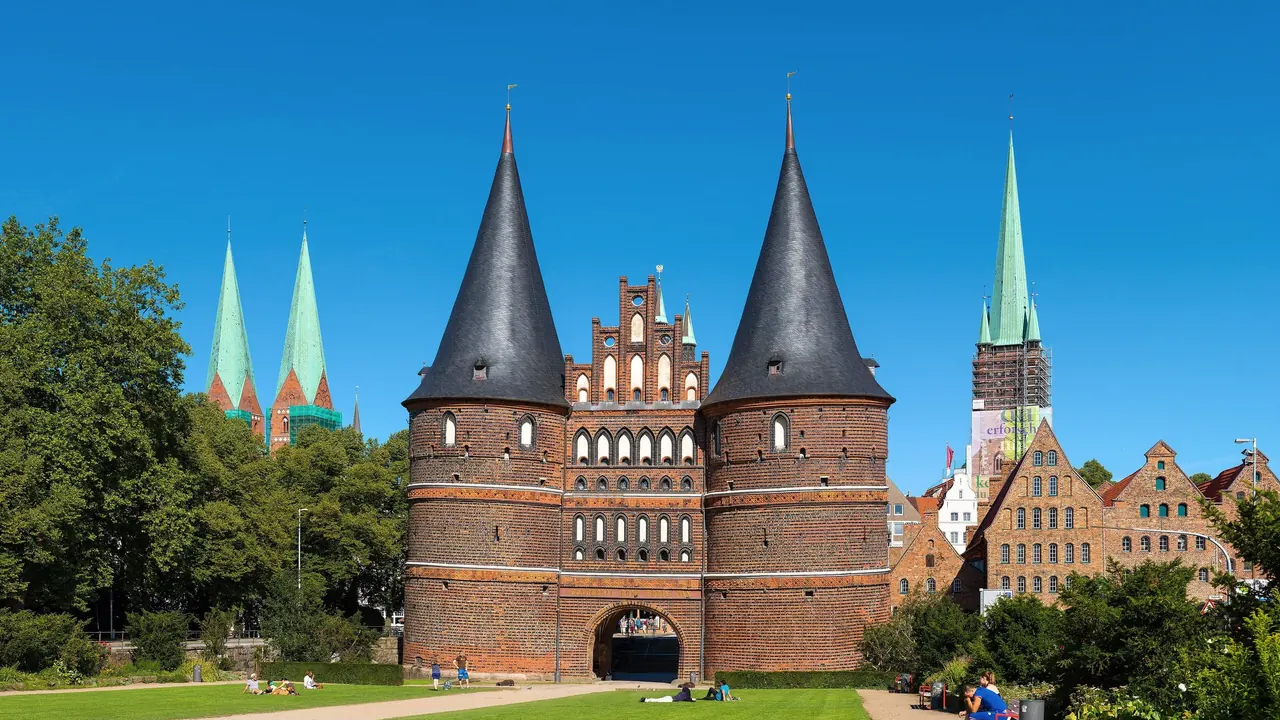
The Holstentor with the spires of the old town
- Getting around70
- Culture & sights68
- Day trips63
Photo: Christian Wolf (www.c-w-design.de), CC BY-SA 3.0 DE, cropped
Match
49
Every category weighted equally
- Beach & sun47
- Culture & arts53
- Food & nightlife47
- Family trip53
- Outdoors51
- Relax & unwind48
- Shopping & style49
- On a budget50
Lubeck in twelve categories
Our verdict on each, scored 0 to 100 against the same fixed benchmark cities, so a score means the same thing on every page.
Beaches & swimming. Scores 38 out of 100.
Food & drink. Scores 42 out of 100.
Culture & sights. Scores 68 out of 100.
Nightlife. Scores 27 out of 100.
Nature & outdoors. Scores 48 out of 100.
Day trips. Scores 63 out of 100.
Good for families. Scores 58 out of 100.
Getting around. Scores 70 out of 100.
Shopping & style. Scores 38 out of 100.
Affordability. Scores 52 out of 100.
Live music & performing arts. Scores 45 out of 100.
Wellness & relaxation. Scores 42 out of 100.
Lubeck category by category
Beaches & swimming
38Lübeck has its own seaside. Travemünde, at the mouth of the Trave and part of the city, has a long sandy beach lined with hooded wicker beach chairs, and the resorts of the Bay of Lübeck, Timmendorfer Strand, Niendorf and Scharbeutz, follow the coast north within half an hour. The Baltic here is calm, shallow and free of tides, which makes it gentle for paddling.
The catch is temperature. Even in July and August the sea usually sits around 17°C to 19°C, and the swimming season runs only from late June to early September. It is a pleasant summer outing or a few beach afternoons tacked onto a city stay, not a reason to book for the water.
Food & drink
42Lübeck's signature is marzipan, made here for centuries and sold in old cafés and confectioners around the town hall, where it comes as cake, pralines and elaborate moulded figures. The other strand is North German coastal cooking: smoked and pickled herring, fish sandwiches from harbour kiosks, plaice, labskaus and Rotspon, Bordeaux wine aged in the city's cellars by long tradition. The Schiffergesellschaft, the sea captains' guild house of the sixteenth century, still serves at long wooden tables under hanging ship models.
Beyond that, the scene is that of a provincial city of two hundred thousand: solid German taverns, a handful of modern bistros, Italian and Asian standards. Travemünde adds fish restaurants on the waterfront. Food is a pleasant part of a visit rather than its point.
Culture & sights
68The old town sits on an island ringed by the Trave and its canals, and almost all of it is a UNESCO World Heritage site: the best-preserved Hanseatic city on the Baltic. Seven tall brick church spires mark the skyline. The Holstentor, the leaning twin-towered gate, is the city's emblem, and the Marienkirche is the model for brick Gothic churches across northern Europe. The town hall, the Heiligen-Geist-Hospital, the merchants' houses with stepped gables and the narrow passages and courtyards behind them reward slow wandering.
The museums are good for the size: the European Hansemuseum tells the story of the merchant league, the Buddenbrookhaus is devoted to Thomas Mann, and there are houses for Günter Grass and Willy Brandt, plus the St. Annen and Behnhaus collections. It is a compact set, seen well in two days.
Nightlife
27Evenings in Lübeck are quiet. There are pubs and wine bars in the old town, a few student haunts and bars along the Obertrave waterfront and in the streets around the cathedral, and Travemünde's promenade is livelier on summer nights. The club scene is minimal and most of the city is asleep by midnight. Anyone after a real night out takes the train to Hamburg.
Nature & outdoors
48The landscape around Lübeck is gentle: flat to rolling farmland, beech woods, lakes and the Baltic shore. The Wakenitz river, running south from the city through reeds and woodland, is a favourite for canoeing and boat trips, and leads towards the Lauenburg lakes nature park. North of Travemünde the Brodtener Steilufer, a crumbling clay cliff above the sea, makes a fine coastal walk, and the Holstein Switzerland lake district lies within an hour.
Cycling is easy everywhere, with long flat routes along the coast and old border strip. Sailing and windsurfing happen on the bay in summer. What is missing is drama: no mountains or wild country, and winters are grey and damp.
Day trips
63Hamburg is the big one, about 45 minutes by train, and deserves a full day for its harbour, the Speicherstadt warehouse district and the Elbphilharmonie. In the other direction, Wismar, a second UNESCO-listed Hanseatic town, is about an hour away, and Schwerin, with its fairytale castle on an island in a lake, is a similar distance.
Closer to home, Ratzeburg sits on an island in its lake with a Romanesque cathedral, Mölln has its connections to the Till Eulenspiegel legend, and Eutin has a castle and a small baroque town. Kiel offers harbour life and the sea. Beyond that the options thin, and the bigger Baltic towns further east are more than two hours away.
Good for families
58Lübeck is easy with children: the old town is small, safe and flat, the Holstentor and the church towers make for adventures, and marzipan shops are an easy reward. The real family draw is the coast. Travemünde's calm, shallow beach suits small children, and the resorts along the bay have promenades, playgrounds and an aquarium. Hansa-Park, a large amusement park on the shore at Sierksdorf, is about half an hour away.
In summer this adds up to a comfortable seaside-and-city stay. Outside the warm months, there is far less made for children, and wet weather means the museums do the work.
Getting around
70The old town fits on an island about 2km long, and everything worth seeing there is a short walk apart, much of it on pedestrianised streets with some cobbles. The main station is just across the river from the Holstentor. City buses fill the gaps, and regional trains run to Travemünde in about twenty minutes and on to Hamburg, so a car is unnecessary unless you want to explore the lakes and small coastal villages.
Shopping & style
38Breite Strasse and Königstrasse form the main shopping spine, with German chain stores, a department store and bookshops. Smaller independents, galleries and craft shops hide in the side streets and courtyard passages, especially around the Hüxstrasse and Fleischhauerstrasse. Marzipan, in boxes, bars and moulded shapes, is the souvenir everyone carries home. For fashion or design in depth, visitors go to Hamburg.
Affordability
52Lübeck sits in the middle range for a Western European city. Rooms in the old town and near the station are moderately priced, with a good spread of mid-range hotels and guesthouses, and there are rarely the steep premiums of a major capital. Eating out at a traditional tavern, a bakery or a fish kiosk by the harbour is reasonable, and the marzipan cafés charge no more than an ordinary coffee house. Buses and the regional train to the coast are inexpensive, and the old town costs nothing to walk.
The exception is the seaside in high summer. Accommodation in Travemünde and the resorts along the bay is noticeably dearer in July and August and books up early, so a beach stay costs more than a city one.
Live music & performing arts
45Theater Lübeck, in an Art Nouveau house on Beckergrube, stages opera, drama and concerts through the season, and the Philharmonic plays in the Musik- und Kongresshalle on the riverside. The city's music academy keeps a steady flow of student recitals, and the churches carry on a long organ tradition: Buxtehude was organist at the Marienkirche, and organ concerts there are a quiet highlight. In summer the Schleswig-Holstein Music Festival brings well-known performers to the city's halls and churches.
Live rock, jazz and pop are limited to a few small venues, so serious concertgoers often head to Hamburg.
Wellness & relaxation
42Lübeck has no bathing tradition of its own, but Travemünde has been a seaside spa resort since the early nineteenth century, and the coast around the bay keeps that habit alive with wellness hotels, saunas and an indoor seawater pool complex at Scharbeutz. The old town is calm by any standard, with quiet courtyards, riverside benches and slow cafés. It suits an unhurried few days, though not a dedicated spa trip.
When should you go?
Pick a month to see what it is like. The climate figures are measured averages, not a forecast.
Lubeck in July
Daytime high, °C
Rainfall in the month, mm
The whole year
Shaded against this city’s own year: the deepest cell is its best month for that figure and the palest its weakest.
Temperature and rainfall are climate normals, averaged over the years shown. Lubeck: 1991-2020 normals, Luebeck-Blankensee (6 km from centre).
Before you go
| Measure | Lubeck |
|---|---|
| Official language | German |
| Currency | Euro (EUR) |
| Sockets | CF230 V, 50 Hz |
| Driving side | Right |
| Time zone | UTC+1, UTC+2 in summer |
| Emergency number | 112 |
| Elevation | 13 m |
| Main airport | Hamburg Helmut Schmidt Airport (HAM)53 km from centre120 non-stop destinations |
| Public holidays this year | 10 days |
By the numbers
| Measure | Lubeck |
|---|---|
| City population | 217,061 |
| People per km² | 1,013 |
| Museums within 10 km | 23 |
| UNESCO World Heritage sites within 50 km | 1 |
| Swim season, months above 21 °C | None |
Compare Lubeck with
Every comparison with a written verdict behind it.
- Aarhus
- Amsterdam
- Baden-Baden
- Berlin
- Cologne
- Copenhagen
- Dresden
- Dusseldorf
- Frankfurt
- Freiburg
- Gdansk
- Gothenburg
- Haarlem
- Hamburg
- Heidelberg
- Karlovy Vary
- Leipzig
- Maastricht
- Malmo
- Munich
- Nuremberg
- Prague
- Rotterdam
- Stuttgart
- The Hague
- Utrecht