Indonesia
Ubud
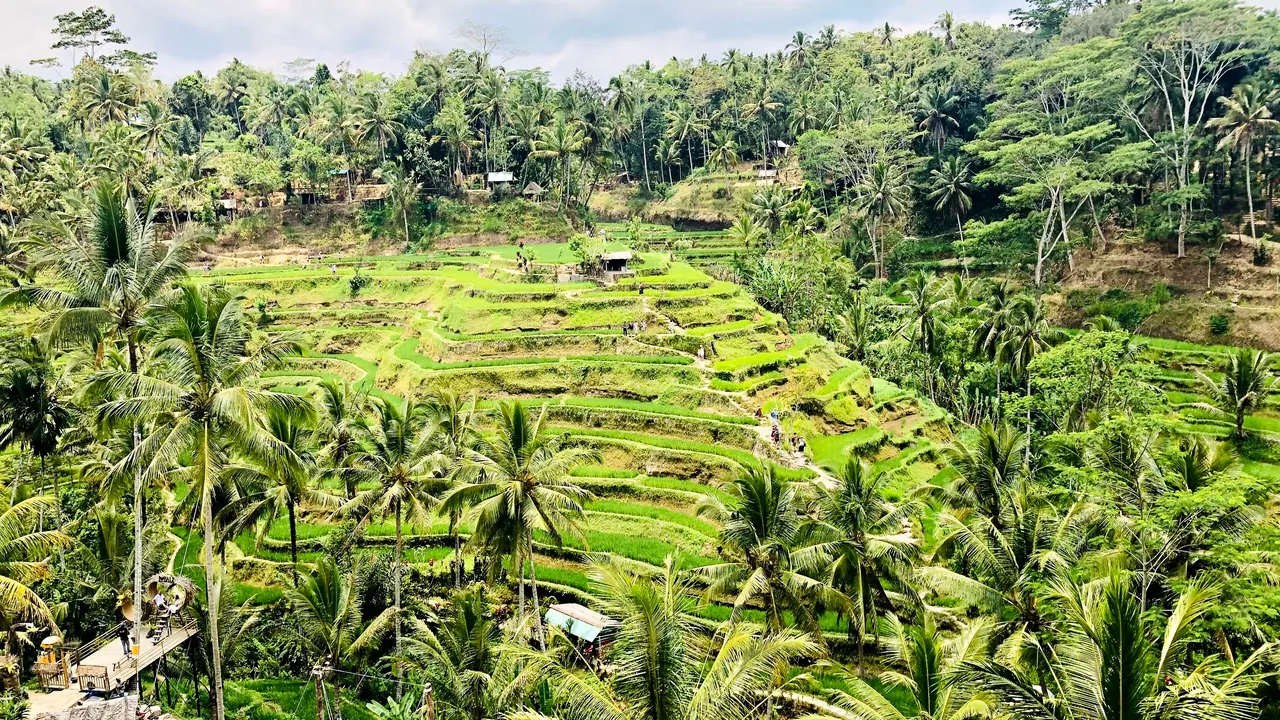
Rice terraces and palms at Tegallalang
- Wellness & relaxation96
- Nature & outdoors80
- Affordability80
Photo: Pinterpandai, CC BY-SA 3.0, cropped
Ubud lies in Bali, which has its own page.
Match
55
Every category weighted equally
- Beach & sun58
- Culture & arts52
- Food & nightlife47
- Family trip56
- Outdoors63
- Relax & unwind63
- Shopping & style51
- On a budget57
Ubud in twelve categories
Our verdict on each, scored 0 to 100 against the same fixed benchmark cities, so a score means the same thing on every page.
Beaches & swimming. Scores 38 out of 100.
Food & drink. Scores 60 out of 100.
Culture & sights. Scores 58 out of 100.
Nightlife. Scores 15 out of 100.
Nature & outdoors. Scores 80 out of 100.
Day trips. Scores 72 out of 100.
Good for families. Scores 48 out of 100.
Getting around. Scores 10 out of 100.
Shopping & style. Scores 52 out of 100.
Affordability. Scores 80 out of 100.
Live music & performing arts. Scores 47 out of 100.
Wellness & relaxation. Scores 96 out of 100.
Ubud category by category
Beaches & swimming
38Ubud sits in the green hills of central Bali, and there is no beach in town. The sea is close enough for a day out, though. Sanur on the south-east coast is the easiest swim, with calm water inside the reef and sea temperatures around 28°C all year. The nearer black-sand beaches of the Gianyar coast, such as Keramas and Saba, are better for watching surfers than for swimming. Depending on traffic, either one takes the best part of an hour by car.
Most visitors swim in their villa or hotel pool, often with a view over the rice fields. If beach life matters most, split your stay and spend part of it on the coast.
Food & drink
60Eating well is easy in Ubud, and the food is more varied than you would expect from a town this size. Balinese cooking is the best of it. Spit-roast suckling pig (babi guling) is served at lunchtime counters. Duck slow-cooked in spice paste (bebek betutu) and crispy fried duck are the town's signature dishes. Small family warungs serve nasi campur with sambal. The morning market near the palace sells fruit, snacks and offering flowers.
There is also a large international layer: plant-based and raw-food cafés, smoothie bowls, Balinese coffee from the Kintamani highlands and a handful of ambitious tasting-menu restaurants built on local produce. The trade-off is that much of the main street caters to visitors, so walk a lane or two away from it to find better cooking.
Culture & sights
58In Ubud, culture is part of daily life rather than something kept behind glass. Family compounds have their own shrines, small offerings sit on every doorstep and processions pass through the streets on temple feast days. In the centre stands the old royal palace, Puri Saren, with Pura Taman Saraswati and its lotus pond beside it. The town has been an artists' centre since the 1930s, and its museums show that history: the Puri Lukisan, Neka and ARMA collections trace Balinese painting from traditional styles through the influence of Western painters who settled here.
On the town's edge is Goa Gajah, the eleventh-century Elephant Cave, and the river valleys around it hold old shrines carved into the rock. The sights are best taken slowly, and two or three days covers the town itself.
Nightlife
15Ubud goes to bed early. Evenings usually mean a long dinner and a drink in a garden bar, maybe with a band in one of the few music bars along the main streets, and most of the town is quiet well before midnight. Many visitors are up at dawn for yoga or a volcano trek, and the town keeps their hours. For clubs and late nights, people make the long drive to Seminyak or Canggu on the coast.
Nature & outdoors
80The landscape is the reason most people stay in Ubud. Rice terraces climb the hillsides all around the town. You can reach them on foot along the Campuhan Ridge path, through the paddies north of the centre, or at the more famous terraces of Tegallalang. Deep river gorges cut through the area. The Ayung offers white-water rafting, and jungle waterfalls such as Tegenungan and Tibumana are a short drive away. The Sacred Monkey Forest is a patch of old jungle in the middle of town, home to hundreds of macaques.
Further out, many visitors climb Mount Batur in the dark for sunrise over the crater lake. Other popular trips are cycling down through villages from the Kintamani rim, or visiting the cool highland lakes around Bedugul. The rainy season, roughly November to March, brings the greenest views and muddier trails.
Day trips
72Ubud makes a good base for exploring Bali's temple heritage. Close by are the holy spring of Tirta Empul, where pilgrims bathe beneath carved spouts, and the royal tombs of Gunung Kawi, cut into a river cliff. A little further off are Besakih, the island's mother temple on the slopes of Mount Agung, and the old court town of Klungkung with its painted pavilions. To the west are the sea temple of Tanah Lot and Pura Ulun Danu Bratan on its lake. The Jatiluwih terraces belong to the UNESCO-listed subak landscape.
You can also reach the coast at Sanur or Seminyak, the clifftop temple at Uluwatu, or the water palace at Tirta Gangga in the east. Almost every trip uses a hired driver, and the island's slow roads decide how many places fit into a day.
Good for families
48Balinese people love children, and families find a warm welcome in guesthouses and restaurants. Villas with private pools make the hot afternoons easy. Nearby there are a safari park and a zoo, and children usually enjoy the dance performances, the rafting on gentler stretches of river and the walks through the rice fields.
The town itself is harder going with small children. Pavements are narrow or missing and the main roads are busy with scooters. The Monkey Forest macaques grab at bags and food. Most outings mean time in a car. Ubud suits families with older children who like the outdoors better than toddlers.
Getting around
10Getting around is Ubud's weak point. There is no public transport worth relying on. The centre is walkable in short stretches, but pavements are narrow and broken and the main streets fill with scooters and cars. Distances between villas, rice fields and sights are longer than they look, and the roads climb steeply in and out of the river valleys.
In practice, visitors use ride-hailing scooters and cars, hire a driver for the day or ride a scooter themselves, which is only sensible for experienced riders. Many hotels outside the centre run shuttles into town. Plan days around a driver, and stay near the centre if you want to walk to dinner.
Shopping & style
52Shopping in Ubud means crafts. The Ubud Art Market, across from the palace, is full of sarongs, baskets, carvings and souvenirs, and haggling is expected. The villages on the road from the south each have their own trade. Mas is known for woodcarving, Celuk for silver and gold jewellery, and Batuan for its fine, crowded paintings. The roads north towards Tegallalang are lined with workshops selling furniture and homeware.
In town, Jalan Hanoman and Monkey Forest Road have small boutiques for linen clothing, yoga wear, natural cosmetics and handmade jewellery. There is no luxury shopping and no department store. Ubud is a place to buy handmade things, not fashion.
Affordability
80Ubud is cheap for most of what a visitor needs. Family-run homestays offer garden rooms with breakfast, local warungs serve full meals for little money, and massages and day-long drivers cost a fraction of Western prices. Temple and museum entry fees are modest.
There is also an expensive Ubud. Its luxury jungle resorts above the river valleys rank among the island's priciest stays, and the cafés and tasting-menu restaurants aimed at visitors charge close to European prices. Imported wine and spirits are heavily taxed. You can stay here on a very small budget, but you can also spend a lot without trying.
Live music & performing arts
47Every evening, somewhere in Ubud, Balinese dance is performed to a live gamelan orchestra. Performances take place in the courtyard of the royal palace, on the lotus-pond stage at Pura Taman Saraswati and in village temple grounds around the town. The programme moves between the delicate Legong, the Barong drama of good and evil, and the Kecak, where a circle of chanting men replaces the instruments, sometimes ending with a fire dance. The Kecak in its familiar form was shaped in the 1930s with Western audiences in mind.
These nightly shows are ticketed and arranged for visitors, but the dancers and musicians belong to village troupes from Ubud and neighbouring communities with long traditions of their own. The same dances and gamelan still appear at temple festivals, and if you come across one, it is a different experience from the staged shows. Beyond dance and gamelan there is little else. A few restaurants hold acoustic and jazz nights, but there is no theatre, opera or concert hall.
Wellness & relaxation
96Wellness is what Ubud is known for. Yoga studios hold classes from dawn to dusk in open pavilions among the trees, and retreats run from a weekend to several weeks. Spas range from simple massage rooms on every street to riverside sanctuaries in the resorts above the Ayung and Petanu gorges. Balinese massage, flower baths, scrubs and traditional healers are part of ordinary life here, not extras for tourists.
The town's whole rhythm supports this: early mornings, vegetarian cafés, sound healing and meditation sessions, and villas facing quiet rice fields. Many visitors also join the purification ritual at the springs of Tirta Empul. The main road can be noisy and crowded, but a few steps into the paddies, the town is quiet again.
When should you go?
Pick a month to see what it is like. The climate figures are measured averages, not a forecast.
Ubud in July
Daytime high, °C
Rainfall in the month, mm
The whole year
Shaded against this destination’s own year: the deepest cell is its best month for that figure and the palest its weakest.
Where the figures come from
Ubud's temperatures are measured 29 km from the centre, at Denpasar / Ngurah-Rai.
Ubud's station stands 209 m below the city centre, so the centre is likely a little cooler than the figures say.
Ubud has no rain gauge within 25 km of the centre, so its rainfall comes from a gridded climate dataset read at the destination rather than from a gauge further away.
Temperature and rainfall are climate normals, averaged over the years shown. Ubud: 1991-2020 normals, Denpasar / Ngurah-Rai (29 km from centre).
Before you go
| Measure | Ubud |
|---|---|
| Official language | Indonesian |
| Currency | Rupiah (IDR) |
| Sockets | CF50 Hz |
| Driving side | Left |
| Time zone | UTC+8 |
| Emergency number | 112 |
| Elevation | 210 m |
| Main airport | Denpasar I Gusti Ngurah Rai International Airport (DPS)29 km from centre64 non-stop destinations |
By the numbers
| Measure | Ubud |
|---|---|
| Museums within 10 km | 14 |
| UNESCO World Heritage sites within 50 km | 1 |
| Swim season, months above 21 °C | 12 months |
Compare Ubud with
Every comparison with a written verdict behind it.
- Bangkok
- Byron Bay
- Cebu
- Chiang Mai
- Colombo
- Da Nang
- Darwin
- Dubai
- Galle
- Honolulu
- Hua Hin
- Jakarta
- Nha Trang
- Phuket
- Pokhara
- Port Douglas
- Rishikesh
- Singapore
- Tulum
- Yogyakarta