Germany
Leipzig
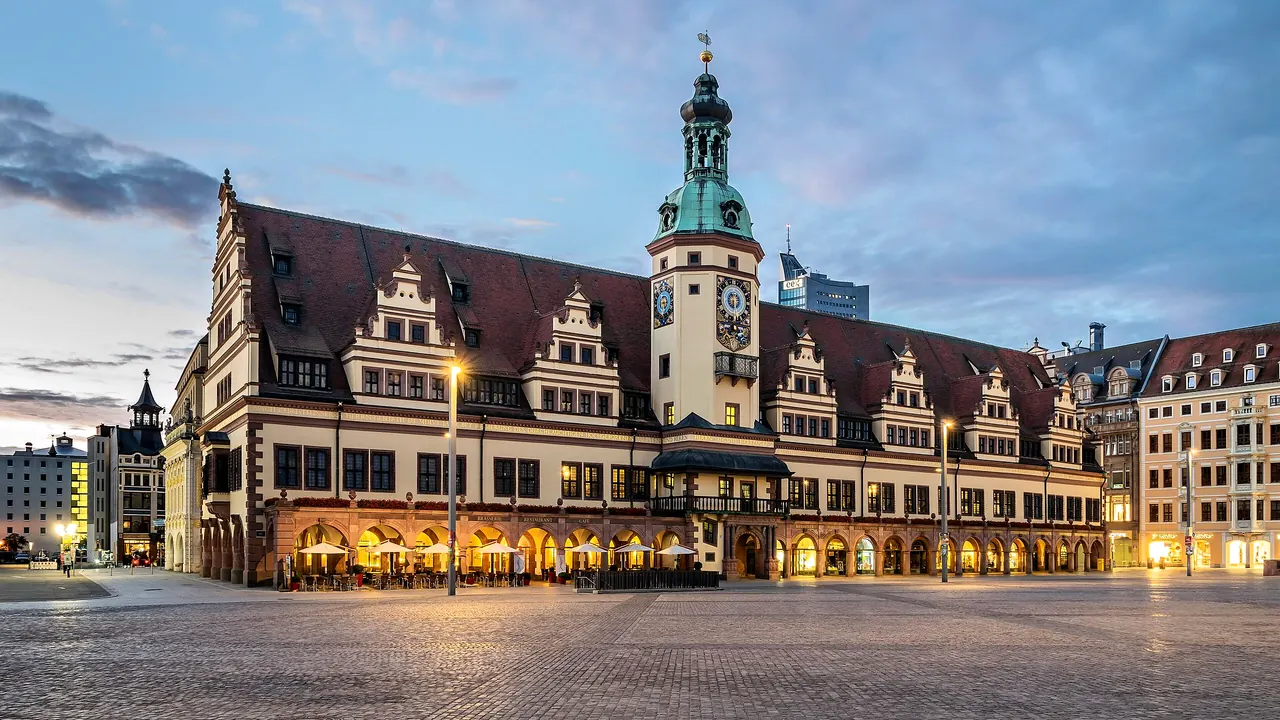
The Old Town Hall at dusk, its arcades lit
- Day trips80
- Live music & the arts78
- Getting around77
Photo: Krzysztof Golik, CC BY-SA 4.0, cropped
Match
56
Every category weighted equally
- Beach & sun50
- Culture & arts61
- Food & nightlife58
- Family trip55
- Outdoors55
- Relax & unwind50
- Shopping & style56
- On a budget55
Leipzig in twelve categories
Our verdict on each, scored 0 to 100 against the same fixed benchmark cities, so a score means the same thing on every page.
Beaches & swimming. Scores 30 out of 100.
Food & drink. Scores 45 out of 100.
Culture & sights. Scores 60 out of 100.
Nightlife. Scores 60 out of 100.
Nature & outdoors. Scores 45 out of 100.
Day trips. Scores 80 out of 100.
Good for families. Scores 62 out of 100.
Getting around. Scores 77 out of 100.
Shopping & style. Scores 45 out of 100.
Affordability. Scores 53 out of 100.
Live music & performing arts. Scores 78 out of 100.
Wellness & relaxation. Scores 33 out of 100.
Leipzig category by category
Beaches & swimming
30Leipzig is far from any coast, but it has something unusual for an inland city. South of the centre, old open-cast lignite mines have been flooded to form a chain of lakes. The Cospudener See and Markkleeberger See have sandy shores, clear water and beach bars, and you can reach them by tram or by bike through the floodplain forest. The Kulkwitzer See to the west is popular with divers and swimmers.
In a warm July or August the water reaches about 22°C, and locals spend whole afternoons out there. The season is short, though, and this is lake bathing for a hot day, not a reason to book a beach vacation.
Food & drink
45Eating in Leipzig is honest and good value rather than a destination in itself. Saxon cooking is filling: roasts with dumplings, Leipziger Allerlei vegetables, and the Leipziger Lerche, a marzipan pastry. The local beer is Gose, a slightly sour, salted wheat beer with a long history here. Coffee matters too. The city has served coffee since the early eighteenth century, and Zum Arabischen Coffe Baum is one of the oldest coffee houses in Europe. Auerbachs Keller, the cellar restaurant where Goethe set a scene in Faust, still serves food.
You'll find the more interesting eating outside the old town. Karl-Liebknecht-Strasse in the Südvorstadt and the canal streets of Plagwitz have casual international kitchens, brunch cafés and beer gardens. Fine dining is limited.
Culture & sights
60Leipzig's sights are about music, trade and the end of East Germany. At the heart of the old town are the Thomaskirche, where Bach worked for 27 years and is buried, and the Nikolaikirche, where the Monday prayers began that led to the peaceful revolution of 1989. Around them is a dense network of passages and courtyard arcades built for the trade fairs, the Mädlerpassage among them. On the southern edge of the city, the huge, brooding Monument to the Battle of the Nations recalls 1813.
The museums are strong rather than famous. There's the Museum der bildenden Künste, the three Grassi museums of applied art, ethnology and musical instruments, and the Bach Museum and Mendelssohn House. The Runde Ecke, the former Stasi headquarters, tells the GDR story. Two or three days is enough.
Nightlife
60Leipzig goes out more than its size would suggest. It's a student city with plenty of empty industrial space, and its club culture grew up in old factories, warehouses and squats. Electronic music leads, and at weekends nights run well past dawn. The scene is loose and unpretentious, with door policies far gentler than in the big capitals.
The bar streets are Karl-Liebknecht-Strasse, known locally as the Karli, which is lined with pubs, cocktail bars and late kiosks, and alternative Connewitz further south. Plagwitz and Lindenau in the west have canal-side bars in converted mills. The old town's Drallewatsch quarter is more mainstream and touristy. Away from term time and weekends it can feel quiet.
Nature & outdoors
45Leipzig is flat, but green. The Auwald, one of the largest floodplain forests in Central Europe, runs right through the city, with paths under old oaks and ash trees. A network of rivers and canals lets you paddle a canoe from Plagwitz almost into the centre, past villas and industrial brick.
South of the city, the lake district made from old mines is good for cycling circuits, sailing and stand-up paddling, and there's a white-water canoe course at the Markkleeberger See. There are no hills worth the name. Real hiking means a train to Saxon Switzerland's sandstone towers or the Harz, both around two hours away.
Day trips
80Day trips are one of the best reasons to stay in Leipzig. It sits at the centre of central Germany's rail network, with heritage towns in every direction. Dresden, with its rebuilt Frauenkirche, the Zwinger and the old masters, is a little over an hour away. So is Weimar, the town of Goethe, Schiller and the Bauhaus. Erfurt's medieval centre and Halle, Handel's birthplace, are under an hour by train.
There are smaller trips too. Lutherstadt Wittenberg has the church where the Reformation began, Naumburg has a UNESCO-listed cathedral, and Dessau has the Bauhaus buildings and the Wörlitz landscape gardens. Meissen's porcelain, the Wartburg above Eisenach, and Berlin itself, about an hour and a quarter away, fill out a long list.
Good for families
62Leipzig is easy with children. The centre is compact and flat, trams are simple to use with a pushchair, and the city has plenty of parks and playgrounds. Leipzig Zoo is the big draw. It's one of the best in Europe, and its huge covered tropical hall, Gondwanaland, works in any weather.
In summer the lakes south of town add sandy shores and shallow water. Next to the Cospudener See is Belantis, a mid-sized theme park. The Panometer's giant panoramas impress older children, and the canal boats and canoes are fun. The museums are mostly for grown-ups, and once you've done the zoo the list thins out.
Getting around
77The old town sits inside a ring road and takes about fifteen minutes to cross on foot. Most of the main sights are within it or just outside. The vast main station is at its northern edge. An extensive tram network runs out to Plagwitz, Connewitz, Gohlis, the zoo and the Battle of the Nations monument, and an underground S-Bahn line crosses the centre and runs south towards the lakes.
The city is flat, with wide streets and many cycle lanes, so a bike is often the quickest way to get around. Nobody needs a car, either in town or for day trips, since the regional and long-distance trains leave from the same station.
Shopping & style
45Leipzig has been a trade-fair city for centuries, and its old town is threaded with covered arcades and courtyards that make shopping pleasant in any weather. Most of the shops are familiar German and international chains, and the Grimmaische and Petersstrasse areas are mainstream. There's little luxury and not much in the way of local crafts.
The more individual shopping is in the west. Karl-Heine-Strasse in Plagwitz has small design shops, vintage clothes and record stores. The Spinnerei, a huge former cotton mill, holds galleries and artists' studios that open together for well-attended weekend tours. Music fans will find sheet music and instrument shops that reflect the city's tradition.
Affordability
53Leipzig's main saving is the room. Hotels and apartments, including ones within walking distance of the old town, cost less than in most large German cities, and there's plenty of choice in mid-range. The exception is the big trade-fair weeks, when the city fills and rates climb sharply, so it's worth checking the fair calendar before booking.
The rest of a stay costs what it does elsewhere in Germany. Restaurant meals, wine, cocktails and taxis are priced at the national level, and so are tram tickets, though the compact centre means you can walk most days. Beer and simple food in the student districts are fair, and museum, concert and opera tickets are reasonable for the quality. Overall it's a mid-priced city with cheap beds, not a budget destination.
Live music & performing arts
78For a city of its size, Leipzig's music is remarkable. The Gewandhaus Orchestra, one of the oldest and finest symphony orchestras in the world, plays in its concert hall on Augustusplatz. Facing it across the square is the opera house, with a full repertory of opera and ballet. The Thomanerchor, the boys' choir Bach once led, sings motets and cantatas in the Thomaskirche most weekends during term. The Bachfest each June fills the city's churches with his music.
Beyond the classical core there's the Musikalische Komödie for operetta and musicals, the Schauspiel Leipzig theatre, and a lively independent and cabaret scene. Smaller clubs host rock, indie and jazz. Every Whitsun, the Wave-Gotik-Treffen brings one of the world's largest gatherings of goth and dark-wave music.
Wellness & relaxation
33Leipzig has no bathing tradition of its own. Wellness here means German sauna culture: modern pool and sauna complexes, a few lakeside saunas, and the usual hotel spas. Proper spa towns such as Bad Düben and Bad Lausick are a short drive away, but you go there separately.
The city is restful in other ways. It's uncrowded for a German city, with long walks through the floodplain forest, slow afternoons in the parks and a quiet Sunday pace. It's a fine place to unwind, but not one to choose for spas.
When should you go?
Pick a month to see what it is like. The climate figures are measured averages, not a forecast.
Leipzig in July
Daytime high, °C
Rainfall in the month, mm
The whole year
Shaded against this city’s own year: the deepest cell is its best month for that figure and the palest its weakest.
Temperature and rainfall are climate normals, averaged over the years shown. Leipzig: 1991-2020 (sunshine 1961-1990, rainfall 1961-1990) normals, Leipzig-Holzhausen (5.7 km from centre).
Before you go
| Measure | Leipzig |
|---|---|
| Official language | German |
| Currency | Euro (EUR) |
| Sockets | CF230 V, 50 Hz |
| Driving side | Right |
| Time zone | UTC+1, UTC+2 in summer |
| Emergency number | 112 |
| Elevation | 110 m |
| Main airport | Leipzig/Halle Airport (LEJ)13 km from centre20 non-stop destinations |
| Public holidays this year | 11 days |
By the numbers
| Measure | Leipzig |
|---|---|
| City population | 615,932 |
| People per km² | 2,068 |
| Museums within 10 km | 40 |
| UNESCO World Heritage sites within 50 km | 1 |
Compare Leipzig with
Every comparison with a written verdict behind it.
- Baden-Baden
- Berlin
- Bratislava
- Cologne
- Copenhagen
- Dresden
- Dusseldorf
- Frankfurt
- Hallstatt
- Hamburg
- Heidelberg
- Innsbruck
- Maastricht
- Malmo
- Munich
- Nuremberg
- Prague
- Salzburg
- Strasbourg
- Stuttgart
- Vienna