Spain
Santiago de Compostela
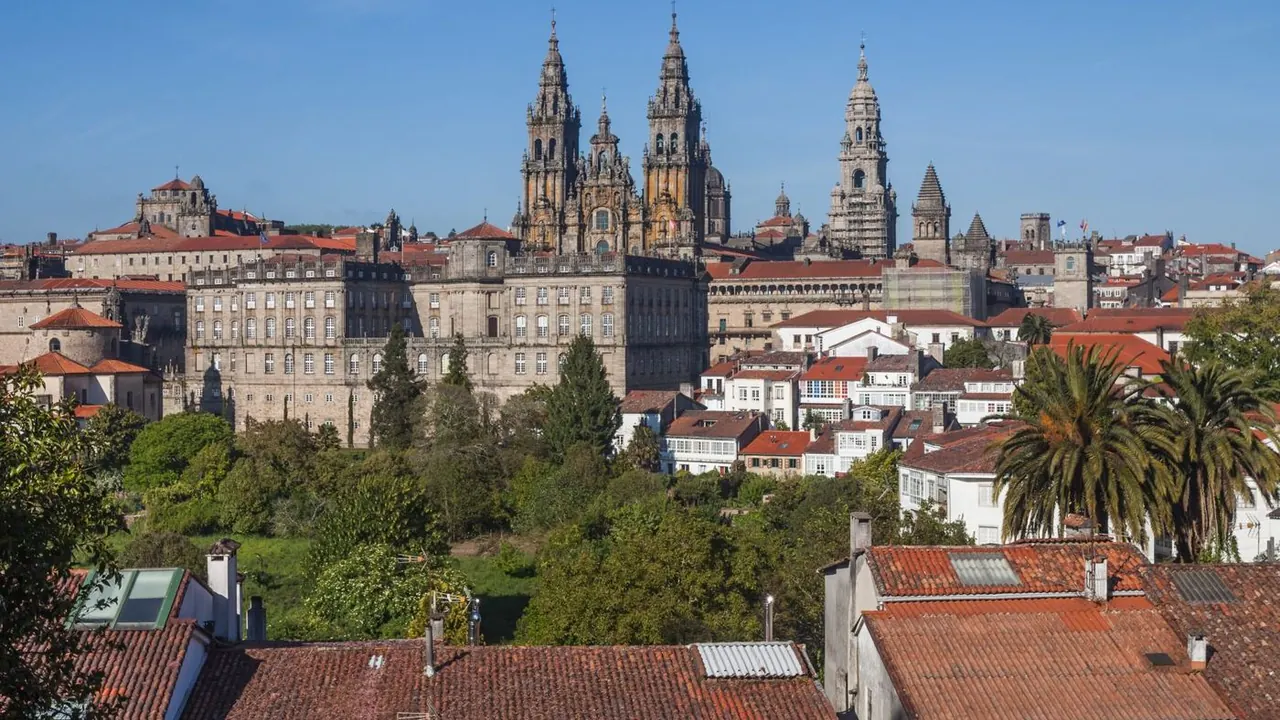
The cathedral above the old town
- Day trips72
- Culture & sights70
- Getting around70
Photo: Luis Miguel Bugallo Sánchez (Lmbuga), CC BY-SA 3.0, cropped
Match
54
Every category weighted equally
- Beach & sun52
- Culture & arts58
- Food & nightlife55
- Family trip55
- Outdoors57
- Relax & unwind53
- Shopping & style53
- On a budget55
Santiago de Compostela in twelve categories
Our verdict on each, scored 0 to 100 against the same fixed benchmark cities, so a score means the same thing on every page.
Beaches & swimming. Scores 32 out of 100.
Food & drink. Scores 68 out of 100.
Culture & sights. Scores 70 out of 100.
Nightlife. Scores 45 out of 100.
Nature & outdoors. Scores 62 out of 100.
Day trips. Scores 72 out of 100.
Good for families. Scores 42 out of 100.
Getting around. Scores 70 out of 100.
Shopping & style. Scores 35 out of 100.
Affordability. Scores 64 out of 100.
Live music & performing arts. Scores 40 out of 100.
Wellness & relaxation. Scores 42 out of 100.
Santiago de Compostela category by category
Beaches & swimming
32Santiago is an inland city, about 35km from the sea, so a beach day means a bus or a drive. The reward is real: the Ría de Muros e Noia and the Ría de Arousa have fine white sand in sheltered inlets, and the rías are calmer than the open ocean. The water stays cold, though, rarely above 19°C even in August, and the Galician summer is short and changeable. Beaches are a pleasant outing in July and August, not a reason to base yourself here.
Food & drink
68Galicia has some of the best seafood in Europe, and Santiago is where many travellers first meet it: pulpo á feira dusted with paprika, razor clams, scallops served in the shell, and percebes for the brave. The Mercado de Abastos is the heart of it, a granite market hall where stalls sell the morning's catch and some counters will cook what you buy. Rúa do Franco and Rúa da Raíña are lined with taverns serving pimientos de Padrón, empanada and tetilla cheese with a glass of Albariño or Ribeiro.
The classic sweet is tarta de Santiago, an almond cake marked with the cross of the order. Portions are generous and the eating is honest rather than inventive, with a small modern tier on top. What it lacks is breadth: international cooking is thin, and the city's appeal is concentrated on one excellent regional cuisine.
Culture & sights
70The cathedral is the reason the city exists, and it repays the journey: a Romanesque pilgrimage church behind a Baroque façade, with the carved Pórtico da Gloria inside, the swinging botafumeiro on great occasions and the shrine of Saint James beneath the altar. Around it the Praza do Obradoiro is one of Spain's grand squares, framed by the Hostal dos Reis Católicos, the Pazo de Raxoi and the college of San Xerome.
The UNESCO-listed old town is a compact maze of granite arcades, monasteries such as San Martiño Pinario and quiet convent squares, best seen in the rain when the stone shines. The Museo do Pobo Galego and the contemporary art centre in Bonaval add depth, and the Cidade da Cultura on Monte Gaiás is a striking modern counterpoint. Two or three days covers it well.
Nightlife
45A big university keeps the old town busy after dark during term. Evenings start with wine and tapas along Rúa do Franco, then move to the small bars around Rúa da Raíña and the Praza de Cervantes, many of them pub-like, some with Galician folk sessions. Thursday is the student night, and Spanish hours mean things do not get going until late. Later still, a handful of clubs in the old town and the Ensanche run until the early morning. It is friendly and characterful rather than big. In summer, when the students have gone home, the crowd shifts to pilgrims, who tend to go to bed early.
Nature & outdoors
62Santiago sits in green, rain-fed hills of oak, eucalyptus and stone-walled fields, and the Camino paths themselves make easy walks straight out of town. The Alameda and Bonaval parks give views over the old town's roofs. Within an hour or two lie the wild cliffs and lighthouses of the Costa da Morte towards Cape Fisterra, the ancient woodland of the Fragas do Eume, and the inlets of the Rías Baixas, good for kayaking and coastal walks. There are no high mountains, and frequent rain is part of the landscape, so a waterproof matters more than sun cream for much of the year.
Day trips
72Santiago is a natural base for the rest of Galicia. A Coruña, with its Roman lighthouse, the Tower of Hercules, and glassed seafront galleries, is about half an hour by train. Pontevedra's pedestrian old town and Vigo's port are a short ride south, and Ourense, with its old bridge and thermal springs, is about forty minutes away by fast train. Lugo, the only city ringed by complete Roman walls, makes a full day.
By car or tour, the Rías Baixas add Cambados and the Albariño wine country, the granite granaries of Combarro and the little town of Padrón. The fishing villages of Fisterra and Muxía at the end of the Camino are about an hour and a half west. Porto lies just beyond the two-hour limit.
Good for families
42Santiago is safe, small and relaxed, and Spanish street life welcomes children late into the evening. The trouble is that there is little made for them: the sights are churches and museums, the old town is cobbled and hilly for pushchairs, and rain can wash out several days in a row. The parks of the Alameda and Bonaval help, and the aquarium and science museums of A Coruña are a short train ride away, but most families will see the city in a day or two and spend the rest on the coast.
Getting around
70The historic centre is small enough to cross on foot in twenty minutes, and nearly everything a visitor wants lies inside it. Streets are pedestrian, granite and often slippery in the rain, with some short climbs. City buses link the old town with the railway station, the Cidade da Cultura and the airport. Trains run up and down the coast to A Coruña, Pontevedra and Vigo and inland to Ourense, but the beaches, wine villages and Costa da Morte are much easier with a car or an organised tour.
Shopping & style
35Shopping here means crafts and food rather than fashion. The street of the Azabachería, beside the cathedral, takes its name from the jet carvers, and black jet, the traditional pilgrim's amulet, is still sold there and nearby, often set in silver. The Praza das Praterías on the cathedral's south side recalls the silversmiths who worked there. Blue-and-white Sargadelos ceramics are the classic Galician gift. Delicatessens sell tetilla cheese, tinned seafood, liqueurs and tarta de Santiago, and the Abastos market is worth a visit for its own sake. Much of the old town is given over to scallop shells and pilgrim souvenirs, and the high-street shops of the Ensanche are ordinary.
Affordability
64Santiago is one of the more affordable cities in Spain. Tapas often arrive free with a drink, set lunch menus are generous, and seafood and local wine cost less than in the big Spanish cities. The old town is walkable, so transport costs little, and entry to the cathedral itself is free, with modest fees for the rooftops and museum. Pensiones and pilgrim hostels keep a stay cheap. The exception is summer, above all around the feast of Saint James in July, when rooms book out and cost noticeably more.
Live music & performing arts
40The city has more live culture than its size suggests. The Real Filharmonía de Galicia plays a season at the Auditorio de Galicia, and the Teatro Principal and Salón Teatro stage drama, mostly in Galician and Spanish. The most distinctive thing to hear is traditional music: bagpipes, tambourines and folk sessions in old-town bars, and student tunas singing in the streets in their black capes. The feast of Saint James in July brings concerts and fireworks on the Obradoiro. There is no opera to speak of, and visiting productions are limited.
Wellness & relaxation
42Santiago has no bathing tradition of its own beyond a few hotel spas, but it is a quiet, unhurried place once the day's pilgrims have arrived, with long lunches and evening walks under the arcades. The real wellness lies nearby: Galicia is rich in hot springs, with the old spa towns of Caldas de Reis and Cuntis half an hour or so away, and Ourense's riverside thermal pools, some free and open to all, about forty minutes by train. Made into an outing, it is a pleasant way to rest walking legs.
When should you go?
Pick a month to see what it is like. The climate figures are measured averages, not a forecast.
Santiago de Compostela in July
Daytime high, °C
Rainfall in the month, mm
The whole year
Shaded against this city’s own year: the deepest cell is its best month for that figure and the palest its weakest.
Temperature and rainfall are climate normals, averaged over the years shown. Santiago de Compostela: 1991-2020 normals, Santiago / Labacolla (8.4 km from centre).
Before you go
| Measure | Santiago de Compostela |
|---|---|
| Official language | Spanish |
| Currency | Euro (EUR) |
| Sockets | CF230 V, 50 Hz |
| Driving side | Right |
| Time zone | UTC+1, UTC+2 in summer |
| Emergency number | 112 |
| Elevation | 260 m |
| Main airport | Santiago-Rosalía de Castro Airport (SCQ)10 km from centre29 non-stop destinations |
| Public holidays this year | 13 days |
By the numbers
| Measure | Santiago de Compostela |
|---|---|
| City population | 100,965 |
| People per km² | 459 |
| Museums within 10 km | 6 |
| UNESCO World Heritage sites within 50 km | 2 |
| Swim season, months above 21 °C | None |
Compare Santiago de Compostela with
Every comparison with a written verdict behind it.
- Alicante
- Barcelona
- Bilbao
- Cadiz
- Cordoba
- Granada
- Lisbon
- Madrid
- Malaga
- Marbella
- Porto
- San Sebastian
- Seville
- Toledo
- Valencia