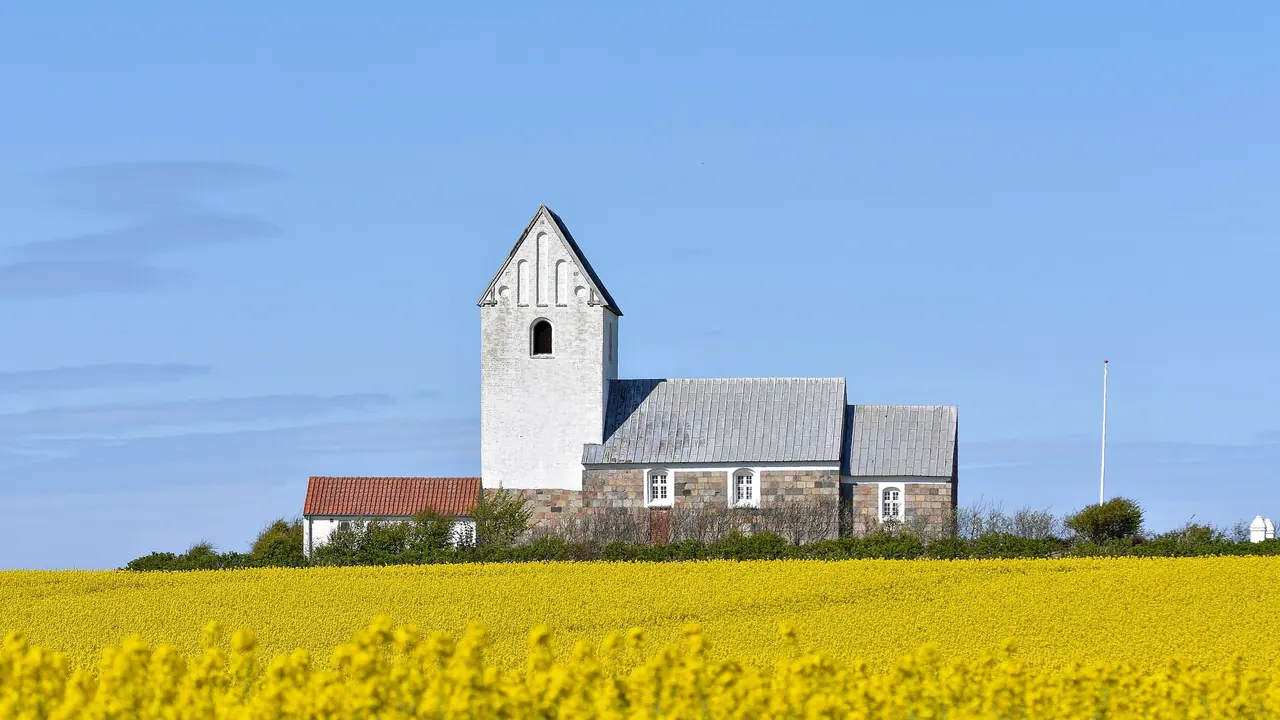
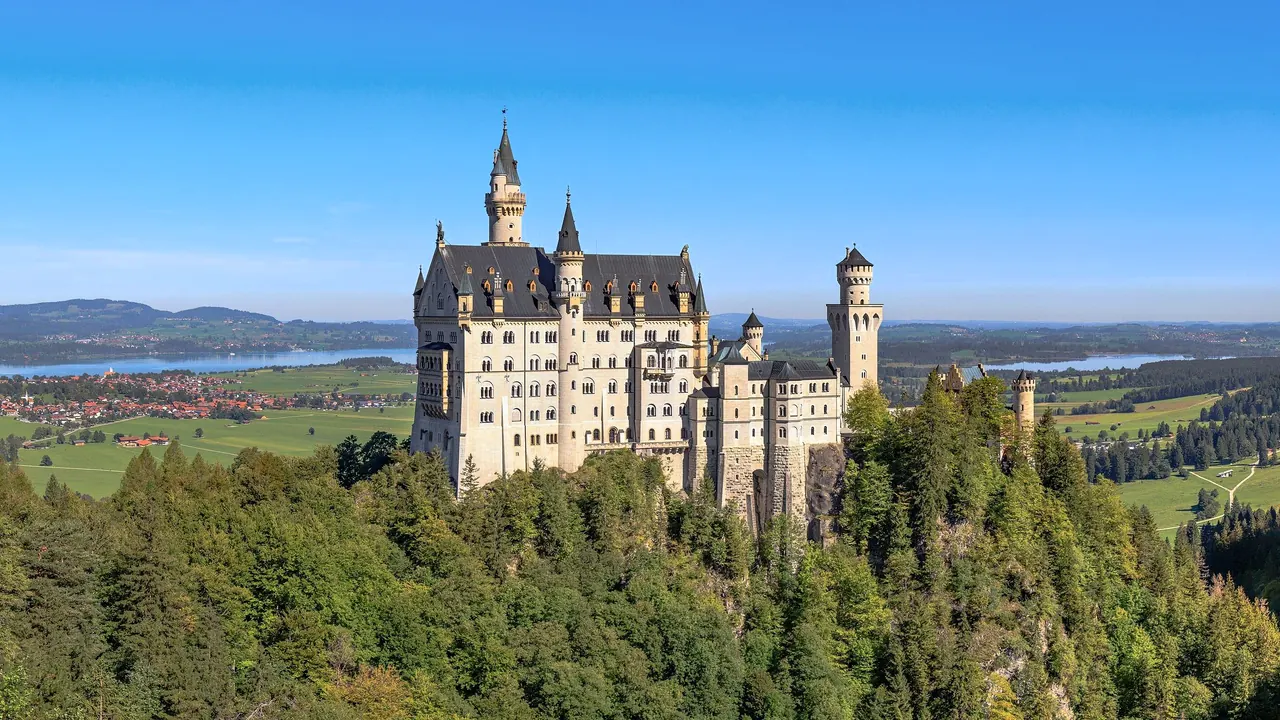
Photos: Denmark by Qwert üpoiuz, CC BY-SA 4.0, cropped; Germany by Llez, CC BY-SA 3.0, cropped.
Denmark or Germany?
Our verdict in twelve categories, each scored against the same fixed benchmark cities, and the climate month by month, so you can choose for your trip.
Choose Denmark for
- beaches
- families
Denmark suits a calmer, more compact trip, at its best in summer with children. Copenhagen can carry most of a visit by itself. Tivoli is in the centre, and the castles of North Zealand and the Viking ships at Roskilde are an hour away by train. The country is small enough that a week can also take in Legoland at Billund or a cottage behind the North Jutland dunes without long journeys. Go for design, cycling, smørrebrød and slow evenings, and expect to pay a good deal more for them.
Choose Germany for
- wellness
- live music and the arts
- nightlife
Germany is the better choice on most other counts, and by the widest margin for spas and evening entertainment. Berlin's weekend-long club nights, the opera houses of Munich, Dresden and Hamburg, and the bathing towns of Baden-Baden and the Black Forest have no real equivalent across the border. Germany also has real mountains in the Bavarian Alps, a far longer list of heritage cities linked by fast trains, and clearly lower prices, especially in Leipzig and Dresden. It rewards a longer trip that moves between several bases.
Scoreboard
Twelve categories on one fixed scale from 0 to 100. The shaded stretch is the gap between the two.
Your match
Pick a travel style or drag the sliders, and both match scores follow your weighting.
Wins on beaches and families with your weighting.
Wins on wellness and live music and the arts with your weighting.
What matters to you?
Category by category
What the scores mean for a trip.
Beaches & swimming
Neither country is a beach destination, and both have only July and August for swimming. Denmark's North Sea coast has the wider, wilder sand, with dune strands from Skagen to Fanø where you can drive onto the beach. Those beaches have surf and strong currents, so the calm swimming is on the Kattegat side at Hornbæk and on Bornholm's white sand at Dueodde.
Germany's best beaches are on the Baltic. Usedom and Rügen have old piers, resort villas and rows of wicker beach chairs along calm, shallow water. Germany also has something Denmark lacks: the lakes of Upper Bavaria and Mecklenburg, which warm up sooner than the sea.
Where in Denmark: North Jutland coast, Bornholm, North Zealand coast, Fanø
Food & drink
The two are close, but they eat well in different ways. Danish food is concentrated in Copenhagen, one of the cities where modern Nordic cooking took shape, with tasting menus, smørrebrød at lunch and cardamom buns from the bakeries. Outside Copenhagen and Aarhus the cooking is plain.
German food follows the regions. There are beer gardens and white sausage in Munich, smoked beer and village breweries in Franconia, and Riesling in the wine taverns of the Moselle. Berlin adds Turkish and Vietnamese street food. Germany has more good places to eat spread across the country, so food trips there can take you well beyond the capital.
Where in Denmark: Copenhagen, Aarhus, Bornholm, Skagen
Culture & sights
Germany has far more to see, and it is spread through the whole country. A single rail trip can link Museum Island in Berlin, the Zwinger and Frauenkirche in Dresden, Cologne Cathedral, the medieval streets of Bamberg and Regensburg, and the Bauhaus in Dessau and Weimar.
Denmark's heritage is well kept but on a smaller scale. Most of it is in Copenhagen's palaces and museums and the castles of North Zealand, Kronborg and Frederiksborg. Roskilde's Viking ships and the rune stones at Jelling add the oldest history. A visitor can see the best of Denmark in about a week, while Germany has enough for several trips.
Where in Denmark: Copenhagen, North Zealand, Roskilde, Jutland
Nightlife
Germany is in another league after dark. Berlin's clubs run from Saturday night into Monday, and the bars stretch from Kreuzberg to Friedrichshain. Hamburg has the Reeperbahn, Cologne has its Kölsch pubs and carnival, and Leipzig and Frankfurt have their own club scenes.
Denmark's nightlife is almost all in Copenhagen: the meatpacking district in Vesterbro, the bars of Nørrebro, and summer drinks by the canals. Aarhus has its student crowd and Aalborg has its single street of bars. Weekday nights are quiet, and the high price of drinks shortens most nights out.
Where in Denmark: Copenhagen, Aarhus, Aalborg
Nature & outdoors
Germany has the mountains Denmark lacks. The Bavarian Alps offer hut-to-hut hiking under the Zugspitze, Saxon Switzerland has sandstone towers for climbers, and the Black Forest and the vineyard slopes of the Rhine and Moselle add long trails and riverside cycle paths.
Denmark is flat, and its best scenery is on the coast. There is the moving Råbjerg Mile dune near Skagen, the dune heath of Thy and the chalk cliffs of Møns Klint. Both countries share the Wadden Sea tidal flats. In Denmark the pleasure is cycling quiet, level roads rather than climbing.
Where in Denmark: Skagen, Thy National Park, Møns Klint, Wadden Sea
Where in Germany: Bavarian Alps, Black Forest, Saxon Switzerland, Rhine and Moselle valleys
Day trips
Germany gives you more bases and more places to reach from each. From Munich you can get to Neuschwanstein, Regensburg or Salzburg. Frankfurt puts Heidelberg and the Rhine Gorge castles close by, and from Dresden or Nuremberg it is a short ride to Meissen, Bamberg or Rothenburg.
Denmark has one excellent base. Kronborg, Frederiksborg, Roskilde and the Louisiana museum are all within an hour of Copenhagen by train, and Malmö and Lund are across the Øresund Bridge. Funen makes a good second base for Egeskov and the island of Ærø. After those two, the options run out sooner than in Germany.
Where in Denmark: Copenhagen, Funen, Aarhus
Good for families
Both countries are easy with children, so the choice comes down to the kind of trip. Denmark's attractions fall into two groups. In Jutland, Billund has the original Legoland and the LEGO House, Givskud's lion park is close by, and Fårup Sommerland is near the North Jutland beaches. Copenhagen makes a separate base, with Tivoli in the centre, Bakken in the woods north of the city, the Blue Planet aquarium and the Experimentarium.
Germany's strengths last through the year. Berlin and Leipzig have two of Europe's best zoos, Munich's Deutsches Museum is a huge hands-on science museum, and the model railway in Hamburg's Speicherstadt appeals to every age. Europa-Park near Freiburg can fill several days, and in winter there are the Christmas markets.
Where in Denmark: Billund, Copenhagen, Djursland, North Jutland
Where in Germany: Black Forest and Europa-Park, Munich, Berlin, Hamburg
Getting around
Germany is a little easier to cover without a car. ICE trains link the big cities, and regional lines reach almost every town of interest. In the Rhine Valley, trains on both banks and river boats link the castle villages. The catch is that long-distance trains are often late, so leave slack in your plans.
Denmark's distances are shorter, and Copenhagen is the best city anywhere for getting around by bike. Away from the main train line, though, the west Jutland dunes, Møn and the Funen manor houses really need a car. Bornholm is a separate trip by ferry or plane.
Where in Denmark: Copenhagen, Aarhus, Odense
Shopping & style
Germany has more variety. There is KaDeWe and the independent shops of Mitte in Berlin, luxury streets in Munich and Düsseldorf, and crafts you can only buy there: Meissen porcelain, Erzgebirge nutcrackers and Black Forest cuckoo clocks. Almost everything closes on Sundays.
Denmark has one clear strength, which is design. In Copenhagen, the furniture and lighting showrooms, Royal Copenhagen porcelain and the Scandinavian fashion labels around Strøget make it a focused shopping trip. Outside Copenhagen, shopping comes down to glass and ceramics on Bornholm and amber on the west coast.
Where in Denmark: Copenhagen, Aarhus, Bornholm
Where in Germany: Berlin, Munich, Düsseldorf, Nuremberg
Affordability
Germany is clearly the cheaper country. Leipzig, Dresden and the eastern towns are good value, Berlin is reasonable for a capital, and regional rail passes keep travel costs down. Munich, Sylt and the Alpine resorts are the expensive exceptions.
Denmark is expensive everywhere, and Copenhagen most of all. The way to make it cheaper is a self-catering cottage or campsite in West Jutland or a farm stay on Funen. Bakery lunches, supermarket shopping and a bike also help.
Where in Denmark: West Jutland, Funen
Live music & performing arts
Germany has more opera and concerts than any other country. Berlin alone has three opera houses and the Berlin Philharmonic. The Semperoper, Leipzig's Gewandhaus and Hamburg's Elbphilharmonie are world-class, and even modest towns run full seasons of opera, ballet and plays from September to June.
Denmark's formal arts are concentrated at the Royal Danish Theatre in Copenhagen, home of one of the oldest ballet companies in the world. Its strength is in summer, when the German season is mostly over: the Copenhagen Jazz Festival in July and the Roskilde Festival.
Where in Denmark: Copenhagen, Aarhus, Roskilde
Wellness & relaxation
Germany is one of the great bathing countries, and Denmark is not a spa destination. Baden-Baden's Friedrichsbad and Caracalla baths, Wiesbaden's Kaiser-Friedrich bath and the many towns named Bad are built around mineral springs. Every city has large thermal and sauna complexes, with textile-free saunas, scheduled infusions and quiet rest rooms.
Denmark has no thermal springs. Its version of wellness is an icy harbour dip followed by a wood-fired sauna, or a summer swim at the Islands Brygge harbour baths. Spa hotels on the East Jutland fjords and the slow, candlelit pace of hygge make up the rest.
Where in Denmark: Copenhagen, Aarhus, East Jutland, North Zealand
Where in Germany: Baden-Baden, Wiesbaden, Bad Reichenhall, Lower Bavarian spa triangle
When should you go?
Pick your month, and for a country the place in it. The climate figures are measured averages, not a forecast.
Where in Germany
Copenhagen (Denmark) in July
Berlin (Germany) in July
Daytime high, °C
Rainfall in the month, mm
Temperature and rainfall are climate normals, averaged over the years shown. Copenhagen (Denmark): 1991-2020 normals, Koebenhavn / Landbohoejskolen (2.4 km from centre). Berlin (Germany): 1991-2020 normals, Berlin / Alexanderplatz (0.9 km from centre).
Denmark has one short window for the beach. Copenhagen reaches about 23°C in July and the sea is at its warmest in August at around 18°C, so July and August are the swimming weeks. May, June and September are pleasant for cycling and coast walks but too cool for a swim. Germany's cities are a little warmer in high summer, with Berlin, Munich and Cologne all near 25°C, which is warm but rarely too hot for walking the streets. Munich has the most sunshine of the German points over the year, but it also gets the heaviest summer rain, around 120mm a month from June to August, so an Alpine trip needs a plan for wet days. Berlin is noticeably drier in those months.
Winter is cold in both countries, with daytime highs around 4°C in Copenhagen, Berlin and Hamburg. Cologne is slightly milder, and all the German points get little sun from November to January. Germany has more to do indoors in winter, with the opera and concert season, the thermal baths and the Christmas markets. In Denmark, winter means harbour saunas and candlelit evenings. In both countries, late spring and early autumn are the easiest months for sightseeing on foot.
Which traveller are you?
For a culture and arts trip, choose Germany. The palaces of Potsdam, Charlemagne's chapel in Aachen, Rothenburg's walls and the Bavarian castles go well beyond Denmark's heritage. In the evenings there is the Bavarian State Opera in Munich, and Bayreuth in summer.
On a family trip with young children, the two are level, so let the season decide. In July and August, Denmark's summer houses behind the dunes give the classic Danish family vacation. In other months, Germany's cities and calm trains suit children better.
On a relaxing and wellness trip, Germany wins. Go in autumn or winter, after the hiking season, and settle in one spa town rather than touring. Bad Reichenhall has the Alps behind it, and the Lower Bavarian spa triangle has quiet countryside around it.
More comparisons
Each shares a side with Denmark or Germany.
Where else could you go?
Set Denmark or Germany against any other country.