Germany
Frankfurt
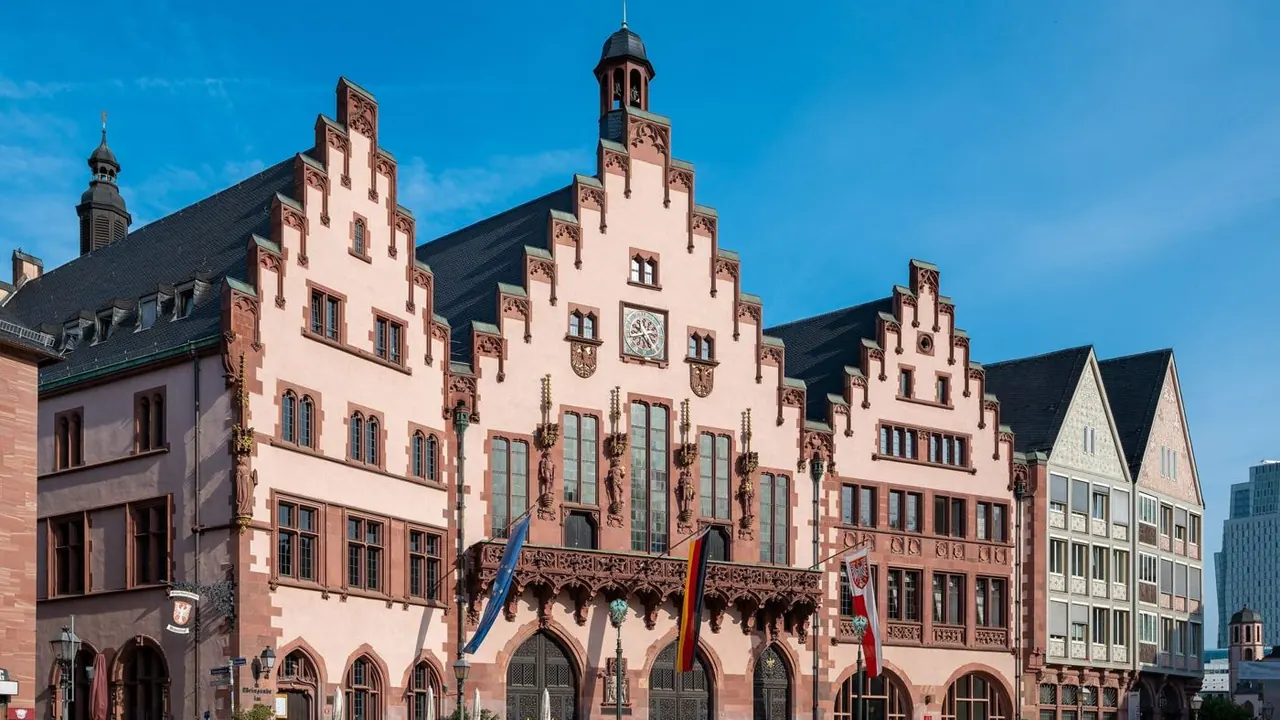
The Römer, the old city hall
- Day trips86
- Getting around78
- Live music & the arts68
Photo: Thomas Wolf, CC BY-SA 3.0 DE, cropped
Match
56
Every category weighted equally
- Beach & sun49
- Culture & arts62
- Food & nightlife57
- Family trip54
- Outdoors57
- Relax & unwind52
- Shopping & style58
- On a budget54
Frankfurt in twelve categories
Our verdict on each, scored 0 to 100 against the same fixed benchmark cities, so a score means the same thing on every page.
Beaches & swimming. Scores 8 out of 100.
Food & drink. Scores 52 out of 100.
Culture & sights. Scores 60 out of 100.
Nightlife. Scores 52 out of 100.
Nature & outdoors. Scores 58 out of 100.
Day trips. Scores 86 out of 100.
Good for families. Scores 62 out of 100.
Getting around. Scores 78 out of 100.
Shopping & style. Scores 56 out of 100.
Affordability. Scores 38 out of 100.
Live music & performing arts. Scores 68 out of 100.
Wellness & relaxation. Scores 52 out of 100.
Frankfurt category by category
Beaches & swimming
8Frankfurt is a long way inland, and the nearest sea is a full day's travel away. In summer, locals swim in outdoor pools and in the gravel-pit lakes on the edge of the city, such as the Langener Waldsee in the forest to the south, which has sandy shores and warm water in July and August. The riverbanks along the Main are for sitting, not swimming. If you want a beach, this is not your city.
Food & drink
52Frankfurt's own food is hearty Hessian cooking, and the place to try it is a traditional apple-wine tavern. Many of the best are in Sachsenhausen, south of the river. You sit at long shared tables, drink tart Apfelwein from grey stoneware jugs, and eat Grüne Soße, a cold herb sauce over eggs and potatoes, or Handkäs mit Musik, a sour-milk cheese in onion vinaigrette. The Kleinmarkthalle, the covered market hall in the centre, is the best single stop for sausages, cheese and regional produce.
The city is international, so beyond these you will find good Turkish, Italian and Asian kitchens, Bahnhofsviertel's cheap global eating, and serious business-dinner restaurants. It is a solid place to eat well, though the local repertoire is small.
Culture & sights
60Most visitors come for the museums. The Museumsufer runs along both banks of the Main and holds more than a dozen institutions. The Städel, with old masters through to modern painting, is the one of real international standing. Others cover film, architecture, applied arts, world cultures and early Jewish history, and the Schirn hosts major exhibitions. The Senckenberg natural history museum is one of the largest in Germany.
The historic city was mostly destroyed in 1944, so what you see is largely rebuilt. The Römer square with its gabled half-timbered fronts, the reconstructed old-town lanes towards the red sandstone cathedral, the Paulskirche where Germany's first parliament met, and Goethe's birthplace are all close together. Around them rises a skyline of towers that has no equal elsewhere in Germany. It makes good material for two or three days.
Nightlife
52Frankfurt and neighbouring Offenbach have a long place in electronic music history, and a small, serious club scene carries on that techno and house tradition at weekends. Most evenings out happen in a few areas. The Bahnhofsviertel, the station district, is rough around the edges and has the most character, with cocktail bars, late kiosks and a mixed crowd. Alt-Sachsenhausen has cider taverns and rowdier pubs. Nordend and Bornheim are home to relaxed neighbourhood bars along Berger Straße, and on summer evenings the Main riverbanks fill with people drinking outside. Being a working city, it is quiet early in the week and only properly busy on Friday and Saturday.
Nature & outdoors
58The Taunus hills begin just beyond the northern suburbs. The Großer Feldberg, at about 880m, is the highest point, with beech forest, Roman frontier trails and mountain-bike routes, all under an hour by S-Bahn and bus. Within the city, the Stadtwald is one of the largest urban forests in Germany, and long, flat cycle paths follow the Main in both directions. A little further out, the Odenwald offers quiet woodland walking, and the vineyard paths of the Rheingau and the Rhine Gorge give some of the best scenery in the region. It is a green, gentle landscape for walking and cycling rather than for anything dramatic.
Day trips
86Day trips are one of Frankfurt's real strengths, because it sits at the centre of Germany's fastest rail network. Heidelberg, with its castle ruin and old university town, is about an hour away. So is the Rhine Gorge, where castles line the river between Rüdesheim and Koblenz and you can take boats between the wine villages. High-speed trains reach Cologne and its cathedral in about an hour, and Würzburg's baroque Residenz in a little more.
Closer in, there is Mainz with its cathedral and Gutenberg Museum, the spa town of Wiesbaden, and Darmstadt's Art Nouveau artists' colony. The Rheingau vineyards are good for Riesling tastings. Speyer and Worms have imperial cathedrals, and Marburg has a hillside old town. You could spend a week here and still have places left to visit.
Good for families
62The Senckenberg museum is the main draw for children, with its hall of dinosaur skeletons. The city zoo is central and walkable, and the Palmengarten's glasshouses and lawns make a calm half-day. The river paths and playgrounds along the Main are good for scooters and bikes, and children enjoy the boat trips past the skyline. Out in the Taunus, a wildlife park in Kronberg and a small fairy-tale amusement park are easy outings, and larger theme parks are further afield. Trams and the S-Bahn take pushchairs without trouble, and the centre is compact. It works well for a few days, though no single attraction is worth the journey.
Getting around
78The centre is compact. You can walk between the Römer, the cathedral, the Zeil and the Museumsufer in a few minutes, and the river bridges join them to Sachsenhausen. U-Bahn, S-Bahn, trams and buses run as one integrated system that also covers the region, so the Taunus, Wiesbaden and Mainz are on the same ticket network. The airport is one of the best connected in Europe, with S-Bahn and long-distance trains to the centre in about a quarter of an hour. The main station links straight to the high-speed network. The many lines and zones take some getting used to, but you will never need a car in the city.
Shopping & style
56The Zeil is the main pedestrian shopping street, lined with department stores, chains and large malls. Just west of it, Goethestraße and the streets around it hold the luxury fashion and jewellery houses that the banking crowd shops at. For independent boutiques, delis and design shops, head to Berger Straße in Nordend and Bornheim, or Schweizer Straße in Sachsenhausen. Apple-wine jugs and stoneware are the local souvenirs. The Saturday flea market on the Main bank and the Kleinmarkthalle add some character. It is good for practical shopping, but the city has no particular speciality to draw shoppers.
Affordability
38Frankfurt is one of the more expensive cities in Germany, and hotels are the reason. Rooms are priced for business travellers, and during the big trade fairs they become very expensive and scarce. Weekends and summer, when the business crowd is away, are often noticeably cheaper. Eating is more reasonable: cider taverns, Turkish grills and market stalls cost little by Western European standards, and the Museumsufer pass covers many museums at once. Public transport is fairly priced. If you time your trip around the trade-fair calendar, it can be a moderate city.
Live music & performing arts
68The city's opera company is one of the most respected in Germany, known for adventurous productions and a full repertory season. The Alte Oper, a grand rebuilt nineteenth-century opera house, is now the main concert hall and hosts the regional radio symphony orchestra and touring ensembles. The Schauspiel stages serious German-language drama, Mousonturm and other independent venues present contemporary dance, and there is a long-running English-language theatre. Frankfurt also has a jazz history going back to the post-war years, and there are still cellar clubs with regular sessions. The season runs from autumn to early summer, and the cultural calendar is quieter in the summer months.
Wellness & relaxation
52Frankfurt is a working city at a working pace, and has no bathing tradition of its own beyond municipal pools and hotel spas. The spa towns around it are a different story. Bad Homburg, at the foot of the Taunus, has a spa park and a large thermal bath complex with saunas. Wiesbaden, under an hour away, has the Kaiser-Friedrich-Therme, an Art Nouveau Roman-Irish bath fed by hot springs. Bad Nauheim and Bad Soden carry on the old tradition of taking the waters. In town, the Palmengarten and the quieter riverbanks are the best places to slow down.
When should you go?
Pick a month to see what it is like. The climate figures are measured averages, not a forecast.
Frankfurt in July
Daytime high, °C
Rainfall in the month, mm
The whole year
Shaded against this city’s own year: the deepest cell is its best month for that figure and the palest its weakest.
Temperature and rainfall are climate normals, averaged over the years shown. Frankfurt: 1991-2020 normals, Frankfurt Westend (2 km from centre).
Before you go
| Measure | Frankfurt |
|---|---|
| Official language | German |
| Currency | Euro (EUR) |
| Sockets | CF230 V, 50 Hz |
| Driving side | Right |
| Time zone | UTC+1, UTC+2 in summer |
| Emergency number | 112 |
| Elevation | 101 m |
| Main airport | Frankfurt Main Airport (FRA)13 km from centre281 non-stop destinations |
| Public holidays this year | 10 days |
By the numbers
| Measure | Frankfurt |
|---|---|
| City population | 760,656 |
| People per km² | 3,063 |
| Museums within 10 km | 53 |
| UNESCO World Heritage sites within 50 km | 4 |
Compare Frankfurt with
Every comparison with a written verdict behind it.