Germany
Heidelberg
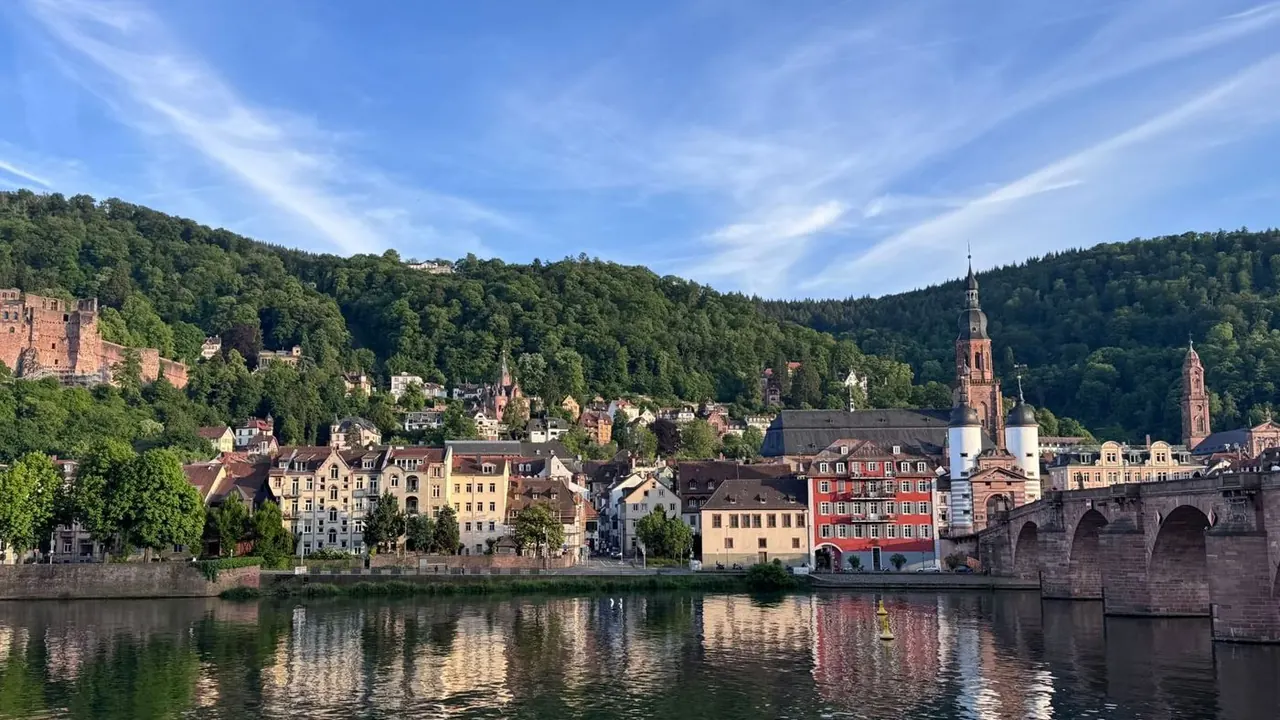
The old town on the Neckar
- Day trips78
- Getting around72
- Families62
Photo: Kuanling Chen, Pexels License
Match
49
Every category weighted equally
- Beach & sun43
- Culture & arts54
- Food & nightlife47
- Family trip51
- Outdoors53
- Relax & unwind46
- Shopping & style49
- On a budget48
Heidelberg in twelve categories
Our verdict on each, scored 0 to 100 against the same fixed benchmark cities, so a score means the same thing on every page.
Beaches & swimming. Scores 7 out of 100.
Food & drink. Scores 40 out of 100.
Culture & sights. Scores 58 out of 100.
Nightlife. Scores 38 out of 100.
Nature & outdoors. Scores 60 out of 100.
Day trips. Scores 78 out of 100.
Good for families. Scores 62 out of 100.
Getting around. Scores 72 out of 100.
Shopping & style. Scores 40 out of 100.
Affordability. Scores 42 out of 100.
Live music & performing arts. Scores 48 out of 100.
Wellness & relaxation. Scores 44 out of 100.
Heidelberg category by category
Beaches & swimming
7Heidelberg is a river town far from any coast, and the Neckar is for boats and riverside lawns rather than swimming. On hot days locals head to the city's outdoor pools or to the flooded gravel-pit lakes scattered across the Rhine plain, about half an hour away. These are pleasant for an afternoon but they are not a beach vacation. Anyone who wants the sea is several hours away.
Food & drink
40Eating in Heidelberg means the hearty cooking of the Kurpfalz and Baden: Maultaschen, Schäufele, pork knuckle, Flammkuchen and, in spring, white asparagus served every way. Wine is the real strength, with the vineyards of the Badische Bergstrasse on the edge of town and the Palatinate wine villages close by, so local Riesling and Pinot appear on every list. The town's sweet speciality is the Studentenkuss, a chocolate born of nineteenth-century student courtship.
The Hauptstrasse and the squares below the castle are lined with places aimed at day-trippers, and quality there is uneven. Better meals tend to be in the side streets of the Altstadt, in Neuenheim across the river and in the wine taverns of the surrounding villages. A large student population keeps cheap kebab, pizza and Asian options plentiful, but the range is that of a small city.
Culture & sights
58The red sandstone ruin of Heidelberg Castle, half-destroyed in the wars of the seventeenth century and left as a Romantic monument, looks down on one of the best-preserved old towns in Germany. Below it the Altstadt runs along the Neckar: the Church of the Holy Spirit on the market square, baroque streets rebuilt after 1693, and the Old Bridge with its gate towers. Inside the castle are the Great Tun, an enormous wine barrel, and the German Pharmacy Museum.
The university, founded in 1386 and the oldest in Germany, gives the town much of its character: the Old University with its ceremonial hall and the Student Prison, its walls covered in graffiti by detained students. The Kurpfälzisches Museum covers regional art and archaeology. It is a compact, very photogenic set that most visitors see in a day or two.
Nightlife
38Going out in Heidelberg is a student affair. The Untere Strasse, a narrow lane parallel to the Hauptstrasse in the Altstadt, is packed with small pubs and bars that fill up late in term time, and historic student taverns with carved tables and old fraternity photographs sit nearby. There are a handful of clubs and late bars, a few in converted buildings out towards the station. Out of term and on weeknights the town quietens early, and anyone wanting a bigger club night takes the train to Mannheim or Frankfurt.
Nature & outdoors
60Heidelberg sits where the Neckar leaves the forested hills of the Odenwald for the flat Rhine plain, so woodland begins at the edge of the old town. The Philosophers' Walk climbs the slope opposite the castle for the classic view, and a funicular runs up the Königstuhl, at 568m, where forest trails lead on for hours. The Heiligenberg across the river has Celtic ramparts and monastery ruins among the trees.
The Neckar Valley cycle path follows the river upstream past castles and villages, and the Bergstrasse to the north has almond blossom in early spring and vineyard walks. The larger Palatinate Forest, with sandstone crags and long hiking routes, is about an hour west. It is gentle, green walking and cycling country rather than mountains.
Day trips
78Heidelberg is a very good base for the Upper Rhine. Speyer, with its vast Romanesque cathedral, is about half an hour away, as are the baroque palace and gardens of Schwetzingen. Worms, with its cathedral and medieval Jewish heritage, the Carolingian gatehouse at Lorsch Abbey and the walled Cistercian monastery of Maulbronn are all easy outings, and Mainz and Frankfurt are around an hour by train.
Up the Neckar, Ladenburg, Neckarsteinach with its four castles and the hilltop town of Bad Wimpfen make a relaxed riverside day. To the west, the half-timbered wine villages of the Palatinate Wine Route, such as Deidesheim, are about an hour by car, and Baden-Baden and Karlsruhe are within similar reach. Strasbourg is possible for a long day.
Good for families
62Heidelberg is small, safe and easy to manage with children. The funicular ride up to the castle and on to the Königstuhl is an outing in itself, and at the top a small fairy-tale park with rides suits younger children. The Heidelberg Zoo by the Neckar is compact and well kept, and boat trips upriver past castles are an easy afternoon.
Within about half an hour, the Technik Museum Speyer has aircraft, a space shuttle and a submarine to climb into, and its sister museum at Sinsheim is similar. A large theme park lies in the Palatinate, under an hour away. The cobbled, sloping Altstadt and crowded Hauptstrasse can be tiring with a pushchair, and the castle itself is mostly ruins and views.
Getting around
72The sights are concentrated in the Altstadt, a long, narrow strip between the river and the castle hill that is easy to walk end to end along the pedestrianised Hauptstrasse. The main station is a fair way west of it, so most arrivals take a tram or bus in. A funicular climbs from the Kornmarkt to the castle and up to the Königstuhl.
Trams, buses and the regional S-Bahn share one fare system across the Rhine-Neckar area, which makes day trips to Mannheim, Speyer, Schwetzingen and the Neckar valley simple without a car. Cycling is common and the riverbanks are flat, although the old town streets are cobbled and the castle approach is steep on foot.
Shopping & style
40Shopping centres on the Hauptstrasse, one of the longest pedestrian streets in Germany, which runs the length of the Altstadt. Its western end has the familiar German high-street chains and department stores, while the eastern end towards the market square turns to souvenirs, cuckoo clocks, Studentenkuss chocolates and beer steins. A few independent bookshops, design and fashion boutiques sit in the side lanes. Local wine from the Bergstrasse makes the best thing to take home. For serious fashion or luxury, Mannheim and Frankfurt are close by train.
Affordability
42Heidelberg costs about what a visitor expects from western Germany, with hotels as the main expense. The town has a limited stock of rooms for the number of visitors, and congresses, graduations and summer weekends push prices up, so many travellers stay in Mannheim or nearby towns and come in by train. Eating is more forgiving: student cafés, bakeries and simple taverns keep a meal reasonable, and the regional transport ticket is good value for day trips. The castle and most museums charge modest entry.
Live music & performing arts
48For a town of its size Heidelberg has a full programme. The municipal theatre in the Altstadt stages opera, drama and dance through the season, and its philharmonic orchestra gives regular concerts. In spring the Heidelberger Frühling festival brings chamber music and leading soloists, and in summer the castle courtyard becomes an open-air stage for the castle festival, with musicals, plays and concerts against the ruins.
Jazz, cabaret and smaller concerts happen in a cultural centre and student venues, and church concerts in the Holy Spirit and Jesuit churches are frequent. A larger opera and theatre house is in Mannheim, about twenty minutes away by train.
Wellness & relaxation
44Heidelberg has no thermal baths of its own, and wellness inside the town is limited to hotel spas and the outdoor pools. Within about half an hour, though, the Kraichgau has spa towns and large thermal bath complexes with saunas and warm saline pools, and Baden-Baden is about an hour south. The town itself is easy to slow down in: long evenings on the Neckar meadows in Neuenheim, quiet forest paths above the Philosophers' Walk and unhurried wine taverns. Midday crowds on the Hauptstrasse and around the castle are the exception to that calm.
When should you go?
Pick a month to see what it is like. The climate figures are measured averages, not a forecast.
Heidelberg in July
Daytime high, °C
Rainfall in the month, mm
The whole year
Shaded against this city’s own year: the deepest cell is its best month for that figure and the palest its weakest.
Temperature and rainfall are climate normals, averaged over the years shown. Heidelberg: 1991-2020 normals, Heidelberg (4.5 km from centre).
Before you go
| Measure | Heidelberg |
|---|---|
| Official language | German |
| Currency | Euro (EUR) |
| Sockets | CF230 V, 50 Hz |
| Driving side | Right |
| Time zone | UTC+1, UTC+2 in summer |
| Emergency number | 112 |
| Elevation | 114 m |
| Main airport | Frankfurt Main Airport (FRA)69 km from centre281 non-stop destinations |
| Public holidays this year | 12 days |
By the numbers
| Measure | Heidelberg |
|---|---|
| City population | 156,092 |
| People per km² | 1,433 |
| Museums within 10 km | 17 |
| UNESCO World Heritage sites within 50 km | 4 |
Compare Heidelberg with
Every comparison with a written verdict behind it.
- Amsterdam
- Annecy
- Antwerp
- Baden-Baden
- Berlin
- Bruges
- Brussels
- Cologne
- Como
- Dresden
- Frankfurt
- Geneva
- Ghent
- Hamburg
- Innsbruck
- Interlaken
- Lucerne
- Lyon
- Maastricht
- Milan
- Munich
- Nuremberg
- Paris
- Prague
- Rotterdam
- Salzburg
- Strasbourg
- Stuttgart
- The Hague
- Turin
- Verona
- Zurich