Germany
Nuremberg
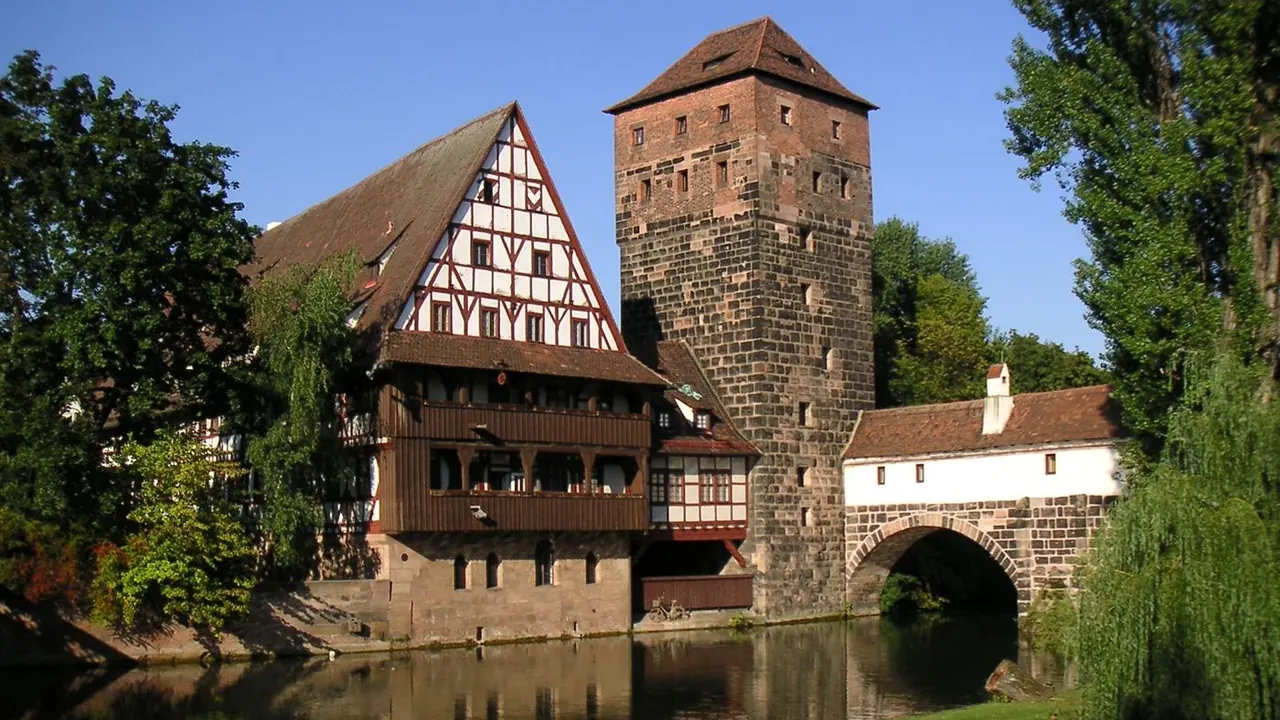
The Weinstadel and the water tower on the Pegnitz
- Day trips80
- Getting around78
- Culture & sights69
Photo: Horst Gutmann, CC BY 2.0, cropped
Match
54
Every category weighted equally
- Beach & sun48
- Culture & arts60
- Food & nightlife53
- Family trip55
- Outdoors56
- Relax & unwind51
- Shopping & style55
- On a budget54
Nuremberg in twelve categories
Our verdict on each, scored 0 to 100 against the same fixed benchmark cities, so a score means the same thing on every page.
Beaches & swimming. Scores 14 out of 100.
Food & drink. Scores 53 out of 100.
Culture & sights. Scores 69 out of 100.
Nightlife. Scores 40 out of 100.
Nature & outdoors. Scores 56 out of 100.
Day trips. Scores 80 out of 100.
Good for families. Scores 64 out of 100.
Getting around. Scores 78 out of 100.
Shopping & style. Scores 45 out of 100.
Affordability. Scores 50 out of 100.
Live music & performing arts. Scores 52 out of 100.
Wellness & relaxation. Scores 47 out of 100.
Nuremberg category by category
Beaches & swimming
14Nuremberg is far inland, and you won't come here to swim. In summer, locals drive or take the train to the Franconian Lake District south of the city, about an hour away. It is a chain of reservoirs, the largest being the Brombachsee, with grassy shores, small sandy strips and water that reaches about 23°C in a warm July or August. It is pleasant for a hot afternoon with children, but the season is short and the lakes are a side trip. In the city itself, swimming means the outdoor pools and leisure baths.
Food & drink
53Nuremberg's food is Franconian, which means heavy, pork-based and built around beer. Its emblem is the finger-sized bratwurst, grilled over beechwood and served three to a bun or six to twelve on a pewter plate with sauerkraut. Schäufele, a slow-roasted pork shoulder with crackling and dumplings, is the Sunday dish. Lebkuchen, the soft spiced gingerbread, has been made here for centuries and is sold all year.
The real draw is beer. Franconia has more small breweries than almost anywhere, and the old town's taverns and the beer gardens on the Pegnitz and in the outer districts pour local lagers and smoky Kellerbier. Beyond this, the restaurant scene is solid but ordinary for a city of its size.
Culture & sights
69The old town is enclosed by almost complete medieval walls and towers. Above it stands the Kaiserburg, the imperial castle where Holy Roman emperors stayed. Below the castle are the Gothic churches of St Sebaldus and St Lorenz, the Hauptmarkt with its Beautiful Fountain, Albrecht Dürer's half-timbered house and the half-timbered streets along the Pegnitz. Much of this was rebuilt after wartime bombing, carefully but visibly. The Germanisches Nationalmuseum, the largest museum of German art and cultural history, could easily fill a day.
Nuremberg's other heritage is twentieth-century and sobering. The vast unfinished Nazi Party Rally Grounds lie in the south-east, with a documentation centre explaining them. Courtroom 600, where the war crimes trials were held, can be visited at the Palace of Justice.
Nightlife
40Going out here is relaxed and mostly happens in bars. The old town has taverns and wine bars, and on summer nights students spill onto the squares and the riverbanks. The more interesting nights are in Gostenhof, west of the walls, where small bars, cafés that turn into drinking spots and alternative venues fill the old working-class streets. There are a few clubs and the student crowd from neighbouring Erlangen keeps weekends busy, but this is a good evening out rather than a reason to come.
Nature & outdoors
56The city sits among pine forests, and the large Reichswald forest begins at the edge of town, good for easy walks and cycling. The best outdoor country is Franconian Switzerland, about an hour north-east. It is a region of wooded valleys, limestone towers and caves, with marked hiking trails between villages and some of Germany's best-known rock climbing. The Pegnitz valley offers gentle riverside cycling, and in summer the Franconian lakes to the south are good for sailing and stand-up paddling. You won't find mountains or drama here, but there is plenty for walkers and cyclists.
Day trips
80This is one of Nuremberg's real strengths. Bamberg, a UNESCO-listed old town of bridges, cathedral hill and smoked-beer taverns, is under an hour away by train. Regensburg, with its Roman and medieval centre on the Danube, and Würzburg, with its baroque Residence and vineyards, are each about an hour away. Rothenburg ob der Tauber and Dinkelsbühl, the best-preserved walled towns on the Romantic Road, are a slightly longer ride.
Bayreuth has Wagner's festival theatre and a baroque opera house, and Munich is about an hour away by fast train. Erlangen and Fürth, practically joined to the city, make easy half days. Franconian wine villages along the Main are also within reach.
Good for families
64Nuremberg has been a toy-making city for centuries, and children notice it. The Toy Museum in the old town covers wooden dolls through to model railways. The railway museum has full-size locomotives and the first German train. The large zoo spreads through wooded former quarries on the eastern edge and has a dolphin and manatee house. Just west of the city in Zirndorf, a big toy brand runs a play park with climbing frames and water play.
In the Christmas market season, a separate children's market with carousels and a small steam train is set up nearby. The centre is safe and easy to handle, though the climb to the castle is steep and cobbled.
Getting around
78Almost everything a visitor wants is inside the walls, about 1.5km across, and you can walk it all. The main station is just outside the southern gate. The only real effort is the cobbled climb up to the castle. For the rest of the city, an integrated network of U-Bahn lines, some of them driverless, trams, buses and S-Bahn trains runs on one ticket system. That covers the zoo, the Rally Grounds, the Palace of Justice and neighbouring Fürth and Erlangen. Regional trains continue into Franconia for day trips, so you won't need a car.
Shopping & style
45The everyday shopping streets run from the station to the Hauptmarkt along Königstraße and Breite Gasse. They are lined with chain stores and department stores and are serviceable rather than special. Visitors usually buy Lebkuchen in decorated tins, wooden toys and tin figures, and crafts from the Handwerkerhof, a small walled courtyard of workshops by the station gate. In Advent, the Christkindlesmarkt on the Hauptmarkt is one of Germany's oldest and most famous Christmas markets, with stalls selling plum-figure dolls, ornaments and gingerbread, and the whole city gets busier. Out of that season, shopping is not much of a draw.
Affordability
50Nuremberg is mid-priced for Western Europe and noticeably easier on the wallet than southern Germany's bigger cities. Tavern meals are filling, local beer is inexpensive, transport costs little and many sights are modestly priced. The catch is hotels. The city hosts large trade fairs, including the world's biggest toy fair, and during those weeks and the Advent market season rooms get scarce and expensive. Avoid those dates and an ordinary stay is fairly priced.
Live music & performing arts
52The Staatstheater, housed in a grand Art Nouveau opera house just outside the walls, stages opera, ballet and drama in repertory through the season. The city has two orchestras, which play in the Meistersingerhalle and on summer evenings give a large open-air concert in the Luitpoldhain park. In summer, the Bardentreffen fills the old town's squares with free folk and world music for a weekend, and a big rock festival takes over the grounds around the Zeppelinfeld. The year-round programme is respectable and regional rather than famous.
Wellness & relaxation
47Nuremberg has no historic baths of its own, but the German sauna habit is well served. A large thermal spa with sauna gardens sits in neighbouring Fürth, a short U-Bahn ride away. Leisure pools with sauna areas are found on the city's edges, where visitors should expect nude, mixed saunas. About an hour west, the small spa town of Bad Windsheim has saline thermal pools you can float in. The pace in the old town is unhurried outside the Christmas market crowds, and slow afternoons in beer gardens or along the Pegnitz are the local way to unwind.
When should you go?
Pick a month to see what it is like. The climate figures are measured averages, not a forecast.
Nuremberg in July
Daytime high, °C
Rainfall in the month, mm
The whole year
Shaded against this city’s own year: the deepest cell is its best month for that figure and the palest its weakest.
Temperature and rainfall are climate normals, averaged over the years shown. Nuremberg: 1991-2020 normals, Nuernberg (5.5 km from centre).
Before you go
| Measure | Nuremberg |
|---|---|
| Official language | German |
| Currency | Euro (EUR) |
| Sockets | CF230 V, 50 Hz |
| Driving side | Right |
| Time zone | UTC+1, UTC+2 in summer |
| Emergency number | 112 |
| Elevation | 209 m |
| Main airport | Nuremberg Airport (NUE)5 km from centre56 non-stop destinations |
| Public holidays this year | 12 days |
By the numbers
| Measure | Nuremberg |
|---|---|
| City population | 531,159 |
| People per km² | 2,848 |
| Museums within 10 km | 50 |
| UNESCO World Heritage sites within 50 km | 1 |
Compare Nuremberg with
Every comparison with a written verdict behind it.