Germany
Bamberg
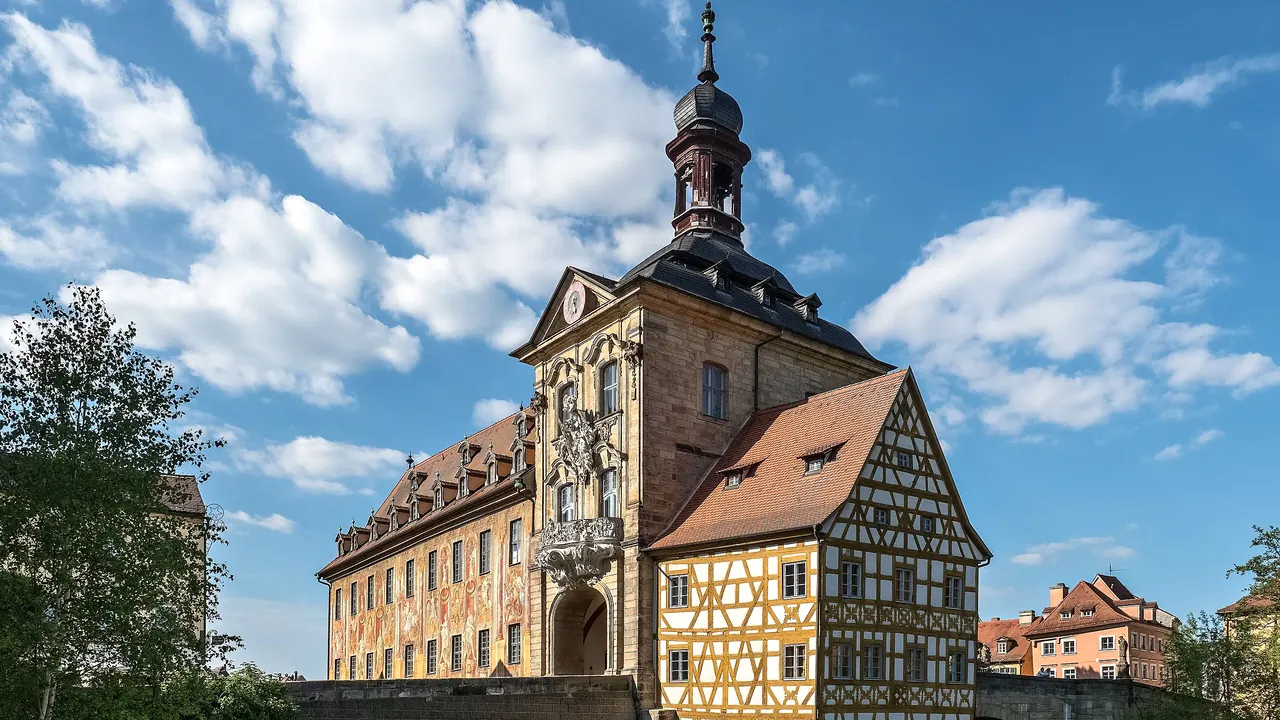
The Old Town Hall on its bridge over the Regnitz
- Day trips72
- Getting around72
- Culture & sights68
Photo: Ermell, CC BY-SA 4.0, cropped
Match
49
Every category weighted equally
- Beach & sun45
- Culture & arts56
- Food & nightlife50
- Family trip50
- Outdoors52
- Relax & unwind48
- Shopping & style50
- On a budget50
Bamberg in twelve categories
Our verdict on each, scored 0 to 100 against the same fixed benchmark cities, so a score means the same thing on every page.
Beaches & swimming. Scores 10 out of 100.
Food & drink. Scores 60 out of 100.
Culture & sights. Scores 68 out of 100.
Nightlife. Scores 32 out of 100.
Nature & outdoors. Scores 55 out of 100.
Day trips. Scores 72 out of 100.
Good for families. Scores 42 out of 100.
Getting around. Scores 72 out of 100.
Shopping & style. Scores 33 out of 100.
Affordability. Scores 55 out of 100.
Live music & performing arts. Scores 45 out of 100.
Wellness & relaxation. Scores 45 out of 100.
Bamberg category by category
Beaches & swimming
10Bamberg is deep inland in Upper Franconia, and the nearest sea is a full day's travel away. In summer, locals swim at the long-established river bathing spot in the Hain park on the Regnitz and at the gravel-pit lakes on the edge of town. There are also indoor and outdoor pools. That is enough to cool off on a hot afternoon, but anyone who wants beach time should plan it for another part of the trip.
Food & drink
60In Bamberg, eating and drinking mostly means beer. The town and its surrounding district hold one of the densest concentrations of small breweries anywhere. Rauchbier, the smoky beer brewed with beechwood-kilned malt, is the local signature, poured from wooden barrels in centuries-old brewery taverns. In summer, life moves up to the Bierkeller, shaded beer gardens dug into the hillsides above town, where people sit at long tables under chestnut trees.
The cooking is hearty Franconian: Schäufele (roast pork shoulder with crackling), dumplings, Bratwurst and Bamberger Hörnla, the local waxy potato. Bakeries and the produce stalls of the market gardeners on Grüner Markt fill in the daytime. What Bamberg lacks is range. There are few international kitchens and a thin fine-dining tier.
Culture & sights
68Bamberg came through the Second World War with little damage. Its old town is one of the largest intact historic centres in Germany and is listed by UNESCO as a whole. The town spreads over seven hills, each once topped by a church or monastery. On the cathedral hill stand the four-towered Imperial Cathedral, with the Bamberg Horseman and the tomb of Emperor Henry II, the Neue Residenz with its rose garden, and the Alte Hofhaltung. Below them, the frescoed Old Town Hall sits on its own island in the Regnitz, with bridges to both banks.
Across the water, the old fishermen's houses of Little Venice line the bank, and Michaelsberg Abbey looks down from its hill. The market gardeners' quarter, with its working plots inside the town, is part of the heritage too. The museums are small. The pleasure lies in walking through the townscape rather than working through collections.
Nightlife
32Evenings in Bamberg revolve around beer rather than dancing. The brewery taverns fill up after work, and the Sand quarter below the cathedral has a row of student bars that stay lively into the night during term time. In summer, the hillside beer cellars are the natural place to spend a long evening. Clubs are few and small, and most of the town is quiet well before the small hours. Anyone after a big night out takes the train to Nuremberg.
Nature & outdoors
55The countryside around Bamberg is gentle and walkable rather than dramatic. Franconian Switzerland, a region of limestone valleys, rock towers, caves and castle-topped crags popular with climbers and hikers, begins less than an hour east. The beech forests of the Steigerwald lie to the west. Long-distance cycle paths follow the Main and Regnitz through meadows and orchard villages, and many hiking routes link one village brewery to the next.
Within town, the riverside Hain park and the green slopes of the seven hills give easy walks. Expect rolling hills and woodland, not mountains or big views, at their best from spring to early autumn.
Day trips
72Bamberg sits on a main rail line in the middle of Franconia, which makes it a very good base. Nuremberg, with its imperial castle, old town and wartime history, is under an hour by train. Würzburg's UNESCO-listed Residence and its vineyards on the Main are about an hour away. Coburg, with its fortress and ducal palaces, and Bayreuth, with its Margravial Opera House and the Wagner festival theatre, are each similarly close.
Nearer still, the baroque pilgrimage basilica of Vierzehnheiligen and Banz Abbey face each other across the upper Main valley. The Franconian wine villages, and the walled towns of Rothenburg ob der Tauber and Dinkelsbühl at the far end of a long day, round out the list.
Good for families
42Bamberg is safe, small and relaxed, and easy to manage with children at a slow pace. The Hain park along the river has playgrounds and space to run, boats can be hired on the Regnitz, and a large leisure pool with slides covers rainy days. Beer gardens are family places in Franconia, with children playing among the tables. Beyond that, little is made for young visitors. The sights are churches and townscape, and the cobbled lanes up the cathedral hill are hard going with a pushchair.
Getting around
72Everything a visitor wants in Bamberg is within walking distance. The island town, the cathedral hill and Little Venice are minutes apart, and the riverside paths are a pleasure in themselves. City buses fan out from a central hub to the station and the outer districts, and bicycles are a common way to get about the flat lower town. The climbs are short but steep, with uneven cobbles up to the cathedral and Michaelsberg. The station is a fair walk from the old town, and it connects to the rest of Franconia, so no car is needed.
Shopping & style
33Shopping in Bamberg is pleasant but limited. The pedestrian streets around Grüner Markt and Lange Strasse hold the usual German chain stores, along with some independent bookshops and boutiques. The more local finds are produce from the town's own market gardens, bottled smoked beer from the brewery shops, and the antique dealers around the cathedral quarter. These make good things to take home. There is no luxury street, no real design scene and little fashion beyond the high-street names, so shopping fills an hour between sights rather than shaping a stay.
Affordability
55Bamberg is a reasonably priced corner of Germany. The local beer is cheap, and a plate of roast pork and dumplings in a brewery tavern costs less than a comparable meal in a big German city. Hotels and guesthouses are moderately priced for most of the year, though rooms in the old town get tighter and dearer at weekends and during the Christmas market season. Since everything is within walking distance, transport costs little. It is ordinary Western European pricing, kept down by Franconian habits.
Live music & performing arts
45Bamberg punches above its size in classical music. The Bamberg Symphony, the Bavarian State Philharmonic, is an orchestra of real international reputation. It plays its home season in the modern concert hall on the Regnitz and tours widely. The ETA Hoffmann Theatre, named after the writer who once worked there, stages drama through the season, and organ and choral concerts are held in the cathedral and the town's churches. Beyond that the scene is small. Live music in bars is mostly student gigs, and there is no opera company of its own. The Bayreuth Festival, an hour away, is the region's great opera event.
Wellness & relaxation
45Bamberg's restorative side comes from its pace: unhurried mornings by the river, long afternoons in shaded beer gardens, and a town that empties of day visitors by evening. The town has no bathing tradition of its own, though its leisure pool has a sauna area. For real thermal bathing, the warm brine pools of Bad Staffelstein in the upper Main valley are about half an hour away by train and make a relaxing half-day out.
When should you go?
Pick a month to see what it is like. The climate figures are measured averages, not a forecast.
Bamberg in July
Daytime high, °C
Rainfall in the month, mm
The whole year
Shaded against this city’s own year: the deepest cell is its best month for that figure and the palest its weakest.
Temperature and rainfall are climate normals, averaged over the years shown. Bamberg: 1991-2020 normals, Bamberg (2.8 km from centre).
Before you go
| Measure | Bamberg |
|---|---|
| Official language | German |
| Currency | Euro (EUR) |
| Sockets | CF230 V, 50 Hz |
| Driving side | Right |
| Time zone | UTC+1, UTC+2 in summer |
| Emergency number | 112 |
| Elevation | 262 m |
| Main airport | Nuremberg Airport (NUE)46 km from centre56 non-stop destinations |
| Public holidays this year | 12 days |
By the numbers
| Measure | Bamberg |
|---|---|
| City population | 77,218 |
| People per km² | 1,414 |
| Museums within 10 km | 11 |
| UNESCO World Heritage sites within 50 km | 1 |
Compare Bamberg with
Every comparison with a written verdict behind it.
- Antwerp
- Baden-Baden
- Basel
- Bergamo
- Berlin
- Bern
- Bled
- Bratislava
- Brno
- Brussels
- Cesky Krumlov
- Colmar
- Cologne
- Como
- Cortina d'Ampezzo
- Dresden
- Dusseldorf
- Frankfurt
- Freiburg
- Graz
- Hallstatt
- Hamburg
- Heidelberg
- Innsbruck
- Interlaken
- Karlovy Vary
- Lausanne
- Leipzig
- Lubeck
- Lucerne
- Lugano
- Luxembourg
- Maastricht
- Munich
- Nuremberg
- Prague
- Rothenburg ob der Tauber
- Salzburg
- Strasbourg
- Stuttgart
- Utrecht
- Verona
- Vienna
- Wroclaw
- Zermatt
- Zurich