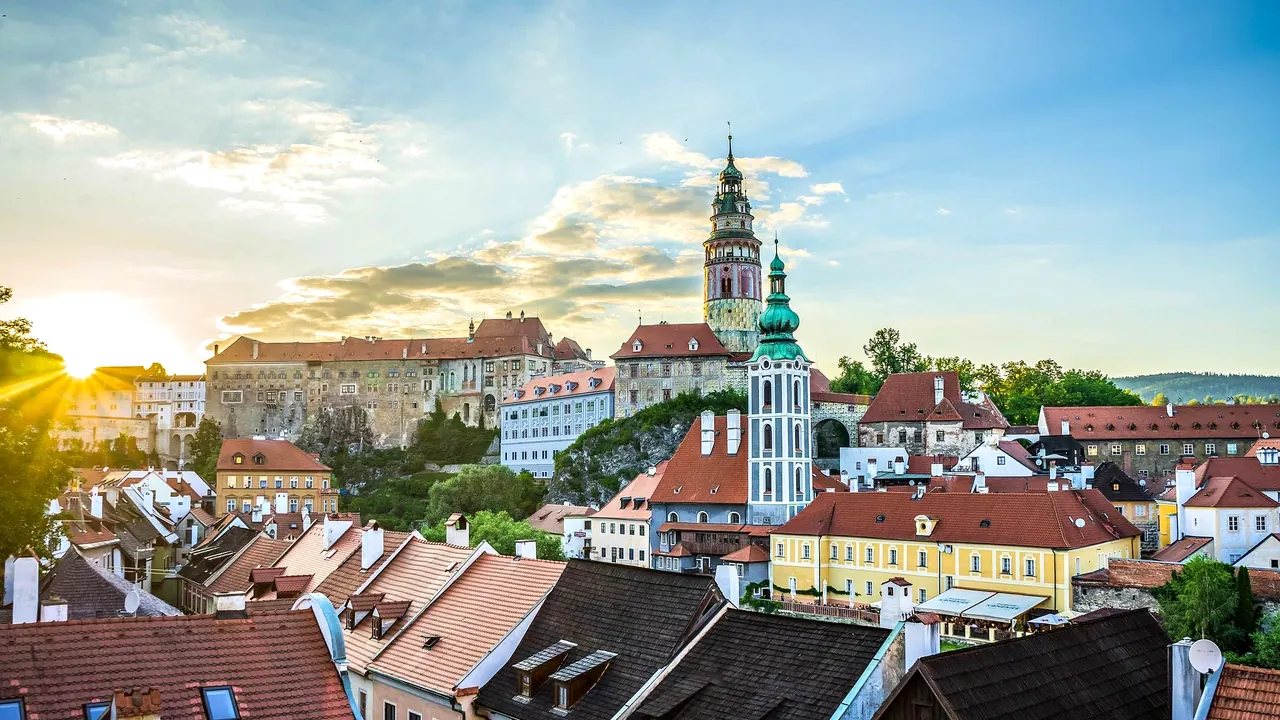
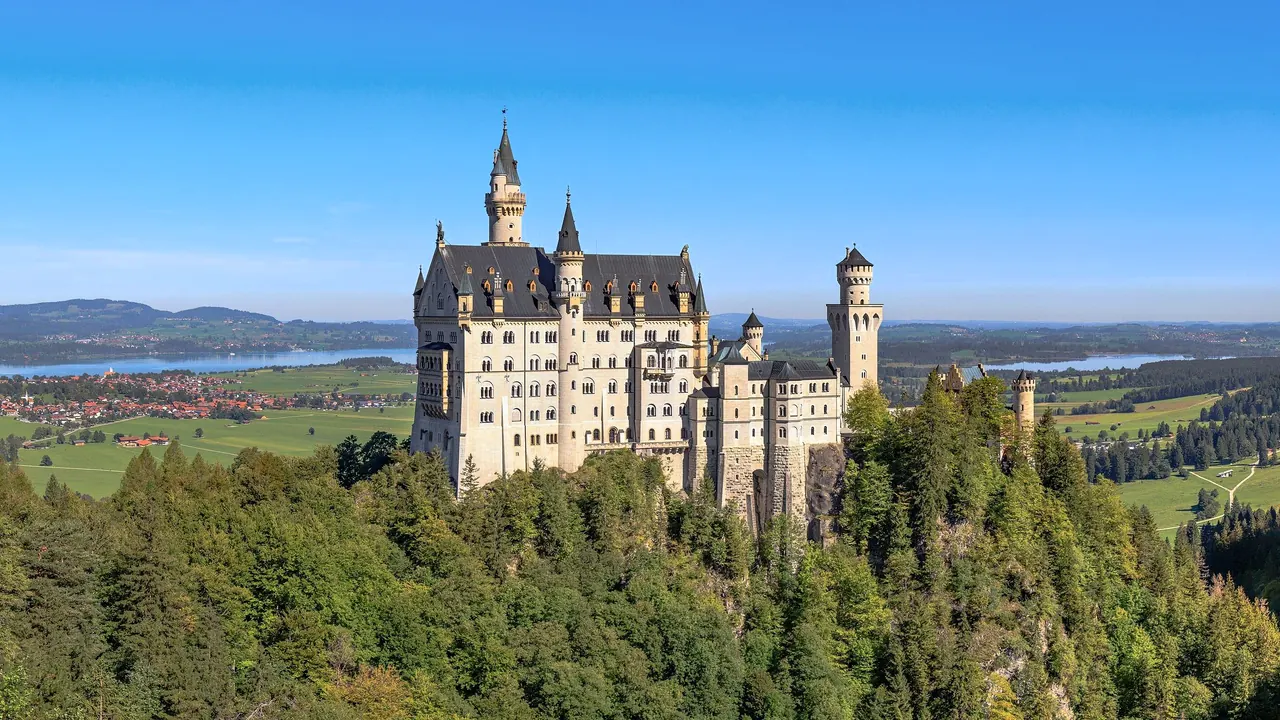
Photos: Czechia by Leonhard Niederwimmer, Pexels License; Germany by Llez, CC BY-SA 3.0, cropped.
Czechia or Germany?
Our verdict in twelve categories, each scored against the same fixed benchmark cities, and the climate month by month, so you can choose for your trip.
Choose Czechia for
- prices
Czechia suits travellers who want old towns, castles and beer in a small country on a moderate budget. Prague can anchor the whole trip, and Kutna Hora, Cesky Krumlov and Olomouc are easy additions. Away from the capital, guesthouses, pub meals and castle tours cost noticeably less, and the colonnaded spa towns of West Bohemia make a gentle end to the trip.
Choose Germany for
- nightlife
- live music and the arts
- beaches
Germany is the better choice when you want more than handsome streets. Berlin's clubs and opera houses, the Semperoper in Dresden, the Bavarian Alps, Europa-Park and the Baltic beaches give music lovers, night owls, hikers and families far more to choose from. Germany also has the deeper spa and sauna culture. You pay Western European prices for that range, and you need more time on trains between places that are much further apart.
Scoreboard
Twelve categories on one fixed scale from 0 to 100. The shaded stretch is the gap between the two.
Your match
Pick a travel style or drag the sliders, and both match scores follow your weighting.
Wins on prices with your weighting.
Wins on nightlife and live music and the arts with your weighting.
What matters to you?
Category by category
What the scores mean for a trip.
Beaches & swimming
Czechia is landlocked, so swimming means lakes. Lipno and Macha Lake have sandy shores, and there are bathing spots among the Trebon fishponds. They make a pleasant summer afternoon, but nobody would plan a trip around them.
Germany has a real coast. On Usedom and Rügen, long white beaches lead up to old piers and wicker beach chairs, and Sylt has wild dunes. The Bavarian lakes give it an inland option too. The season is short and northern, but you can build a summer week around the beach here, and you can't in Czechia.
Where in Czechia: Lipno, Macha Lake, Trebon
Food & drink
Both countries revolve around beer, but Germany offers more variety. In Czechia, it comes down to pubs pouring unpasteurised tank lager in the land where Plzen invented the style. The food is roast pork and dumplings, svickova and fruit dumplings, with wine cellars around Mikulov as the alternative. Outside Prague and Brno, the cooking is good but plain.
Germany changes from region to region. You get Bavarian beer gardens and Munich's Viktualienmarkt, smoked beer in Franconia, Riesling in the Moselle villages and Hamburg's fish sandwiches. Berlin adds Turkish and Vietnamese street food and serious fine dining, so it is easier to eat varied meals day after day.
Culture & sights
Prague's castle district, Charles Bridge, Old Town Square and Jewish Quarter survive as one continuous historic centre, while Germany's heritage is spread across dozens of cities. Beyond Prague, Czechia keeps whole towns intact: Cesky Krumlov below its castle in a river bend, the arcaded painted square of Telc, Baroque Olomouc. The buildings are the draw here. The museums rarely are.
Germany has the great collections and the weight of modern history. There is Museum Island and the traces of the Wall in Berlin, Munich's royal residences and galleries, Cologne Cathedral, the Bauhaus and Luther's Wittenberg. War damage left some German city centres rebuilt or modern, so unbroken old streets are easier to find in Czechia.
Where in Czechia: Prague, Cesky Krumlov, Kutna Hora, Olomouc
Nightlife
Germany is far ahead for going out. Berlin's club culture runs from Saturday night into Monday, with bars from Kreuzberg to Friedrichshain. Hamburg has the Reeperbahn and Cologne its crowded Kölsch pubs, and Leipzig and Frankfurt add their own club scenes.
In Czechia, going out mostly means Prague: good pubs, cocktail bars in Vinohrady and a few big clubs, but stag groups in the Old Town. Zizkov and Brno's student bars are more relaxed, and in most other towns the night ends early.
Nature & outdoors
Germany has the higher ground and more variety. The Bavarian Alps offer the Zugspitze, Königssee and hut-to-hut hiking. There is also the Black Forest, the vineyard cliffs and cycle paths of the Rhine and Moselle, and Rügen's chalk cliffs above the Baltic.
Czechia is gentler, with forest, sandstone and river valleys. Bohemian Switzerland continues the same rock country as Saxon Switzerland across the border, with the Pravcicka Gate and boat trips through the gorges. The Krkonose top out around 1,600m, and canoeing the Vltava from Cesky Krumlov is the classic summer outing.
Where in Czechia: Bohemian Switzerland, Krkonose, Sumava, Moravian Karst
Where in Germany: Bavarian Alps, Black Forest, Saxon Switzerland, Rhine and Moselle valleys
Day trips
Day trips are easy in both countries, and Germany has a slight edge in range. Czechia is so compact that Kutna Hora, Karlstejn, Plzen and Terezin are each about an hour from Prague. From Brno you can reach the Lednice wine villages, and even Vienna.
Germany has more bases to choose from. Munich puts Neuschwanstein and Salzburg within reach, Frankfurt the Rhine Gorge and Heidelberg, Dresden Meissen, and Nuremberg Bamberg and Rothenburg. The rides are often an hour or two rather than one.
Good for families
Germany is the easier and fuller choice with children. Europa-Park deserves several days of its own, and there are also Phantasialand and Legoland. Munich's Deutsches Museum and Hamburg's giant model railway entertain all ages, and the Baltic beaches are calm and shallow.
Czechia is safe and relaxed, with costumed castle tours, Prague's zoo and funicular, and the safari park at Dvur Kralove. In summer, Lipno and the Krkonose run treetop walks and toboggan runs. There is no big theme park, though, and cobbled old towns are hard work with a pushchair.
Where in Czechia: Prague, Krkonose, Lipno, Dvur Kralove
Where in Germany: Black Forest and Europa-Park, Munich, Berlin, Hamburg
Getting around
You can travel both countries comfortably without a car, but the experience differs. Czechia is small enough that trains and frequent coaches cover nearly everything, including the run to Cesky Krumlov. Prague's simple three-line metro and its trams are easy to learn.
Germany has high-speed ICE trains between its big cities and dense U-Bahn networks, which make long distances practical. Its long-distance trains are often late, though, so leave slack for missed connections. In both countries, a car helps in rural areas such as the Sumava and the Black Forest.
Shopping & style
Germany is the better place for serious shopping. There is the Kurfürstendamm and KaDeWe in Berlin, Düsseldorf's Königsallee and Munich's Maximilianstrasse, along with independent design shops in Mitte. Note that shops close on Sundays across the country.
Czechia is mainly for crafts: Bohemian glass, garnet jewellery, marionettes and Karlovy Vary porcelain. Parizska in Prague is its only real fashion street. Both countries come alive with Christmas markets in December, and Germany has more of them, led by Nuremberg and Dresden.
Where in Czechia: Prague, Karlovy Vary
Where in Germany: Berlin, Munich, Düsseldorf, Nuremberg
Affordability
Czechia is the cheaper of the two. Brno and Olomouc have modest hotels and some of Europe's cheapest good beer, and South Bohemian guesthouses cost little. Only central Prague's tourist routes approach Western prices.
Germany is priced like the rest of Western Europe. Leipzig and Dresden are good value, and Berlin is moderate, but Munich, the Alpine resorts and Sylt quickly push a budget up. Regional rail passes and bakeries help keep costs down.
Where in Czechia: Brno, Olomouc, South Bohemia
Live music & performing arts
Germany is the stronger choice for music and theatre. Berlin has three opera houses and the Berlin Philharmonic. Dresden has the Semperoper, Leipzig the Gewandhaus and Hamburg the Elbphilharmonie, and the Bayreuth Festival is devoted to Wagner. Even medium-sized towns run full seasons of opera and ballet.
Czechia's music is concentrated in Prague, which is still a fine place to hear it. You can catch Mozart at the Estates Theatre, the Czech Philharmonic at the Rudolfinum and the Prague Spring festival. Brno's Janacek tradition and Cesky Krumlov's summer festival add to what Prague offers.
Where in Czechia: Prague, Brno, Karlovy Vary, Cesky Krumlov
Wellness & relaxation
Czechia's spa tradition is concentrated in West Bohemia. Karlovy Vary, Marianske Lazne and Frantiskovy Lazne have kept their nineteenth-century colonnades and leafy parks, and the daily routine is slow: you walk from one spring to the next and drink the water as a treatment. Public thermal pools are few, so a spa visit works best as a stay of several nights on a cure programme in a spa hotel. Luhacovice in Moravia and the peat baths of Trebon are quieter alternatives.
Germany offers both kinds of visit, and that is why it comes out ahead. Baden-Baden, Wiesbaden and Aachen, where people have bathed since Roman times, keep up the grand old tradition, and the Lower Bavarian spa triangle and the Black Forest spa hotels suit a longer stay. You can also drop into a big thermal and sauna complex for an afternoon in almost any city, even on a short city break. Germans take their saunas seriously, so expect to go without swimwear.
Where in Czechia: Karlovy Vary, Marianske Lazne, Frantiskovy Lazne, Luhacovice
Where in Germany: Baden-Baden, Wiesbaden, Bad Reichenhall, Lower Bavarian spa triangle
When should you go?
Pick your month, and for a country the place in it. The climate figures are measured averages, not a forecast.
Where in Germany
Prague (Czechia) in July
Berlin (Germany) in July
Daytime high, °C
Rainfall in the month, mm
Temperature and rainfall are climate normals, averaged over the years shown. Prague (Czechia): 1991-2020 normals, Praha-Libus (8.1 km from centre). Berlin (Germany): 1991-2020 normals, Berlin / Alexanderplatz (0.9 km from centre).
The two countries share a central European climate, so their best months are much the same. From late May to September, Prague and Berlin both reach about 25°C at the height of summer. That is the time for lake swimming in Czechia and for the Baltic beaches on Usedom and Rügen. The difference is in the rain. Prague gets most of its rain in summer, about 80mm in June. Munich is much wetter, with around 121mm a month from June to August, which matters if you plan to hike in the Alps. Hamburg stays cooler at about 23°C in high summer, with more cloud.
Winters are cold and dark in both countries, so they suit museums, concerts and spas rather than long walks. Prague's winters are the driest of the cities, though often grey. Cologne has the mildest winters, at around 7°C in December. May, June and September are the most comfortable months for walking in either country.
Which traveller are you?
More comparisons
Each shares a side with Czechia or Germany.
Where else could you go?
Set Czechia or Germany against any other country.