Germany
Munich
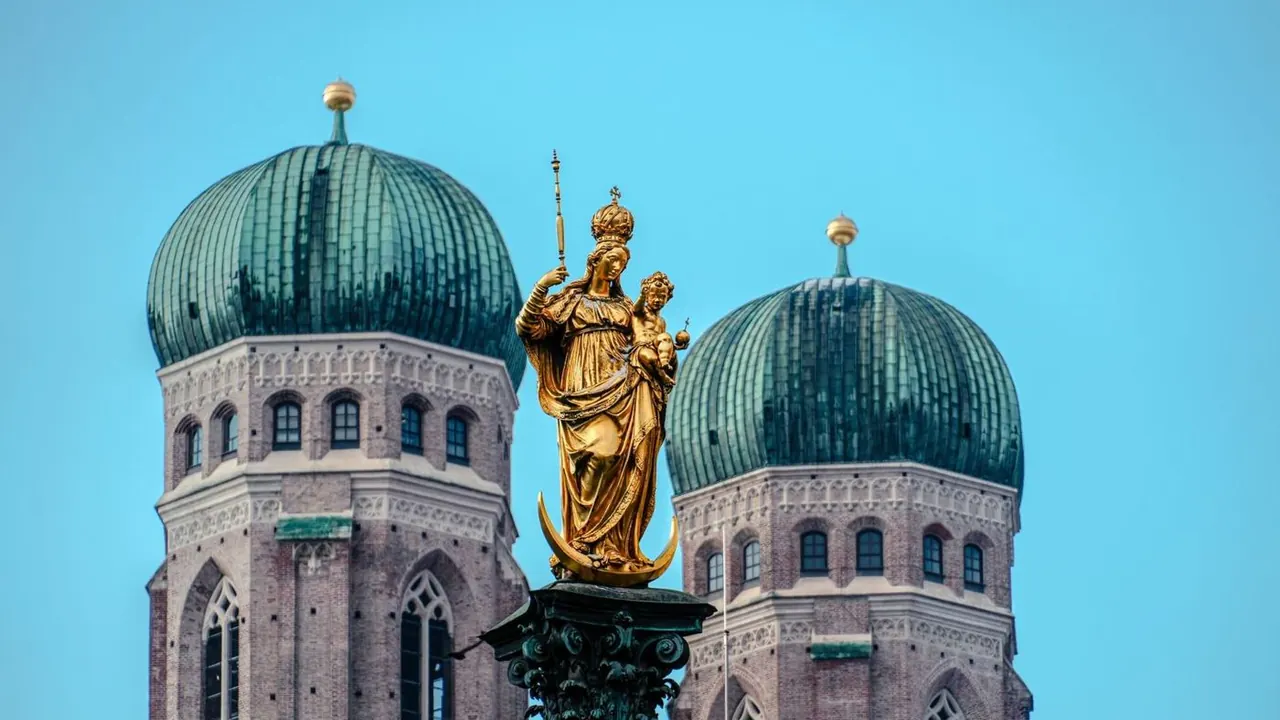
The Frauenkirche towers and the Mariensäule
- Day trips86
- Getting around86
- Live music & the arts84
Photo: 0xd1ma, Pexels License
Match
67
Every category weighted equally
- Beach & sun60
- Culture & arts73
- Food & nightlife67
- Family trip66
- Outdoors69
- Relax & unwind64
- Shopping & style70
- On a budget63
Munich in twelve categories
Our verdict on each, scored 0 to 100 against the same fixed benchmark cities, so a score means the same thing on every page.
Beaches & swimming. Scores 28 out of 100.
Food & drink. Scores 62 out of 100.
Culture & sights. Scores 79 out of 100.
Nightlife. Scores 56 out of 100.
Nature & outdoors. Scores 82 out of 100.
Day trips. Scores 86 out of 100.
Good for families. Scores 78 out of 100.
Getting around. Scores 86 out of 100.
Shopping & style. Scores 72 out of 100.
Affordability. Scores 32 out of 100.
Live music & performing arts. Scores 84 out of 100.
Wellness & relaxation. Scores 62 out of 100.
Munich category by category
Beaches & swimming
28Munich is far from any sea, but it is a city of summer swimmers. On warm days locals sunbathe on the gravel banks of the Isar south of the centre, and the Flaucher stretch fills with families and barbecues. The real swimming is in the lakes: the Starnberger See and the Ammersee are under an hour by S-Bahn, with lawns, jetties and clear water that reaches about 20-23°C in high summer.
The season runs from about June to early September, and the water is alpine-fed, so swims are fresh rather than warm. Nobody comes here for the beach. Lake days are a pleasant break in a city trip, not the reason for one.
Food & drink
62Eating and drinking in Munich centre on beer. The six big breweries still run vast beer halls and leafy beer gardens where you can sit under chestnut trees with a litre of Helles and, by old custom, bring your own picnic. The cooking that goes with it is hearty and meaty: roast pork with crackling, Schweinshaxe, white sausage with sweet mustard and pretzels before noon, Obatzda cheese spread and Dampfnudeln.
The Viktualienmarkt, an open-air market a step from Marienplatz, is the place for snacks, cheese and fruit. Afternoon coffee and cake is taken seriously, and the city has a respectable tier of starred restaurants. Beyond Bavarian fare the range is narrower, with good Italian, Turkish and Balkan cooking but less depth elsewhere.
Culture & sights
79Munich is a city of royal collections. The Kunstareal in Maxvorstadt groups the Alte Pinakothek, one of Europe's great collections of old masters, with the Neue Pinakothek, the Pinakothek der Moderne, the Glyptothek's Greek and Roman sculpture and the Lenbachhaus with its Blue Rider painters. The Residenz, the Wittelsbach palace in the centre, is a maze of courtyards and state rooms, and Nymphenburg Palace sits in its formal park to the west.
The Deutsches Museum on its island in the Isar is one of the largest science and technology museums anywhere. The old town around Marienplatz, the Frauenkirche, the Asamkirche and Ludwigstrasse is handsome, though much was rebuilt after wartime bombing. The Dachau memorial lies just outside the city.
Nightlife
56A night out in Munich often starts in a beer hall or beer garden and stays there. Beyond that, the Glockenbachviertel and Gärtnerplatz area has the densest run of cocktail bars and gay bars, Schwabing and Maxvorstadt have student pubs, and a handful of serious techno and house clubs keep going until morning at weekends.
The tone is prosperous and fairly tidy rather than wild, and many neighbourhoods are quiet by midnight on weeknights. The big exception is the Oktoberfest, held on the Theresienwiese from late September, when huge tents and the crowds they draw take over the city for just over two weeks.
Nature & outdoors
82Munich sits on a flat plain, but on clear days the Alps show on the southern skyline, and the foothills begin about an hour away. Trains and regional buses reach the Wetterstein around Garmisch-Partenkirchen, the Zugspitze, Tegernsee and the Isar valley for alpine hiking in summer and skiing in winter. The Five Lakes region is good for cycling, sailing and gentle walks.
In the city, the English Garden is one of the largest urban parks in Europe. Surfers ride the standing wave on the Eisbach at its edge, and green cycle paths follow the Isar south out of town. Spring and autumn are the best walking seasons. Winter brings snow to the mountains, though the city itself is often grey.
Day trips
86Munich is one of the best bases in Central Europe for a day out. Augsburg, with its Renaissance town hall and Fuggerei almshouses, is half an hour by train. Nuremberg's old town and castle are about an hour away by fast train, and medieval Regensburg on the Danube about an hour and a half. Across the border, baroque Salzburg is roughly an hour and a half away, and Innsbruck under two hours.
The royal castles are the classic excursion. Neuschwanstein and Hohenschwangau near Füssen take about two hours, and Herrenchiemsee stands on an island in the Chiemsee. Smaller towns such as Landshut, Freising, Wasserburg and the painted villages of Oberammergau and Mittenwald round out a long list.
Good for families
78Munich is easy with children: safe, clean and green, with playgrounds in every park and transport that takes pushchairs. The Tierpark Hellabrunn is a large zoo laid out along the Isar meadows. The Deutsches Museum has hands-on sections and a children's area, the transport museum shows trains and cars, and there is a Sea Life aquarium in the Olympic Park.
Beer gardens are family places, often with playgrounds attached. The English Garden and the lake beaches make easy summer days out, and Legoland Deutschland is about an hour and a half away by car. Many sights are aimed at adults, but the city itself is gentle enough to get around without strain.
Getting around
86Munich's old town is compact and largely pedestrianised, so Marienplatz, the Residenz, the Viktualienmarkt and the main churches are a short walk apart. The U-Bahn, S-Bahn, trams and buses run on one integrated network, are clean and safe, and reach the museums, Nymphenburg, the Olympic Park and the airport easily. The S-Bahn also runs out to the lakes.
The city is flat and well suited to cycling, with long riverside and park routes. A car is a burden in town and unnecessary for most day trips, which run on regional trains. Delays on the central S-Bahn line are the main irritation.
Shopping & style
72Munich is a prosperous city and its shopping shows it. Maximilianstrasse and the Theatinerstrasse arcades hold the luxury houses, while the pedestrian axis of Neuhauser Strasse and Kaufingerstrasse carries department stores and high-street chains. Dallmayr, a delicatessen trading for centuries, is a destination in its own right for coffee and fine food.
The distinctive purchase is Tracht, the Bavarian costume of dirndls and lederhosen, made by specialist tailors and sold in shops around the centre. Glockenbach and Schwabing have independent fashion and design boutiques, and the Christmas markets fill the old town with craft stalls in December. Flea markets and bazaar-style shopping are limited.
Affordability
32Munich is the most expensive city in Germany, and hotels are where a visitor feels it. Rooms are dear all year and become very dear during the Oktoberfest and the big trade fairs. Restaurant meals cost Western European capital prices.
Some things soften the bill. Beer-hall food and beer garden snacks are fair value, bringing your own picnic to a beer garden is a tradition, the parks and lakes are free, several museums charge only a token fee on Sundays, and public transport is reasonably priced for what it gives.
Live music & performing arts
84The Bavarian State Opera, playing in the columned National Theatre on Max-Joseph-Platz, is one of the leading opera companies in the world, with a season that runs most of the year and a summer opera festival with a long history. Alongside it, the Bavarian Radio Symphony Orchestra, the Munich Philharmonic and the Bavarian State Orchestra give the city three orchestras of real standing. Concerts are held in the Herkulessaal of the Residenz and in the Prinzregententheater, among other halls.
The gilded rococo Cuvilliés Theatre stages chamber opera in an intimate setting, the Gärtnerplatztheater specialises in operetta and musicals, and the Residenztheater and Kammerspiele are the main houses for German-language drama. There is a respected jazz club scene, and touring rock and pop acts play regularly at the Olympic Park. English-language theatre is scarce.
Wellness & relaxation
62Munich has a genuine bathing tradition. The Müller'sches Volksbad on the Isar is an Art Nouveau swimming hall with vaulted pools and a Roman-style steam bath. Public saunas follow the German custom of mixed, textile-free sauna rooms with infusion rituals. At Erding, about forty minutes away, stands one of Europe's largest thermal bath complexes, and the old spa towns of Bad Tölz and Bad Reichenhall lie towards the mountains.
The pace of life helps too. Long afternoons in a shady beer garden, lying on the lawns of the English Garden or by the Isar, and quiet Sundays when shops close all make the city easier to slow down in than its prosperity suggests.
When should you go?
Pick a month to see what it is like. The climate figures are measured averages, not a forecast.
Munich in July
Daytime high, °C
Rainfall in the month, mm
The whole year
Shaded against this city’s own year: the deepest cell is its best month for that figure and the palest its weakest.
Temperature and rainfall are climate normals, averaged over the years shown. Munich: 1991-2020 normals, München (1.9 km from centre).
Before you go
| Measure | Munich |
|---|---|
| Official language | German |
| Currency | Euro (EUR) |
| Sockets | CF230 V, 50 Hz |
| Driving side | Right |
| Time zone | UTC+1, UTC+2 in summer |
| Emergency number | 112 |
| Elevation | 519 m |
| Main airport | Munich Airport (MUC)29 km from centre210 non-stop destinations |
| Public holidays this year | 12 days |
By the numbers
| Measure | Munich |
|---|---|
| City population | 1,505,036 |
| People per km² | 4,844 |
| Museums within 10 km | 74 |
| UNESCO World Heritage sites within 50 km | 1 |
Compare Munich with
Every comparison with a written verdict behind it.