Germany
Cologne
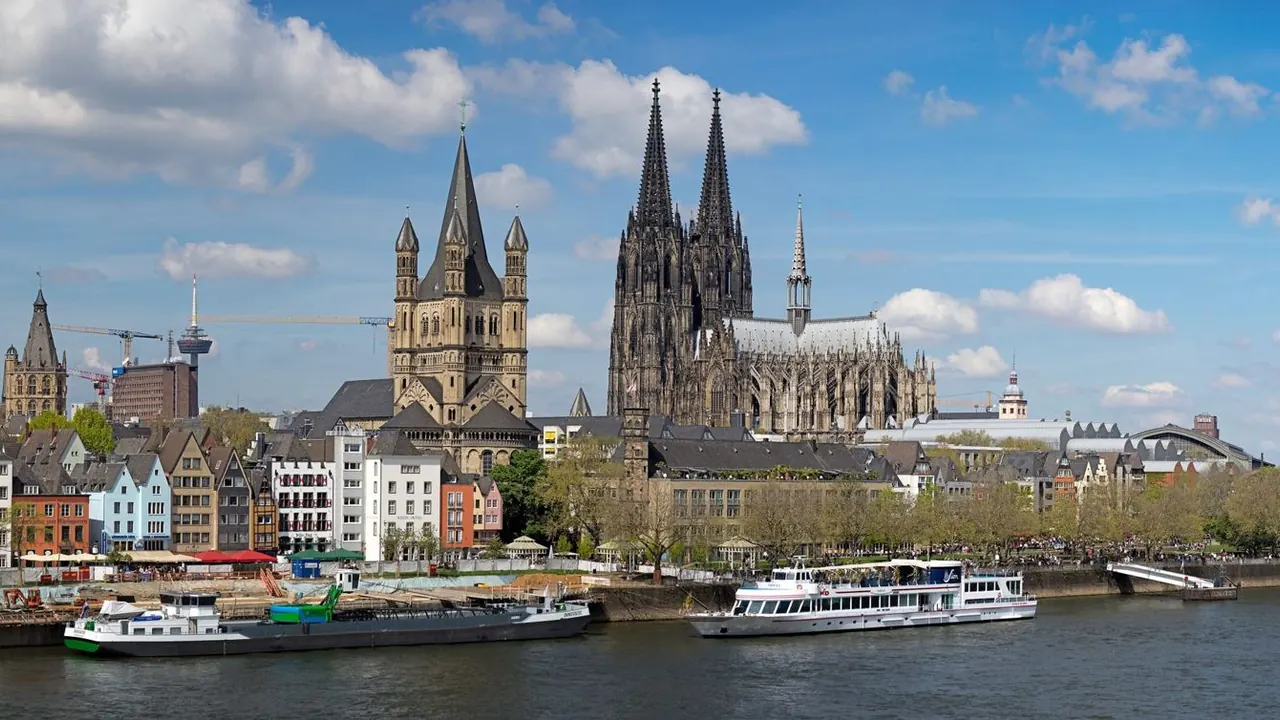
The cathedral and Great St. Martin on the Rhine
- Day trips80
- Getting around74
- Families70
Photo: Jörg Braukmann, CC BY-SA 4.0, cropped
Match
58
Every category weighted equally
- Beach & sun52
- Culture & arts64
- Food & nightlife60
- Family trip57
- Outdoors58
- Relax & unwind53
- Shopping & style60
- On a budget57
Cologne in twelve categories
Our verdict on each, scored 0 to 100 against the same fixed benchmark cities, so a score means the same thing on every page.
Beaches & swimming. Scores 14 out of 100.
Food & drink. Scores 52 out of 100.
Culture & sights. Scores 67 out of 100.
Nightlife. Scores 66 out of 100.
Nature & outdoors. Scores 56 out of 100.
Day trips. Scores 80 out of 100.
Good for families. Scores 70 out of 100.
Getting around. Scores 74 out of 100.
Shopping & style. Scores 57 out of 100.
Affordability. Scores 46 out of 100.
Live music & performing arts. Scores 68 out of 100.
Wellness & relaxation. Scores 50 out of 100.
Cologne category by category
Beaches & swimming
14Cologne is an inland river city, and the Rhine is not for swimming. The current is strong, shipping is heavy, and the sandy banks at Rodenkirchen or along the Poller Wiesen are for sitting, not bathing. In summer locals go to the flooded gravel pits on the edge of the city instead. Fühlinger See, Escher See and Otto-Maigler-See have grassy banks, small sandy stretches and water that reaches about 22°C on warm days. They make a pleasant afternoon, but they are a side activity. The nearest sea is the Dutch or Belgian coast, too far for a day out.
Food & drink
52Eating in Cologne centres on the Brauhaus. In the big beer halls of the Altstadt and around the cathedral, waiters known as Köbes bring small, straight glasses of Kölsch and replace them until you put a beer mat on top. The food is hearty Rhineland cooking: Himmel un Ääd (black pudding with apple and mashed potato), sauerbraten, pork knuckle, and the Halve Hahn, which is a rye roll with aged Gouda rather than half a chicken. The Kölsch ritual itself is the part worth seeking out.
Away from the brewhouses the range is decent rather than deep. The Belgian Quarter and Ehrenfeld have modern bistros, cafés and good Turkish and Middle Eastern food, the last strongest along Ehrenfeld's Venloer Strasse. There are a few serious fine-dining kitchens. Still, few visitors come to Cologne for its food.
Culture & sights
67The cathedral is the reason many people come. It is a Gothic giant whose twin spires dominate the riverfront, and inside are the Shrine of the Three Kings and centuries of stained glass. Below its level, Cologne has a second heritage layer that visitors often miss: a ring of twelve great Romanesque churches, St Gereon and St Maria im Kapitol among them. There are also Roman foundations, mosaics and pieces of the old city wall from the city's two thousand years.
The museums are strong. Museum Ludwig holds one of Europe's best collections of Pop Art and twentieth-century art. The Wallraf-Richartz covers medieval to Impressionist painting, and Kolumba sets religious art inside the ruins of a bombed church. Most of the city, however, was rebuilt quickly after the Second World War. Outside a few streets near the river, the townscape is plain, so the highlights are individual buildings rather than a historic whole.
Nightlife
66Cologne likes going out, and it is unpretentious about it. Evenings often begin in the Kölsch brewhouses of the Altstadt and move to the Belgian Quarter's cocktail and wine bars, or to the Zülpicher Strasse student strip, which is packed at weekends. Ehrenfeld, the former industrial district in the west, has clubs and late bars in old factory buildings. The city also has one of Germany's largest and most open gay scenes, centred on the streets around Rudolfplatz and the Schaafenstrasse.
The high point of the year is Carnival. During the street-carnival days that run up to Rosenmontag, the whole city drinks and sings in costume from morning until long after dark. Outside that season the scene is lively and late at weekends but quieter in the week, and its clubs do not draw dedicated clubbers from abroad.
Nature & outdoors
56The city itself is flat, but it is greener than it first looks. A double ring of parks, the Grüngürtel, encircles the centre, and the Stadtwald and the Rhine meadows suit long walks and runs. Cycle paths follow the river for many kilometres in both directions. Within about forty minutes the land rises. The Siebengebirge, south of Bonn, has wooded volcanic hills, the Drachenfels crag and well-marked trails above the river. The Bergisches Land to the east is a region of rolling hills, valleys and reservoirs.
About an hour away, the Eifel has a national park, crater lakes and the vineyard slopes of the Ahr valley, which suit day hikes. There are no real mountains, and the climate is mild and often grey. This is a base for good walking and cycling, not for adventure.
Day trips
80Cologne sits at the centre of a dense web of fast trains, and that is one of its real strengths as a base. Brühl's rococo Augustusburg palace and Falkenlust hunting lodge are a quarter of an hour away. Bonn, with Beethoven's birthplace and the old government quarter, is about twenty minutes. Düsseldorf, with its Altstadt and Rhine promenade, takes about half an hour. Aachen, where Charlemagne's octagonal chapel forms the core of the cathedral, is under forty minutes.
Going south, the Rhine Gorge takes about an hour and a half by train. There, castle-crowned wine towns such as Bacharach and St Goar line the river, and Koblenz sits where the Moselle joins it. The Ahr valley offers red-wine villages closer to home. Across the borders, Maastricht and Liège are within reach, and Brussels is a little under two hours by high-speed train. The Ruhr's industrial heritage at Zollverein adds a very different kind of outing.
Good for families
70Cologne is an easy city with children. Cologne Zoo, one of Germany's oldest, has a large elephant park and an aquarium. The Chocolate Museum on the Rhine harbour peninsula wins over most children with its working production line and chocolate fountain. A cable car swings across the river to the Rheinpark, which has playgrounds and wide lawns, and the riverside promenades are traffic-free.
The biggest single draw is Phantasialand at Brühl, one of Europe's major theme parks, a short trip south of the city. Science centres, adventure playgrounds in the Grüngürtel and boat trips on the Rhine fill out a stay. Germans are relaxed about children in brewhouses and cafés. The main drawbacks are crowds and the drunken streets at Carnival time, which is not a period to plan around small children.
Getting around
74Getting around is simple for most visitors. The main railway station sits right beside the cathedral, so arrival puts you in the heart of the old town. The cathedral, the museums, the Altstadt and the river are all within a flat, walkable area. A bridge walk across the Hohenzollern Bridge leads to Deutz and the Rheinpark. A network of trams and partly underground light rail, the Stadtbahn, together with S-Bahn trains, reaches the Belgian Quarter, Ehrenfeld, the zoo and the suburbs.
The network map is not the most intuitive, and the trams can be crowded and irregular. For most stays, though, there is no need for a car. Cycling is popular and largely flat, with long riverside paths.
Shopping & style
57Cologne is a serious high-street city. Schildergasse and Hohe Strasse, the pedestrian spine running south from the cathedral, are among Germany's busiest shopping streets, lined with chain stores and department stores. Ehrenstrasse and the Belgian Quarter are more rewarding for independent fashion, design shops and small concept stores. Mittelstrasse and the streets near Apostelnkirche have most of the higher-end labels, though luxury depth is modest.
The local speciality is Eau de Cologne, which still comes from the historic perfume houses on Glockengasse and opposite the town hall. Christmas markets fill the squares in Advent and are the city's great seasonal shopping moment. Otherwise, Cologne is a place for practical shopping more than a shopping destination.
Affordability
46Cologne is mid-priced for Western Europe. A brewhouse meal with a few glasses of Kölsch costs less than in most capitals, public transport is fairly priced, and many churches, including the cathedral, are free to enter. Hotels are the main expense. Rates are moderate in ordinary weeks but rise sharply during the big trade fairs at the Messe and during Carnival, when rooms can be scarce and expensive. Check the fair calendar before you book.
Live music & performing arts
68Cologne's stage life is broad and solid. The Cologne Opera and the Schauspiel Köln share the theatre complex on Offenbachplatz. The Philharmonie, an acoustically admired hall set beneath the square beside the cathedral, is home to the Gürzenich Orchestra and the WDR Symphony Orchestra. The West German public broadcaster's ensembles add a strong radio orchestra, a big band and choirs. Romanesque churches host early-music concerts.
The popular side is just as strong. The city has a long tradition of electronic and experimental music, a lively jazz scene, and many small clubs in Ehrenfeld and the Südstadt hosting gigs most nights. The arena in Deutz brings in big touring acts, and the Carnival sessions, with their dialect bands and songs, are a performance tradition found nowhere else.
Wellness & relaxation
50Cologne has more to offer for unwinding than its party reputation suggests. It shares the German sauna culture: large, mostly textile-free sauna landscapes with steam rooms, cold plunges and quiet rooms, which locals use as an ordinary weekend habit. In the Rheinpark, a thermal bath complex fed by local mineral springs looks across the river to the cathedral. Aachen, under forty minutes away, has drawn bathers to its hot springs since Roman times.
The city itself is not slow. The centre is busy, and Carnival is the opposite of restful. Even so, quiet walks along the Rhine meadows and long afternoons in the Grüngürtel parks are always within easy reach.
When should you go?
Pick a month to see what it is like. The climate figures are measured averages, not a forecast.
Cologne in July
Daytime high, °C
Rainfall in the month, mm
The whole year
Shaded against this city’s own year: the deepest cell is its best month for that figure and the palest its weakest.
Temperature and rainfall are climate normals, averaged over the years shown. Cologne: 1991-2020 normals, Köln-Stammheim (5.4 km from centre).
Before you go
| Measure | Cologne |
|---|---|
| Official language | German |
| Currency | Euro (EUR) |
| Sockets | CF230 V, 50 Hz |
| Driving side | Right |
| Time zone | UTC+1, UTC+2 in summer |
| Emergency number | 112 |
| Elevation | 59 m |
| Main airport | Cologne Bonn Airport (CGN)15 km from centre115 non-stop destinations |
| Public holidays this year | 11 days |
By the numbers
| Measure | Cologne |
|---|---|
| City population | 1,025,523 |
| People per km² | 2,532 |
| Museums within 10 km | 40 |
| UNESCO World Heritage sites within 50 km | 3 |
Compare Cologne with
Every comparison with a written verdict behind it.