Spain
Cadiz
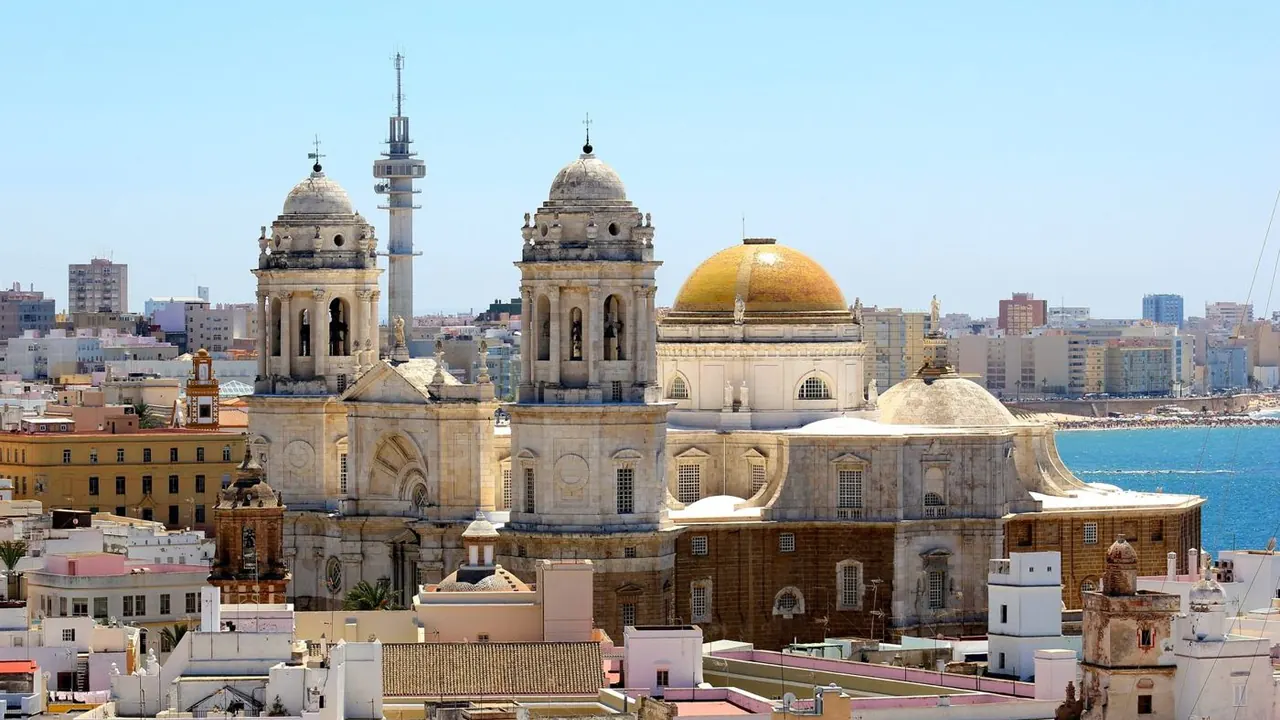
The cathedral from the Torre Tavira
- Beaches80
- Day trips80
- Getting around70
Photo: Bronch, CC BY-SA 3.0 ES, cropped
Match
60
Every category weighted equally
- Beach & sun62
- Culture & arts60
- Food & nightlife58
- Family trip64
- Outdoors65
- Relax & unwind61
- Shopping & style57
- On a budget60
Cadiz in twelve categories
Our verdict on each, scored 0 to 100 against the same fixed benchmark cities, so a score means the same thing on every page.
Beaches & swimming. Scores 80 out of 100.
Food & drink. Scores 68 out of 100.
Culture & sights. Scores 62 out of 100.
Nightlife. Scores 45 out of 100.
Nature & outdoors. Scores 66 out of 100.
Day trips. Scores 80 out of 100.
Good for families. Scores 60 out of 100.
Getting around. Scores 70 out of 100.
Shopping & style. Scores 35 out of 100.
Affordability. Scores 58 out of 100.
Live music & performing arts. Scores 52 out of 100.
Wellness & relaxation. Scores 42 out of 100.
Cadiz category by category
Beaches & swimming
80The sea surrounds the city, and beach life runs through a summer stay. La Caleta, a small sheltered cove between two castles in the old town, is the one locals swim at. Playa Victoria runs for several kilometres of wide, fine golden sand along the newer part of the city. It is clean and easy to reach on foot or by bus, and it fills with families from June to September. In August the Atlantic here reaches about 22°C, warmer than most of this ocean's European coast.
Within an hour's drive the Costa de la Luz opens up: long, empty strands at El Palmar, Conil and Zahara de los Atunes, and the dune-backed bay of Bolonia. The levante, a strong easterly wind, can blast sand across the beaches for days at a time. The swimming season runs roughly from June to early October.
Food & drink
68Eating here means fish, and it is very good. Freidurías sell paper cones of fried fish, cazón en adobo (marinated dogfish) and tortillitas de camarones, crisp shrimp fritters. Tapas bars in the old town and the La Viña quarter serve local almadraba bluefin tuna, the catch of the traditional trap fisheries along this coast, for much of the year. The Mercado Central, an old market hall, has fish stalls in the morning and food counters later in the day.
To drink there is cold manzanilla and fino from the sherry towns close by. The range is narrow: little international cooking, few ambitious restaurants inside the city itself, and late, unhurried meals in the Spanish style. If you want seafood and tapas, the city is hard to fault.
Culture & sights
62Founded by the Phoenicians, Cadiz claims to be the oldest city in Western Europe. The old town sits on a narrow peninsula of tall, pale houses with watchtowers on top, built when the city ran Spain's trade with the Americas. The gold-domed cathedral faces the sea, and you can climb its bell tower. The Torre Tavira has a camera obscura that projects the rooftops. The Museo de Cádiz holds Phoenician marble sarcophagi, and the Roman theatre lies half-hidden in the Barrio del Pópulo.
The Oratorio de San Felipe Neri is where Spain's liberal constitution of 1812 was signed. The castles of Santa Catalina and San Sebastián guard La Caleta. It all makes for two or three rewarding days, not a city crammed with major museums.
Nightlife
45Evenings follow the Spanish pattern. People eat late and drink at tapas bars in La Viña and around Plaza de San Francisco, and the small squares fill on warm nights. In summer the scene moves to the seafront promenade along Playa Victoria, with terraces and bars open into the early hours. The rest of the year is calmer, with a few late bars and a small club scene, much of it student-driven.
Carnival, held each February, is the exception. For ten days the whole city turns into a costumed street party that runs through the night. Outside those weeks, travellers who want serious clubbing usually go elsewhere.
Nature & outdoors
66The city sits on the edge of the Bahía de Cádiz natural park, a flat landscape of salt pans, tidal channels and marsh full of flamingos, herons and spoonbills, good for birdwatching and kayaking. Along the coast to the south, the pine forest of La Breña runs along high cliffs above the sea near Barbate. Tarifa, about an hour and a quarter away, is one of Europe's great kitesurfing and windsurfing spots, and boats go out from there into the Strait to see dolphins and whales.
Inland, the limestone peaks and gorges of the Sierra de Grazalema give real mountain walking within about two hours. Across the Guadalquivir from Sanlúcar lies the wetland wilderness of Doñana. The city itself is flat, with the sea for scenery.
Day trips
80This is one of the best bases in Andalusia. Jerez is about half an hour by train and has sherry bodegas, a Moorish fortress and its famous riding school. A ferry crosses the bay to El Puerto de Santa María, another sherry town. Sanlúcar de Barrameda, home of manzanilla, sits at the mouth of the Guadalquivir. Seville, with its cathedral, Alcázar and old quarters, is under two hours by train.
By car, the hilltop white towns are close. Vejer de la Frontera and Arcos de la Frontera are the most striking, and Medina Sidonia is quieter. Beside the beach at Bolonia stand the ruins of Baelo Claudia, a Roman fish-salting town. Tarifa, at Spain's southern tip, has an old walled centre.
Good for families
60For a beach vacation with children it works well. Playa Victoria is wide and sandy, with lifeguards and room to spread out in summer. La Caleta is small and sheltered. The old town is flat, compact and car-light, its parks such as the Alameda and the Genovés have shade and space to run, and Spanish children stay out with their families late into warm evenings, so nobody minds a toddler at the next table.
There is very little built for children: no large aquarium, zoo or theme park. Afternoons with older children may mean castle walls, the camera obscura or a ferry across the bay. Summer heat at midday and the gusty levante are the main things to plan around.
Getting around
70The old town is small, flat and mostly closed to traffic, and its narrow grid of streets is easy to walk from one shore to the other. City buses run the length of the long isthmus to Playa Victoria. The seafront promenade is an easy walk or cycle along the sea.
Trains run straight out of the old town to Jerez and Seville, and a catamaran crosses the bay to El Puerto de Santa María and Rota. The Costa de la Luz beaches, the white villages and Tarifa are poorly served by public transport, so you will need a hire car or a tour for those.
Shopping & style
35Shopping here is modest and local. Calle Ancha, Columela and the streets around Plaza de las Flores hold Spanish high-street chains, older family-run shops and a few small boutiques. The Mercado Central and the flower stalls nearby are the most enjoyable places to browse. Hand-painted fans, ceramics, flamenco fashion and bottles of sherry make the best things to take home.
There is no luxury quarter or design scene to speak of. Serious shopping means Seville.
Affordability
58Eating and drinking are good value. Tapas bars, freidurías and the market counters let you eat very well for little, and a glass of sherry or a beer costs less than in most of Western Europe. Buses, local trains and the bay ferry are cheap, and the main sights charge small entrance fees, if any.
Rooms are the expensive part. The old town has few hotels, and in July, August and Carnival week they fill up and cost more. Staying near Playa Victoria, or coming in spring or autumn, keeps a stay much cheaper.
Live music & performing arts
52Cadiz is one of the cradles of flamenco, the home of the bright, quick song called alegrías. In the old fishermen's quarter of Santa María, small peñas, the members' clubs where flamenco is kept alive, put on singing, guitar and dancing for audiences who know the forms well. A few tablaos stage shows for visitors.
The neo-Mudéjar Gran Teatro Falla hosts the official Carnival contest, where satirical choirs called chirigotas and comparsas sing sharp, witty songs about politics and city life. The theatre also has a steady year-round programme of plays and concerts, and every autumn it hosts a long-running festival of Ibero-American theatre. Opera and orchestral music are thin, and Seville is the place for them.
Wellness & relaxation
42There is no real bathing or spa tradition in the city itself. Wellness means hotel spas, and the larger resort spas with sea-water treatments are a short drive away at Novo Sancti Petri near Chiclana. In Jerez, half an hour away, Arab-style baths offer warm pools and massage.
What the city does offer is pace. Days here are slow: a walk along the sea walls, a long lunch, a siesta through the hottest hours and an evening stroll as the sun sets over La Caleta. Visitors who need treatments should plan them in. Those who simply want to slow down will find it easy.
When should you go?
Pick a month to see what it is like. The climate figures are measured averages, not a forecast.
Cadiz in July
Daytime high, °C
Rainfall in the month, mm
The whole year
Shaded against this city’s own year: the deepest cell is its best month for that figure and the palest its weakest.
Temperature and rainfall are climate normals, averaged over the years shown. Cadiz: 1991-2020 normals, Cadiz Bay / Puntales (5.2 km from centre).
Before you go
| Measure | Cadiz |
|---|---|
| Official language | Spanish |
| Currency | Euro (EUR) |
| Sockets | CF230 V, 50 Hz |
| Driving side | Right |
| Time zone | UTC+1, UTC+2 in summer |
| Emergency number | 112 |
| Elevation | 11 m |
| Main airport | Jerez Airport (XRY)31 km from centre25 non-stop destinations |
| Public holidays this year | 12 days |
By the numbers
| Measure | Cadiz |
|---|---|
| City population | 109,950 |
| People per km² | 9,087 |
| Museums within 10 km | 11 |
| UNESCO World Heritage sites within 50 km | 0 |
| Swim season, months above 21 °C | 3 months |
Compare Cadiz with
Every comparison with a written verdict behind it.