Switzerland
Davos
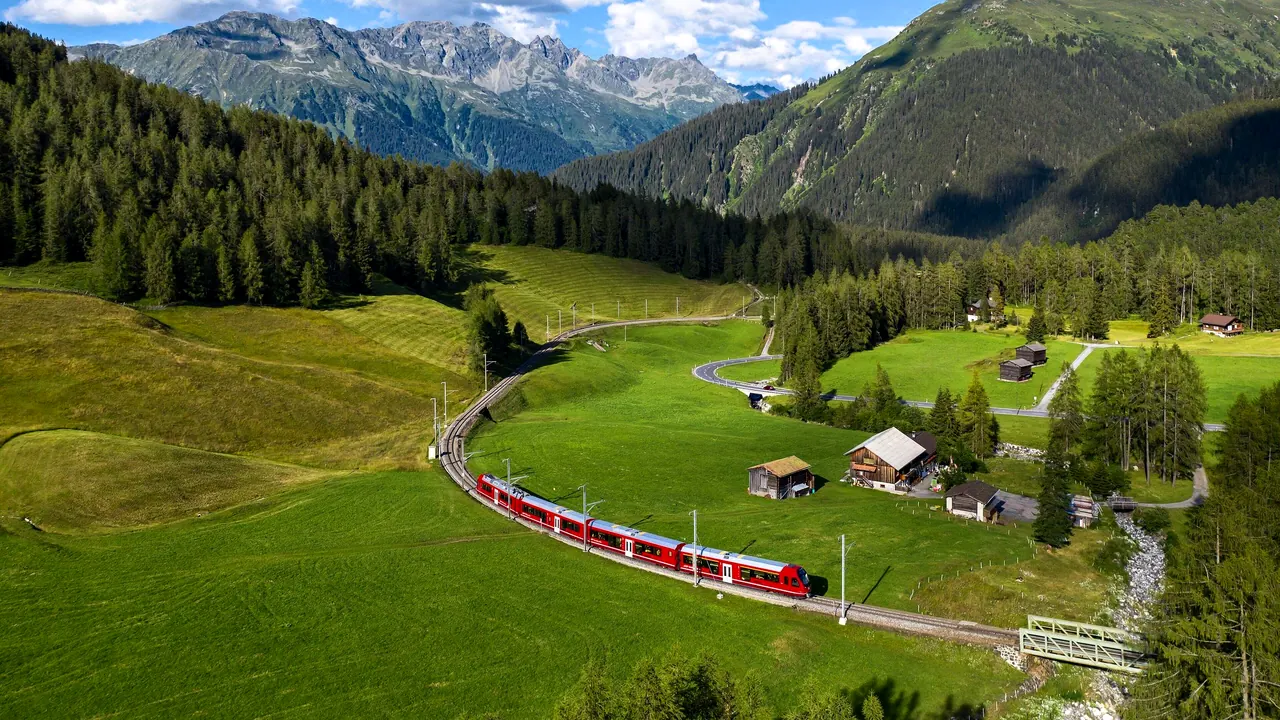
A red Rhaetian Railway train between Davos Wolfgang and Laret
- Nature & outdoors92
- Getting around77
- Families58
Photo: Kabelleger / David Gubler, CC BY-SA 4.0, cropped
Davos lies in Swiss Alps, which has its own page.
Match
38
Every category weighted equally
- Beach & sun37
- Culture & arts37
- Food & nightlife32
- Family trip42
- Outdoors46
- Relax & unwind41
- Shopping & style36
- On a budget35
Davos in twelve categories
Our verdict on each, scored 0 to 100 against the same fixed benchmark cities, so a score means the same thing on every page.
Beaches & swimming. Scores 10 out of 100.
Food & drink. Scores 32 out of 100.
Culture & sights. Scores 22 out of 100.
Nightlife. Scores 22 out of 100.
Nature & outdoors. Scores 92 out of 100.
Day trips. Scores 50 out of 100.
Good for families. Scores 58 out of 100.
Getting around. Scores 77 out of 100.
Shopping & style. Scores 20 out of 100.
Affordability. Scores 5 out of 100.
Live music & performing arts. Scores 16 out of 100.
Wellness & relaxation. Scores 55 out of 100.
Davos category by category
Beaches & swimming
10Davos is a mountain town at about 1,560m, and swimming is a minor summer pleasure rather than a reason to come. The Davosersee at the northern end of town has a lido with lawns and a jetty, but even in July and August the water rarely gets much above 16°C to 18°C, and the season is short. Most visitors who want to swim use the indoor leisure pool or a hotel pool. The nearest sea is a long day's travel away.
Food & drink
32Eating in Davos means Graubünden mountain cooking and resort hotel dining. The regional dishes are worth seeking out: capuns (chard-wrapped dumplings), pizokel, barley soup, air-dried Bündnerfleisch and the walnut-and-caramel Engadiner Nusstorte. You find them at their best in mountain huts on the ski runs and in the side valleys, where a long lunch on a sunny terrace is part of the day.
In town there are hotel restaurants, a few ambitious kitchens and plenty of pizza, fondue and raclette, but not much range beyond that. Many places close or cut back between seasons. There is no street-food or market culture to speak of, so people who travel to eat will find it limited.
Culture & sights
22Davos is not a sightseeing town, but it has more history than its flat-roofed hotel blocks suggest. From the late nineteenth century it was a health resort where tuberculosis patients came for the altitude and the dry air, and this is the setting of Thomas Mann's The Magic Mountain. Former sanatoria such as the Schatzalp above the town, with their sun balconies, still show what that era looked like. The Kirchner Museum holds the largest collection of work by the Expressionist painter Ernst Ludwig Kirchner, who lived and painted here. A winter sports museum, a local history museum and the old church of St Johann complete a short list you can see in one or two days.
Nightlife
22Going out in Davos follows the ski season. In winter, après-ski starts at the bottom of the Jakobshorn and Parsenn runs and carries on in hotel bars, a few lively pubs and a couple of small clubs along the Promenade. At weekends and in the busiest weeks of the winter season the noise lasts past midnight. Out of season the town goes quiet, and on summer evenings it usually comes down to dinner and a drink on a terrace. Anyone who wants a real night out will find it small and expensive.
Nature & outdoors
92Davos lies in a high Alpine valley, and almost every day here is spent outdoors. In winter there are five ski areas: Parsenn, Jakobshorn, Pischa, Rinerhorn and Madrisa above Klosters. There is also long-established cross-country skiing on more than 100km of trails along the valley floor and into the Sertig and Dischma valleys, plus winter walking paths, toboggan runs and a big natural ice rink.
In summer the same lifts carry hikers and mountain bikers onto a dense network of marked trails and singletrack, from easy lake circuits to high passes and summits above 3,000m. The quiet side valleys end below glaciers and are good for spotting marmots, chamois and ibex. The Swiss National Park is within reach for a day. Weather comes in fast at this altitude, and late spring and November are muddy and quiet.
Day trips
50Most day trips from Davos are trips by train, and the train ride is often the highlight. The Rhaetian Railway runs down to Filisur and the Landwasser Viaduct and along the UNESCO-listed Albula line over the pass to St Moritz and the Upper Engadine, in about an hour and a half. Chur, the oldest town in Switzerland, with a compact medieval centre and cathedral, is about an hour and a quarter away. Through the Vereina tunnel you reach the Lower Engadine, with the painted houses of Guarda and the spa town of Scuol, in about an hour.
Klosters is a short hop. Liechtenstein is within reach by car. Zurich and Lucerne are too far for a comfortable day out.
Good for families
58Davos works well for families who like being outdoors. In winter there are children's ski schools with gentle nursery slopes, long toboggan runs such as the one down from the Schatzalp, and skating on the big natural rink. In summer there are easy lakeside walks, mountain playgrounds at the top stations, adventure trails and the lido on the Davosersee. A large indoor leisure pool with slides helps on bad-weather days.
The town is safe and easy, and the free local buses run its length. What it lacks are zoos, aquariums, science museums or theme parks, and teenagers who are not into sport may get bored. The altitude rarely bothers children, but the first day can tire them.
Getting around
77You don't need a car in Davos. The town stretches for about 4km along the valley between Davos Dorf and Davos Platz, each with its own Rhaetian Railway station. Local buses run along the main road and out to the side valleys, and a guest card usually gives you free rides. The Parsenn funicular and the Jakobshorn cable car leave from the town itself, so you can walk or take the bus to the slopes. The Promenade is pleasant on foot, but the full length of town is a long walk, especially in ski boots. Arriving by train from Zurich takes a little over two hours with a change at Landquart.
Shopping & style
20Shopping in Davos is mostly along the Promenade: ski and outdoor gear shops, sports rental, some Swiss watch and jewellery stores, a few fashion boutiques and delicatessens selling Bündnerfleisch, mountain cheese and Nusstorte to take home. It covers what a skier or hiker needs and makes for a pleasant browse in the evening, but there is no market, no craft tradition and nothing distinctive enough to plan a trip around.
Affordability
5Davos is among the most expensive places to spend a vacation. Hotels, restaurants and lift passes all cost Swiss resort prices, and mountain huts on the slopes charge extra for their setting. In the peak winter weeks, and above all during the annual World Economic Forum in January, rooms are scarce and cost even more. Free local buses with the guest card, rental apartments and self-catering help a little. Early summer and autumn are cheaper, but some hotels and restaurants close then.
Live music & performing arts
16There isn't much performing arts in Davos. The high point is the summer classical festival, which brings young musicians to play in churches, hotels and unusual places around the valley. The congress centre hosts the occasional concert, and in winter some hotel bars have live music. Outside these there is no regular theatre, opera or concert season, and people who want an evening of serious music or theatre will have to travel to Zurich.
Wellness & relaxation
55Davos was built as a place to recover, and the clear, dry mountain air that first brought tuberculosis patients here is still part of its appeal. Wellness in town means hotel spas and saunas: most of the larger hotels have pools and treatment rooms, and the town's big leisure pool has a sauna and wellness area open to day visitors. For proper thermal bathing, the mineral baths of Scuol in the Lower Engadine are about an hour away through the Vereina tunnel.
The pace is slowest in summer and on quiet winter weekdays, when sun terraces, unhurried walks and long lunches set the rhythm. In the peak ski weeks the town is much busier.
When should you go?
Pick a month to see what it is like. The climate figures are measured averages, not a forecast.
Davos in July
Daytime high, °C
Rainfall in the month, mm
The whole year
Shaded against this destination’s own year: the deepest cell is its best month for that figure and the palest its weakest.
Where the figures come from
Davos's temperatures are measured 53 km from the centre, at S. Valentino Alla Muta.
Davos has no rain gauge within 25 km of the centre, so its rainfall comes from a gridded climate dataset read at the destination rather than from a gauge further away.
Temperature and rainfall are climate normals, averaged over the years shown. Davos: 1991-2020 normals, S. Valentino Alla Muta (53.4 km from centre).
Before you go
| Measure | Davos |
|---|---|
| Official language | French, German, Italian, Romansh |
| Currency | Swiss Franc (CHF) |
| Sockets | CJ230 V, 50 Hz |
| Driving side | Right |
| Time zone | UTC+1, UTC+2 in summer |
| Emergency number | 112 |
| Elevation | 1,559 m |
| Main airport | Zürich Airport (ZRH)122 km from centre226 non-stop destinations |
| Public holidays this year | 9 days |
By the numbers
| Measure | Davos |
|---|---|
| Population | 10,738 |
| People per km² | 38 |
| Museums within 10 km | 3 |
| UNESCO World Heritage sites within 50 km | 2 |
Compare Davos with
Every comparison with a written verdict behind it.
- Adelboden
- Alpe d'Huez
- Andermatt
- Arosa
- Avoriaz
- Chamonix
- Châtel
- Courchevel
- Crans-Montana
- Engelberg
- Flaine
- Grindelwald
- Gstaad
- Klosters
- La Clusaz
- La Plagne
- La Rosière
- Laax
- Le Grand-Bornand
- Lenzerheide
- Les Arcs
- Les Deux Alpes
- Les Gets
- Les Menuires
- Leukerbad
- Megève
- Méribel
- Montgenèvre
- Morzine
- Mürren
- Saas-Fee
- Saint-Gervais-les-Bains
- Samnaun
- Samoëns
- Serre Chevalier
- St. Moritz
- Tignes
- Val Cenis
- Val d'Isère
- Val Thorens
- Verbier
- Wengen
- Zermatt