Spain
Ronda
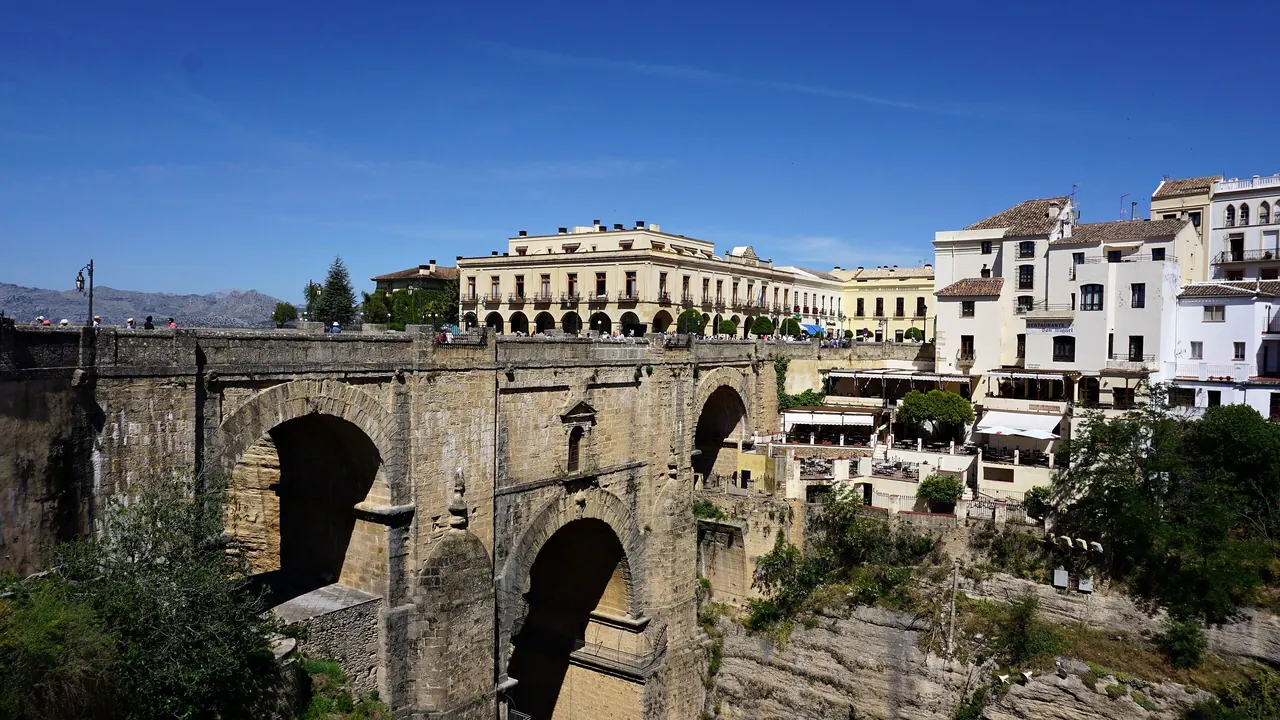
The Puente Nuevo and the white town above the gorge
- Nature & outdoors78
- Day trips74
- Affordable cities63
Photo: Julia Kostecka, CC BY 2.0, cropped
Match
43
Every category weighted equally
- Beach & sun41
- Culture & arts45
- Food & nightlife38
- Family trip47
- Outdoors52
- Relax & unwind43
- Shopping & style39
- On a budget45
Ronda in twelve categories
Our verdict on each, scored 0 to 100 against the same fixed benchmark cities, so a score means the same thing on every page.
Beaches & swimming. Scores 20 out of 100.
Food & drink. Scores 40 out of 100.
Culture & sights. Scores 58 out of 100.
Nightlife. Scores 15 out of 100.
Nature & outdoors. Scores 78 out of 100.
Day trips. Scores 74 out of 100.
Good for families. Scores 32 out of 100.
Getting around. Scores 55 out of 100.
Shopping & style. Scores 22 out of 100.
Affordability. Scores 63 out of 100.
Live music & performing arts. Scores 20 out of 100.
Wellness & relaxation. Scores 33 out of 100.
Ronda category by category
Beaches & swimming
20Ronda is a mountain town and its beaches are an hour away. The Costa del Sol around San Pedro de Alcántara and Estepona is roughly 50km south, down a road full of hairpin bends over the Serranía. The sea there is warm Mediterranean, around 22°C in late summer, and the beaches are long, sandy and built up.
Without a car the coast is hard to reach, and even with one it fills a whole day. In summer most visitors cool off in a hotel or rural-house pool. If swimming in the sea matters, stay on the coast and visit Ronda for a day.
Food & drink
40Food here is the cooking of the Serranía, the mountain country around the town: oxtail stew, which is linked to the bullfighting tradition, lamb and game, cured hams and sausages from the hills, wild mushrooms and chestnuts from the Genal valley in autumn, and hearty dishes such as migas. Vineyards around the town make wine under the Sierras de Málaga label, and several wineries outside town offer tastings.
The best eating is in the tapas bars of the Mercadillo, the newer part of town, away from the restaurants with views on the gorge. Those view terraces mostly serve set menus to day-trippers. The choice of other cuisines is small and fine dining is limited, so a few days covers it well.
Culture & sights
58Ronda's great sight is its setting. The town sits on both sides of El Tajo, a gorge more than 100m deep. The Puente Nuevo, an eighteenth-century stone bridge, spans it and joins La Ciudad, the old Moorish town, to the Mercadillo, which grew up after the Christian conquest. The views from the bridge, the cliff-top paths and the trail down to the valley floor are what most people remember.
Around them is a compact group of real heritage. The Real Maestranza bullring is one of the oldest in Spain and has a museum, and its town is where modern bullfighting on foot took shape. The Arab baths below the old town are some of the best preserved in the country. There is also the Mondragón palace, the church of Santa María la Mayor, built on the site of the old mosque, and the stairway cut through the rock at the Casa del Rey Moro. The museums are small, so one or two unhurried days are enough.
Nightlife
15Evenings in Ronda centre on tapas and late dinners. The Plaza del Socorro and the streets around it stay lively until fairly late in summer, as Spanish towns do. There are a few bars for a drink afterwards, but almost no club scene, and the town is quiet by the early hours outside the September fair. Come for a good evening meal, not a night out.
Nature & outdoors
78Ronda stands on a plateau ringed by limestone mountains. The countryside is a strong reason to stay here rather than just drive through. The Sierra de Grazalema lies to the west, with steep crags, the Garganta Verde ravine and griffon vultures overhead. It catches more rain than almost anywhere in Spain, so it is unusually green. To the east, the Sierra de las Nieves national park protects rare forests of Spanish fir and high ground for hiking.
A path drops from the town to the foot of the Tajo gorge, and the cliffs are popular with climbers. The Caminito del Rey, a walkway along the walls of the El Chorro gorge, is about an hour away by car. The Genal valley's chestnut woods turn copper in autumn. Spring and autumn are the best seasons for walking, since summer afternoons are hot and winter nights can be cold.
Day trips
74The white villages of the Serranía and the Sierra de Cádiz are the classic outing. Setenil de las Bodegas, with houses built under overhanging rock, is about twenty minutes away. Grazalema and Zahara de la Sierra, below its castle, are within the hour, and Arcos de la Frontera is a little further. Close to town are the Roman ruins of Acinipo and the Cueva de la Pileta, a cave with Palaeolithic paintings.
Antequera, with its prehistoric dolmens and old town, is a little over an hour away, and so is Marbella's old quarter. Málaga, Seville, Jerez and Gibraltar each take one and a half to two hours, which is long but manageable for a full day. Buses and the occasional train serve the bigger towns, but a hire car makes all the difference for the villages.
Good for families
32Ronda is safe and relaxed, and children are welcome in its squares and tapas bars late into the evening, as they are all over Spain. Older children usually enjoy the bridge, the walk down into the gorge, the stairway cut through the rock at the Casa del Rey Moro and the cave visits nearby. Beyond that there is little made for them: no zoo, aquarium or theme park. The lanes are steep and cobbled, which makes pushchairs hard work, and some viewpoints are high and exposed. Families do best in a country house with a pool, with short trips into the hills.
Getting around
55Within Ronda you walk everywhere. The old town, the bridge, the bullring and the Mercadillo's shopping streets are a few minutes apart, though some lanes down into La Ciudad and towards the gorge are steep. The town has a railway station on the line between Algeciras and Antequera, plus buses to Málaga, Seville and the coast. These are useful for arriving but slow and infrequent for exploring. The white villages, the natural parks and the Caminito del Rey are really car territory, and parking in the old town is tight.
Shopping & style
22Shopping is modest. Carrera Espinel, the pedestrian street through the Mercadillo, has ordinary Spanish chain and local shops, and the streets near the bridge sell souvenirs, ceramics and leather goods. The things worth taking home are edible: wine from the nearby wineries, cured meats, olive oil and convent sweets. Nobody comes to Ronda to shop.
Affordability
63Ronda costs less than the big Spanish cities or the nearby coast. Tapas bars and set lunch menus in the Mercadillo are good value, the sights charge modest entry fees, and the compact town costs nothing to get around. Rural houses and small hotels in the surrounding countryside are fairly priced for what they offer. Costs rise at the hotels with views over the gorge and the terraces beside the bridge, and in spring, at Easter and during the September fair. A hire car is the biggest extra for most visitors.
Live music & performing arts
20Performance in Ronda is mostly flamenco, staged in small venues and a few bars for visitors, with livelier informal sessions sometimes during fiestas. A small municipal theatre has an occasional programme. The calendar's big event is the September fair, with the historic Corrida Goyesca, a bullfight in eighteenth-century costume, held in the old bullring. Otherwise there is little to attend in the evenings.
Wellness & relaxation
33Ronda has no living bathing culture. Its Arab baths are a historic monument to visit, not a place to bathe, and spa treatments mean a few hotel spas. What it does offer is a slow pace. Once the coach parties leave in the late afternoon, the town grows quiet. Country hotels and old farmhouses in the surrounding hills, with pools, olive groves and big views, suit a few days of doing very little.
When should you go?
Pick a month to see what it is like. The climate figures are measured averages, not a forecast.
Ronda in July
Daytime high, °C
Rainfall in the month, mm
The whole year
Shaded against this city’s own year: the deepest cell is its best month for that figure and the palest its weakest.
Where the figures come from
Ronda has no weather station within reach, so its figures come from a gridded climate model rather than a measured record, and read a broad area rather than the city itself.
Temperature and rainfall are climate normals, averaged over the years shown. Ronda: 1991-2020 normals, TerraClimate 4 km grid at the town, no weather station within 90 km.
Before you go
| Measure | Ronda |
|---|---|
| Official language | Spanish |
| Currency | Euro (EUR) |
| Sockets | CF230 V, 50 Hz |
| Driving side | Right |
| Time zone | UTC+1, UTC+2 in summer |
| Emergency number | 112 |
| Elevation | 724 m |
| Main airport | Málaga-Costa del Sol Airport (AGP)60 km from centre166 non-stop destinations |
| Public holidays this year | 12 days |
By the numbers
| Measure | Ronda |
|---|---|
| City population | 33,671 |
| People per km² | 87 |
| Museums within 10 km | 5 |
| UNESCO World Heritage sites within 50 km | 0 |
| Swim season, months above 21 °C | 1 month |
Compare Ronda with
Every comparison with a written verdict behind it.
- Alicante
- Barcelona
- Bilbao
- Cadiz
- Casablanca
- Coimbra
- Cordoba
- Faro
- Fes
- Granada
- Lisbon
- Madrid
- Malaga
- Marbella
- Salamanca
- San Sebastian
- Santiago de Compostela
- Seville
- Sintra
- Tangier
- Toledo
- Valencia
- Zaragoza