France
Carcassonne
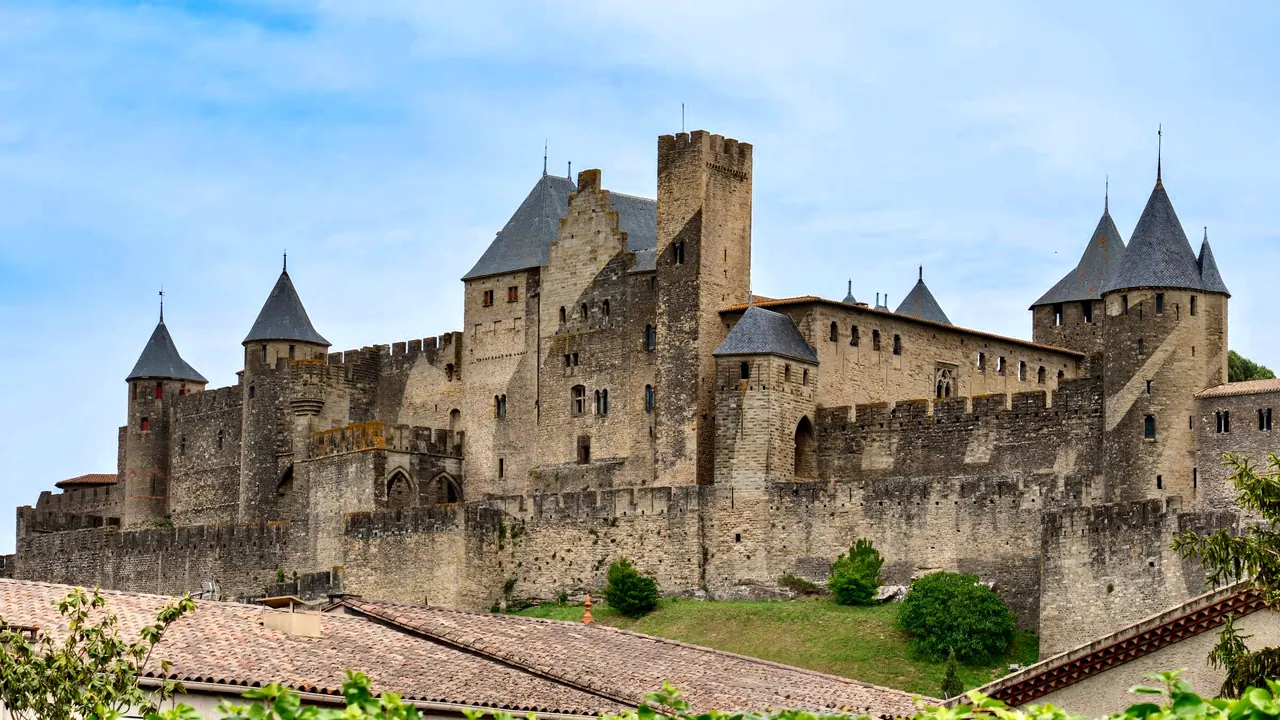
The Château Comtal and the towers of the Cité
- Day trips76
- Culture & sights62
- Nature & outdoors58
Match
44
Every category weighted equally
- Beach & sun44
- Culture & arts46
- Food & nightlife39
- Family trip50
- Outdoors52
- Relax & unwind45
- Shopping & style41
- On a budget46
Carcassonne in twelve categories
Our verdict on each, scored 0 to 100 against the same fixed benchmark cities, so a score means the same thing on every page.
Beaches & swimming. Scores 37 out of 100.
Food & drink. Scores 44 out of 100.
Culture & sights. Scores 62 out of 100.
Nightlife. Scores 18 out of 100.
Nature & outdoors. Scores 58 out of 100.
Day trips. Scores 76 out of 100.
Good for families. Scores 52 out of 100.
Getting around. Scores 48 out of 100.
Shopping & style. Scores 22 out of 100.
Affordability. Scores 55 out of 100.
Live music & performing arts. Scores 28 out of 100.
Wellness & relaxation. Scores 33 out of 100.
Carcassonne category by category
Beaches & swimming
37Carcassonne is an inland town, and the sea is not part of daily life here. The nearest swimming is at the Lac de la Cavayère, a reservoir a short drive east of the Cité with sandy shores, lifeguards in summer and water warm enough for a long swim in July and August. It suits families and an afternoon off from sightseeing.
The Mediterranean beaches at Gruissan and Narbonne-Plage are about an hour away by car. They are long, sandy and shallow, and the sea reaches around 23°C in high summer, though the local tramontane wind can make it choppy. They make a good day out, but nobody bases a beach vacation in Carcassonne.
Food & drink
44This is cassoulet country. The slow-cooked bean, duck and sausage dish is on nearly every menu, and the Lauragais to the west claims it as its own. The surrounding vineyards are a real strength: Corbières, Minervois and Malepère reds, and the sparkling blanquette of Limoux, which is served at a fair price almost everywhere.
Where you eat matters. Inside the walls of the Cité, restaurants serve the medieval crowds with set menus of uneven quality. The better meals and the local atmosphere are down in the Bastide Saint-Louis, around Place Carnot and its morning market and in the covered market hall. Range is limited: a few ambitious kitchens, solid bistros and little beyond southern French cooking.
Culture & sights
62The reason most people come is La Cité: a double ring of walls with fifty-two towers on a hill above the River Aude, the most complete medieval fortified town in Europe. It was heavily restored by Viollet-le-Duc in the nineteenth century, with slate roofs that critics still argue about, and the result is a striking skyline at dusk. Inside are the Château Comtal, with a walk along the ramparts, and the Basilica of Saint-Nazaire, whose Gothic stained glass is the finest in the town.
Below the hill, the Bastide Saint-Louis is a thirteenth-century grid town with arcaded squares and two Gothic churches, and the Canal du Midi, also UNESCO-listed, passes along its edge. Beyond these, museums are few and small, and two days covers the sights well.
Nightlife
18Evenings are quiet. Once the day visitors leave, the Cité becomes calm and atmospheric for a walk on the floodlit walls, with a few wine bars and restaurant terraces staying open. Down in the Bastide, the cafés and bars around Place Carnot are where locals gather, livelier on summer weekends than in winter, but there is little in the way of clubs or late nights. Those looking for a real night out head for Toulouse or Montpellier.
Nature & outdoors
58Carcassonne sits in a gap between two upland areas. To the north, the Montagne Noire has beech and chestnut forest, gorges and quiet walking trails; to the south, the dry, garrigue-covered Corbières hills carry vineyards and the ruins of Cathar castles on rocky ridges, with good hiking between them. The upper Aude valley leads south into the Pyrenean foothills and gorges such as those of Galamus and the Aude itself, with white-water rafting in summer.
The towpath of the Canal du Midi is the easy option: flat, shaded by plane trees and ideal for cycling or hiring a boat. Spring and autumn are best for walking, since summers are hot and the wind can be relentless. A car is needed for almost everything beyond the canal.
Day trips
76The surrounding region is one of the richest in southern France for days out. The Cathar castles are the signature trip: Peyrepertuse and Quéribus perch on limestone ridges about an hour and a quarter south, with Lastours and its four ruined towers much closer. Toulouse is about an hour by train, and Narbonne, with its Roman road and unfinished cathedral, under forty minutes.
Smaller places reward a car. Lagrasse has a Benedictine abbey and a medieval bridge, Minerve sits on a rock above two gorges, Mirepoix has a timbered arcaded square, and Limoux is the home of blanquette. Albi's brick cathedral is within two hours, as is the fishing port of Collioure. Between them lie the Corbières and Minervois wine estates, many open for tastings.
Good for families
52For children, the Cité is a storybook castle come to life: drawbridges, towers, ramparts to walk and, in summer, jousting and falconry displays. That alone carries a day or two. The Lac de la Cavayère adds a supervised lake beach, a water park and walking trails, and there is an animal park with kangaroos on the edge of town.
The drawbacks are practical. The Cité is steep, cobbled and packed in July and August, when midday heat makes the ramparts hard work, and pushchairs struggle on the old streets. The town is safe and relaxed, and families usually do best combining the castle with the lake and a few outings by car.
Getting around
48The town itself is easy. The Bastide Saint-Louis is flat and compact, the railway station is at its northern edge beside the Canal du Midi, and the Cité is about a twenty-five minute walk away across the Pont Vieux and up a steady climb, with a shuttle bus in season. Cars are kept out of the Cité, and parking is outside the gates.
Beyond the town it changes. Trains run well to Toulouse and Narbonne, but the castles, villages and vineyards are poorly served by public transport, so most visitors hire a car or join tours.
Shopping & style
22Shopping is not a reason to come. The lanes of the Cité are lined with shops selling plastic swords, knight costumes and Cathar trinkets, with a few selling local wine, nougat and soaps. The Bastide has a modest provincial high street of French chains and independent shops along Rue de Verdun and Rue Georges Clemenceau.
The best things to take home are edible: tinned cassoulet, Corbières and Minervois wine, blanquette from Limoux and produce from the market on Place Carnot.
Affordability
55Carcassonne costs what a provincial town in southern France costs, which is noticeably less than the big French cities. Rooms in the Bastide and around the canal are moderately priced outside high summer, local wine is cheap, and lunchtime set menus are good value. The town is small enough to walk, which keeps transport costs low.
The expensive part is the Cité itself: hotels inside the walls command a premium, and restaurants there charge more for less. Prices climb sharply in July and August, while spring and autumn are much easier on the budget. Car hire is the extra cost most visitors face.
Live music & performing arts
28The performing arts season is concentrated in summer. The Festival de Carcassonne fills July with concerts, theatre and dance, with headline acts on the stage of the open-air theatre inside the Cité walls, a setting that makes even a familiar show memorable. Bastille Day brings a famous fireworks display over the walls.
For the rest of the year, the municipal theatre in the Bastide offers a modest programme of plays and concerts, and live music is limited to the occasional bar gig. Opera and major classical concerts mean a trip to Toulouse.
Wellness & relaxation
33The town has no baths or bathing tradition of its own, and spa options are mostly limited to a few hotels. The upper Aude valley to the south has small, old spa villages, Rennes-les-Bains and Alet-les-Bains among them, whose thermal waters are within an hour by car, but they are modest, local places rather than destinations.
The restorative side of Carcassonne is its pace outside high summer: slow lunches, walks along the plane-shaded Canal du Midi and quiet evenings on the walls once the crowds have gone. In July and August the Cité is crowded and hot, and calm is harder to find.
When should you go?
Pick a month to see what it is like. The climate figures are measured averages, not a forecast.
Carcassonne in July
Daytime high, °C
Rainfall in the month, mm
The whole year
Shaded against this city’s own year: the deepest cell is its best month for that figure and the palest its weakest.
Where the figures come from
Carcassonne has no rain gauge within 25 km of the centre, so its rainfall comes from a gridded climate dataset read at the city rather than from a gauge further away.
Carcassonne's sunshine is measured 68 km from the centre, at Perpignan.
Temperature and rainfall are climate normals, averaged over the years shown. Carcassonne: 1999-2020 (sunshine 1991-2020, rainfall 1991-2020) normals, Carcassonne (2.8 km from centre).
Before you go
| Measure | Carcassonne |
|---|---|
| Official language | French |
| Currency | Euro (EUR) |
| Sockets | CE230 V, 50 Hz |
| Driving side | Right |
| Time zone | UTC+1, UTC+2 in summer |
| Emergency number | 112 |
| Elevation | 81 m |
| Main airport | Carcassonne Salvaza Airport (CCF)4 km from centre10 non-stop destinations |
| Public holidays this year | 11 days |
By the numbers
| Measure | Carcassonne |
|---|---|
| City population | 46,080 |
| People per km² | 708 |
| Museums within 10 km | 6 |
| UNESCO World Heritage sites within 50 km | 2 |
Compare Carcassonne with
Every comparison with a written verdict behind it.
- Aix-en-Provence
- Annecy
- Antibes
- Avignon
- Barcelona
- Biarritz
- Bilbao
- Bordeaux
- Cannes
- Chamonix
- Colmar
- Dijon
- Geneva
- Girona
- Lausanne
- Lille
- Lyon
- Marseille
- Monaco
- Montpellier
- Nantes
- Nice
- Paris
- Saint-Tropez
- San Sebastian
- Strasbourg
- Toulouse
- Turin
- Valencia
- Zaragoza