United Kingdom
Bristol
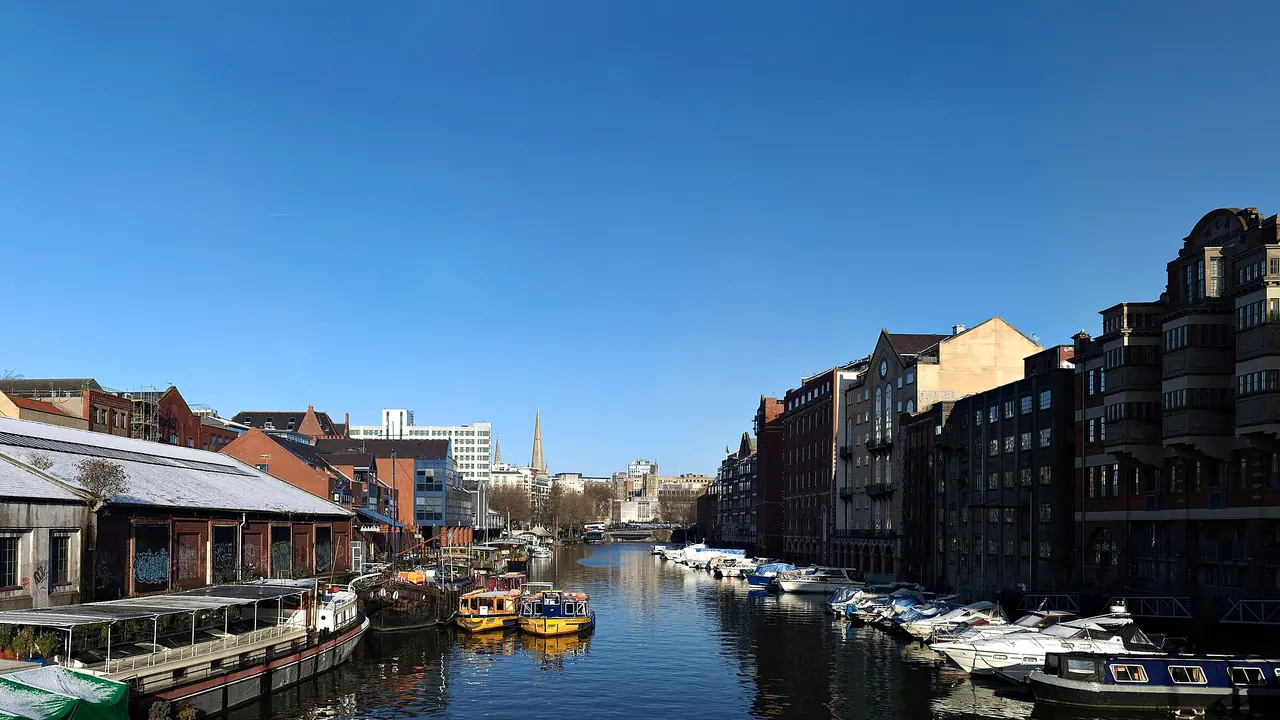
The Floating Harbour at Welsh Back, with boats on the Avon
- Day trips79
- Nightlife64
- Nature & outdoors63
Photo: NotFromUtrecht, CC BY-SA 3.0, cropped
Match
53
Every category weighted equally
- Beach & sun48
- Culture & arts56
- Food & nightlife54
- Family trip51
- Outdoors55
- Relax & unwind49
- Shopping & style54
- On a budget51
Bristol in twelve categories
Our verdict on each, scored 0 to 100 against the same fixed benchmark cities, so a score means the same thing on every page.
Beaches & swimming. Scores 15 out of 100.
Food & drink. Scores 57 out of 100.
Culture & sights. Scores 55 out of 100.
Nightlife. Scores 64 out of 100.
Nature & outdoors. Scores 63 out of 100.
Day trips. Scores 79 out of 100.
Good for families. Scores 60 out of 100.
Getting around. Scores 55 out of 100.
Shopping & style. Scores 50 out of 100.
Affordability. Scores 38 out of 100.
Live music & performing arts. Scores 57 out of 100.
Wellness & relaxation. Scores 42 out of 100.
Bristol category by category
Beaches & swimming
15Bristol sits at the head of the Severn estuary, where the tidal range is among the largest in the world. The water is brown with silt, the shore is mud at low tide, and the sea reaches about 17°C at best in late summer. Weston-super-Mare is under an hour away and has a long sandy promenade, but the tide retreats so far that a swim needs careful timing. The best bathing nearby is in tidal sea pools such as the Victorian marine lake at Clevedon, which locals use for cold-water dips. Real swimming beaches in Devon, Cornwall or Gower need a long drive, so beach life plays no part in a stay here.
Food & drink
57Bristol eats well for a city of its size, and almost all of it comes from independent places. St Nicholas Market in the old city has covered food stalls serving everything from pies to Caribbean and Middle Eastern dishes. Shipping-container kitchens line the harbourside, and Gloucester Road, Stokes Croft and North Street in Bedminster are full of small bakeries, coffee roasters and neighbourhood restaurants. A handful of ambitious modern British kitchens use produce from Somerset and the West Country.
Drinking is the more local part. West Country cider is everywhere, from farmhouse scrumpy to old cider houses, and the city has a large craft brewing scene with taprooms in former warehouses. There is no Bristol cuisine as such, though, and the city suits curious grazers more than anyone travelling in search of a defining dish.
Culture & sights
55Bristol's sights come from its centuries as a trading port and its role in Victorian engineering. Brunel's SS Great Britain, the iron steamship preserved in the dry dock where it was built, is the outstanding museum. His Clifton Suspension Bridge spans the Avon Gorge above Georgian Clifton, whose crescents and terraces are the city's most handsome architecture. St Mary Redcliffe is one of England's finest Gothic parish churches, and the cathedral, the Georgian Queen Square and the harbourside M Shed museum, which tells the city's story including its part in the slave trade, fill out a day or two.
The Bristol Museum and Art Gallery is a good general collection, and the street art in Stokes Croft and Bedminster, including Banksy's early work in his home city, is a real draw. Two or three days are enough to see what matters.
Nightlife
64Going out is one of Bristol's real strengths. The city has a long sound-system and club culture behind trip hop, drum and bass and dubstep, and a large student population keeps it busy all year. Clubs gather in old warehouses and railway arches around Temple Meads and along the harbour, where a moored boat has long served as a club. The bars and late pubs of Stokes Croft and the old city are scruffier and more creative.
The Harbourside and the old city have waterside pubs and cocktail bars for a gentler night, while Clifton and Whiteladies Road are smarter and more student-led. Weekend nights are lively and run late. The scene is smaller than in the biggest capitals, but it has its own sound and attitude.
Nature & outdoors
63Green space reaches into the city itself. The Downs are an open plateau above the Avon Gorge, whose limestone cliffs attract climbers, while Leigh Woods and the deer park at Ashton Court across the river offer woodland walks and mountain-bike trails. The old Bristol to Bath railway path is a traffic-free cycle route of about 25km through the countryside.
Further out, the Mendip Hills and the cliffs of Cheddar Gorge are under an hour away and good for walking and caving. The wooded Wye Valley is about an hour away, and the Brecon Beacons and Exmoor, both about two hours, offer proper upland hiking. The landscape is soft, green and rolling rather than dramatic, and the mild, damp climate makes it pleasant for walking in most seasons.
Day trips
79Day trips are one of the best reasons to stay in Bristol. Bath, with its Roman baths, abbey and Georgian crescents, is only a quarter of an hour away by train. Wells, England's smallest cathedral city, and the abbey ruins and tor at Glastonbury are about an hour south. Cardiff, with its castle and waterfront, is under an hour west across the Severn.
To the east, the stone villages of the southern Cotswolds, such as Castle Combe and Lacock, are about an hour by car. Salisbury's cathedral, Stonehenge and the stone circle at Avebury make a full and rewarding day. Tintern Abbey in the Wye Valley, Berkeley Castle and Gloucester's cathedral add more.
Good for families
60Bristol is a comfortable city to bring children to. The SS Great Britain is well set up for young visitors, and We The Curious, a hands-on science centre with a planetarium on the harbourside, can fill a rainy day. The aquarium is next door. Little harbour ferries make getting between them part of the fun.
On the city's northern edge, a wildlife park run by the city's old zoological society gives animals plenty of space. Noah's Ark Zoo Farm and the deer at Ashton Court are within easy reach, and the Downs and Leigh Woods leave room to run about. The city is relaxed and welcoming to children. The hills are steep for pushchairs, though, and there is no large theme park nearby.
Getting around
55Central Bristol is compact enough to walk. The old city, the harbourside, Queen Square and the shopping streets are all close together, and yellow harbour ferries link points along the Floating Harbour. Walking up to Clifton and the Suspension Bridge means a steep climb, though, and the city's hills tire legs quickly.
The city has no metro or tram, so beyond the centre a visitor relies on buses that get stuck in heavy traffic. Temple Meads station is a walk from the core and well connected for day trips by train. A car is not needed in the city, but it helps for reaching the countryside.
Shopping & style
50Bristol's mainstream shopping centres on Cabot Circus and Broadmead, a large covered complex of chain stores and department stores. The character lies elsewhere. Gloucester Road is a long run of independent shops, from record stores and delis to vintage clothes. Park Street climbs towards Clifton past fashion boutiques, while Clifton Village has gift shops and galleries in Georgian arcades.
St Nicholas Market, in the old Exchange, sells crafts, books and curios alongside its food stalls. There is little luxury shopping and no local craft tradition that visitors seek out, so shopping here makes a pleasant afternoon rather than a reason to come.
Affordability
38Bristol is one of the more expensive British cities outside London, though cheaper than the capital. City-centre hotels are moderately priced on weekdays but fill up and climb at weekends and during events. Eating out costs what it does elsewhere in England, with market stalls and street food offering the best value. Most of the main museums and churches are free, which helps, as does a compact centre that can largely be explored on foot. Budget travellers will find it manageable rather than cheap.
Live music & performing arts
57Bristol has a lively stage and music scene for its size. The Bristol Old Vic, built in the 1760s and the oldest continuously working theatre in the English-speaking world, produces its own work in a Georgian auditorium. The Hippodrome hosts touring musicals, ballet and visiting opera. The Tobacco Factory in Bedminster stages fringe theatre and Shakespeare.
The Bristol Beacon is the main concert hall for classical and big-name acts, and St George's on Brandon Hill is a fine Georgian setting for chamber music. Live music is the strongest suit, though. Small venues across Stokes Croft, the harbour and Old Market host bands, jazz and electronic acts most nights. There is no resident opera company or orchestra of international standing.
Wellness & relaxation
42Bristol has no bathing tradition of its own, but it has a few good places to slow down. The Victorian lido tucked behind Clifton's terraces is a heated open-air pool with a spa, a quietly restorative half day. Cold-water swimmers gather at the tidal pools along the Severn coast. The real draw is Bath, about a quarter of an hour by train, where the thermal spa lets you bathe in Britain's only natural hot springs on a rooftop above the abbey.
Otherwise wellness means hotel spas and yoga studios. The city's pace is creative and sociable rather than calm, though Clifton and the Downs are a peaceful retreat.
When should you go?
Pick a month to see what it is like. The climate figures are measured averages, not a forecast.
Bristol in July
Daytime high, °C
Rainfall in the month, mm
The whole year
Shaded against this city’s own year: the deepest cell is its best month for that figure and the palest its weakest.
Where the figures come from
Bristol's station stands 178 m above the city centre, so the centre is likely a little warmer than the figures say.
Bristol has no rain gauge within 25 km of the centre, so its rainfall comes from a gridded climate dataset read at the city rather than from a gauge further away.
Bristol's sunshine is measured 43 km from the centre, at Lyneham.
Temperature and rainfall are climate normals, averaged over the years shown. Bristol: 1991-2020 normals, Lulsgate Bottom (11.8 km from centre).
Before you go
| Measure | Bristol |
|---|---|
| Official language | English |
| Currency | Pound Sterling (GBP) |
| Sockets | G230 V, 50 Hz |
| Driving side | Left |
| Time zone | UTC, UTC+1 in summer |
| Emergency number | 112 or 999 |
| Elevation | 11 m |
| Main airport | Bristol Airport (BRS)11 km from centre117 non-stop destinations |
| Public holidays this year | 8 days |
By the numbers
| Measure | Bristol |
|---|---|
| City population | 472,465 |
| People per km² | 4,311 |
| Museums within 10 km | 23 |
| UNESCO World Heritage sites within 50 km | 3 |
| Swim season, months above 21 °C | None |
Compare Bristol with
Every comparison with a written verdict behind it.
- Aberdeen
- Antwerp
- Bath
- Belfast
- Brighton
- Bruges
- Brussels
- Cambridge
- Cardiff
- Cork
- Dublin
- Edinburgh
- Galway
- Ghent
- Glasgow
- Inverness
- Kilkenny
- Killarney
- Lille
- Limerick
- Liverpool
- London
- Manchester
- Nantes
- Oxford
- Paris
- Rotterdam
- St Andrews
- The Hague
- York