Spain
Salamanca
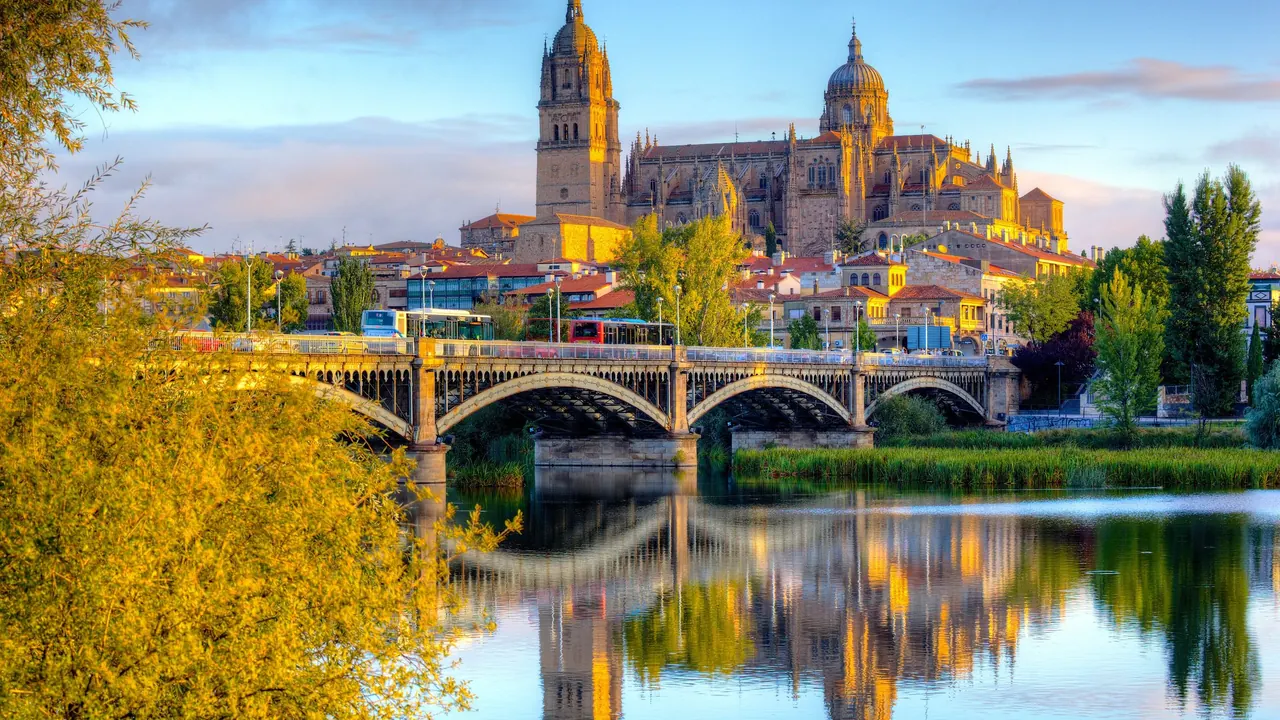
The cathedrals above the River Tormes in the morning sun
- Getting around74
- Culture & sights73
- Day trips70
Photo: Jiuguang Wang, CC BY-SA 3.0 ES, cropped
Match
52
Every category weighted equally
- Beach & sun47
- Culture & arts58
- Food & nightlife54
- Family trip50
- Outdoors52
- Relax & unwind47
- Shopping & style53
- On a budget53
Salamanca in twelve categories
Our verdict on each, scored 0 to 100 against the same fixed benchmark cities, so a score means the same thing on every page.
Beaches & swimming. Scores 6 out of 100.
Food & drink. Scores 58 out of 100.
Culture & sights. Scores 73 out of 100.
Nightlife. Scores 63 out of 100.
Nature & outdoors. Scores 52 out of 100.
Day trips. Scores 70 out of 100.
Good for families. Scores 45 out of 100.
Getting around. Scores 74 out of 100.
Shopping & style. Scores 33 out of 100.
Affordability. Scores 65 out of 100.
Live music & performing arts. Scores 37 out of 100.
Wellness & relaxation. Scores 42 out of 100.
Salamanca category by category
Beaches & swimming
6Salamanca sits on the high Castilian plain, a long day's drive from any coast, so there is no beach life here. In the heat of July and August locals use the municipal open-air pools and the river beaches along the Tormes and in the reservoirs and villages of the province. These are pleasant for an afternoon, but nobody should choose Salamanca for swimming.
Food & drink
58Eating in Salamanca centres on the bar counter. The town of Guijuelo, just to the south, cures some of Spain's finest ibérico ham, and it is sliced everywhere, alongside chorizo, farinato sausage and hornazo, a pastry baked around pork loin and egg. Evenings are spent moving between tapas bars around the Plaza Mayor, Calle Van Dyck and the streets off Rúa Mayor, where a large student population keeps portions generous and food informal.
The Mercado Central next to the Plaza Mayor is good for ham, cheese and charcuterie, and the hearty Castilian cooking includes roast suckling pig, lamb and morucha beef. Wine comes from nearby Toro, Ribera del Duero and the Sierra de Salamanca. There are a few ambitious modern kitchens, but the range is narrow: little seafood worth seeking out and not much international cooking.
Culture & sights
73The old city is a UNESCO World Heritage Site and its golden Villamayor sandstone is part of the experience. The Plaza Mayor is one of the finest baroque squares in Spain. The Plateresque façade of the University, one of Europe's oldest, holds the small carved frog that visitors hunt for. The Old and New Cathedrals stand side by side, and you can climb the towers for views over the town. Close by are the shell-studded Casa de las Conchas, the Clerecía, the convents of San Esteban and Las Dueñas and the Roman bridge over the Tormes.
The sights are close together, and two or three days covers them well. Museums are the weaker part: the Casa Lis museum of Art Nouveau and Art Deco is the standout, and the rest are modest. Come back after dark, when the stone is floodlit and the whole centre glows.
Nightlife
63Salamanca has one of Spain's best-known student nightlives. Tens of thousands of university and language-school students fill the old centre from Thursday to Saturday. The night begins with tapas, moves to packed bars around the Plaza Mayor, Calle Bordadores and Gran Vía, and ends in dance bars and small clubs that stay open well past 3am. It is cheap, friendly and full of foreigners studying Spanish, and the floodlit streets stay busy late.
The drawback is limited range. Most places aim at a young crowd and there is little serious club culture or a sophisticated cocktail scene. Outside term time, especially in high summer, the city is much quieter.
Nature & outdoors
52The city stands on the open, wheat-coloured plain of the Meseta, and walking and cycling paths along the River Tormes are the green space close at hand. The real landscapes start about an hour away. To the south, the Sierra de Francia and Las Batuecas natural park have chestnut and oak forests, deep valleys and well-marked trails, and the Sierra de Béjar and the western edge of Gredos rise above 2,000m. To the west, the Arribes del Duero cut a granite canyon along the Portuguese border, with boat trips and viewpoints.
In spring and autumn the hills are at their best. Summers on the plain are hot and winters are cold and clear. A car is needed for almost all of this.
Day trips
70Old Castile is dense with historic towns, and Salamanca is a good base for them. Ávila, with its complete medieval walls, is about an hour away. So is Zamora, a quiet riverside town with a remarkable set of Romanesque churches. Toward Portugal, the fortified border town of Ciudad Rodrigo has a cathedral and ramparts, and the half-timbered mountain villages of La Alberca, Mogarraz and Candelario keep their traditional architecture almost untouched.
Closer in, Alba de Tormes holds the tomb of Saint Teresa and Ledesma has a medieval bridge and walls. Toro adds a wine region with its own Romanesque collegiate church, and Valladolid's museums are within easy reach by train. Segovia is possible on a long day. Many of the villages are hard to reach without a car.
Good for families
45Salamanca is safe, compact and largely pedestrian. Spanish culture takes children everywhere, including to the terraces of the Plaza Mayor late on summer evenings. Children enjoy hunting for the frog on the University façade and the astronaut carved on the New Cathedral, climbing the cathedral towers and walking the riverside parks along the Tormes. There is also a small museum of historic cars.
There is little made especially for children, though: no zoo, aquarium or theme park, and the main sights are churches and colleges. July and August afternoons are very hot and winters are bitterly cold. A day or two works well as part of a wider family trip.
Getting around
74Inside the city, getting around is very easy. Nearly every sight sits in a compact, largely pedestrianised old town that you can cross on foot in about 20 minutes, from the Plaza Mayor down to the Roman bridge. City buses connect the railway and bus stations with the centre, and few visitors need them for anything else.
Trains run to Madrid and Valladolid and coaches serve the provincial towns, but the mountain villages, the Sierra de Francia and the Arribes del Duero are much easier to reach by car. Some old-town streets are cobbled and gently sloping, which takes care with a pushchair.
Shopping & style
33Shopping is modest. The pedestrian streets of Toro and Zamora, which run north from the Plaza Mayor, are lined with Spanish high-street chains and a department store, and the old town sells plenty of university-themed souvenirs. The most worthwhile buys are local: ibérico ham, sausages and cheese from the Mercado Central and specialist shops, and charro jewellery, the traditional silver filigree buttons and pendants of the province. Look elsewhere for luxury, design boutiques or major markets.
Affordability
65Salamanca is one of the easier cities in Western Europe on the wallet. With so many students, bar and tapas prices stay low, and a drink at the counter often comes with a free tapa. Rooms in and around the old town are moderately priced for a historic city, with plenty of simple guesthouses and mid-range hotels, though prices climb on festival weekends and around Easter. Everything is within walking distance, so you will spend little on getting around. The cathedrals, the university and the towers charge admission, and these add up over a full day of sightseeing.
Live music & performing arts
37The Teatro Liceo, just off the Plaza Mayor, and a modern municipal performing arts centre host touring theatre, dance, flamenco and concerts. The university runs its own concerts and choral music, sometimes held in its historic halls and churches. The most characteristic sound of the city is the tunas, groups of students in black capes who sing and play guitars and mandolins under the arcades of the Plaza Mayor in the evenings.
A few bars host live jazz and local bands, and the summer brings outdoor concerts and an arts festival. There is no opera season or resident major orchestra, so dedicated concertgoers will find the programme thin.
Wellness & relaxation
42Salamanca has no bathing culture of its own. In the city, a spa day means a hotel spa or one of the small Arab-style bath houses. The traditional waters are a short drive away. The balneario at Ledesma, on the Tormes, is about half an hour from the city and is an old-fashioned spa hotel built over mineral springs. About an hour south, across the border in Extremadura, the spa town of Baños de Montemayor draws on thermal springs that have been used since Roman times.
The pace of the city counts for more. Outside the late weekend hours the old town is calm, with long lunches, a real afternoon siesta and quiet cloisters to sit in, such as those of San Esteban and Las Dueñas. The riverside paths are good for an unhurried evening walk. It suits a restful, slow vacation, but anyone who wants spas at the centre of the trip should look elsewhere.
When should you go?
Pick a month to see what it is like. The climate figures are measured averages, not a forecast.
Salamanca in July
Daytime high, °C
Rainfall in the month, mm
The whole year
Shaded against this city’s own year: the deepest cell is its best month for that figure and the palest its weakest.
Temperature and rainfall are climate normals, averaged over the years shown. Salamanca: 1991-2020 normals, Salamanca / Matacan (13.9 km from centre).
Before you go
| Measure | Salamanca |
|---|---|
| Official language | Spanish |
| Currency | Euro (EUR) |
| Sockets | CF230 V, 50 Hz |
| Driving side | Right |
| Time zone | UTC+1, UTC+2 in summer |
| Emergency number | 112 |
| Elevation | 798 m |
| Main airport | Adolfo Suárez Madrid–Barajas Airport (MAD)184 km from centre239 non-stop destinations |
| Public holidays this year | 12 days |
By the numbers
| Measure | Salamanca |
|---|---|
| City population | 146,110 |
| People per km² | 3,690 |
| Museums within 10 km | 13 |
| UNESCO World Heritage sites within 50 km | 1 |
Compare Salamanca with
Every comparison with a written verdict behind it.
- Alicante
- Barcelona
- Biarritz
- Bilbao
- Cadiz
- Coimbra
- Cordoba
- Faro
- Granada
- Lisbon
- Madrid
- Malaga
- Marbella
- Porto
- Ronda
- San Sebastian
- Santiago de Compostela
- Seville
- Sintra
- Toledo
- Valencia
- Zaragoza