Netherlands
Utrecht
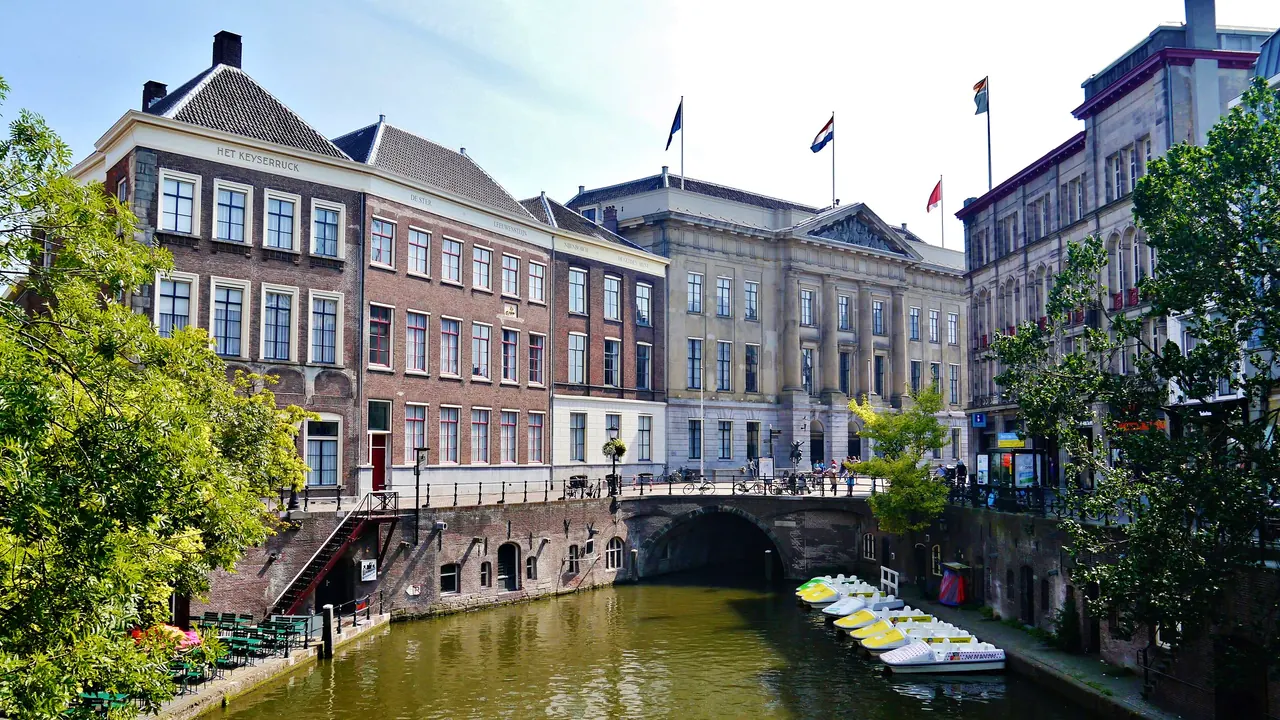
The Oudegracht with its wharf cellars and the bridge by the town hall
- Day trips86
- Getting around84
- Families66
Photo: Zairon, CC BY-SA 4.0, cropped
Match
53
Every category weighted equally
- Beach & sun46
- Culture & arts59
- Food & nightlife53
- Family trip53
- Outdoors54
- Relax & unwind48
- Shopping & style55
- On a budget51
Utrecht in twelve categories
Our verdict on each, scored 0 to 100 against the same fixed benchmark cities, so a score means the same thing on every page.
Beaches & swimming. Scores 15 out of 100.
Food & drink. Scores 42 out of 100.
Culture & sights. Scores 60 out of 100.
Nightlife. Scores 45 out of 100.
Nature & outdoors. Scores 48 out of 100.
Day trips. Scores 86 out of 100.
Good for families. Scores 66 out of 100.
Getting around. Scores 84 out of 100.
Shopping & style. Scores 55 out of 100.
Affordability. Scores 35 out of 100.
Live music & performing arts. Scores 58 out of 100.
Wellness & relaxation. Scores 40 out of 100.
Utrecht category by category
Beaches & swimming
15Utrecht is an inland city, and beach life plays no real part in a stay. The nearest sea is the North Sea at Zandvoort or Scheveningen, about an hour or more away by train. The water there rarely gets above about 18°C, and the season is short.
In a warm spell, local people swim in the recreation lakes on the edge of the city, such as the Maarsseveense Plassen and the Strijkviertel, and in the Loosdrecht lakes a little further north. These are pleasant places to cool off, but they are not a reason to come.
Food & drink
42Eating in Utrecht is pleasant rather than memorable. The city has no strong cuisine of its own. What makes a meal here is the setting: terraces on the old wharves of the Oudegracht sit right at the water's edge, below street level, in the cellars that once served as storerooms.
The large student population keeps everyday eating varied and casual, with lunch cafés, Indonesian and Surinamese kitchens, and a solid tier of modern bistros around the Twijnstraat and Lombok. The market on Vredenburg is good for Dutch cheese, herring and stroopwafels. The brown cafés pour a decent range of Dutch and Belgian beers. Fine dining is limited, and few people plan a trip around food here.
Culture & sights
60Utrecht has one of the best-preserved medieval centres in the Netherlands. Its focus is the Dom Tower, the tallest church tower in the country, which you can climb for views over the whole province. A storm in 1674 brought down the cathedral's nave, so the tower now stands apart across an open square from the surviving choir and cloister. The Oudegracht, with its two-level wharves and cellars, is unlike any other canal in the country.
The museums are good but modest. Catharijneconvent covers religious art, the Centraal Museum holds the Rietveld and De Stijl collections, and the Speelklok museum shows mechanical music instruments. The Rietveld Schröder House is a small UNESCO-listed masterpiece of modern design. Two or three days covers it all comfortably.
Nightlife
45Going out in Utrecht is a student affair. The centre fills on weeknights as well as weekends, mostly with bars and café terraces around the Neude, the Janskerkhof and along the Oudegracht, where drinking at the canal edge on summer evenings is the main event. Brown cafés and beer bars set the tone more than cocktail lounges.
There are a handful of clubs and late venues, some of them run by student and cultural organisations, but the scene is modest. Visitors who want a big night out usually take the short train ride to Amsterdam.
Nature & outdoors
48The landscape around Utrecht is flat and green, and the best way to see it is by bike. Cycling routes run out along the river Vecht, past country estates and windmills, and into polders crossed by ditches and old dikes. To the east, the Utrechtse Heuvelrug national park has low wooded ridges, heath and sandy forest trails for walking and mountain biking. To the north, the Loosdrecht lakes are good for sailing and canoeing.
It is gentle, pleasant country, best from spring to autumn. There are no hills of any height and no real wilderness, so it suits relaxed cycling more than serious hiking.
Day trips
86Day trips are one of the strongest reasons to base yourself in Utrecht. It sits at the centre of the Dutch rail network, so most of the country's highlights are a short, simple train ride away. Amsterdam is under half an hour, and Rotterdam and The Hague are well under an hour. Delft, Leiden, Haarlem and the cheese town of Gouda are all easy to reach as well.
Closer to home, there is the neo-Gothic Kasteel de Haar and the fortified town of Naarden. Further afield are the windmills of Kinderdijk, the Kröller-Müller Museum and the open-air museum near Arnhem, and the old centre of Den Bosch. You can see a whole country's worth of towns without changing hotels.
Good for families
66Utrecht is an easy, low-stress city with children. The centre is compact and calm, and Dutch culture takes children everywhere as a matter of course. The national Railway Museum, set in an old station, is one of the best children's museums in the country. Miffy, the rabbit created by Utrecht illustrator Dick Bruna, has her own museum for toddlers. The Speelklok museum's barrel organs and music boxes appeal to all ages.
Kasteel de Haar makes a good fairy-tale outing. Zoos and the big theme parks are a train or car ride away. The one thing to watch is the constant stream of bikes, which takes some care with small children.
Getting around
84Getting around is simple. Utrecht Centraal, the country's busiest station, lies right on the edge of the old town. From there, the Dom, the canals and most of the museums are a short walk on flat streets, and even the Railway Museum is within walking distance. Buses and trams cover the outer districts and the university campus at Uithof, all on the same tap-in card system as the trains.
The local way to travel is by bike. Rental bikes are easy to find, and the station has a vast underground cycle park. A car is a hindrance in the centre and is never needed.
Shopping & style
55Utrecht's shopping is at its best in the small streets. The Oudegracht wharves, the Lange and Korte Elisabethstraat, the Zadelstraat and the Twijnstraat are lined with independent fashion, design, book and homeware shops. The large covered mall at Hoog Catharijne, joined to the station, handles the high-street chains.
Markets add character. There is a big general market on Vredenburg, a flower market along the Janskerkhof and a textile market by the canal. Luxury brands are largely absent, so serious fashion shoppers head to Amsterdam.
Affordability
35Utrecht is an expensive place to stay. The historic centre has few hotels, so rooms there are scarce and priced like those in any large Western European city, and weekends and festival weeks are dearer still. Restaurants, café terraces and bars charge normal Dutch prices, and a sit-down dinner with drinks adds up quickly.
The day-to-day costs are easier. The museums charge modest entry fees. The centre is so compact that most visitors spend almost nothing on local transport, and a rental bike covers the rest. The large student population keeps plenty of cheap lunch cafés, snack bars and simple pubs going, especially around the university quarter. Careful visitors can keep daily spending down, but the cost of a bed means this is not a budget destination.
Live music & performing arts
58For a city of its size, Utrecht has a strong music life. The hub is TivoliVredenburg, a large concert building that stacks several halls on top of one another. Its programme runs from classical concerts and the Radio Philharmonic to pop, jazz and experimental acts, often on the same evening. The Stadsschouwburg puts on Dutch-language theatre and dance, and there are smaller stages around the centre.
The calendar adds weight. The Festival Oude Muziek is one of Europe's leading early-music festivals, and the city hosts an adventurous autumn music festival and the national film festival. There is no opera house, and theatre is mostly in Dutch.
Wellness & relaxation
40Utrecht has no bathing tradition of its own. The nearest thing is the Dutch sauna and wellness centre: large complexes with several saunas, steam rooms, outdoor pools and quiet rooms, found in the green belt around the city and usually requiring a short drive or bus ride. Hotel spas in the centre are few and small.
The pace makes up for some of this. Once the day-trippers leave, the centre is fairly calm. Slow evenings at the water's edge on the canal wharves, and quiet cloister gardens like the Pandhof beside the Dom, make for easy unwinding.
When should you go?
Pick a month to see what it is like. The climate figures are measured averages, not a forecast.
Utrecht in July
Daytime high, °C
Rainfall in the month, mm
The whole year
Shaded against this city’s own year: the deepest cell is its best month for that figure and the palest its weakest.
Temperature and rainfall are climate normals, averaged over the years shown. Utrecht: 1991-2020 normals, De Bilt (4.3 km from centre).
Before you go
| Measure | Utrecht |
|---|---|
| Official language | Dutch |
| Currency | Euro (EUR) |
| Sockets | CF230 V, 50 Hz |
| Driving side | Right |
| Time zone | UTC+1, UTC+2 in summer |
| Emergency number | 112 |
| Elevation | 5 m |
| Main airport | Amsterdam Airport Schiphol (AMS)34 km from centre287 non-stop destinations |
| Public holidays this year | 11 days |
By the numbers
| Measure | Utrecht |
|---|---|
| City population | 359,370 |
| People per km² | 3,619 |
| Museums within 10 km | 28 |
| UNESCO World Heritage sites within 50 km | 5 |
| Swim season, months above 21 °C | None |
Compare Utrecht with
Every comparison with a written verdict behind it.
- Amsterdam
- Antwerp
- Baden-Baden
- Bruges
- Brussels
- Cologne
- Dusseldorf
- Frankfurt
- Ghent
- Hamburg
- Heidelberg
- London
- Maastricht
- Paris
- Rotterdam
- Strasbourg
- Stuttgart
- The Hague
- York