Bosnia and Herzegovina
Mostar
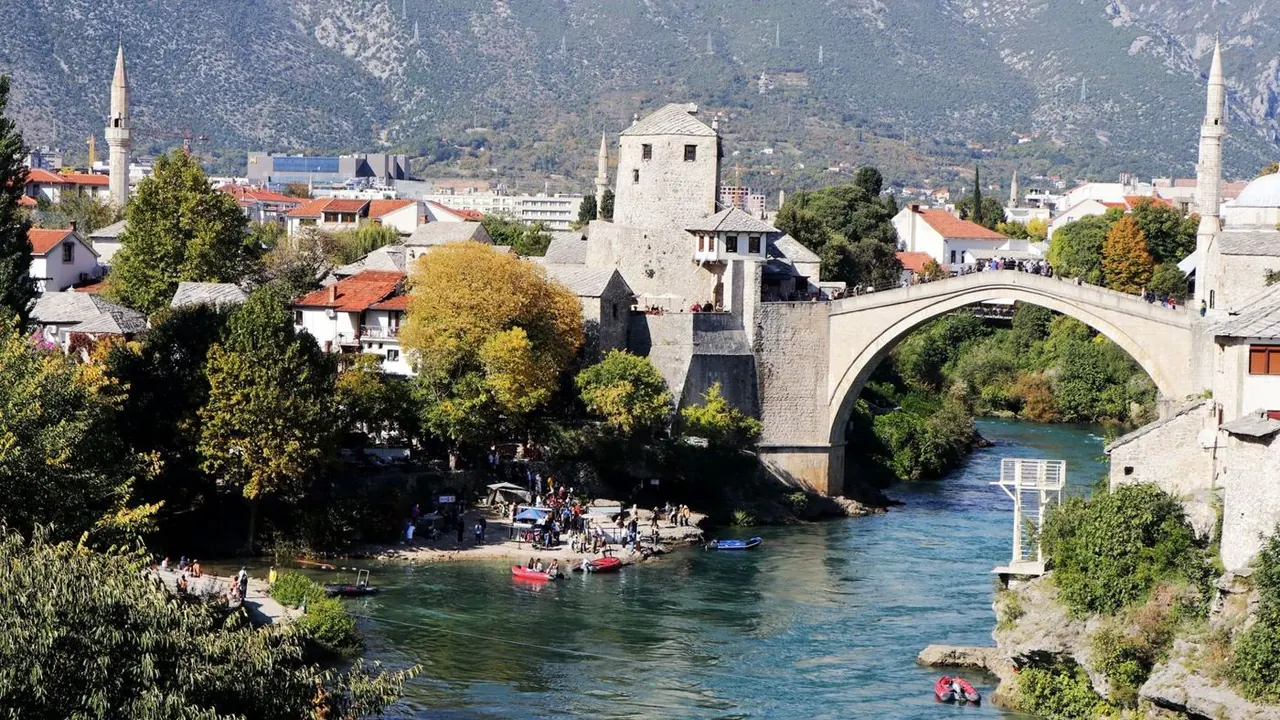
Stari Most and the old town
- Affordable cities78
- Nature & outdoors64
- Day trips60
Photo: Alan Wang, Pexels License
Match
41
Every category weighted equally
- Beach & sun40
- Culture & arts42
- Food & nightlife38
- Family trip45
- Outdoors48
- Relax & unwind40
- Shopping & style39
- On a budget45
Mostar in twelve categories
Our verdict on each, scored 0 to 100 against the same fixed benchmark cities, so a score means the same thing on every page.
Beaches & swimming. Scores 24 out of 100.
Food & drink. Scores 40 out of 100.
Culture & sights. Scores 54 out of 100.
Nightlife. Scores 25 out of 100.
Nature & outdoors. Scores 64 out of 100.
Day trips. Scores 60 out of 100.
Good for families. Scores 34 out of 100.
Getting around. Scores 44 out of 100.
Shopping & style. Scores 32 out of 100.
Affordability. Scores 78 out of 100.
Live music & performing arts. Scores 16 out of 100.
Wellness & relaxation. Scores 20 out of 100.
Mostar category by category
Beaches & swimming
24Mostar is an inland city, and beach life is not part of a stay here. The Neretva runs emerald green through the centre but stays cold even in high summer, fed by mountain water, so locals mostly use it for a quick plunge from the rocks below the old town.
The swim most visitors take is at the Kravica waterfalls, about 40km south, where a wide pool beneath the falls fills with bathers on hot days. For the sea, the short Bosnian strip of Adriatic coast at Neum is a little over an hour by car, and the Croatian beaches of the Makarska Riviera are further on. Both make a day out, not a base.
Food & drink
40Eating in Mostar means Bosnian home cooking with an Ottoman accent: ćevapi grilled over charcoal and served in soft somun bread with raw onion, burek and other pies rolled from thin pastry, stuffed peppers and slow-cooked meat and vegetable dishes. Terraces overlooking the river crowd the lanes near the bridge, and a short walk away from them the cooking gets more honest.
Herzegovina is wine country, and the white Žilavka and red Blatina grown in the hot valleys around the city are worth asking for. Bosnian coffee, served in a copper džezva with a cube of sugar and a piece of rahat lokum, is a slow ritual rather than a quick drink. The range stops there: international and fine dining are thin.
Culture & sights
54The Old Bridge, Stari Most, is the reason Mostar is known: a single high stone arch over the Neretva, built by the Ottomans in the sixteenth century, destroyed in 1993 and rebuilt stone by stone with the surrounding old town now a UNESCO site. Divers leap from its crown into the cold river, a tradition kept up for centuries.
Around it lie the Kujundžiluk bazaar street, the Koski Mehmed Pasha Mosque with its climbable minaret and river view, and Ottoman houses such as Bišćević and Muslibegović with their carpeted rooms. Further out, Austro-Hungarian buildings and war-scarred façades along the old front line tell the city's harder history. It is a compact set, absorbing for a day or two.
Nightlife
25Evenings in Mostar are mostly about lingering over dinner and drinks on terraces with a view of the lit bridge. Once the coach groups leave, the old town grows quiet. A handful of cocktail bars and student-oriented clubs keep things going later on weekends, more so in summer, but going out is modest in scale and nobody plans a trip around it.
Nature & outdoors
64Mostar sits in a hot karst basin ringed by bare limestone mountains, with Velež rising to the east and the jagged Prenj range to the north, one of the wildest massifs in the Balkans. The Neretva and its tributaries are the green thread through it all: rafting and kayaking run in the canyons upstream, and the Buna spring at Blagaj bursts from a sheer cliff a short drive away.
Within an hour or two lie the high plateau of Blidinje, the Hutovo Blato wetland with its migrating birds, and marked but rugged hiking routes. Summer in the valley is fierce, often above 35°C, so spring and autumn suit walking and cycling far better.
Day trips
60Mostar's day trips are a cluster of small, characterful places in the Herzegovina valleys rather than a list of major towns. The dervish tekke at Blagaj, built against the cliff where the Buna rises, is a short drive away. The walled Ottoman village of Počitelj climbs a hillside above the Neretva about half an hour south, and Stolac adds old mosques and a field of medieval stećci tombstones. Međugorje is a pilgrimage town that draws Catholic visitors from across the world, and for most others it is a curiosity.
North along the Neretva, Jablanica has its wrecked wartime bridge, and Konjic has its own Ottoman bridge and Tito's Cold War bunker. Sarajevo is the one big destination, about two hours away by train through the Neretva gorge, so a visit there makes a long day. Dubrovnik and the Dalmatian coast are further away and across a border, so they suit an overnight stay better. Most of these trips need a car or an organised tour.
Good for families
34Families can manage Mostar easily for a day or two, but there is little built for children. The bridge divers and the climb up a minaret entertain for an afternoon, and swimming beneath the Kravica waterfalls is the outing most children remember. Against that, the old town's polished stone lanes are steep and slippery, pushchairs struggle, and summer heat in the valley is hard on small children. Bosnians are warm towards children, and restaurants welcome them without fuss.
Getting around
44Everything a visitor comes to see in Mostar is within walking distance: the old town, the bridge and the Austro-Hungarian centre fit into a short stroll along the river. The cobbles are worn smooth and slippery, so good shoes matter. Beyond that the picture changes. City buses serve residents rather than visitors, and Blagaj, Počitelj and Kravica are easiest by car, taxi or tour. The train to Sarajevo and long-distance buses link the city to the rest of the region.
Shopping & style
32Shopping in Mostar is the Kujundžiluk, the old coppersmiths' street leading to the bridge. A few workshops still hammer copper coffee sets and plates by hand, and there are kilims, embroidered textiles and Turkish-style lamps, though much of what fills the stalls is imported souvenir stock. Look for a craftsman working in the doorway. Beyond the bazaar there are ordinary malls and little in the way of fashion or design.
Affordability
78Mostar is one of the cheaper places to travel in Europe. Guesthouses and family-run apartments are inexpensive, a plate of ćevapi or a bottle of local wine costs little, and coffee is a small daily pleasure rather than an expense. The terraces with bridge views and rooms in the old town in midsummer charge more, but stepping a few streets away brings prices back down quickly.
Live music & performing arts
16Performing arts play a small part in a visit. The city has a national theatre and a long-established youth theatre, performing mostly in local languages, and summer brings open-air concerts and festival events. For most of the year, though, there is little programmed for visitors, and live music means the odd band in a café bar.
Wellness & relaxation
20Mostar has no bathing culture to speak of. The Ottoman hammam near the bridge survives as a historic building rather than a working bath, and spa treatments are limited to a few hotels. The restorative side of a stay is the pace: long coffees in the shade, and the early mornings and evenings, when the coach groups have gone and the old town falls quiet to the sound of the river.
When should you go?
Pick a month to see what it is like. The climate figures are measured averages, not a forecast.
Mostar in July
Daytime high, °C
Rainfall in the month, mm
The whole year
Shaded against this city’s own year: the deepest cell is its best month for that figure and the palest its weakest.
Temperature and rainfall are climate normals, averaged over the years shown. Mostar: 1991-2020 normals, Mostar (0.9 km from centre).
Before you go
| Measure | Mostar |
|---|---|
| Official language | Croatian, Serbian, Bosnian |
| Currency | Convertible Mark (BAM) |
| Sockets | CF230 V, 50 Hz |
| Driving side | Right |
| Time zone | UTC+1, UTC+2 in summer |
| Emergency number | 112 |
| Elevation | 60 m |
| Main airport | Sarajevo International Airport (SJJ)68 km from centre38 non-stop destinations |
| Public holidays this year | 8 days |
By the numbers
| Measure | Mostar |
|---|---|
| City population | 105,448 |
| People per km² | 90 |
| Museums within 10 km | 3 |
| UNESCO World Heritage sites within 50 km | 1 |
Compare Mostar with
Every comparison with a written verdict behind it.
- Amalfi
- Belgrade
- Bled
- Budapest
- Dubrovnik
- Kotor
- Ljubljana
- Naples
- Positano
- Rome
- Rovinj
- Salerno
- Sarajevo
- Skopje
- Sofia
- Sorrento
- Split
- Tirana
- Venice
- Zadar
- Zagreb