Spain
Seville
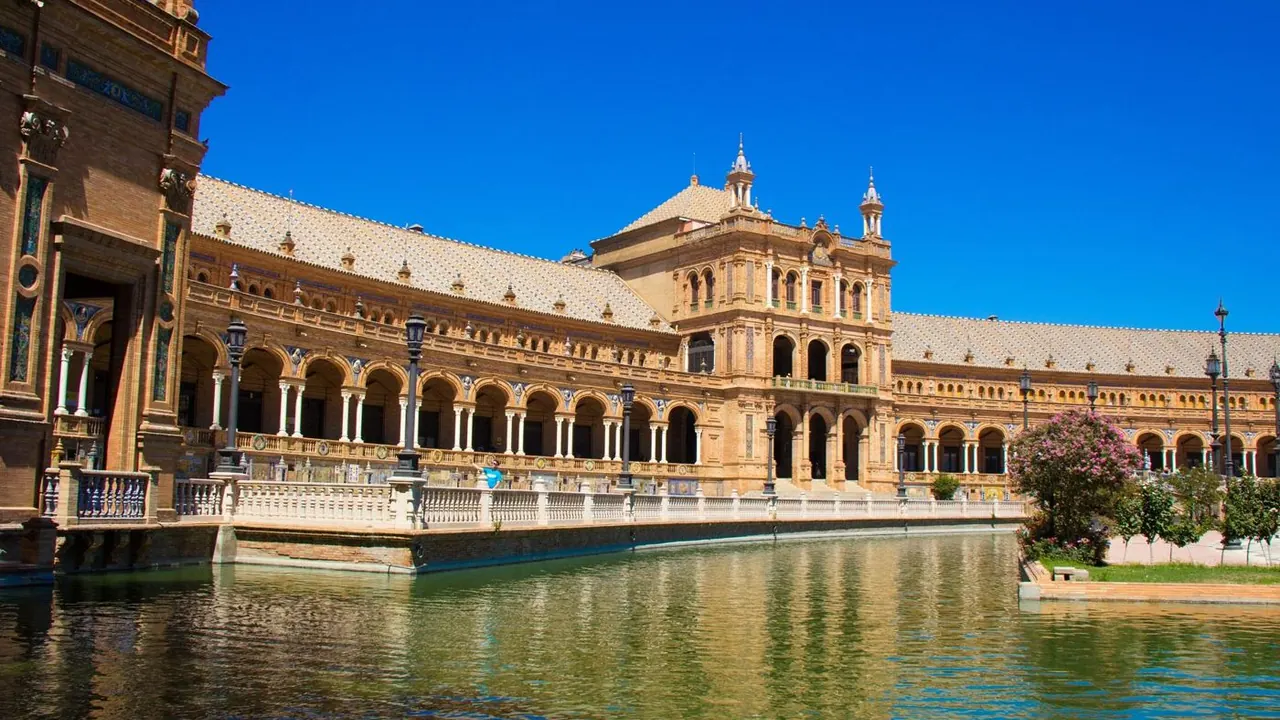
Plaza de España
- Culture & sights82
- Day trips80
- Food & drink73
Photo: Tibor Kovacs, CC BY 2.0, cropped
Match
60
Every category weighted equally
- Beach & sun53
- Culture & arts67
- Food & nightlife64
- Family trip57
- Outdoors59
- Relax & unwind54
- Shopping & style63
- On a budget59
Seville in twelve categories
Our verdict on each, scored 0 to 100 against the same fixed benchmark cities, so a score means the same thing on every page.
Beaches & swimming. Scores 18 out of 100.
Food & drink. Scores 73 out of 100.
Culture & sights. Scores 82 out of 100.
Nightlife. Scores 62 out of 100.
Nature & outdoors. Scores 52 out of 100.
Day trips. Scores 80 out of 100.
Good for families. Scores 55 out of 100.
Getting around. Scores 72 out of 100.
Shopping & style. Scores 55 out of 100.
Affordability. Scores 58 out of 100.
Live music & performing arts. Scores 68 out of 100.
Wellness & relaxation. Scores 40 out of 100.
Seville category by category
Beaches & swimming
18Seville is an inland city on the Guadalquivir, and the sea is not part of daily life here. The nearest beaches are on the Atlantic coast of Huelva, such as Matalascañas and Mazagón, about an hour and a quarter by car, with the long sands of Cádiz province further on. The water there is pleasant in summer, around 22°C, so a beach day is entirely possible, but it means a car or a coach and most of a day.
In the city itself, summer swimming means a hotel rooftop pool or a municipal pool. Travellers who want the sea as part of their vacation usually split their stay with a few nights on the coast.
Food & drink
73Eating in Seville means tapas, and the city does them with more conviction than almost anywhere. The rhythm is standing at a bar counter or a pavement barrel, ordering a few plates at a time and moving on: spinach with chickpeas, salmorejo, pringá, fried fish from the Cádiz coast, slow-cooked pork cheek, jamón from the sierra. Old tile-fronted bars in Santa Cruz, El Arenal and Triana sit alongside more inventive kitchens around the Alameda.
Drink is cold beer, manzanilla and fino from the sherry towns, and orange-blossom vermouth. Mercado de Triana and the Feria market are good for produce and casual stalls. What the city lacks is range: international cooking and top-end dining are limited, and the tourist streets around the cathedral serve plenty of tired paella.
Culture & sights
82Seville has one of the great historic centres of Europe. The Real Alcázar is a working royal palace whose Mudéjar courtyards, tiled halls and gardens span the Islamic and Christian eras, and next to it stands the cathedral, the largest Gothic church in the world, built onto a mosque whose minaret survives as the Giralda bell tower. The Archivo de Indias completes a UNESCO-listed trio. Around them the lanes of Santa Cruz twist between whitewashed houses and orange-tree squares.
Beyond the core are the curving tiled arcade of Plaza de España in María Luisa Park, the noble palace of Casa de Pilatos, the Museo de Bellas Artes with Murillo and Zurbarán, baroque churches and the Metropol Parasol's wooden canopy. Most of it lies within walking distance, and three or four days fill easily.
Nightlife
62Nights in Seville start late and happen mostly outdoors. Dinner rarely begins before ten, and the evening drifts from tapas bars into terraces and small squares. The Alameda de Hércules is the most mixed and youthful strip, with bars, alternative crowds and LGBT-friendly places; Triana and the streets around the Plaza de la Alfalfa are busy until the early hours, and in summer the riverbanks fill with open-air bars once the heat breaks.
The club scene is limited and mostly geared to local students. During the April Fair the whole city stays out all night in the casetas, but on an ordinary week this is a city for long, sociable evenings rather than serious clubbing.
Nature & outdoors
52Seville sits in the flat valley of the Guadalquivir, and the landscape around the city is farmland, olive groves and orange orchards. Within town, María Luisa Park and the river paths are the main green space, good for cycling, rowing and kayaking on the old river channel.
Further out, the Doñana marshes and dunes, about an hour and a half away, are one of Europe's great wetlands, with flamingos, migrating birds and a slim chance of the Iberian lynx, usually seen on guided 4x4 trips. The cork-oak hills of the Sierra Norte and Sierra de Aracena offer gentle hiking. Summer is too hot for most outdoor activity; spring and autumn are the times to go.
Day trips
80Seville is an excellent base for Andalusia. The best day out is Córdoba, under an hour by high-speed train, with its Great Mosque, Jewish quarter and flower-filled patios. Closer still are the Roman ruins of Itálica on the city's edge and the hilltop town of Carmona, half an hour away.
To the south lie Jerez, about an hour by train, for sherry bodegas and horses, and Cádiz, an old port city on a narrow peninsula, with Sanlúcar de Barrameda and El Puerto de Santa María nearby. Arcos de la Frontera opens up the white villages, and Osuna and Écija add baroque towns. Ronda is a long day by road, and Granada is better done overnight.
Good for families
55Spanish culture is easy with children, and they are welcome in tapas bars and squares late into the evening. The flat, compact centre helps, and María Luisa Park is the obvious escape, with ducks and pigeons, horse carriages and rowing boats on the canal at Plaza de España. The Alcázar gardens, with their maze and fountains, tend to hold children's attention longer than most monuments.
On La Cartuja, the island used for the 1992 Expo, there is a theme park with a summer water park, and an aquarium sits by the river. The serious drawback is the heat: July and August regularly pass 40°C, which makes sightseeing with small children hard work. Spring and autumn are much easier.
Getting around
72Seville's historic centre is flat and compact, and nearly everything a visitor wants to see, from the cathedral to Triana and Plaza de España, is within a half-hour walk. Many of the old streets are narrow and pedestrianised, and orange trees give some shade.
Public transport plays a supporting role: a short tram line along the main avenue, a single metro line, a dense bus network and an extensive web of bike lanes with a public bike scheme that makes cycling genuinely practical. A car is a nuisance in the centre and only useful for the coast or the countryside. The real obstacle is summer heat, which turns a midday walk into an ordeal.
Shopping & style
55Shopping in Seville is about local crafts more than fashion. Triana has been a pottery quarter for centuries, and its workshops still sell hand-painted tiles and ceramics. Around Calle Sierpes and Calle Cuna you find shops selling flamenco dresses, embroidered shawls, mantillas, hand-painted fans and guitars, much of it made for locals preparing for the April Fair rather than for tourists.
Sierpes and Tetuán also hold the main high-street and Spanish chain stores, and the long-running Thursday flea market on Calle Feria is good for browsing. Luxury brands and independent design shops are few, and the streets near the cathedral lean heavily towards souvenirs.
Affordability
58Seville is a reasonably priced city by Western European standards. Eating out is the clearest saving: a tapas evening costs far less than a sit-down dinner in most capitals, and beer and wine are cheap. The centre is walkable, so transport costs little, and several monuments have free entry at certain times.
Accommodation is where the bill varies. Rooms are moderate for most of the year and good value in the summer heat, but during Holy Week and the April Fair hotel rates climb steeply and the best-located places fill months ahead. The Alcázar and cathedral tickets are the main sightseeing costs.
Live music & performing arts
68Seville is the heartland of flamenco, and seeing it live is one of the main reasons to come. Every night there are performances in intimate tablaos around Santa Cruz and Triana, in cultural centres devoted to the art, and in the more informal peñas where local aficionados gather. The Bienal de Flamenco, held in autumn of even-numbered years, brings the leading performers to the city.
The Teatro de la Maestranza on the river hosts opera, fitting for the city where Carmen, Don Giovanni and The Barber of Seville are set, along with the Royal Symphony Orchestra of Seville. The Lope de Vega theatre and smaller venues add drama and dance. Outside flamenco, the scene is solid rather than deep.
Wellness & relaxation
40Seville has no real bathing tradition of its own. A few Arab-style bath houses in old mansions in the centre offer warm, hot and cold pools under arched ceilings, with massages, and these make an atmospheric evening. Beyond them, wellness means hotel spas and rooftop pools.
What the city does offer is pace. Life slows in the afternoon heat, the tiled courtyards of the old houses and the Alcázar gardens are cool and quiet, and long lunches are normal. The flip side is the noise of narrow streets at night and the crowds during Holy Week and the Fair, so this is a city for unhurried days rather than a place to come specifically to recharge.
When should you go?
Pick a month to see what it is like. The climate figures are measured averages, not a forecast.
Seville in July
Daytime high, °C
Rainfall in the month, mm
The whole year
Shaded against this city’s own year: the deepest cell is its best month for that figure and the palest its weakest.
Temperature and rainfall are climate normals, averaged over the years shown. Seville: 1991-2020 normals, Sevilla / San Pablo (8.1 km from centre).
Before you go
| Measure | Seville |
|---|---|
| Official language | Spanish |
| Currency | Euro (EUR) |
| Sockets | CF230 V, 50 Hz |
| Driving side | Right |
| Time zone | UTC+1, UTC+2 in summer |
| Emergency number | 112 |
| Elevation | 18 m |
| Main airport | Seville Airport (SVQ)9 km from centre96 non-stop destinations |
| Public holidays this year | 12 days |
By the numbers
| Measure | Seville |
|---|---|
| City population | 689,423 |
| People per km² | 4,896 |
| Museums within 10 km | 24 |
| UNESCO World Heritage sites within 50 km | 1 |
Compare Seville with
Every comparison with a written verdict behind it.
- Alicante
- Barcelona
- Bilbao
- Cadiz
- Casablanca
- Cordoba
- Faro
- Fes
- Granada
- Lisbon
- Madrid
- Malaga
- Marbella
- Porto
- San Sebastian
- Santiago de Compostela
- Tangier
- Toledo
- Valencia
- Zaragoza