United Kingdom
Oxford
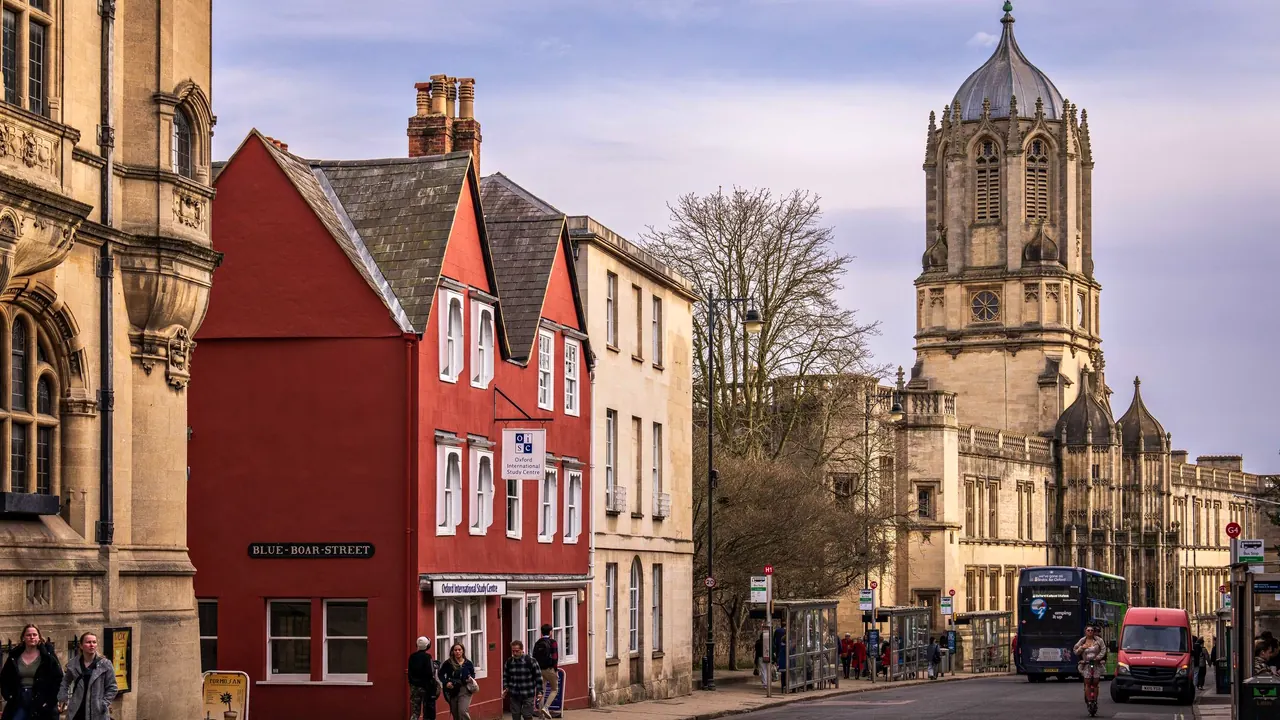
Tom Tower at Christ Church from St Aldates
- Day trips85
- Getting around74
- Culture & sights72
Photo: Mark Stebnicki, Pexels License
Match
49
Every category weighted equally
- Beach & sun41
- Culture & arts57
- Food & nightlife49
- Family trip49
- Outdoors51
- Relax & unwind44
- Shopping & style51
- On a budget47
Oxford in twelve categories
Our verdict on each, scored 0 to 100 against the same fixed benchmark cities, so a score means the same thing on every page.
Beaches & swimming. Scores 10 out of 100.
Food & drink. Scores 40 out of 100.
Culture & sights. Scores 72 out of 100.
Nightlife. Scores 35 out of 100.
Nature & outdoors. Scores 50 out of 100.
Day trips. Scores 85 out of 100.
Good for families. Scores 52 out of 100.
Getting around. Scores 74 out of 100.
Shopping & style. Scores 52 out of 100.
Affordability. Scores 30 out of 100.
Live music & performing arts. Scores 55 out of 100.
Wellness & relaxation. Scores 32 out of 100.
Oxford category by category
Beaches & swimming
10Oxford is about as far from the sea as anywhere in England, and the south coast is more than an hour and a half away. Swimming here means fresh water. Local swimmers use stretches of the Thames along Port Meadow and the Cherwell in summer, where the water rarely gets above 18°C and the banks are grassy rather than sandy. There is also a large open-air pool at Hinksey. These are pleasant for a dip on a hot afternoon, but anyone who wants a beach should plan a separate trip.
Food & drink
40Eating in Oxford centres on the pub. Old taverns with low beams and riverside pubs out on the towpaths serve good ale and dependable British cooking, and a Sunday roast by the Thames is one of the nicer things to do here. The Covered Market, trading since the eighteenth century, has butchers, bakers, cheese counters and small lunch stalls.
For more range, go up Cowley Road east of the river, which has cheap Middle Eastern, South Asian and Caribbean food, or to Jericho, which has neighbourhood bistros. The city has a handful of serious restaurants, but there is no cuisine of its own and much of the centre is chains serving students and day visitors. Expect to eat well rather than memorably.
Culture & sights
72The centre of Oxford is a set of medieval and later college quadrangles, chapels and libraries packed into a few streets, built in honey-coloured stone and almost all still in use. The Radcliffe Camera, the Bodleian Library with its Divinity School, the Sheldonian Theatre and the Bridge of Sighs lie within a few minutes' walk of each other. Christ Church, with its great hall and cathedral, is the best-known college to visit, and Magdalen, New College and Merton have fine cloisters and gardens.
The museums are better than the city's size would suggest. The Ashmolean is Britain's oldest public museum and has strong antiquities and old masters. The Pitt Rivers is a crowded Victorian hall of ethnography, and the Natural History Museum is housed under a soaring Gothic glass roof. Two or three full days cover it well.
Nightlife
35Going out in Oxford mostly means the pub. Historic city-centre taverns fill with students and locals in term time, and on summer evenings the riverside pubs along the Thames are the place to be. Cowley Road has the city's livelier side, with late bars and a couple of small clubs, and Jericho has a few relaxed cocktail and wine bars.
The scene follows the university calendar. During the long summer vacation it gets noticeably quieter, and on most nights the centre is calm by midnight. It suits an evening drink after dinner, not a big night out.
Nature & outdoors
50Oxford's countryside is gentle and green, and it starts close to the centre. Christ Church Meadow, the University Parks and the wide common grazing land of Port Meadow, where horses and cattle roam, are all within walking distance. The Thames Path and the Cherwell give easy, flat walks and bike rides into open fields. Punting and rowing on the rivers are the classic outdoor pastimes.
Within an hour lie the rolling Cotswold hills with their stone-walled footpaths, the beech woods of the Chilterns and the chalk ridge of the Ridgeway, an ancient trackway. It is countryside for long, mild walks rather than adventure, and it is at its best from late spring to early autumn.
Day trips
85Oxford is one of the best bases in England for day trips. Blenheim Palace, a World Heritage Site where Churchill was born, is about twenty minutes away at Woodstock. The Cotswold villages and market towns, among them Burford, Bibury, Chipping Campden and Stow-on-the-Wold, are within an hour by car. Trains reach London in about an hour, so its museums and landmarks make an easy day out.
Stratford-upon-Avon and Shakespeare's houses, Warwick Castle, Windsor Castle and Georgian Bath are all within about an hour and a half. Smaller outings include the Thames-side towns of Henley and Abingdon. Some of the Cotswold trips are much easier with a car or a tour.
Good for families
52Oxford is easy to manage with children. It is small, safe and walkable, and the parks and meadows give room to run. The Natural History Museum, with its dinosaur skeletons, and the Pitt Rivers next door, with its cases of masks, boats and curiosities, are free and usually win children over. Punting on the Cherwell is a memorable afternoon, and older children who know Harry Potter will recognise the hall and staircase at Christ Church and parts of the Bodleian.
Beyond that, most of what the city offers is grown-up. The Cotswold Wildlife Park, Blenheim's gardens and maze, and the Harry Potter studio tour near Watford all need a trip out.
Getting around
74The heart of Oxford is small and mostly flat, and you can cross it on foot in twenty minutes. Several central streets are closed to through traffic, so walking between colleges, museums and the river is the natural way to see the city. Frequent buses run out along the main roads to Headington, Cowley and Summertown, and bicycles are everywhere.
The railway station is a short walk from the centre and has direct trains to London and the Midlands. A car is more of a burden than a help in the city because parking is scarce. Drivers usually leave it at the park-and-ride sites on the edge of town.
Shopping & style
52Shopping in central Oxford is mainly a modern shopping centre near the castle and the usual high-street chains on Cornmarket and Queen Street. It is more distinctive in its details: the Covered Market's small traders, the independent shops of Little Clarendon Street and Jericho, and the antique map and print sellers. Blackwell's on Broad Street is a bookshop of historic standing, and its basement room is one of the largest book-selling spaces in the country. University-branded clothing is the city's own souvenir.
Designer bargain hunters head to the outlet village near Bicester, about twenty minutes away, where luxury labels draw shoppers from far afield.
Affordability
30Oxford is an expensive place to stay. There are few hotel rooms in the centre, and demand from university events, conferences and graduations keeps prices high, especially in summer and in term-time weeks with ceremonies. Many visitors stay out by the ring road or come for the day from London.
Once you are here, costs are easier. The main museums are free, the centre is walkable, and pub meals and Cowley Road cafés keep eating out reasonable. Entry to the colleges and to guided tours of the libraries adds up over a few days.
Live music & performing arts
55Oxford's most distinctive performances are its choral services. On most evenings in term, the choirs of Christ Church Cathedral, Magdalen and New College sing Evensong, and visitors can sit in. These choirs have world reputations, and their singing in a candlelit chapel is the city's great live experience. The Sheldonian Theatre has orchestral and choral concerts, and the Holywell Music Room, among the oldest purpose-built concert halls in Europe, has chamber music and jazz.
Theatre is smaller. The Playhouse and the larger New Theatre stage touring drama and musicals, and student productions fill college gardens in summer. A few pub venues and a mid-sized hall on Cowley Road cover rock and indie gigs.
Wellness & relaxation
32Oxford has no spa or bathing tradition. Pampering means a hotel spa or a day spa, and there are not many of either. What it offers is quiet. The Botanic Garden, the oldest in Britain, the walled college gardens, the deer park at Magdalen and the walk along Addison's Walk are good places to slow down, especially early in the morning before the tour groups arrive. A slow afternoon on a punt does much the same. Go elsewhere for a restorative break built around treatments or thermal water.
When should you go?
Pick a month to see what it is like. The climate figures are measured averages, not a forecast.
Oxford in July
Daytime high, °C
Rainfall in the month, mm
The whole year
Shaded against this city’s own year: the deepest cell is its best month for that figure and the palest its weakest.
Where the figures come from
Oxford's temperatures are measured 37 km from the centre, at Fairford Royal Air Force Base.
Oxford has no rain gauge within 25 km of the centre, so its rainfall comes from a gridded climate dataset read at the city rather than from a gauge further away.
Oxford's sunshine is measured 57 km from the centre, at Lyneham.
Temperature and rainfall are climate normals, averaged over the years shown. Oxford: 1961-1990 (sunshine 1991-2020, rainfall 1991-2020) normals, Fairford Royal Air Force Base (37 km from centre).
Before you go
| Measure | Oxford |
|---|---|
| Official language | English |
| Currency | Pound Sterling (GBP) |
| Sockets | G230 V, 50 Hz |
| Driving side | Left |
| Time zone | UTC, UTC+1 in summer |
| Emergency number | 112 or 999 |
| Elevation | 73 m |
| Main airport | London Heathrow Airport (LHR)63 km from centre224 non-stop destinations |
| Public holidays this year | 8 days |
By the numbers
| Measure | Oxford |
|---|---|
| City population | 147,500 |
| People per km² | 3,235 |
| Museums within 10 km | 11 |
| UNESCO World Heritage sites within 50 km | 1 |
Compare Oxford with
Every comparison with a written verdict behind it.
- Aberdeen
- Amsterdam
- Antwerp
- Bath
- Belfast
- Brighton
- Bristol
- Bruges
- Brussels
- Cambridge
- Cardiff
- Cork
- Dublin
- Edinburgh
- Ghent
- Glasgow
- Haarlem
- Heidelberg
- Inverness
- Kilkenny
- Lille
- Liverpool
- London
- Maastricht
- Manchester
- Paris
- Rotterdam
- St Andrews
- The Hague
- Utrecht
- York