France
Lille
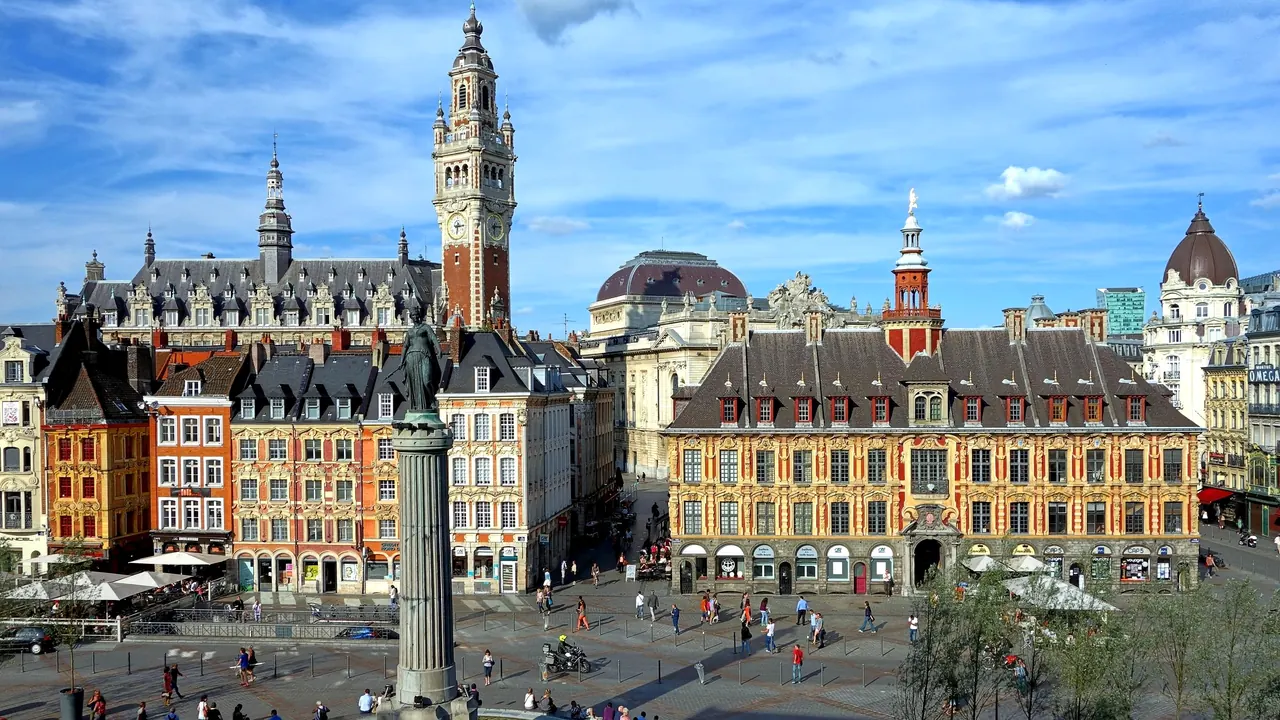
The Grand Place with the Goddess column and the Old Stock Exchange
- Day trips90
- Getting around78
- Culture & sights64
Photo: Velvet, CC BY-SA 3.0, cropped
Match
53
Every category weighted equally
- Beach & sun46
- Culture & arts60
- Food & nightlife57
- Family trip51
- Outdoors52
- Relax & unwind46
- Shopping & style57
- On a budget52
Lille in twelve categories
Our verdict on each, scored 0 to 100 against the same fixed benchmark cities, so a score means the same thing on every page.
Beaches & swimming. Scores 17 out of 100.
Food & drink. Scores 60 out of 100.
Culture & sights. Scores 64 out of 100.
Nightlife. Scores 55 out of 100.
Nature & outdoors. Scores 33 out of 100.
Day trips. Scores 90 out of 100.
Good for families. Scores 50 out of 100.
Getting around. Scores 78 out of 100.
Shopping & style. Scores 58 out of 100.
Affordability. Scores 47 out of 100.
Live music & performing arts. Scores 52 out of 100.
Wellness & relaxation. Scores 27 out of 100.
Lille category by category
Beaches & swimming
17Lille is an inland city, and beaches are not part of a stay here. The nearest sand is Malo-les-Bains at Dunkirk, about an hour by train, a wide, windy North Sea beach where the water rarely gets above 17°C to 18°C even in August. The Belgian coast and the Opal Coast resorts around Wimereux and Le Touquet are further, with long dune beaches better suited to walking and sand yachting than to swimming. In summer, people in Lille go for a bracing day by the sea, not for beach life.
Food & drink
60Lille eats like the Flemish city it once was. The estaminets, small wood-panelled taverns in Vieux-Lille, serve carbonnade flamande slow-cooked in beer, potjevleesch in jelly, waterzooi and the welsh, cheddar melted over beer-soaked bread and ham. Maroilles, a pungent local cheese, turns up in tarts and on almost everything else. Beer matters more than wine: northern French and Belgian ales, brewery taps and specialist beer bars are a large part of the evening.
Sweet things belong to the city too. Meert, a pastry shop since the eighteenth century, is known for its vanilla-filled waffles, and the Sunday market at Wazemmes is a lively, multi-ethnic food market. Fine dining exists but is not deep, and the range beyond regional cooking is ordinary.
Culture & sights
64The Palais des Beaux-Arts is the main reason to come: one of France's largest fine-art museums outside Paris, with Flemish and Dutch masters, Goya, Delacroix and a hall of eighteenth-century relief maps of fortified towns. Around it, Vieux-Lille is a dense quarter of brick and carved stone in Flemish baroque style, best seen at the Vieille Bourse and the Grand Place, with the tall belfry of the town hall listed by UNESCO.
Further out, Vauban's star-shaped citadel, the Hospice Comtesse and the house where Charles de Gaulle was born add history, while La Piscine in Roubaix, an art museum inside an Art Deco swimming pool, and the LaM modern art museum in Villeneuve-d'Ascq are reached by metro or tram. Two or three days covers it well.
Nightlife
55With one of the largest student populations in France, Lille goes out more than its size suggests. Rue Masséna and Rue Solférino are lined with cheap, loud student bars that fill on Thursday nights, while Vieux-Lille has beer cafés, wine bars and cocktail bars in old brick cellars for a calmer crowd. The club scene is modest within the city, and serious late nights have traditionally meant crossing into Belgium nearby. It is a good, friendly night out, but not a reason in itself to pick the city.
Nature & outdoors
33French Flanders is flat, farmed and densely settled, so outdoor time here is gentle. The Citadel park and the adjoining Bois de Boulogne give a large green loop along the Deûle canal, and towpaths make easy, level cycling out of the city. The Monts de Flandre, low hills such as Mont Noir and Mont des Cats, offer short walks with wide views. For real scenery, the chalk cliffs of Cap Blanc-Nez and Cap Gris-Nez on the Opal Coast are a long day out, with coastal walking and views to England on clear days.
Day trips
90Lille sits at a crossroads, and this is its great strength as a base. Brussels is about half an hour by fast train, Ghent about an hour and Bruges a little more, with Antwerp also in easy reach. Paris is around an hour by TGV, and London is close enough by Eurostar for an ambitious day. Tournai, with its cathedral, is just over the Belgian border.
On the French side, Arras has two arcaded Flemish squares and its belfry, Amiens has one of the great Gothic cathedrals, and the Louvre-Lens shows treasures from the Paris collections. The First World War battlefields and memorials around Ypres, Vimy and the Somme make sobering, rewarding days out by car or tour.
Good for families
50Lille is easy with children, if not built for them. The small zoo in the Citadel park sits beside playgrounds, seasonal fairground rides and wide, flat paths for bikes and scooters, which makes the park the natural place to spend a morning. The natural history museum is a good rainy-day stop, and the Forum des Sciences in Villeneuve-d'Ascq is a hands-on science centre reached by metro.
The bigger draws lie outside the city: the large zoo park of Pairi Daiza across the Belgian border and the Nausicaá aquarium on the coast at Boulogne-sur-Mer. The centre is compact and relaxed, but the cobbles of Vieux-Lille are hard work with a pushchair.
Getting around
78The centre is flat and compact, and most visitors walk everywhere between the Grand Place, Vieux-Lille and the Palais des Beaux-Arts. Lille's two main stations, Lille Flandres and Lille Europe, stand side by side within walking distance of the old town, which makes arriving and leaving for day trips unusually easy. Two lines of the VAL, the world's first fully automated metro, plus the tram to Roubaix and Tourcoing, cover the wider metropolitan area. A car is unnecessary, and a nuisance in the old streets.
Shopping & style
58Shopping in Lille is good for a regional city. Rue Neuve and Rue de Béthune carry the French and international chains, and the Euralille complex by the stations adds a large mall. Vieux-Lille is the more interesting part, with independent fashion, design shops, delicatessens and the city's few luxury labels in its narrow streets. Wazemmes market on Sundays mixes food with clothes and bric-a-brac.
Once a year, at the start of September, the Braderie turns the whole city into an enormous flea market, often called the largest in Europe, with antiques, junk and stalls along kilometres of streets over a weekend.
Affordability
47Lille is moderately priced for Western Europe. Hotel rooms are reasonable for most of the year, though they fill up and cost more during the Braderie and the big trade fairs. Estaminet meals and beer are fairly priced, the metro is inexpensive, and the main museums do not take much out of a budget. Restaurants and cafés cost what they do across most of urban France, so a stay here is comfortable rather than cheap.
Live music & performing arts
52Lille has a solid cultural season for its size. The Opéra de Lille, a grand early twentieth-century house on the Place du Théâtre, stages opera, dance and concerts, and the Orchestre National de Lille plays a full symphonic season. The Théâtre du Nord is one of France's national theatres, and Roubaix and Tourcoing add contemporary dance and more stages. For rock and pop, the Zénith and the Aéronef bring touring acts. It is a dependable programme, though few visitors plan a trip around it.
Wellness & relaxation
27Lille has no bathing tradition of its own, and its most famous swimming pool is the Art Deco one in Roubaix, now an art museum. Relaxation means hotel spas, a few day spas and slow afternoons in tea rooms and on café terraces in Vieux-Lille. The nearest real thermal bath is at Saint-Amand-les-Eaux, a small spa town a short train ride away. The city's pace is easygoing, but it is not a place to come for rest.
When should you go?
Pick a month to see what it is like. The climate figures are measured averages, not a forecast.
Lille in July
Daytime high, °C
Rainfall in the month, mm
The whole year
Shaded against this city’s own year: the deepest cell is its best month for that figure and the palest its weakest.
Temperature and rainfall are climate normals, averaged over the years shown. Lille: 1991-2020 normals, Lille (7.8 km from centre).
Before you go
| Measure | Lille |
|---|---|
| Official language | French |
| Currency | Euro (EUR) |
| Sockets | CE230 V, 50 Hz |
| Driving side | Right |
| Time zone | UTC+1, UTC+2 in summer |
| Emergency number | 112 |
| Elevation | 17 m |
| Main airport | Lille Airport (LIL)8 km from centre61 non-stop destinations |
| Public holidays this year | 11 days |
By the numbers
| Measure | Lille |
|---|---|
| City population | 238,246 |
| People per km² | 6,846 |
| Museums within 10 km | 23 |
| UNESCO World Heritage sites within 50 km | 6 |
Compare Lille with
Every comparison with a written verdict behind it.
- Amsterdam
- Annecy
- Antibes
- Antwerp
- Avignon
- Baden-Baden
- Basel
- Bath
- Biarritz
- Bordeaux
- Brighton
- Bristol
- Bruges
- Brussels
- Cambridge
- Cannes
- Cardiff
- Chamonix
- Colmar
- Cologne
- Dijon
- Dusseldorf
- Frankfurt
- Ghent
- Haarlem
- Heidelberg
- London
- Lyon
- Maastricht
- Manchester
- Marseille
- Montpellier
- Nantes
- Nice
- Oxford
- Paris
- Rotterdam
- Saint-Tropez
- Strasbourg
- Stuttgart
- The Hague
- Toulouse
- Utrecht
- York