Bosnia and Herzegovina
Sarajevo
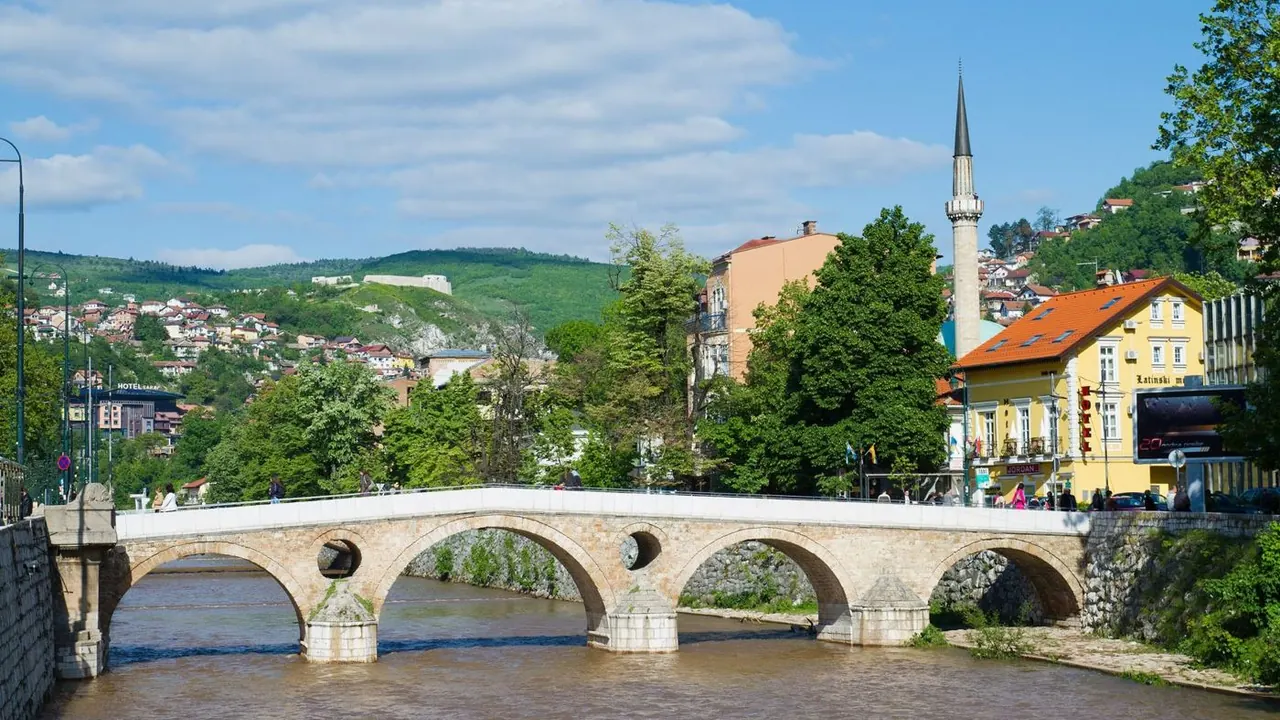
The Latin Bridge over the Miljacka
- Affordable cities80
- Nature & outdoors78
- Culture & sights64
Match
51
Every category weighted equally
- Beach & sun48
- Culture & arts55
- Food & nightlife51
- Family trip52
- Outdoors56
- Relax & unwind50
- Shopping & style51
- On a budget54
Sarajevo in twelve categories
Our verdict on each, scored 0 to 100 against the same fixed benchmark cities, so a score means the same thing on every page.
Beaches & swimming. Scores 6 out of 100.
Food & drink. Scores 60 out of 100.
Culture & sights. Scores 64 out of 100.
Nightlife. Scores 44 out of 100.
Nature & outdoors. Scores 78 out of 100.
Day trips. Scores 62 out of 100.
Good for families. Scores 38 out of 100.
Getting around. Scores 60 out of 100.
Shopping & style. Scores 40 out of 100.
Affordability. Scores 80 out of 100.
Live music & performing arts. Scores 40 out of 100.
Wellness & relaxation. Scores 42 out of 100.
Sarajevo category by category
Beaches & swimming
6Sarajevo is a mountain city in an inland valley, and it is not a place for a beach vacation. The Adriatic coast is about three hours away by road, too far for a day by the sea. Closer to home, locals swim in the cold mountain rivers and in the Jablanica lake on the road south in summer, and in hotel and public pools. If swimming matters to your trip, plan a few days on the Croatian or Montenegrin coast afterwards.
Food & drink
60Eating in Sarajevo means Ottoman-Balkan comfort food done with great care. Ćevapi, small grilled sausages served in soft somun bread with onion and kajmak, are the city's signature, and Baščaršija is lined with grills that make little else. Pita bakeries sell burek and its cousins filled with cheese, spinach or potato by weight, and traditional eateries serve slow dishes such as begova čorba soup, stuffed vegetables and lamb cooked under a metal lid.
Coffee is a ritual here: Bosnian coffee in a copper džezva, with a sugar cube and a piece of rahat lokum, taken slowly. Add baklava and tufahija, local beer and fruit rakija, and the food is distinctive and satisfying. It is narrow, though, and international and fine dining are limited.
Culture & sights
64Sarajevo's appeal is the way centuries and faiths meet in a few walkable streets. Baščaršija, the Ottoman bazaar quarter, gathers around the Sebilj fountain, the Gazi Husrev-beg Mosque and its madrasa, and the old covered markets. A few minutes west, the street turns into Austro-Hungarian avenues, with the Orthodox and Catholic cathedrals and the Old Synagogue all close by. The Latin Bridge marks the spot where the assassination of 1914 set off the First World War, and the striped pseudo-Moorish City Hall stands on the riverbank.
The 1990s siege is part of every visit, at the Tunnel of Hope near the airport, the War Childhood Museum and the Sarajevo roses set into the pavements. The National Museum holds the medieval Sarajevo Haggadah. It is a strong, moving set of sights, though compact rather than grand.
Nightlife
44Going out in Sarajevo centres on café-bars, which fill from the afternoon and turn louder as evening comes on. The streets around Ferhadija and the Old Town are busy on warm nights, and a student crowd keeps a handful of cellar bars, pubs and small clubs going past midnight at weekends. Drinks are cheap and the mood is sociable rather than wild. In summer the city is busier and stays out later. The club scene is small, though, and many evenings end over rakija rather than on a dancefloor.
Nature & outdoors
78Mountains surround Sarajevo on every side, and they are close. A cable car rises from the edge of the Old Town to Mount Trebević, where forest paths lead past the overgrown concrete bobsleigh track from the 1984 Winter Olympics. Jahorina and Bjelašnica, the Olympic ski mountains, are under an hour's drive away, with reliable winter skiing and summer hiking and mountain biking on open, grassy ridges.
From Bjelašnica a trail and a rough road lead to Lukomir, a stone shepherds' village high above the Rakitnica canyon. On the city's western edge, Vrelo Bosne is a park of springs and streams at the source of the Bosna river, and rafting on the Neretva is within reach to the south. Most trails are lightly marked, and in winter smog can sit in the valley while the peaks are in sunshine.
Day trips
62The great day trip is Mostar, about two hours south by a scenic train that follows the Neretva gorge. Its rebuilt Ottoman bridge and old bazaar are the best-known sight in the country. On the same route lie Konjic, with its own old stone bridge and Tito's underground Cold War bunker, and Jablanica, with its wartime bridge over the river. Blagaj's dervish house at the foot of a cliff and the hillside fortress village of Počitelj go well with Mostar.
To the north-west, Travnik has Ottoman mosques, a fortress and the house where the writer Ivo Andrić was born. To the east, the UNESCO-listed Mehmed Paša Sokolović Bridge at Višegrad is about two hours away. Roads are slow and winding, and most of these trips work best by car or tour.
Good for families
38Children are welcomed warmly in Sarajevo, and the flat Old Town is easy to walk with them, with pigeons at the Sebilj and treats in every pastry shop. The Trebević cable car, horse-drawn carriages along the avenue to Vrelo Bosne and its streams, and the small zoo at Pionirska dolina make good family outings. In winter there is gentle skiing on the nearby mountains. Beyond that, little here is made for children: the main sights are about history and war, the hillside neighbourhoods are steep, and smoke from the grills and winter smog trouble small lungs.
Getting around
60Sarajevo lies along a narrow east-west valley, which makes it easy to understand. The Old Town and the Austro-Hungarian centre are compact and flat enough to cover on foot. The tram system dates back to the late nineteenth century and follows the valley floor from a loop around Baščaršija west to Ilidža, with a short branch to the railway station. Trolleybuses, buses and minibuses fill in the gaps, climbing to the hillside neighbourhoods, and taxis are plentiful and cheap.
The tram is in effect a single corridor, though, and away from it the network is harder for a visitor to follow. The residential slopes above the centre are steep, with long flights of steps. The airport, the Tunnel of Hope and the ski mountains are best reached by taxi, hired car or tour.
Shopping & style
40Shopping in Sarajevo is mainly about Baščaršija. On Kazandžiluk, the coppersmiths' street, you can still hear craftsmen hammering coffee sets, trays and engraved plates, and the old Bezistan covered market and the lanes around it sell carpets, kilims, leather slippers and filigree jewellery. Plenty of it is souvenir stock, so it pays to look closely. Away from the bazaar there are ordinary high-street chains and a few large shopping malls, but little in the way of local design or luxury.
Affordability
80Sarajevo is among the cheapest capitals in Europe for a visitor. A plate of ćevapi, a pastry from a pita bakery or a coffee in the bazaar costs very little, and sit-down meals with drinks stay modest. Trams and taxis are inexpensive, entry to most museums is cheap, and comfortable guesthouses and mid-range hotels in the centre cost well below Western European levels. Prices go up somewhat in the Old Town and during the film festival in summer, but a stay here is easy on the budget.
Live music & performing arts
40Sarajevo has a modest but real stage life. The National Theatre, a handsome Austro-Hungarian building, stages drama, opera and ballet through the season, and the Sarajevo Philharmonic gives regular concerts. The city's festivals go deeper than its everyday programme: MESS brings international theatre in autumn, and a long-running jazz festival fills venues in November.
The most local sound is sevdah, slow and melancholy Bosnian love songs, which you may hear in traditional restaurants and small clubs. Most plays are in the local language, and outside the festivals there is not much for a visitor to plan a trip around.
Wellness & relaxation
42Wellness in Sarajevo starts at Ilidža, at the end of the tram line. Its sulphurous thermal springs have been used since Roman times, and a spa complex there offers warm pools and treatments. Nearby, the shaded avenue and streams of Vrelo Bosne make a calm walk. In the centre, the slow Bosnian habit of lingering for an hour over one coffee sets a gentle pace. The city's historic hammam is now an exhibition space rather than a working bath, though, and outside hotel spas there is no real bathing culture. In winter, smoke and smog in the valley can make the city feel less restful.
When should you go?
Pick a month to see what it is like. The climate figures are measured averages, not a forecast.
Sarajevo in July
Daytime high, °C
Rainfall in the month, mm
The whole year
Shaded against this city’s own year: the deepest cell is its best month for that figure and the palest its weakest.
Temperature and rainfall are climate normals, averaged over the years shown. Sarajevo: 1991-2020 normals, Sarajevo-Bejelave (2 km from centre).
Before you go
| Measure | Sarajevo |
|---|---|
| Official language | Croatian, Serbian, Bosnian |
| Currency | Convertible Mark (BAM) |
| Sockets | CF230 V, 50 Hz |
| Driving side | Right |
| Time zone | UTC+1, UTC+2 in summer |
| Emergency number | 112 |
| Elevation | 518 m |
| Main airport | Sarajevo International Airport (SJJ)7 km from centre38 non-stop destinations |
| Public holidays this year | 8 days |
By the numbers
| Measure | Sarajevo |
|---|---|
| City population | 275,524 |
| People per km² | 1,947 |
| Museums within 10 km | 25 |
| UNESCO World Heritage sites within 50 km | 1 |
Compare Sarajevo with
Every comparison with a written verdict behind it.
- Amalfi
- Belgrade
- Bled
- Bratislava
- Budapest
- Dubrovnik
- Kotor
- Ljubljana
- Mostar
- Naples
- Positano
- Rovinj
- Skopje
- Sofia
- Sorrento
- Split
- Tbilisi
- Tirana
- Zadar
- Zagreb