France
Montpellier
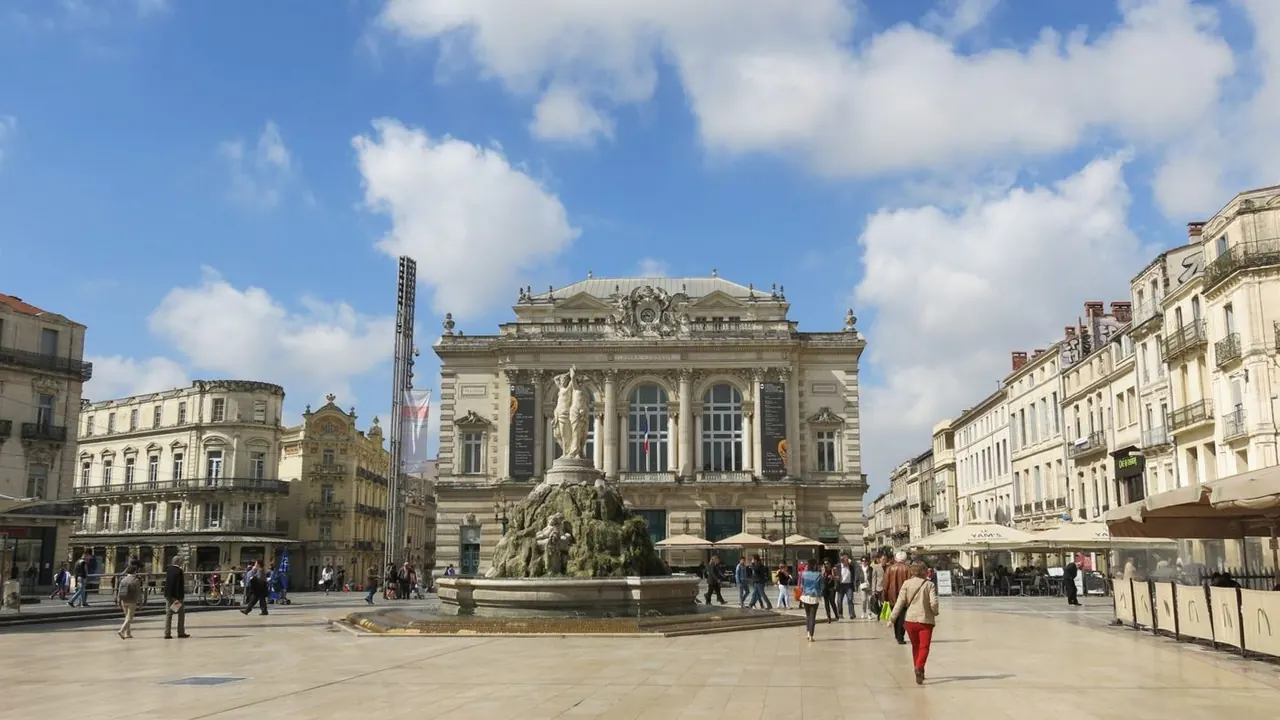
The opera house on Place de la Comédie
- Day trips85
- Getting around74
- Nature & outdoors72
Match
62
Every category weighted equally
- Beach & sun61
- Culture & arts63
- Food & nightlife61
- Family trip63
- Outdoors65
- Relax & unwind60
- Shopping & style60
- On a budget60
Montpellier in twelve categories
Our verdict on each, scored 0 to 100 against the same fixed benchmark cities, so a score means the same thing on every page.
Beaches & swimming. Scores 64 out of 100.
Food & drink. Scores 64 out of 100.
Culture & sights. Scores 60 out of 100.
Nightlife. Scores 56 out of 100.
Nature & outdoors. Scores 72 out of 100.
Day trips. Scores 85 out of 100.
Good for families. Scores 62 out of 100.
Getting around. Scores 74 out of 100.
Shopping & style. Scores 47 out of 100.
Affordability. Scores 50 out of 100.
Live music & performing arts. Scores 63 out of 100.
Wellness & relaxation. Scores 42 out of 100.
Montpellier category by category
Beaches & swimming
64Montpellier sits a short way inland, so the sea is a trip rather than a walk. The coast is close, though. Palavas-les-Flots and Carnon are about 11km away by tram and bus or a short drive, and from there a long strip of fine sand runs east past La Grande-Motte to the dunes of l'Espiguette, the wildest and least built-up stretch. The water is shallow, gently shelving and easy for swimmers, and it reaches about 23°C in late summer, though a strong northerly wind can chill it for a day or two.
In July and August half the city goes to the sea after work, and the nearer beaches get crowded and car parks fill early. Sète, to the west, adds long sandy beaches backed by a lagoon. There are no rocky coves or clear island water here. This is a flat coast of open sand, good for a few beach days in a city break rather than a beach vacation in itself.
Food & drink
64Eating in Montpellier means eating the Languedoc. The wine country starts at the city's edge, with Pic Saint-Loup reds and whites from the Terrasses du Larzac on most lists, and oysters and mussels come from the Thau lagoon less than half an hour away. Look for tielle, the spicy octopus pie from Sète, and brandade from Nîmes. The Halles Castellane in the old centre and the Saturday market under the Arceaux aqueduct are where to see local produce, and the Halles Laissac has small counters where you can eat.
A large student population keeps plenty of cheap, casual places open, and the terraces of the Écusson fill on warm evenings. Higher up there are a few ambitious modern French kitchens, but the city is better at good bistros and market cooking than at depth or range.
Culture & sights
60The heart of the city is the Écusson, a medieval old town of narrow lanes and stone hôtels particuliers with hidden courtyards, mostly free of cars. It opens onto the Place de la Comédie and its opera house, and in the west rises to the Promenade du Peyrou, a formal seventeenth-century terrace with a triumphal arch, a royal statue and the long Saint-Clément aqueduct running away from it. The fortress-like Cathédrale Saint-Pierre stands beside the medical faculty, which has taught since the Middle Ages, and the Jardin des Plantes next door is the oldest botanical garden in France.
The Musée Fabre is the big draw, with a serious collection of European painting from the Flemish masters to Soulages. The Antigone district, a neoclassical housing scheme by Ricardo Bofill, adds a striking piece of twentieth-century architecture. Two or three days cover it well.
Nightlife
56With one of the largest student populations in France, Montpellier is livelier after dark than its size suggests. The evening starts on the terraces around Place Jean-Jaurès and the squares of the Écusson, where small bars, pubs and wine bars fill up on weeknights as well as weekends. The mood is young, casual and loud rather than polished. Most bars close in the small hours and the crowd then moves to clubs out towards Lattes and the coast, which usually means a taxi.
In summer the night moves outdoors and towards the beach towns, while outside term time the centre is noticeably quieter. It is a good, easy place for a night out, not a reason to come.
Nature & outdoors
72The city sits between lagoons and hills, and both are close. To the south, the shallow étangs behind the coast are full of flamingos and herons, and the Camargue, with its white horses, marshes and birdlife, is about an hour away. To the north the garrigue rises through vineyards to Pic Saint-Loup, a limestone ridge with a popular climb to the summit, and beyond it the Hérault cuts deep gorges near Saint-Guilhem-le-Désert, good for canoeing. The Cirque de Navacelles and the southern Cévennes are within about an hour and a half.
Cycling is easy on the flat coastal paths and along the canal, and the windy coast suits kitesurfing and windsurfing. Spring and autumn are the best seasons for walking, since summer in the garrigue is hot and dry.
Day trips
85This is one of the city's great strengths. Nîmes is about half an hour by train, with a Roman arena and temple in remarkable condition, and the Pont du Gard is a short drive beyond it. Arles, with its Roman monuments and Van Gogh connections, and Avignon, with the Palace of the Popes and its bridge, are each about an hour away. To the west, the walled citadel of Carcassonne is about an hour and a half by train.
Closer in, Sète is a fishing port of canals and seafood on a hill above the sea, Aigues-Mortes is a medieval walled town in the salt marshes, and Saint-Guilhem-le-Désert is a stone village around an abbey in the gorge of the Hérault. Pézenas, Uzès and the wine villages of the Languedoc fill any spare days, though several of the smaller places are far easier with a car.
Good for families
62Montpellier is an easy city with children. The old town is largely pedestrian, the trams are simple to use with a pushchair, and the beaches nearby shelve gently into calm, warm water, which suits small swimmers. The Zoo de Lunaret is set in a large wooded park on the north side of the city, and the Odysseum district has a big aquarium and a planetarium side by side. The Jardin des Plantes and the Peyrou terrace give space to run around.
Beyond that the list is short, and a longer stay leans on the coast, where the beach towns have small fairgrounds and promenades in summer. July and August can be very hot in the stone streets of the centre, so beach mornings and indoor afternoons work best.
Getting around
74The historic centre is small and mostly closed to cars, so most sights are a short walk from each other, though the Écusson is built on a low hill with some slopes and uneven paving. The tram network, with its brightly decorated cars, links the station, the old town, Antigone, Port Marianne, the Odysseum district and the university quarters, and it is the easiest way across the wider city. Bike-share docks and cycle lanes help on the flatter parts.
The beaches are reachable by tram to the edge of the city and then a bus, which works but is slow in summer. The main station has fast trains to Nîmes, Avignon, Arles and Carcassonne. For the hills, the gorges and the Camargue, a car makes things much simpler.
Shopping & style
47Shopping is pleasant but ordinary. The lanes of the Écusson, around the rue de l'Ancien Courrier and the streets off the Place de la Comédie, hold small fashion boutiques, bookshops, delicatessens and wine shops in old stone buildings. The large Polygone mall sits next to the Comédie, and the Odysseum on the eastern edge has more big-brand stores. The most rewarding buys are edible: wine from the surrounding appellations, olive oil, honey and local specialities from the covered markets. There is no luxury street to speak of and little in the way of local crafts.
Affordability
50Montpellier is mid-range for Western Europe. Hotels in the centre are moderately priced for most of the year, and the large student population keeps plenty of cheap places to eat and drink, from casual counters to bars with modest prices. The market halls and good-value lunch menus help stretch a budget further. The tram is reasonably priced, and the Musée Fabre is a fair-priced visit. Sit-down dinners and wine in restaurants are where the costs build up, and rooms both in town and along the coast get noticeably more expensive in July and August.
Live music & performing arts
63For a city of its size Montpellier has a serious stage. The Opéra Comédie, a nineteenth-century horseshoe theatre on the main square, and the large modern Opéra Berlioz in the Corum share a season of opera, ballet and concerts by the city's national orchestra. Contemporary dance is the specialism: the Montpellier Danse festival each summer is one of the most respected in Europe, and the city has a national choreographic centre.
Summer is the high season, when the Radio France festival brings classical and jazz concerts, many of them free, and the Printemps des Comédiens fills the outdoor theatres of the Domaine d'O. Through the rest of the year there are good subsidised theatres and small music venues fed by the student crowd, but no great depth of theatre or jazz.
Wellness & relaxation
42The city has no bathing culture of its own, and wellness inside Montpellier means hotel and day spas. The nearest real thermal water is at Balaruc-les-Bains on the Thau lagoon, about half an hour away, a long-established spa town whose thermal centre takes day visitors as well as those on medical cures. Inland, Lamalou-les-Bains is another small spa town in the hills.
The pace helps more than the facilities. Long lunches, shaded squares in the old town and slow evenings on café terraces make for an unhurried stay outside the student rush, though the centre is lively rather than quiet.
When should you go?
Pick a month to see what it is like. The climate figures are measured averages, not a forecast.
Montpellier in July
Daytime high, °C
Rainfall in the month, mm
The whole year
Shaded against this city’s own year: the deepest cell is its best month for that figure and the palest its weakest.
Temperature and rainfall are climate normals, averaged over the years shown. Montpellier: 1991-2020 normals, Montpellier (7.8 km from centre).
Before you go
| Measure | Montpellier |
|---|---|
| Official language | French |
| Currency | Euro (EUR) |
| Sockets | CE230 V, 50 Hz |
| Driving side | Right |
| Time zone | UTC+1, UTC+2 in summer |
| Emergency number | 112 |
| Elevation | 7 m |
| Main airport | Montpellier-Méditerranée Airport (MPL)8 km from centre41 non-stop destinations |
| Public holidays this year | 11 days |
By the numbers
| Measure | Montpellier |
|---|---|
| City population | 310,240 |
| People per km² | 5,452 |
| Museums within 10 km | 14 |
| UNESCO World Heritage sites within 50 km | 2 |
| Swim season, months above 21 °C | 2 months |
Compare Montpellier with
Every comparison with a written verdict behind it.