France
Arles
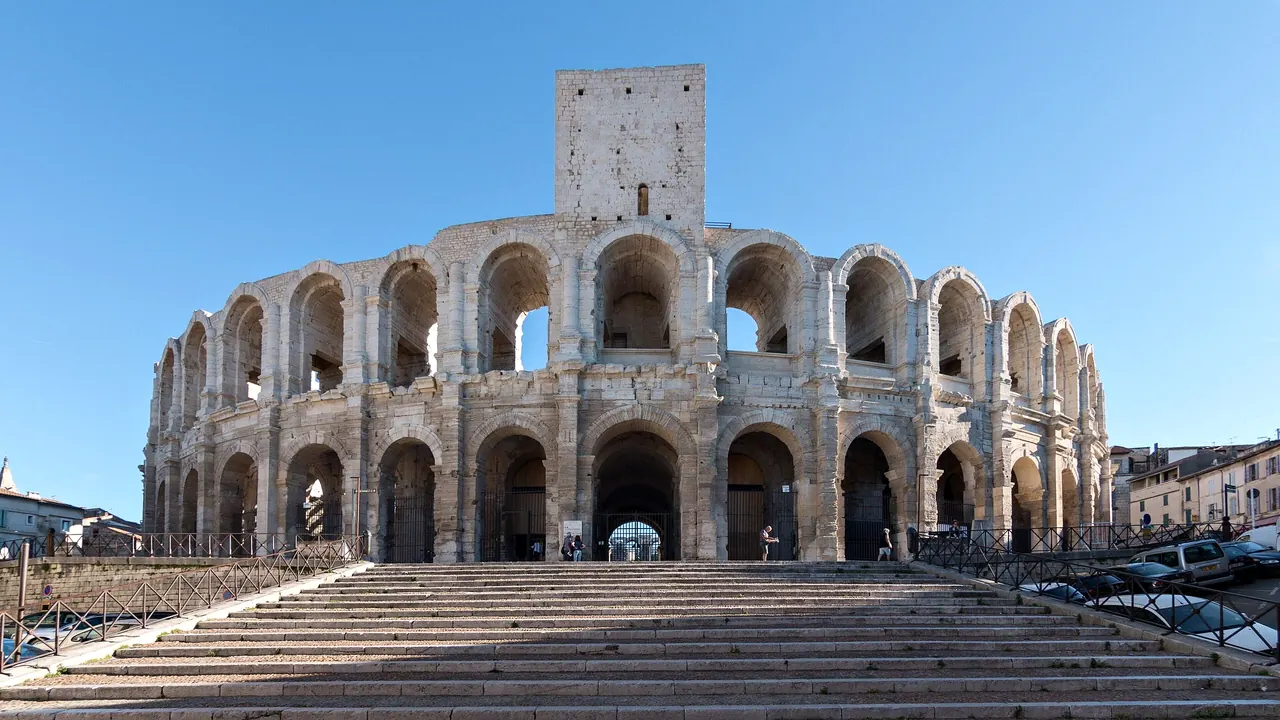
The Roman amphitheatre
- Day trips87
- Culture & sights70
- Nature & outdoors70
Photo: Martin Kraft, CC BY-SA 3.0, cropped
Match
49
Every category weighted equally
- Beach & sun48
- Culture & arts52
- Food & nightlife45
- Family trip53
- Outdoors57
- Relax & unwind49
- Shopping & style46
- On a budget49
Arles in twelve categories
Our verdict on each, scored 0 to 100 against the same fixed benchmark cities, so a score means the same thing on every page.
Beaches & swimming. Scores 50 out of 100.
Food & drink. Scores 50 out of 100.
Culture & sights. Scores 70 out of 100.
Nightlife. Scores 22 out of 100.
Nature & outdoors. Scores 70 out of 100.
Day trips. Scores 87 out of 100.
Good for families. Scores 42 out of 100.
Getting around. Scores 55 out of 100.
Shopping & style. Scores 35 out of 100.
Affordability. Scores 46 out of 100.
Live music & performing arts. Scores 33 out of 100.
Wellness & relaxation. Scores 28 out of 100.
Arles category by category
Beaches & swimming
50Arles is a river town on the Rhône, and the sea is a drive away across the Camargue. The beaches there are long, flat and wild. Saintes-Maries-de-la-Mer, about 40km south, has sand and dunes either side of the village, with a stretch of easy beach in town and quieter, more natural shore further along the dyke. Beyond Salin-de-Giraud lie the vast, open strands of Piémanson and Beauduc, where there is space to spread out even in August. In July and August the Mediterranean reaches about 23°C and is shallow and easy for swimming, though the mistral can whip it up and the mosquitoes come with the marshes.
You need a car or the occasional bus, and there is little shade or service on the wilder stretches. It makes a good day at the sea, not a beach vacation.
Food & drink
50Eating in Arles is Provence with a Camargue accent. The local dishes are gardiane, a slow bull stew with red wine, Camargue red and white rice, tellines (tiny clams from the beaches), saucisson d'Arles and olive oil from the Alpilles. The Saturday market along the Boulevard des Lices runs for well over a kilometre and is the town's great food event, with a smaller one on Wednesdays. Terraces on the Place du Forum and the small squares of the old town serve long lunches with rosé from the Costières and the Alpilles.
There are a handful of ambitious, chef-led restaurants, but the range is narrow and many places close in winter. This is a town for good market produce and long lunches, not for a wide restaurant scene.
Culture & sights
70Few towns of this size hold so much. Roman Arles survives in the arena, which is still in use, the antique theatre, the underground galleries of the cryptoporticus, the Baths of Constantine and the Alyscamps, an avenue of stone tombs that Van Gogh and Gauguin both painted. The portal and cloister of Saint-Trophime are some of the finest Romanesque carving in Provence. The whole group is UNESCO-listed and sits within a short walk.
The Museum of Ancient Arles holds a Roman barge pulled from the Rhône and a fine run of sarcophagi. The Musée Réattu and the Fondation Vincent van Gogh cover art, and the Luma campus, with its twisting tower by Frank Gehry, adds a modern landmark. Photography is part of the town's identity through the Rencontres festival every summer. It is compact, though, and two full days cover it well.
Nightlife
22Evenings in Arles mostly mean a late dinner on a square and a drink at the café tables on the Place du Forum, and then the town goes quiet. There are a few bars and the odd music night, but no club scene to speak of. The exception is the feria at Easter and in September, when bodegas set up in the streets and the town stays up late for a few days. Outside those weeks, people looking for a night out drive to Montpellier or Marseille.
Nature & outdoors
70Arles is the gateway to the Camargue, the vast Rhône delta of lagoons, salt flats, reed beds and rice fields that starts on the edge of town. Pink flamingos feed in the étangs, white horses and black bulls graze the marshes, and birdwatchers come for herons, egrets and migrating waders in spring and autumn. The usual ways in are on horseback from the ranches, by bike along the dykes around the Étang de Vaccarès, or on foot through the bird reserve near Saintes-Maries.
To the north-east, the limestone ridges of the Alpilles give real hiking and cycling among olive groves and pines. Summer is hot and buzzing with mosquitoes, and the mistral can blow hard. Spring and autumn are the best seasons.
Day trips
87This is Arles's great strength. Avignon, with the Papal Palace and its bridge, is about 20 minutes by train, and Nîmes, with its Roman arena and Maison Carrée, about half an hour. The Pont du Gard is under an hour's drive. Closer still are the hill village of Les Baux-de-Provence, Saint-Rémy with Glanum's Roman ruins and the asylum where Van Gogh painted, Tarascon's castle on the Rhône and the abbey of Montmajour.
West and south lie the walled town of Aigues-Mortes and the pilgrimage church of Saintes-Maries-de-la-Mer. Marseille and Aix-en-Provence are about an hour away, and Uzès, Orange and Montpellier are within reach. Trains cover the big towns, but a car makes the villages far easier.
Good for families
42Arles itself is small, safe and walkable, and children usually enjoy climbing about the Roman arena, with its views from the towers, and the dark galleries of the cryptoporticus. The real appeal for families is outside town: pony and horse rides at Camargue ranches, flamingos at the ornithological park near Saintes-Maries, and shallow, gentle sea on the delta beaches.
There are no big attractions made for children, though. Summer heat and mosquitoes can be hard work, the old streets are cobbled and uneven for buggies, and most outings need a car. It suits families with older children who like history and animals more than those looking for organised fun.
Getting around
55Inside Arles everything is close. The arena, theatre, Saint-Trophime, the museums and the river quays are all within about fifteen minutes' walk, and a small free shuttle bus loops the centre. The station is a short walk from the old town, with regular trains to Avignon, Nîmes, Marseille and Montpellier.
Beyond the town it gets harder. Regional buses to Saintes-Maries, Les Baux and Saint-Rémy are infrequent, and the Camargue's reserves, ranches and wild beaches are really only practical by car or bike. Most visitors who stay several days hire a car.
Shopping & style
35Shopping in Arles is small-scale and Provençal. The Saturday market on the Boulevard des Lices is the highlight, with olive oil, Camargue salt and rice, soaps, linens and bric-a-brac. Around the old town there are shops for printed Provençal cottons, santons, pottery, gardian shirts and hats, and several fine bookshops, since Arles is a publishing town. Photography books and prints are easy to find. There is no fashion or luxury shopping beyond a few boutiques, and anyone wanting that goes to Aix or Marseille.
Affordability
46Arles is one of the more reasonable bases in Provence, noticeably cheaper than the smart villages of the Luberon or the Alpilles. Lunch menus, market food and mid-range hotels cost what they do in any French provincial town. Most sights are covered by a combined pass. Rooms are scarce and dearer in July and during the ferias and photography festival, and hiring a car, which most visitors need, adds to the bill.
Live music & performing arts
33Live performance in Arles is mostly seasonal and open-air. In summer the Roman theatre and the arena host concerts and shows, and the Les Suds festival brings world music to the squares and courtyards for a week each July. The ferias at Easter and in September fill the arena with bullfights and the streets with brass bands, and the course camarguaise, in which nobody kills the bull, runs through the warm months.
The town theatre has a modest season of drama and dance, but there is no opera or orchestra of note. Outside summer, the serious programmes are in Avignon, Nîmes and Marseille.
Wellness & relaxation
28Arles has no bathing culture or thermal tradition, and spa treatments mean the few spas in the better hotels and the mas around town. What it offers instead is pace: shaded squares, long lunches, siestas through the summer heat and quiet evenings by the Rhône. Some converted farmhouses in the Camargue and the Alpilles are run as restful retreats with pools. It is a calm place to slow down, not a destination for spas.
When should you go?
Pick a month to see what it is like. The climate figures are measured averages, not a forecast.
Arles in July
Daytime high, °C
Rainfall in the month, mm
The whole year
Shaded against this city’s own year: the deepest cell is its best month for that figure and the palest its weakest.
Where the figures come from
Arles's temperatures are measured 28 km from the centre, at Nimes / Courbessac.
Arles has no rain gauge within 25 km of the centre, so its rainfall comes from a gridded climate dataset read at the city rather than from a gauge further away.
Temperature and rainfall are climate normals, averaged over the years shown. Arles: 1991-2020 (sunshine 1981-2010) normals, Nimes / Courbessac (28 km from centre).
Before you go
| Measure | Arles |
|---|---|
| Official language | French |
| Currency | Euro (EUR) |
| Sockets | CE230 V, 50 Hz |
| Driving side | Right |
| Time zone | UTC+1, UTC+2 in summer |
| Emergency number | 112 |
| Elevation | 0 m |
| Main airport | Marseille Provence Airport (MRS)54 km from centre126 non-stop destinations |
| Public holidays this year | 11 days |
By the numbers
| Measure | Arles |
|---|---|
| City population | 51,811 |
| People per km² | 68 |
| Museums within 10 km | 3 |
| UNESCO World Heritage sites within 50 km | 5 |
| Swim season, months above 21 °C | 2 months |
Compare Arles with
Every comparison with a written verdict behind it.
- Aix-en-Provence
- Andorra la Vella
- Annecy
- Antibes
- Avignon
- Barcelona
- Basel
- Bergamo
- Bern
- Biarritz
- Bordeaux
- Cannes
- Carcassonne
- Chamonix
- Colmar
- Como
- Dijon
- Geneva
- Genoa
- Girona
- Interlaken
- La Spezia
- Lausanne
- Lille
- Lucca
- Lucerne
- Lugano
- Lyon
- Marseille
- Milan
- Monaco
- Montpellier
- Nantes
- Nice
- Paris
- Pisa
- Portofino
- Saint-Malo
- Saint-Tropez
- Strasbourg
- Toulouse
- Turin
- Zermatt