Austria
Graz
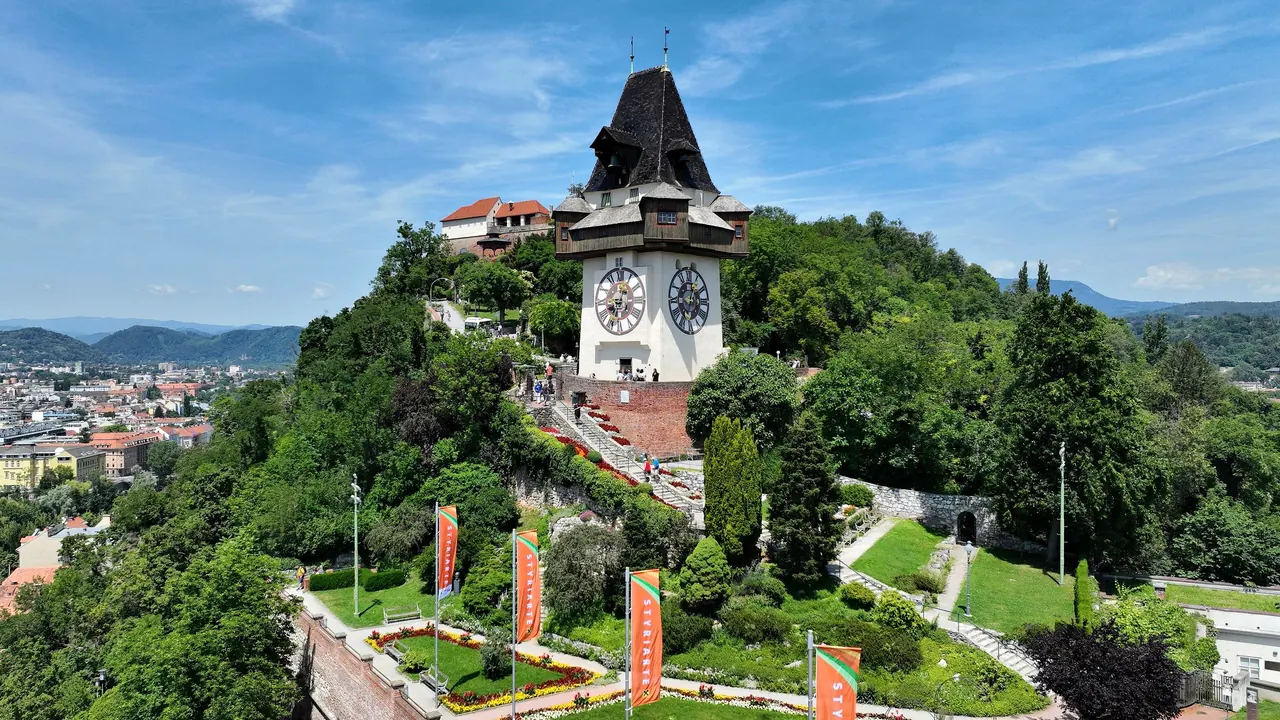
The Clock Tower on the Schlossberg, seen from the south
- Getting around80
- Nature & outdoors70
- Culture & sights64
Photo: C.Stadler/Bwag, CC BY-SA 4.0, cropped
Match
54
Every category weighted equally
- Beach & sun49
- Culture & arts60
- Food & nightlife55
- Family trip55
- Outdoors56
- Relax & unwind52
- Shopping & style56
- On a budget53
Graz in twelve categories
Our verdict on each, scored 0 to 100 against the same fixed benchmark cities, so a score means the same thing on every page.
Beaches & swimming. Scores 12 out of 100.
Food & drink. Scores 60 out of 100.
Culture & sights. Scores 64 out of 100.
Nightlife. Scores 40 out of 100.
Nature & outdoors. Scores 70 out of 100.
Day trips. Scores 63 out of 100.
Good for families. Scores 60 out of 100.
Getting around. Scores 80 out of 100.
Shopping & style. Scores 48 out of 100.
Affordability. Scores 45 out of 100.
Live music & performing arts. Scores 60 out of 100.
Wellness & relaxation. Scores 50 out of 100.
Graz category by category
Beaches & swimming
12Graz is an inland city in the hills of Styria, a long way from any sea, and the Mur running through it is not for swimming. In summer, locals cool off at the bathing lakes on the flat land south of the city, the Schwarzlsee above all. These are former gravel pits with grassy banks, jetties and kiosks, and they warm to about 23°C in July and August. Stubenbergsee in the eastern hills is a pleasant half-day out. Lake swimming here is a hot-afternoon break, not a reason to come, and the big Carinthian lakes are too far for an easy outing.
Food & drink
60Graz eats Styrian, and the regional larder is the point. Dark green pumpkin seed oil goes on salads, soups and even vanilla ice cream. Fried chicken is served cold in salad with the oil, runner beans are dressed in vinegar, and the dish called Steirisches Wurzelfleisch is pork boiled with root vegetables and horseradish. The farmers' markets at Kaiser-Josef-Platz and Lendplatz run every morning except Sunday, with stalls of cheese, cured ham, apples and that oil.
The wine is crisp Sauvignon Blanc and Welschriesling from the steep hills of the south, poured in the city and at the rustic Buschenschank taverns less than an hour away. Old town inns, Lend's casual places and coffee houses cover most needs. Range beyond Austrian cooking is modest.
Culture & sights
64The old town is one of the best-kept historic centres in Central Europe. Its red-tiled roofs, Renaissance arcaded courtyards and Baroque façades run from the Hauptplatz up to the cathedral and the domed Mausoleum of Emperor Ferdinand II. Above it all is the Schlossberg, the wooded castle hill topped by the Uhrturm clock tower, the city's emblem. The Landeszeughaus is a standout: a seventeenth-century armoury still holding thousands of suits of armour and weapons, stacked as though waiting for a Turkish siege.
On the western edge, Schloss Eggenberg is a Baroque palace built around an astronomical scheme, with state rooms and a park where peacocks roam. Modern landmarks across the Mur add contrast: the blue, bulbous Kunsthaus and the steel Murinsel in the river. Two or three days covers it well.
Nightlife
40With tens of thousands of students, Graz goes out more than its size suggests, though on a small scale. The main area is the cluster of lanes around Mehlplatz and Färbergasse in the old town, known locally as the Bermuda Triangle, where bars spill into the lanes on summer nights. Across the river, Lend has looser, artier bars, and the university quarter around Zinzendorfgasse fills up during term. A handful of clubs stay open late at weekends. It suits a relaxed evening of wine bars and pub crawling, not serious clubbing, and the city goes noticeably quieter in the long summer break when the students leave.
Nature & outdoors
70Graz sits where the eastern Alps flatten into rolling hill country, and green is close on every side. The Schöckl, the city's home mountain at 1,445m, has a cable car and walking trails on its flanks and views across Styria. Paragliders launch from its summit. The Mur cycle path runs through the city and along the river valley, and the wooded hills of the Grazer Bergland are a short bus ride out.
Further out, the Bärenschützklamm gorge climbs past waterfalls on wooden ladders. The South Styrian wine hills make gentle, beautiful walking country in autumn, and within about two hours the limestone walls of the Gesäuse and the Hochschwab offer proper alpine hiking. Ski slopes are reachable but not on the doorstep.
Day trips
63The best outings take you into Styria's countryside towns and wine villages. The South Styrian Wine Road starts about forty minutes south, with Buschenschank taverns on steep vineyard slopes, and it can be combined with the old wine town of Ehrenhausen. Riegersburg castle sits on a volcanic crag to the east, about an hour away, in a region of spa villages and craft producers. The Lipizzaner stud farm at Piber and the Austrian Open-Air Museum at Stübing, a valley of relocated farmhouses, are both short drives.
Further out, Admont Abbey has one of the world's largest monastic libraries, and the pilgrimage basilica at Mariazell is about two hours north. Across the Slovenian border, Maribor is about an hour by train, with its river front and old vine. A car makes most of these easier.
Good for families
60Graz is easy with children: compact, safe, clean and calm, with trams that take buggies and plenty of playgrounds in the Stadtpark and the Augarten. The Schlossberg is the highlight. Families ride the glass lift or the funicular up, then come down by a long underground slide inside the hill. The Märchenbahn, a little train, runs through fairytale scenes in tunnels in the rock. FRida & freD, a dedicated children's museum in the Augarten, has hands-on exhibitions and theatre.
Outside the city, the Herberstein wildlife park and the farmhouses at the Stübing open-air museum make good half-days, and the Schöckl has summer toboggan runs. There is no big zoo, aquarium or theme park, so a long stay calls for countryside outings.
Getting around
80The centre of Graz is small and flat, and most of the old town is pedestrianised, so the main sights are a few minutes' walk apart. Trams run through the heart of town along the Herrengasse and out to the main station, Eggenberg and the suburbs, and buses cover the rest, all on one simple ticket. A lift and a funicular climb the Schlossberg, and cycling is common and easy on the flat ground along the Mur. Nobody needs a car in the city. The vineyards, castles and mountain outings beyond it are a different matter, since buses there are sparse and a car is much easier.
Shopping & style
48Shopping in Graz is pleasant rather than a draw. The Herrengasse and the narrow, sloping Sporgasse hold the main high-street and traditional shops in historic buildings. Kastner & Öhler, the city's grand department store since the nineteenth century, has a rooftop terrace with views over the old town roofs. Lend, across the river, has small design shops, vintage stores and studios.
The things worth taking home are edible. You can buy pumpkin seed oil, Styrian wine, Schilcher rosé, apple brandies and Zotter-style craft chocolate from the region at the farmers' markets and delicatessens. Traditional costume and loden are sold in specialist shops. There is little luxury retail beyond a few labels.
Affordability
45Graz costs what you would expect of a mid-sized Western European city. It is fair rather than cheap. Hotels are reasonably priced for Austria and only climb during big festivals and trade fairs. Because of the students, there are plenty of good-value lunch menus, bakeries and casual places, while sit-down dinners and wine cost the usual Austrian amounts. Public transport is reasonably priced and the compact centre can be walked, so getting around costs little. Combined tickets cover many of the sights, including the Joanneum museums.
Live music & performing arts
60For a city its size, Graz takes performance seriously. The Opera, a handsome late-nineteenth-century house and the second largest in Austria, runs a full season of opera, operetta, ballet and musicals. The Schauspielhaus is the main theatre, and the Musikverein für Steiermark has hosted orchestral and chamber concerts for generations.
Two festivals mark the calendar. Styriarte, in early summer, focuses on early and classical music, and steirischer herbst, in autumn, is long known for avant-garde theatre, art and performance. The music university's renowned jazz programme feeds a lively club and concert jazz scene, and smaller stages hold cabaret, rock and touring acts. Little is staged in German-free formats beyond music.
Wellness & relaxation
50Graz itself has no historic bathing culture, only public pools and hotel spas. But it is the gateway to Styria's thermal region, a string of spa villages in the hills to the east, about an hour away. Bad Blumau has a thermal resort designed by Hundertwasser, all wavy lines and grass roofs. Loipersdorf, Bad Waltersdorf and Bad Radkersburg offer large warm pools and saunas open to day visitors.
The city's own pace helps. Life here is unhurried and the centre is quiet by day. Locals linger in coffee houses and in the gardens of the Stadtpark, and the shaded paths of the Schlossberg are good for an hour of calm above the roofs.
When should you go?
Pick a month to see what it is like. The climate figures are measured averages, not a forecast.
Graz in July
Daytime high, °C
Rainfall in the month, mm
The whole year
Shaded against this city’s own year: the deepest cell is its best month for that figure and the palest its weakest.
Temperature and rainfall are climate normals, averaged over the years shown. Graz: 1991-2020 normals, Graz Airport (7.9 km from centre).
Before you go
| Measure | Graz |
|---|---|
| Official language | German, Austrian Sign Language |
| Currency | Euro (EUR) |
| Sockets | CF230 V, 50 Hz |
| Driving side | Right |
| Time zone | UTC+1, UTC+2 in summer |
| Emergency number | 112 |
| Elevation | 353 m |
| Main airport | Graz Airport (GRZ)9 km from centre26 non-stop destinations |
| Public holidays this year | 16 days |
By the numbers
| Measure | Graz |
|---|---|
| City population | 306,971 |
| People per km² | 2,406 |
| Museums within 10 km | 29 |
| UNESCO World Heritage sites within 50 km | 1 |
Compare Graz with
Every comparison with a written verdict behind it.
- Belgrade
- Bled
- Bologna
- Bratislava
- Budapest
- Cortina d'Ampezzo
- Dresden
- Florence
- Hallstatt
- Innsbruck
- Krakow
- Ljubljana
- Mostar
- Munich
- Nuremberg
- Prague
- Rovinj
- Salzburg
- Sarajevo
- Split
- Trieste
- Venice
- Verona
- Vienna
- Zadar
- Zagreb